Best Marketplace Inventory Management Software in 2026 (Reviewed)
Looking for the best marketplace inventory management software in 2026? Compare top tools including Carro, Zoho, Linnworks, Cin7 & more in this detailed guide.

Key Takeaways (TL;DR)
- The Best Overall Marketplace Inventory Management Software: Carro is the best marketplace inventory management software for marketplace operators and retailers building dropship-based or extended assortment programs. It manages the full supplier lifecycle: from catalog ingestion to order routing and instant payouts, without requiring you to hold inventory.
- Why Do You Need It: Managing multiple supplier relationships manually creates order errors, inventory discrepancies, and fulfillment delays that scale linearly with growth. Having the best marketplace inventory management software at your disposal removes those failure points through automation, real-time sync, and centralized supplier oversight.
- Who It's For: Marketplace operators, online retailers, and DTC brands looking to expand their product assortment through curated supplier partnerships without the overhead of traditional inventory investment.
- How to Choose the Right One: To choose the right marketplace inventory management software, you need to match the tool to your fulfillment model first (owned inventory vs. dropship vs. hybrid). Once that's done, make sure to evaluate its integration compatibility with your existing stack and whether the pricing model scales with your order volume or charges a flat monthly fee.
- Expected Price: Carro operates on a 5% of sales model with a Growth Plan available for operators needing autonomous merchandising and priority support.
Top Marketplace Inventory Management Software at a Glance
| Company | Best For | Key Features | Pricing |
|---|---|---|---|
| Carro | Marketplace operators & retailers running dropship or extended assortment programs. | Hand-matched supplier network, real-time sync, automated order routing, instant payouts. | 5% of sales (Standard); Growth Plan (custom) |
| Linnworks | Established multichannel retailers managing high order volumes across 100+ integrations. | Multi-warehouse management, order routing, listing management, 100+ channel connections. | Custom pricing based on order volume, not revenue |
| Cin7 Core | Mid-market B2B/DTC brands needing connected inventory, accounting + multichannel selling. | Real-time inventory tracking, 700+ integrations, manufacturing support, POS. | $349–$999/mo (Core); Omni plan for enterprise usage |
| Zoho Inventory | Small-to-mid businesses wanting affordable multichannel inventory with Zoho ecosystem fit. | Multi-channel selling, order management, serial/batch tracking, Zoho integrations. | Starts at $29/org/mo; up to $249/org per month |
| Veeqo | Amazon-heavy sellers needing free multichannel inventory + shipping label management. | Real-time multi-channel sync, Amazon integration, warehouse scanning, shipping discounts. | From $19/mo for up to 300 orders; up to $350/mo for 4,000 orders |
| Sellbrite | Small multichannel sellers wanting simple order-based inventory management. | Bidirectional inventory sync, Amazon/eBay/Walmart/Etsy listings, centralized order management. | From $19/mo; up to $179/mo at the highest plan |
| Ordoro | Sellers running a mix of owned inventory and dropship relationships. | Dropship automation alongside traditional inventory, kitting, multi-channel management. | $299–$349/mo for "Dropshipping" and "Inventory" tiers |
| Brightpearl by Sage | Mid-to-large retailers needing full retail ops (ERP + inventory + accounting + automation). | Automation engine, omnichannel order management, financial management, warehouse ops. | Custom pricing; connect with sales team for quote |
What Is Marketplace Inventory Management Software?
Before we jump into exploring the best marketplace inventory management tools, it's crucial to understand what value these tools really add. In simple terms, marketplace inventory management software is a category of tools that track, sync, and manage product availability across multiple sales channels and supplier relationships from a centralized interface.
In a traditional single-channel retail setup, inventory lives in one location and one system. As soon as you add multiple storefronts, supplier partners, marketplaces, or fulfillment locations, that single-source approach breaks down. Orders come in from five channels simultaneously. Inventory updates need to propagate instantly. Supplier feeds need normalization. Payouts need reconciliation.
Marketplace inventory management software handles all of that. The best marketplace inventory management tools in 2026 go further: they don't just track what's in your warehouse - but also manage supplier catalogs, automate order routing to the right fulfillment partner, monitor SLAs, and generate the financial reporting that ties it all together.
The category has evolved significantly in the last 3 years. Earlier tools were primarily designed to sync product listings and prevent overselling across Amazon, eBay, and Shopify. Today's tools are increasingly built for operators running distributed inventory networks, where the product doesn't live in your warehouse at all, but in a supplier network that you orchestrate through the platform.
Choosing the right software category between traditional multichannel sync vs. full marketplace orchestration is the first decision worth getting right.
Why Do You Need Marketplace Inventory Management Software?
A slow inventory sync from a supplier means a product stays listed as available when it's actually out of stock. A manual order routing process means a customer's order sits in a queue while your team figures out which supplier should fulfill it.
A slow inventory sync from a supplier means a product stays listed as available when it's actually out of stock. A manual order routing process means a customer's order sits in a queue while your team figures out which supplier should fulfill it.
These aren't edge cases. They're what happens at scale without the right marketplace inventory management software in place. Beyond preventing errors, there's a structural growth argument.
Retailers using automated dropship management programs reduce operational headcount requirements while expanding their product selection - the economics of growth improve as assortment grows, rather than deteriorating as more suppliers require more manual coordination.
For marketplace operators specifically, the stakes are higher. When a customer buys from your marketplace and the experience is poor: late delivery, wrong product, no tracking - the damage lands on your brand, not the supplier's. Marketplace inventory management software is the operational layer that protects the customer experience across a distributed supplier network.
The compounding benefit shows up in real metrics, with retailers in Carro's network having achieved up to 3.5x revenue growth, 180% growth in average order value, and up to 3x catalog expansion through curated, well-managed supplier relationships rather than adding suppliers without infrastructure to support them.
Who Needs Marketplace Inventory Management Software?
An effective marketplace inventory management tool is an ideal fit for the following customers:
Online Marketplace Operators
Pure-play marketplace operators: businesses whose entire model is connecting buyers with a curated supplier network; need software that manages the full supplier lifecycle. This includes onboarding, catalog normalization, real-time inventory sync, order routing, SLA tracking, and financial settlement.
For this audience, the choice between Carro and enterprise tools like Rithum or Mirakl comes down to scale, technical resources, and whether the marketplace is running a dropship model or a held-inventory model.
Multi-Channel Retailers Adding Supplier Partners
Retailers who started with their own inventory and are now adding supplier partners to expand their assortment need inventory software that handles both models simultaneously. Ordoro is a practical choice for this audience at the smaller end.
Cin7 handles it at the mid-market level. Carro is the most focused option for retailers whose growth strategy is specifically built around supplier partnerships rather than warehouse expansion.
DTC Brands Expanding Into Retail Distribution
DTC brands that want to distribute through retail partners without the capital requirements of traditional wholesale need marketplace inventory management tools that support the supplier side of dropship operations. This means clean order fulfillment workflows, real-time inventory visibility shared with retail partners, and payout structures that don't require waiting 60 days.
Carro's supplier-side tools are designed specifically for this use case, addressing the ecommerce partnerships channel that many DTC brands have underused.
Amazon and eBay Power Sellers
High-volume sellers primarily operating on Amazon, eBay, Walmart, and Etsy need tools built around listing management, inventory sync to those specific channels, and shipping optimization. Veeqo, Sellbrite, and Linnworks address this audience well.
The tradeoff is that these tools are channel-sync first and supplier-orchestration second - they're better suited to sellers managing their own inventory than to operators managing a distributed supplier network.
Growing SMBs Moving Off Spreadsheets
Small businesses that have outgrown spreadsheet-based inventory management need affordable entry points that don't require enterprise-level technical setup. Zoho Inventory's free and Standard plans address this audience well.
Sellbrite's order-based pricing makes it accessible for sellers not yet processing high volumes. The priority for this segment is ease of setup and predictable pricing, not the full supplier orchestration features that marketplace operators require.
Best Marketplace Inventory Management Software: In-Depth Reviews
1. Carro
Overview
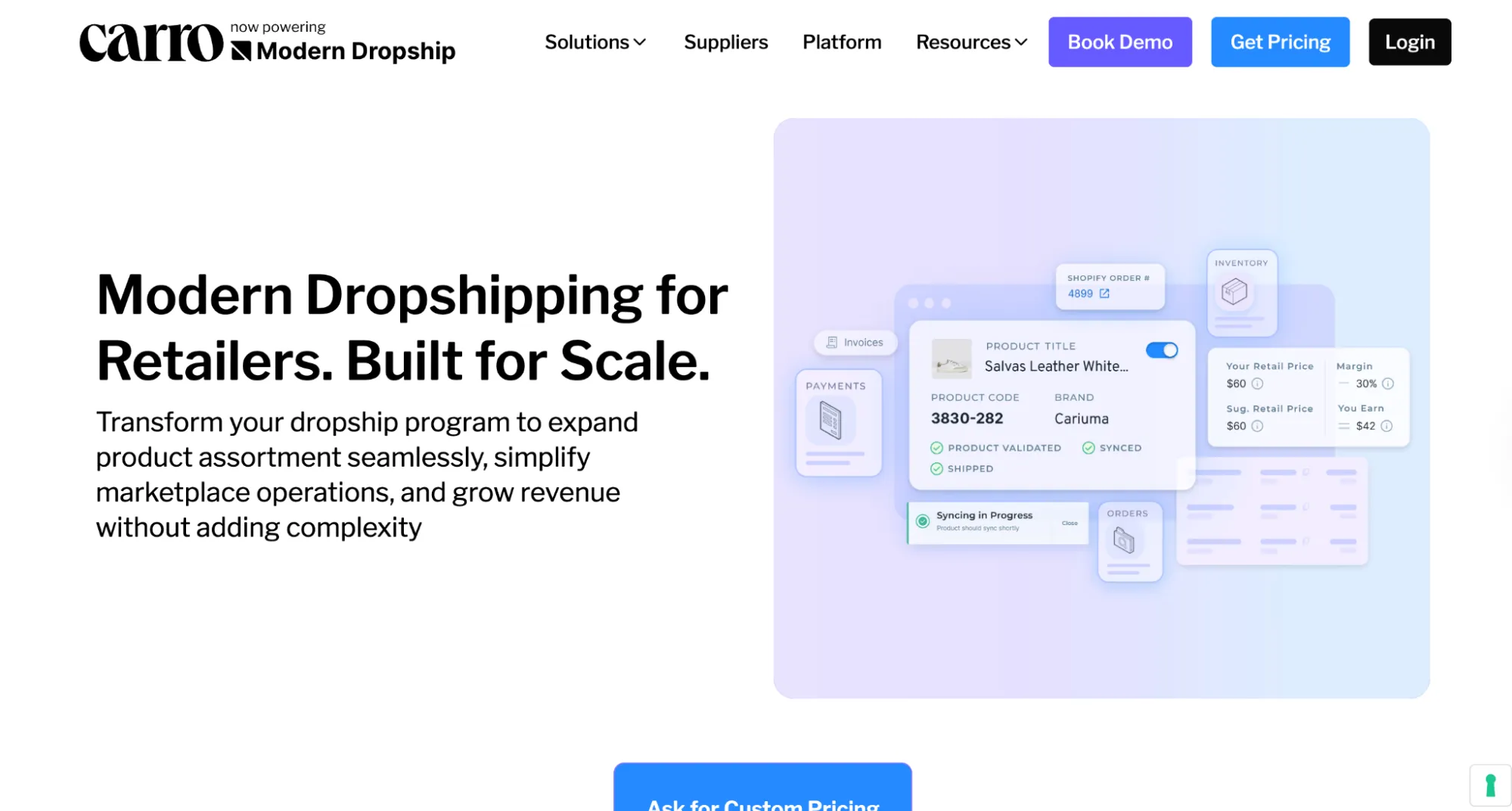
Carro, now powering Modern Dropship, is a dropship and marketplace infrastructure tool built for retailers, marketplace operators, and DTC brands looking to grow product assortment without owning inventory.
Unlike general-purpose inventory management tools, our platform is designed specifically for distributed retail - the model where inventory lives with supplier partners, orders are automatically routed to the right fulfillment source, and the customer sees a unified shopping experience regardless of which supplier ships their order.
Our solution addresses the core operational challenge of multi-supplier marketplace management: how do you scale to hundreds of suppliers without the overhead of manual catalog ingestion, order coordination, and payment reconciliation?
The answer is a combination of automated workflows, real-time sync, and account management that handles the supplier relationship layer so the retailer can focus on growth.
Ideal For
- Online marketplace operators running curated dropship programs across multiple brand partners.
- Retailers on Shopify, BigCommerce, WooCommerce, or Magento expanding assortment through supplier partnerships.
- DTC brands acting as suppliers distributing through retail partners with instant payout requirements.
- Businesses launching new marketplace programs without the resources to build custom supplier infrastructure.
- Retailers testing new categories who need to add supplier products without inventory risk.
Top Features
- Hand-Matched Supplier Network: Our account management team facilitates introductions between retailers and brand partners based on category fit, audience alignment, and operational compatibility. This isn't a self-serve directory, but a curated matching process that reduces the time from "exploring a new partner" to "active partnership generating orders." For retailers, this means faster time to assortment expansion. For brands, this means distribution through channels that actually fit their positioning.
- Real-Time Inventory Sync Across Storefronts: Product information, pricing, and inventory levels sync automatically across all connected storefronts. Carro supports Shopify, WooCommerce, BigCommerce, and Magento natively, with EDI and SFTP connections available for suppliers operating on different technical infrastructure. This prevents overselling and keeps product data accurate without manual updates.
- Automated Order Routing and Instant Payouts: When a customer places an order on a retail partner's storefront, the order routes automatically to the correct supplier for fulfillment. We process supplier payouts immediately when orders ship - not on Net 30 or Net 60 terms. For DTC brands and suppliers, this cash flow difference is material: revenue lands when orders go out, not weeks later.
- Seamless Catalog Expansion Without Inventory Risk: Our platform lets retailers broaden their product range by connecting directly to supplier catalogs without purchasing stock, managing warehouse positions, or forecasting demand upfront. New products go live on your storefront as soon as a supplier relationship is activated, and inventory is pulled in real time from the supplier's side. This means you can test new categories, fill assortment gaps, and respond to demand signals without the lead time or capital exposure that traditional buying requires.
Why We Stand Out?
Carro is purpose-built for distributed retail: a model where inventory lives with supplier partners and the retailer or marketplace operator provides the distribution infrastructure. Most multichannel inventory tools are built for sellers managing their own stock.
Our platform is ideal for operators orchestrating someone else's inventory across a structured partner network.
The combination of hand-matched partnerships, real-time sync, and instant payouts addresses three problems that generic dropship tools don't solve: partner quality, operational reliability, and cash flow timing.
Pros
- Purpose-built for multi-supplier marketplace and dropship models, not adapted from a warehouse management tool
- Instant supplier payouts vs. Net 60 terms in traditional wholesale
- Hand-matched partner introductions reduce activation time from months to weeks
- Supports Shopify, BigCommerce, WooCommerce, Magento + EDI and SFTP
- Supplier approval control; brands can choose which retailers carry their products
Cons
- Not the right fit for sellers managing purely owned warehouse inventory with no supplier network
- Brands seeking maximum raw reach across any retailer (volume over fit) won't benefit from our curated approach
- Not an ERP or full accounting system; pairs best with your existing finance stack rather than replacing it
- US-focused: built around USD transactions and Stripe-approved-country requirements, less suited to retailers operating outside North America
Pricing
Carro currently offers two plans:
- Standard Plan: 5% of sales. Includes Shopify, Magento, BigCommerce, WooCommerce integrations, end-to-end dropship automation, automated payments and billing, real-time sync, and access to a network of 1.5 million+ products from brand partners.
- Growth Plan: Custom pricing. Adds autonomous merchandising, priority support, hand-matched supplier network, and advanced catalog expansion tools. All plans include unlimited transactions and no upfront fees.
Final Verdict
Carro is the best marketplace inventory management software for marketplace operators, multi-supplier retailers and DTC brands using dropship partnerships as the primary distribution model.
The combination of hand-matched partnerships, real-time infrastructure, and instant supplier payouts makes us distinctly suited to this use case; not as a general-purpose inventory tool that handles dropship as an afterthought, but as infrastructure built specifically for the way distributed retail actually works.
2. Linnworks
Overview
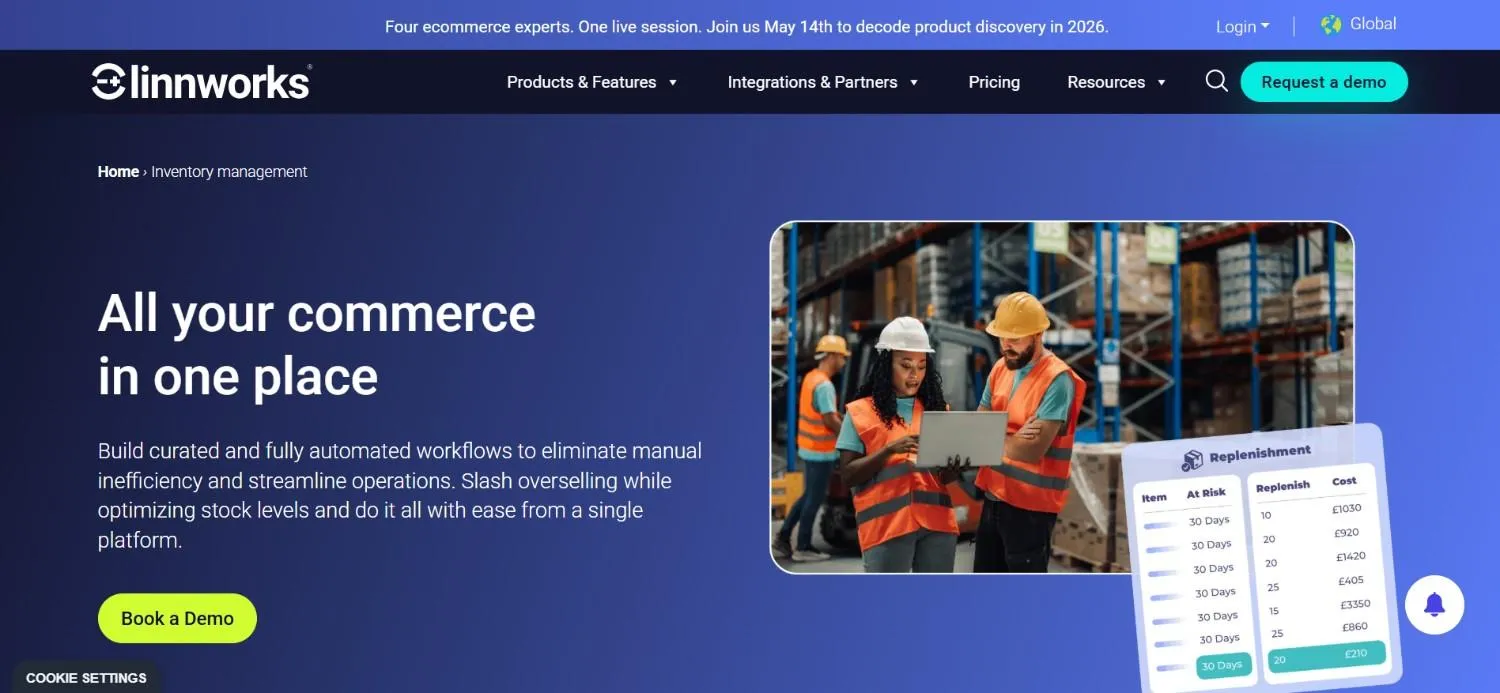
Linnworks is an enterprise-grade multichannel commerce platform built for established retailers managing high order volumes across multiple sales channels and warehouses.
Originally founded in the UK, Linnworks has grown into one of the most integration-rich tools in the category, connecting to over 100 sales channels, marketplaces, and shipping carriers from a single dashboard. It also includes SkuVault Core (its warehouse management product) for retailers needing physical inventory control.
Ideal For
- High-volume multichannel retailers processing 500+ orders per day
- Businesses managing multiple warehouse locations with complex fulfillment routing
- Amazon, eBay, Shopify, and Walmart sellers who need centralized listing management
- Retailers transitioning from spreadsheets or legacy systems to a unified commerceplatform
Top Features
- 100+ Channel Integrations: Linnworks connects to major marketplaces (Amazon, eBay, Walmart, Etsy, TikTok Shop), ecommerce platforms (Shopify, WooCommerce, Magento), and shipping carriers from a single platform. This breadth of connection is one of its strongest differentiators for sellers already operating across many channels.
- Automated Order Routing: Orders are automatically sorted, prioritized, and routed based on rules you configure: by carrier, warehouse, order type, or channel. This reduces manual intervention and error rates at high order volumes.
- Inventory Forecasting and Analytics: Linnworks provides demand forecasting and sales analytics tools that help retailers plan purchasing, reduce overstock, and identify high-performing SKUs across channels.
Why They Stand Out?
Linnworks is one of the strongest choices for multi-channel retailers who need a single platform covering orders, inventory, warehouse management, shipping, and analytics at significant volume.
Its 100+ integration network is broader than most competitors in the category, and its SkuVault Core module adds physical warehouse management capability for businesses that need it.
Pros
- One of the broadest integration networks in the category (100+ channels and carriers)
- Strong for high-volume operations where order routing automation generates real time savings
- SkuVault Core adds physical warehouse management for retailers with complex fulfillment
- AI-assisted order routing and automation tools included in the Advanced plan
Cons
- No published pricing; quote-based model makes budgeting harder upfront
- Steep learning curve for initial configuration; onboarding is an additional cost
- Less suited to dropship-first or supplier-orchestration models without owned inventory
Pricing
Linnworks offers custom pricing plans priced on order volume, not revenue - no percentage fees. Users can add extra modules for advanced functionality, thereby paying only for what they need.
Final Verdict
Linnworks is one of the best marketplace inventory management tools for established multichannel retailers managing owned inventory at high volume. It's harder to justify for businesses under 500 orders/day given the cost and configuration complexity. It's not the right tool for marketplace operators whose model is supplier-side dropship orchestration rather than warehouse-managed fulfillment.
3. Cin7 Core
Overview
Cin7 Core (formerly DEAR Systems) is a cloud-based inventory and order management platform designed for small-to-mid-market businesses in retail, wholesale, and manufacturing. It connects inventory tracking, purchasing, sales orders, manufacturing, and accounting integrations into a single system with 700+ native and partner integrations.
Cin7 Omni (the enterprise tier, formerly Orderhive) serves larger organizations requiring more customization - making it one of the best marketplace inventory management software tools to choose from in 2026.
Ideal For
- Mid-market DTC and B2B brands managing inventory across multiple channels with accounting integration needs
- Businesses in light manufacturing or assembly needing BOM and production order support
- Wholesale distributors managing B2B portals alongside direct channel selling
- Multi-location retailers needing connected inventory and accounting from one system
Top Features
- 700+ Integrations: Cin7 Core connects to major ecommerce platforms, marketplaces, shipping carriers, and accounting software (Xero, QuickBooks, MYOB). The breadth of native integrations reduces the need for custom API work at mid-market scale.
- Manufacturing and Assembly Support: Cin7's Standard Assembly Manufacturing module handles bills of materials, production orders, and kitting - which is unusual at this price point and makes it a strong fit for brands that manufacture or assemble products before selling them.
- B2B Portal: Cin7 includes a configurable B2B portal that lets wholesale customers and sales reps place orders, compare prices, and manage self-service transactions without requiring a separate tool.
Why They Stand Out?
Cin7 Core sits at a useful intersection: enterprise-level inventory features at a mid-market price. The $349-$999/month range delivers capabilities (multi-location inventory, manufacturing support, B2B portals) that competitors charge significantly more for. For growing wholesale-DTC hybrid brands, it's one of the stronger choices in the category.
Pros
- Transparent, publicly available pricing ($349-$999/mo for Core tiers)
- Manufacturing and assembly support built into the platform
- Strong accounting integrations (Xero, QuickBooks, MYOB) without needing a separate ERP
- B2B portal included for wholesale-DTC hybrid operations
Cons
- Can require significant initial configuration time - onboarding investments vary by complexity
- Some users report pricing escalations over time, especially with add-ons required for advanced features
- Less suited to pure dropship or marketplace operator models than to businesses managing owned inventory
- Support quality has received mixed user feedback following the DEAR Systems rebranding
Pricing
The 'Standard' pricing plan starts at $349/month (access for 5 users, up to 6,000 annual orders and 2 ecommerce integrations). You can also opt for the 'Pro' plan, which costs $599/month, with support for up to 10 users, 24,000 annual orders and 4 integrations.
The highest tier is $999/month - with support up to 15 users, 120,000 annual orders, WMS and 6 integrations. There's also an 'Omni' plan that's suitable for enterprise clients and is custom-tailored in terms of pricing.
Final Verdict
Cin7 Core is a strong fit for mid-market brands managing owned inventory with complex accounting needs, manufacturing workflows, or B2B wholesale channels. It's less suitable for pure marketplace operators or retailers whose growth strategy is supplier-side dropship rather than warehouse expansion.
4. Zoho Inventory
Overview
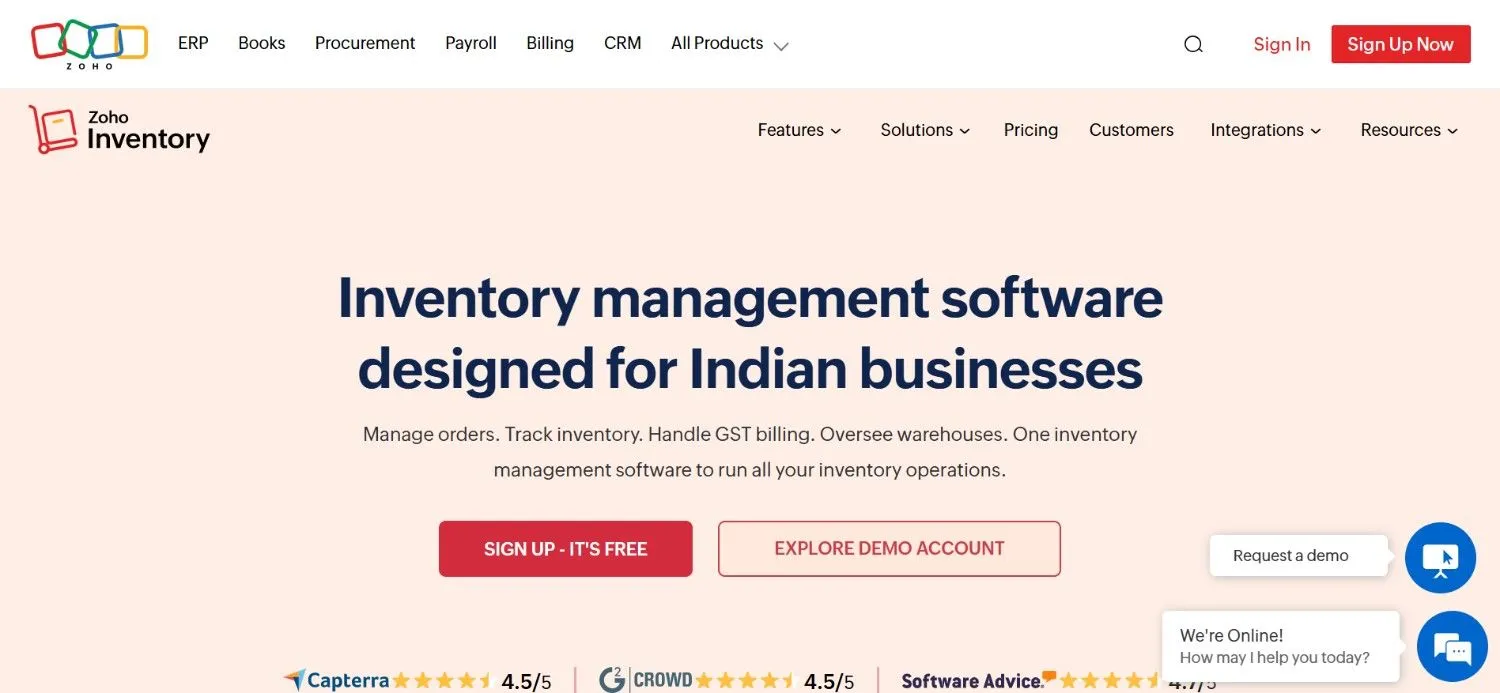
Zoho Inventory is a cloud-based inventory management tool positioned primarily for small-to-mid businesses that are already using or considering the broader Zoho software suite. It handles multi-channel selling, order management, serial and batch tracking, and connects to Amazon, eBay, Shopify, Etsy, and WooCommerce.
Its free tier and affordable paid plans make it accessible for businesses early in their inventory management journey - making it one of the best marketplace inventory management tools in the market currently.
Ideal For
- Small businesses with limited order volumes needing an affordable starting point
- Companies already using Zoho CRM, Zoho Books, or other Zoho products
- Multichannel sellers on Amazon, eBay, and Shopify with moderate complexity
- Businesses that need serial or batch number tracking at a low price point
Top Features
- Multichannel Order Management: Zoho Inventory connects sales orders from Amazon, eBay, Etsy, Shopify, and WooCommerce into a single dashboard, with inventory syncing across channels when orders are placed.
- Zoho Ecosystem Integration: Zoho Inventory integrates natively with Zoho Books (accounting), Zoho CRM, and Zoho Analytics; reducing the integration overhead for businesses already operating inside the Zoho stack. This is one of the clearest arguments for choosing Zoho Inventory over standalone alternatives.
- Demand Forecasting and Reorder Points: Historical sales data feeds demand forecasting tools that help smaller businesses predict inventory needs and set automated reorder points, reducing the manual burden of purchase planning.
Why They Stand Out?
Zoho Inventory is one of the most cost-accessible multichannel inventory tools in the category, with a free plan that handles up to 50 orders per month and paid plans starting at $29/organization per month.
For businesses that need more than a spreadsheet but aren't ready to invest in enterprise tools, it's a practical and well-regarded starting point.
Pros
- Transparent, affordable pricing from $29/organization per month
- Strong native integrations with Zoho Books and Zoho CRM
- Serial and batch number tracking available at mid-tier plans
Cons
- Advanced features (serial tracking, automation, additional locations) are gated behind higher-tier plans
- User seat limits are tight; Standard and Professional plans only include 2 users
- Less suitable for high-volume operations or complex marketplace operator models
- Limited outside the Zoho ecosystem; best when paired with other Zoho tools
Pricing
The pricing starts at $29/organization per month and goes up to $249/organization per month at the highest tier.
Final Verdict
Zoho Inventory is a solid starting tool for small businesses and Zoho ecosystem users. It's harder to recommend as a primary marketplace inventory management tool for businesses scaling past 3,000 monthly orders or running complex supplier partner networks. The value is real at the entry tier; the limitations become visible as operational complexity grows.
5. Veeqo
Overview
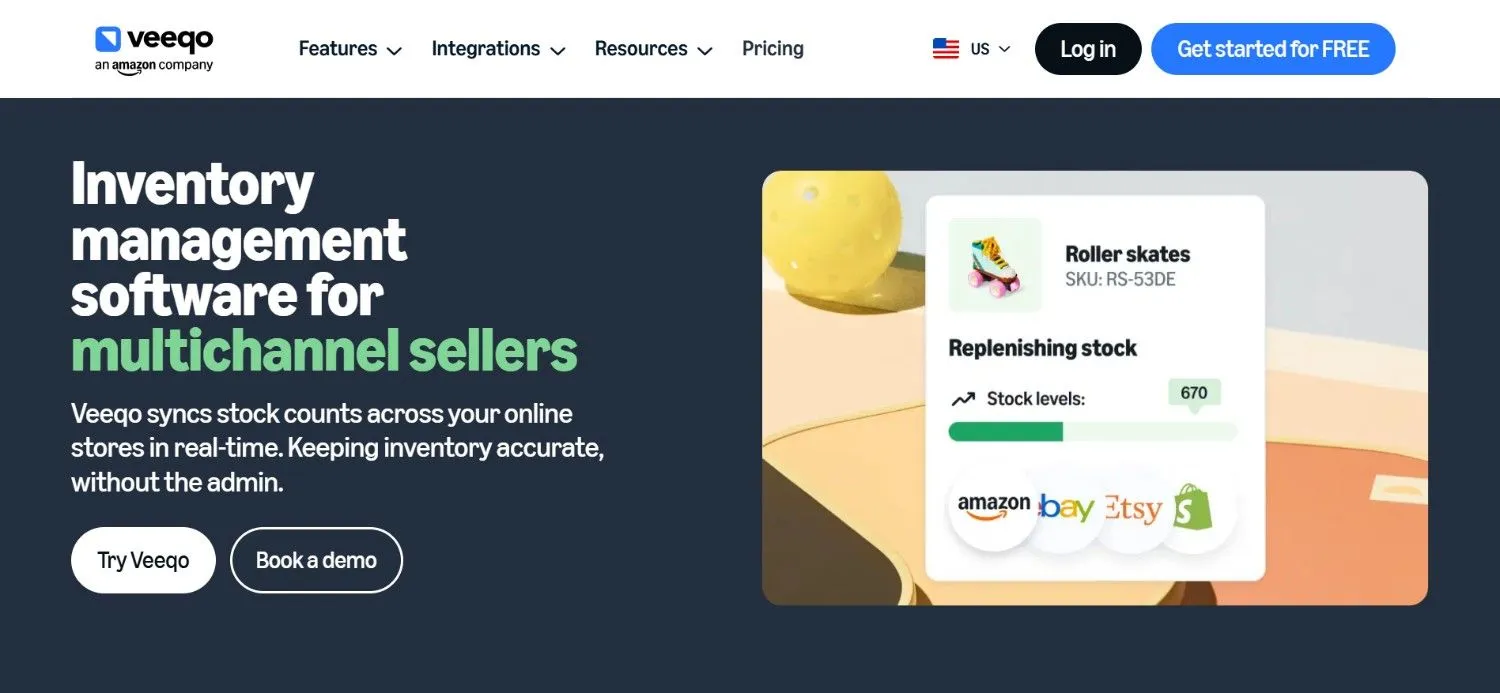
Veeqo (owned by Amazon) is a multichannel fulfillment and inventory management tool with a strong free tier for shipping management and an order-based pricing model for its inventory features. It's best known for its Amazon integration depth, pre-negotiated carrier rates, and barcode-based warehouse picking tools.
As of 2026, Veeqo is transitioning from a fully free model to usage-based subscription plans for its advanced inventory features.
Ideal For
- Amazon-primary sellers needing free, integrated shipping label management
- Multichannel sellers (Amazon, eBay, Shopify, Walmart) wanting centralized order processing at low cost
- Small-to-mid businesses with warehouse operations benefiting from barcode scanning
- Retailers looking for pre-negotiated carrier rates alongside inventory management
Top Features
- Amazon-Native Integration: Veeqo's Amazon ownership gives it deep integration with Amazon Seller Central - including inventory sync, FBA support, and Buyer-Seller Messaging. For Amazon-heavy operations, this reduces friction that other tools typically create.
- Pre-Negotiated Carrier Rates: Veeqo gives users access to discounted rates with UPS, USPS, FedEx, and DHL without requiring individual carrier negotiations. For sellers with high shipping volume, this can meaningfully reduce per-shipment costs.
- Warehouse Scanning and Picking: Veeqo's scanner hardware and digital picking tools support barcode-based receiving and quality control, reducing pick errors in physical warehouse operations.
Why They Stand Out?
Veeqo's Amazon integration and free shipping tier make it one of the stronger choices for Amazon-centric sellers who want multichannel inventory management without a large monthly commitment. Its usage-based pricing model (launching May 2026) maintains accessibility for variable-volume sellers.
Pros
- Free shipping management with no monthly cap (supported by carrier commissions)
- Deep Amazon integration - FBA, Seller Central, multi-warehouse support
- Pre-negotiated carrier discounts included with all plans
- Warehouse barcode scanning tools available
Cons
- Inventory management features transitioning to paid plans from May 2026 - pricing structure still settling
- Less suited to dropship or supplier-orchestration models without owned warehouse inventory
- Some users report customer service inconsistencies at scale
- Limited integration depth outside Amazon, Shopify, and eBay for less common channels
Pricing
The pricing starts at $19/month for up to 300 orders and goes up to $350/month for up to 4,000 orders. In addition, there's also a free plan available.
Final Verdict
Veeqo is a practical starting point for Amazon-heavy multichannel sellers at the small-to-mid scale. The free shipping tier provides genuine value.
As inventory management features move to paid plans, the cost-benefit will depend on order volume and how central Amazon is to the business. It's not suited to marketplace operators running supplier-side dropship programs.
6. Sellbrite
Overview
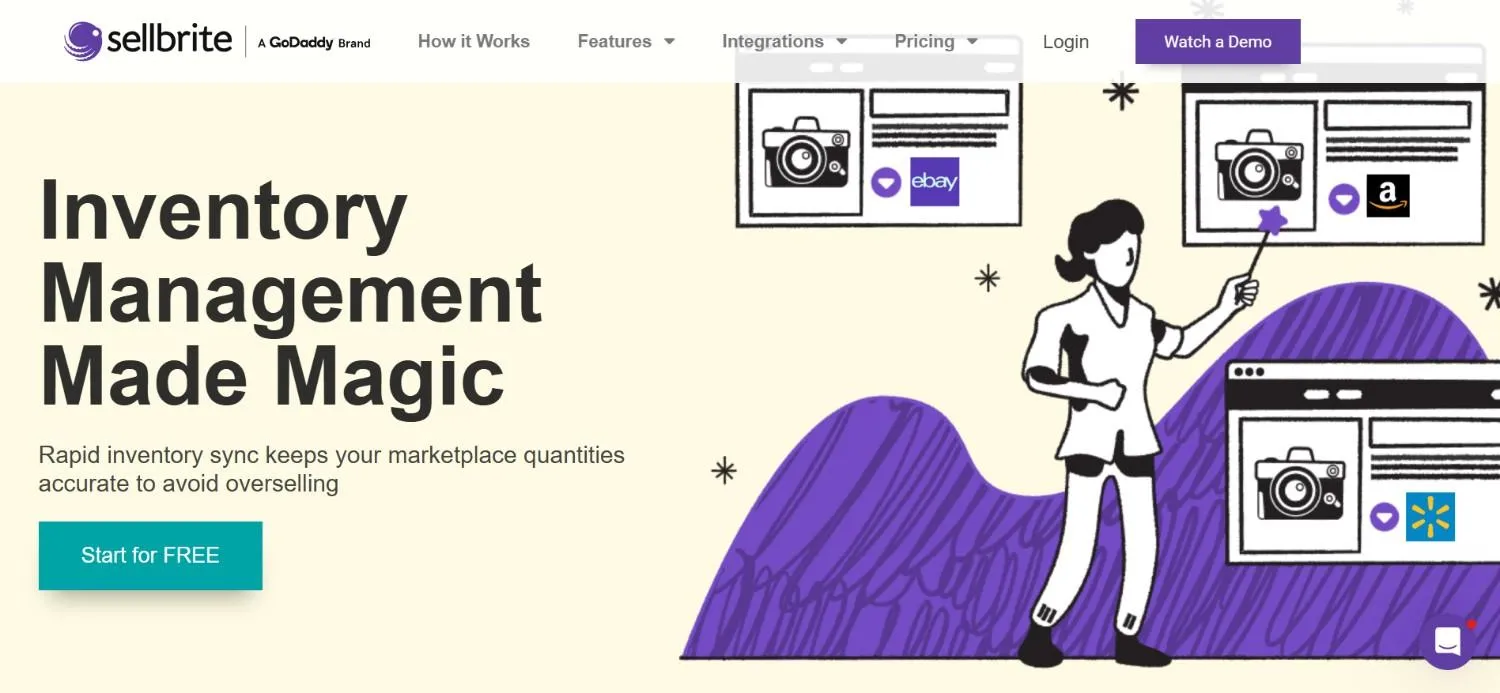
Sellbrite (owned by GoDaddy since 2019) is a straightforward multichannel listing and inventory management tool designed for sellers active on Amazon, eBay, Walmart, Etsy, and Shopify.
Its order-based pricing model makes it accessible for small sellers, and its bidirectional inventory sync prevents overselling across channels. It's primarily a listing and sync tool rather than a full inventory management platform.
Ideal For
- Small multichannel sellers starting out on 2-4 marketplaces
- Businesses primarily focused on listing management and oversell prevention
- Sellers wanting a low-cost entry point before graduating to more complex tools
- Amazon and eBay sellers who don't yet need warehouse or supplier management features
Top Features
- Bidirectional Inventory Sync: Sellbrite syncs inventory levels across all connected channels in real time, adjusting available quantities when orders are placed on any channel. This prevents overselling, the most basic problem for multichannel sellers.
- Centralized Listing Management: Create and manage listings across Amazon, eBay, Walmart, Etsy, and Shopify from a single interface, with bulk editing tools to update prices or descriptions across channels simultaneously.
- Order Centralization: All orders from connected channels appear in a single dashboard, reducing the need to check multiple platform backends to process or track orders.
Why They Stand Out?
Sellbrite is one of the more accessible entry points for multichannel inventory management at this price range. Its simplicity is a genuine strength for sellers who need oversell prevention and centralized order management without complex configuration.
Pros
- Simple to set up and use - low learning curve for new multichannel sellers
- Order-based pricing is fair for sellers with variable monthly volumes
- Solid bidirectional sync across major US marketplaces
Cons
- Limited inventory management depth; no warehouse management, demand forecasting, or advanced automation
- Development has slowed since the GoDaddy acquisition in 2019
- No Southeast Asian marketplace support - limited for international expansion
- Not suitable for wholesale, manufacturing, or supplier-side dropship operations
Pricing
Pricing for Sellbrite starts at $19/month and goes up to $179/month at the highest plan available.
Final Verdict
Sellbrite is a reasonable starting tool for small sellers managing 2-4 US marketplaces who need basic sync and listing management. It's unlikely to serve businesses well as they scale beyond a few hundred orders per month or add operational complexity. For marketplace operators or suppliers, it doesn't address the use case.
7. Ordoro
Overview
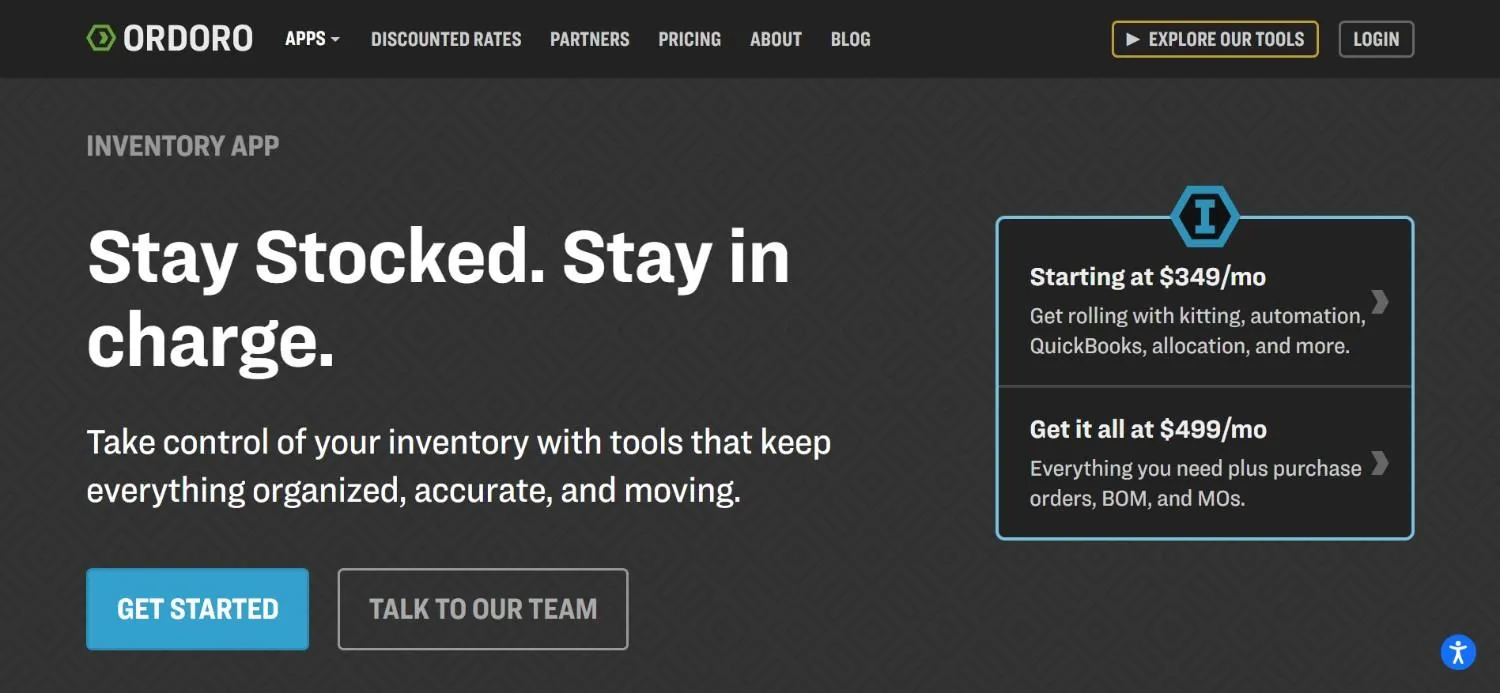
Ordoro is a multichannel order management and inventory tool that occupies a useful niche: it handles both traditional owned-inventory management and dropship automation within the same platform. For sellers who run a mixed model, some products they stock, others they dropship from suppliers - Ordoro removes the need for separate tools for each fulfillment type.
Ideal For
- Sellers managing a mix of owned inventory and dropship supplier relationships
- Shopify merchants needing dropship automation alongside standard inventory management
- Small-to-mid businesses wanting shipping automation integrated with inventory
- Operations needing kitting and bundling support at a mid-range price point
Top Features
- Dropship Automation: Ordoro automates order routing to dropship suppliers, including automated PO generation, supplier email notifications, and tracking updates. For sellers managing both models, this removes the manual coordination that typically makes mixed-model operations messy.
- Multi-Carrier Shipping: Ordoro connects to major shipping carriers with rate comparison tools, batch label printing, and shipping automation rules that route orders to the best carrier based on criteria you set.
- Kitting and Bundling: Ordoro supports kits and bundles; products assembled from multiple components - with inventory tracking that deducts the right components when a kit order is placed.
Why They Stand Out?
Ordoro sits at a practical mid-market price point and handles the mixed inventory/dropship model more cleanly than most tools at its tier. For Shopify-centric sellers who have started working with supplier partners, it's one of the stronger options that doesn't require an enterprise-level investment.
Pros
- Dropship automation built into the same tool as standard inventory management
- Strong Shopify integration, trusted by hundreds of Shopify merchants
- Kitting and bundling support without requiring add-ons
Cons
- Less suited to pure marketplace operators with large supplier networks
- Reporting tools are more limited than enterprise alternatives
- Some integrations require higher-tier plans
- Not a full ERP, usually pairs the best with a separate accounting tool
Pricing
While there is a free plan available, the 'Dropshipping' plan starts at $299/month and the 'Inventory' tier is priced at $349/month.
Final Verdict
Ordoro is a solid mid-tier choice for Shopify merchants running a hybrid inventory model. It's particularly worth evaluating for sellers who have started adding supplier dropship relationships alongside their own stock. It's not a marketplace-grade supplier orchestration tool and won't serve well for operators managing hundreds of supplier partners.
8. Brightpearl (by Sage)
Overview
Brightpearl is a retail operations platform acquired by Sage in 2022 and repositioned for mid-to-large retailers and wholesalers needing a full back-office system. It combines inventory management, order management, financial management, warehouse operations, and an automation engine in a single ERP-adjacent tool.
Since the Sage acquisition, it no longer publishes pricing publicly and usually targets buyers doing $5M+ in revenue.
Ideal For
- Mid-to-large retailers operating across DTC, wholesale, and physical retail simultaneously
- Businesses needing integrated accounting alongside inventory and order management
- Omnichannel merchants managing Shopify, BigCommerce, Amazon, and physical retail from one system
- Established retailers with the budget and implementation resources for a full platform deployment
Top Features
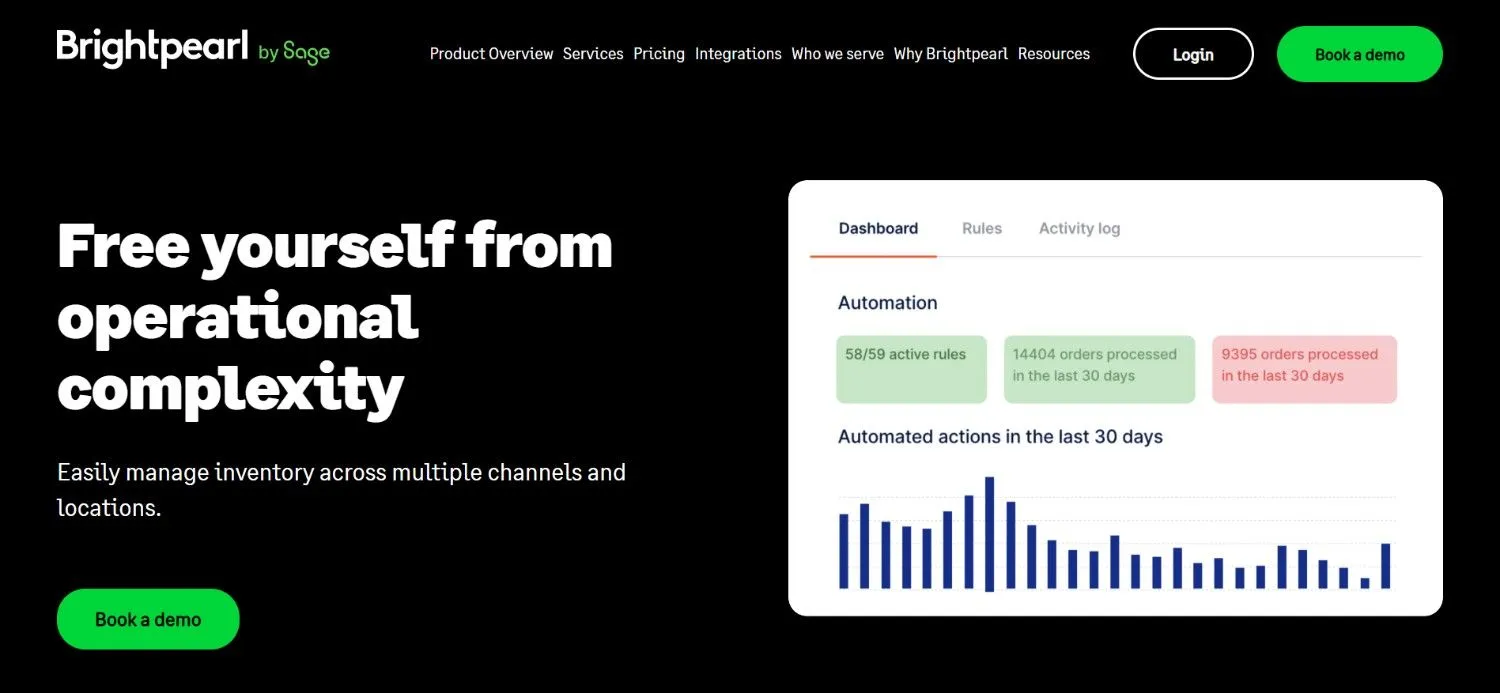
- Automation Engine: Brightpearl's Automation Engine triggers workflows based on order status, inventory levels, or customer events - reducing manual intervention in routine back-office tasks like order routing, purchase order creation, and fulfillment escalations.
- Integrated Financial Management: Brightpearl includes general ledger, accounts receivable, accounts payable, and multi-currency support; removing the need to maintain a separate accounting system for most mid-market retailers.
- Omnichannel Order Management: Brightpearl connects orders from multiple channels (online, in-store, wholesale) with inventory and financial management in a single view, giving operations teams a real-time picture of the business across all channels.
Why They Stand Out?
Brightpearl is one of the best marketplace inventory management software options for mid-market retailers who need an integrated back-office platform rather than best-of-breed tools stitched together. The combination of inventory, accounting, and automation in one system reduces the integration overhead that grows as operational complexity increases.
Pros
- Full retail operations platform (inventory + accounting + warehouse + automation)
- Strong automation engine for reducing manual back-office workflows
- Omnichannel-native design; works across online, in-store, and wholesale simultaneously
- Well-suited for enterprise-grade, large-scale retailers
Cons
- No public pricing; requires a sales conversation before any budget evaluation
- Higher pricing and implementation costs make it an out-of-reach proposition for most SMBs and small brands
- Implementation usually takes anywhere between 8-16 weeks
- Limited marketplace integrations compared to multichannel-first tools like Linnworks
Pricing
Custom pricing options available. You'll need to connect with their sales team for a tailored pricing structure suitable for your volume and requirements.
Final Verdict
Brightpearl is one of the best marketplace inventory management tools for mid-to-large scale retailers who need a full retail operations platform and have the budget to support it.
For small businesses, early-stage sellers, or marketplace operators focused on supplier-side dropship orchestration, the cost structure and implementation complexity don't make sense.
9. Rithum
Overview
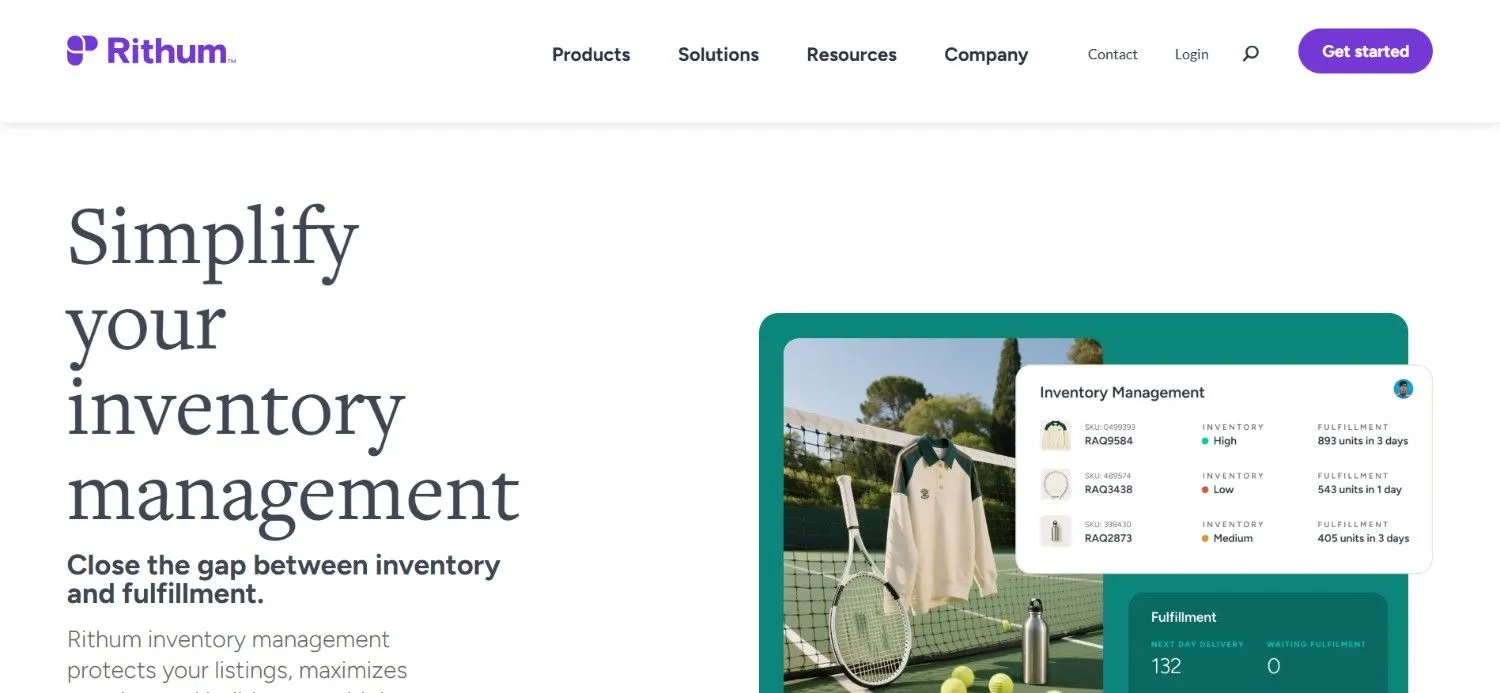
Rithum was formed from the merger of CommerceHub and ChannelAdvisor: two enterprise ecommerce infrastructure companies. It offers solutions for both brands (marketplace listings, inventory management, retail media advertising) and retailers (dropship management, private marketplace infrastructure, supplier discovery).
For large retailers and enterprise brands managing hundreds of supplier relationships or selling across dozens of global marketplaces, Rithum provides the infrastructure layer that connects all of it.
Ideal For
- Enterprise brands managing listings and advertising across 100+ global marketplaces
- Large retailers running dropship or private marketplace programs at significant scale
- Operations teams needing centralized supplier performance reporting across a large vendor network
- Businesses where retail media advertising and inventory management need to work from the same data layer
Top Features
- Marketplace Listings Management: Rithum centralizes product listing creation, optimization, and syndication across global marketplaces. The platform handles feed management, compliance requirements, and listing quality scoring for major channels including Amazon, Walmart, Target, and international marketplaces.
- Dropship Program Management: Rithum's retailer-side dropship tools manage supplier onboarding, order routing, and performance tracking for large dropship programs. The SupplyExplorer feature helps retailers discover and vet new supplier partners - making it one of the best inventory management software for marketplace operations.
- Retail Media Advertising: Rithum connects inventory data with retail media advertising management, allowing brands to connect ad spend to actual product availability and sales performance across channels from a single reporting view.
Why They Stand Out?
Rithum is a good choice in the market for enterprise retailers and brands that need marketplace infrastructure at global scale.
The combination of ChannelAdvisor's listing management heritage and CommerceHub's dropship infrastructure gives it unique coverage across both sides of the marketplace equation.
Pros
- Enterprise-grade coverage for both marketplace listings and dropship supplier management
- Strong retail media advertising integration connects ad data to inventory and sales
- SupplyExplorer helps retailers discover and connect with new supplier partners
- Built for global scale - supports international marketplaces and multi-region operations
Cons
- Custom enterprise pricing with revenue-percentage fee structures reported by users at scale
- Complex platform with a steep learning curve - requires dedicated internal resources
- Long-term contracts with limited flexibility, based on user reports
- Support quality and response times receive mixed reviews from enterprise users
- Not suited to SMBs or mid-market operators without dedicated commerce operations teams
Pricing
Rithum's pricing is custom-tailored, typically involving implementation fees and ongoing platform costs structured for enterprise retail contracts. No publicly available figure/range is available.
Final Verdict
Rithum is worth evaluating for enterprise-scale retailers and brands that need a single infrastructure layer for both marketplace listing management and dropship supplier networks. For most mid-market operators, the cost, complexity, and contract structure make it disproportionate to the need.
10. Marketplacer
Overview
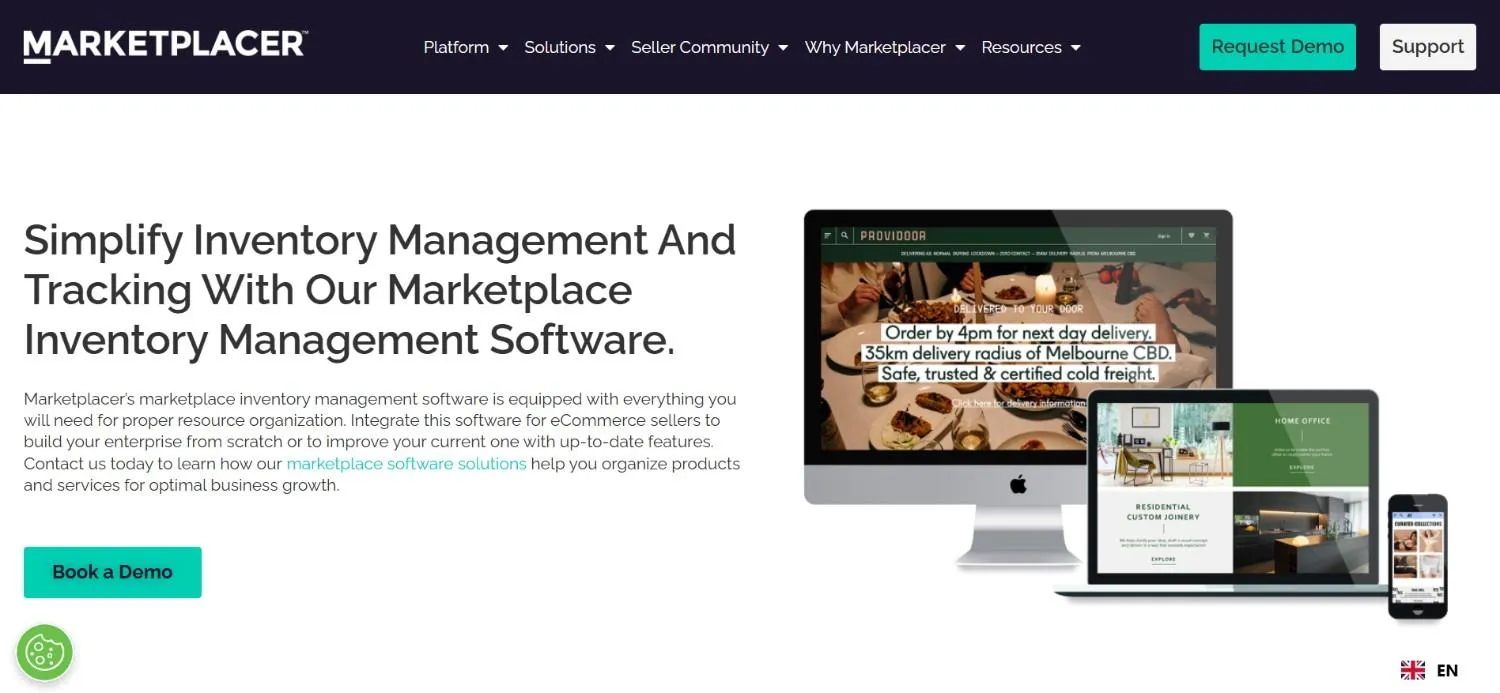
Marketplacer is a global SaaS marketplace infrastructure platform built for retailers, brands, distributors, and B2B operators that want to launch or scale a multi-vendor marketplace without rebuilding their existing commerce stack.
Rather than replacing your storefront, Marketplacer sits as a marketplace engine layer that connects your frontend - whether Shopify Plus, BigCommerce, Salesforce Commerce Cloud, Adobe Commerce, or a custom stack - with third-party seller catalogs, order routing, payouts, and analytics.
The platform is used by businesses that want to expand their product assortment through third-party sellers, run dropship programs at scale, or build curated marketplace experiences for specific verticals including retail, B2B, loyalty programs, grocery, and media.
Ideal For
- Retailers and brands wanting to add marketplace or extended assortment capability to an existing storefront without replatforming
- B2B operators building multi-vendor digital commerce experiences across complex product categories
- Enterprise organizations with the resources to configure and run a full multi-vendor marketplace operation
- Businesses expanding globally who need multi-language support (English, Spanish, Portuguese, French, German) and international seller onboarding
- Organizations running loyalty, media, or community commerce programs alongside product marketplace functionality
Top Features
- AI-Assisted Seller Onboarding and Product Ingestion: Marketplacer's AI and machine learning tools automate the heavy lifting of catalog ingestion, normalizing product data from diverse seller formats and reducing the manual taxonomy and mapping work that typically slows marketplace launches. The platform's Seller Community also gives operators access to a slew of vetted, global sellers for faster network activation.
- Composable Marketplace Architecture: Marketplacer is designed to integrate with your existing commerce frontend rather than replace it. Native connectors for Shopify Plus, BigCommerce, Salesforce Commerce Cloud, Adobe Commerce, Commercetools, and Magento 2 mean you keep your existing storefront and customer experience while adding marketplace engine capability behind it.
- End-to-End Order and Payout Management: The platform manages order routing to the correct seller, returns processing, seller remittance, and reconciliation within a single system. Real-time order routing and logistics integrations keep fulfillment running across a multi-seller network without manual coordination.
Why They Stand Out?
Marketplacer is one of the best marketplace inventory management tools in the market, especially for enterprise retailers and B2B operators that want to add marketplace functionality to an existing commerce architecture.
Its composable design: add marketplace capability without replatforming; is a meaningful differentiator for organizations that have already invested in their frontend stack and don't want to rebuild it to support multi-vendor selling.
Pros
- Composable architecture; integrates with existing storefronts rather than replacing them
- AI-assisted product ingestion reduces manual catalog work at scale
- Broad integration coverage: Shopify Plus, BigCommerce, Salesforce Commerce Cloud, Adobe Commerce, Commercetools
- Multi-language support and global seller network for international marketplace programs
- Purpose-built for multi-vendor marketplace models with end-to-end order and payout management
Cons
- Custom pricing only; no published rates, which makes early budget evaluation harder
- Enterprise-oriented; smaller teams or early-stage operators may find the setup complexity disproportionate
- Implementation requires meaningful configuration investment before go-live
- Less suited to retailers simply managing existing owned warehouse inventory without a multi-vendor component
Pricing
Custom quote based on usage scale, integration requirements, and support levels. Pricing combines a platform subscription fee with transaction-based charges. Contact the Marketplacer sales team directly for a detailed cost breakdown.
Final Verdict
Marketplacer is a strong choice for enterprise retailers, brands, and B2B operators building or scaling a multi-vendor marketplace on top of an existing commerce stack.
Its composable architecture and AI-assisted onboarding tools address the two biggest friction points in marketplace launches: technical integration and supplier catalog complexity.
For businesses that don't yet have an existing storefront infrastructure or are operating at small-to-mid scale, the configuration complexity and custom pricing model make it a harder fit compared to purpose-built dropship tools like Carro.
How to Choose the Best Marketplace Inventory Management Tools (What to Consider)?
Here are a few things to keep in mind while choosing the best marketplace inventory management software for your brand:
1. Match the Tool to Your Fulfillment Model
The most important filter is your inventory structure. Are you managing physical stock in one or more warehouses? Running a dropship program where suppliers fulfill orders on your behalf? Operating a hybrid model with some owned inventory and some supplier-fulfilled products?
Tools like Linnworks and Cin7 Core are built for owned inventory management at scale, while Carro is built for supplier-orchestrated dropship programs. On the other hand, a tool like Ordoro is adept at handling both models at a mid-market price point.
Getting this wrong produces an expensive tool that doesn't fit how your operations actually work.
2. Distribution Model: Warehouse Footprint vs. Partner Network
Closely related but distinct from the fulfillment question is the strategic one: how do you plan to scale distribution as the business grows? Two structurally different answers exist.
The warehouse-footprint model expands distribution by adding owned or operated locations: more warehouses, more stock, more headcount. Tools like Linnworks, Cin7, and Brightpearl support this model well, with multi-location inventory tracking, transfer orders, and warehouse management features.
The partner-network model expands distribution by adding suppliers rather than locations. The product lives with brand partners, orders route automatically to the correct fulfillment source, and the operational complexity of growth lives in the platform rather than in the warehouse. Carro is built specifically for this model, while Mirakl, Marketplacer, and Rithum support it at the enterprise tier.
For retailers and marketplace operators evaluating where to invest, the question isn't only "what tool fits today's setup?" but "which distribution model aligns with how I want to grow over the next 24 months?"
3. Evaluate Integration Compatibility With Your Existing Tech
Before evaluating features, confirm that any tool on your shortlist integrates natively with your storefront and accounting software. A tool with 700 integrations which doesn't support your specific ERP or financial system will require a lot of custom development, ultimately erasing the cost savings.
A tool like Carro supports Shopify, WooCommerce, BigCommerce, Magento, EDI, and SFTP. Cin7 Core integrates with Xero, QuickBooks, and most major ecommerce platforms.
Similarly, Zoho Inventory integrates best with the Zoho suite so make sure to map your stack requirements before shortlisting.
4. Understand the Pricing Model and Scaling Behavior
Some tools charge a flat monthly fee regardless of order volume (Cin7, Zoho). Others charge based on order volume (Sellbrite, Veeqo). Carro's 5% of sales model means your cost scales directly with revenue - zero cost when you're not selling, proportional cost when you are.
At low volumes, order-based pricing (Sellbrite) or percentage-of-sales pricing (Carro) tends to be more accessible than flat enterprise fees (Linnworks, Brightpearl).
At high volumes, the math reverses. It is recommended that you model your expected order volume and GMV against each pricing structure before making a decision.
5. Cash Flow and Payout Structure
For retailers running dropship programs and brands selling through retail partners, payout timing affects working capital as much as pricing does. Most marketplace and wholesale arrangements operate on Net 30 or Net 60 terms - meaning suppliers wait 30 to 60 days after a sale to receive payment.
For early-stage and growth-stage brands, this delay can be the difference between scaling distribution and stalling on cash flow. Carro processes supplier payouts immediately when orders ship, eliminating the working capital gap that traditional retail relationships create.
If you're a brand evaluating distribution channels, or a retailer building a supplier network where partner cash flow affects partner reliability, payout timing is worth treating as a primary criterion rather than a footnote.
6. Factor In Implementation Time and Internal Resource Allocation
Enterprise tools like Brightpearl, Mirakl, and Rithum require significant implementation investment: weeks to months of configuration, data migration, and staff training. That's a real cost that doesn't show up in the monthly subscription fee.
Carro is designed to activate within weeks, not months. Zoho Inventory and Sellbrite have self-serve setup flows accessible without technical resources. Match the implementation complexity to your team's capacity and timeline.
7. Speed to New Assortment and Category Expansion
Once a tool is implemented, how long does it take to add a new product, supplier, or category? For retailers whose growth strategy depends on assortment expansion, speed-to-revenue from new products is one of the highest-leverage metrics in the entire stack.
Traditional warehouse-based expansion involves wholesale negotiations, purchase orders, lead times, and forecasting cycles - often measured in months. Self-serve dropship directories speed this up but trade off partner quality. Enterprise marketplace platforms offer scale but require dedicated supplier acquisition resources.
Carro's hand-matched supplier network compresses this cycle: account managers facilitate retailer-brand introductions based on category fit, with partner activation typically happening in weeks rather than months.
Across a 1.5 million+ product network, this enables retailers to fill assortment gaps, test categories, and respond to demand signals faster than warehouse-based or self-serve alternatives allow.
8. Assess Supplier Management Capabilities Specifically
If your growth model involves adding supplier partners - whether through a dropship program, extended assortment, or marketplace model - evaluate how each tool handles the supplier side of the relationship.
Most multichannel inventory tools manage the retailer's side well. They manage the supplier onboarding, catalog normalization, and payout infrastructure less well.
Carro's supplier lifecycle management: from hand-matched introductions through order routing to instant payouts - is one of the most complete supplier-side capabilities in this comparison. For operators where supplier quality and cash flow are strategic concerns, this distinction matters.
9. Evaluate Customer Support Quality at Your Expected Usage Level
Support quality varies significantly in this category, and the cost of a support gap (a delayed order, a mis-routed shipment, a supplier sync error) often exceeds the monthly software fee.
For partner-network models specifically, the relevant support dimension extends beyond standard ticket response: it includes how well the platform helps you onboard suppliers, navigate technical hurdles for non-technical brand partners, and resolve operational issues across a distributed network.
The likes of Brightpearl and Rithum have received mixed support reviews from enterprise users, whereas tools like Cin7 Core's support is praised in reviews but has declined at scale following recent price changes.
Carro's Growth Plan includes priority support and a dedicated account management layer that covers partner introductions alongside technical issues, with retailer testimonials specifically calling out the team's willingness to support smaller, less-technical brand partners directly through onboarding.
Everything You Need to Know About Marketplace Inventory Management Software
| Company | Pros | Cons | Ease of Use | Integrations | Support | Affordability |
|---|---|---|---|---|---|---|
| Carro | Instant payouts; hand-matched partners; purpose-built for distributed retail | Not for owned warehouse inventory; not an ERP; US-focused | ★ ★ ★ ★ ☆ | ★ ★ ★ ★ ☆ | ★ ★ ★ ★ ☆ | ★ ★ ★ ★ ☆ |
| Linnworks | 100+ integrations; strong at high volume; warehouse management included | Expensive; steep learning curve; quote-based pricing | ★ ★ ★ ☆ ☆ | ★ ★ ★ ★ ☆ | ★ ★ ★ ☆ ☆ | ★ ★ ★ ☆ ☆ |
| Cin7 Core | Transparent pricing; manufacturing support; strong accounting integrations | Config-heavy; price escalation concerns; not dropship-first | ★ ★ ★ ☆ ☆ | ★ ★ ★ ★ ☆ | ★ ★ ★ ★ ☆ | ★ ★ ★ ☆ ☆ |
| Zoho Inventory | Free plan; affordable tiers; Zoho ecosystem fit | Tight user limits; feature-gated tiers; limited outside Zoho | ★ ★ ★ ★ ☆ | ★ ★ ★ ☆ ☆ | ★ ★ ★ ☆ ☆ | ★ ★ ★ ★ ☆ |
| Veeqo | Free shipping tier; Amazon-native; carrier discounts | Inventory plans transitioning to paid; CS inconsistency | ★ ★ ★ ★ ☆ | ★ ★ ★ ★ ☆ | ★ ★ ★ ☆ ☆ | ★ ★ ★ ★ ☆ |
| Sellbrite | Simple to use; order-based pricing; good for entry-level | Limited depth; slow development post-GoDaddy | ★ ★ ★ ★ ☆ | ★ ★ ★ ☆ ☆ | ★ ★ ★ ☆ ☆ | ★ ★ ★ ★ ☆ |
| Ordoro | Dropship + owned inventory in one tool; Shopify-strong | Limited reporting; not enterprise-grade; requires accounting tool | ★ ★ ★ ★ ☆ | ★ ★ ★ ☆ ☆ | ★ ★ ★ ★ ☆ | ★ ★ ★ ☆ ☆ |
| Brightpearl by Sage | Full retail ops platform; accounting included; strong automation | No published pricing; expensive; long implementation | ★ ★ ★ ☆ ☆ | ★ ★ ★ ★ ☆ | ★ ★ ★ ★ ☆ | ★ ★ ☆ ☆ ☆ |
| Rithum | Enterprise-scale marketplace + dropship; global reach; retail media | Enterprise-only; complex; revenue-percentage pricing | ★ ★ ☆ ☆ ☆ | ★ ★ ★ ★ ☆ | ★ ★ ★ ★ ☆ | ★ ★ ☆ ☆ ☆ |
| Marketplacer | Purpose-built for multi-vendor marketplaces; AI-assisted seller onboarding; integrates without replatforming | Custom pricing only; enterprise-oriented; steeper setup complexity for small teams | ★ ★ ★ ☆ ☆ | ★ ★ ★ ★ ☆ | ★ ★ ★ ★ ☆ | ★ ★ ☆ ☆ ☆ |
Expand Distribution With Carro
Marketplace operators and retailers who build their growth strategy around supplier partnerships need infrastructure that matches the model. Most inventory management tools are built for warehouse-first operations. Carro is built for the distributed retail model, where inventory lives with your partners, orders route automatically, and your operational complexity doesn't multiply every time you add a new supplier.
The two things that differentiate us in this comparison include:
- Instant supplier payouts (no Net 60 wait for the economics to confirm themselves) and,
- Hand-matched partner introductions (curated by account managers based on fit, not self-serve from a generic directory).
Together, they change both the speed and the quality of how marketplace operators build their supplier network - with retailers in our network achieving up to 3.5x revenue growth, 180% growth in average order value, and up to 3x catalog expansion.
Carro is the right fit for marketplace operators, multi-supplier retailers and DTC brands who have a proven product and are looking to expand distribution through curated retail partnerships; all without the inventory risk, upfront ad spend or waiting for months for the first partnership to generate revenue.
To know more about how we can help, book a demo now and start expanding your distribution with Carro.
Frequently asked questions
What is the best marketplace inventory management software in 2026?
Carro is the best marketplace inventory management software for marketplace operators and retailers building dropship-based or extended assortment programs. We manage the full supplier lifecycle with real-time sync, automated order routing and instant payouts - with retailers in our network seeing up to 3.5x revenue growth, 180% AOV growth, and up to 3x catalog expansion via direct brand partnerships.
What should I consider when choosing marketplace inventory management tools?
When choosing marketplace inventory management tools, start with your fulfillment model - owned inventory, dropship, or hybrid - since tools are architected differently for each. Then evaluate integration compatibility with your existing storefront and accounting stack, pricing model behavior at your expected order volume, implementation complexity relative to your team's resources, and how well the tool handles the supplier side of your operations. For operators building a partner-based distribution model, supplier onboarding quality, payout timing, and partner approval control are critical factors that generic multichannel tools often underweight.
How does Carro differ from similar marketplace inventory management alternatives?
Carro differs from alternatives primarily in what it is built for: distributed retail and supplier-orchestrated dropship programs rather than owned warehouse management. While tools like Linnworks and Cin7 Core centralize inventory across warehouses a retailer owns, Carro centralizes the supplier network - normalizing fragmented supplier data, syncing real-time inventory, routing orders automatically, and processing instant payouts when orders ship. The hand-matched supplier network is another meaningful difference: account managers facilitate introductions based on audience fit and operational compatibility, which compresses partner activation from months to weeks compared to cold outreach or self-serve directories.
How do I get started with Carro?
Getting started with Carro takes minutes and you can simply sign up for the platform and integrate your existing eCommerce platform and tech stack. This eliminates the need for custom development or any manual coding of features. Once connected, our account management team will work with you to identify retail partners matching your audience profile and category. From there, partner activation typically happens within weeks.
How easy is it to switch to Carro from another inventory tool?
Switching to Carro from another inventory tool is straightforward for businesses whose primary use case is supplier-based dropship or extended assortment: we connect to your existing storefront rather than replacing it. If you're currently using a warehouse management tool for owned inventory, Carro can run alongside it since the two tools serve different functions. The 5% of sales pricing also means there's no upfront investment to start testing the platform. Most new accounts see their first partner activation within a few weeks of onboarding.
Does marketplace inventory management software work for dropship-only operations?
Marketplace inventory management software works well for dropship-only operations. In fact, dropship is one of the primary models the category was built to support. The key is choosing a tool designed for supplier-side orchestration rather than one adapted from a warehouse management background. Carro's entire infrastructure is built around the dropship model: real-time inventory sync with supplier catalogs, automated order routing to the correct fulfillment partner, and instant payouts when orders ship.
What are the benefits of inventory management software for online marketplaces?
The benefits of inventory management software for online marketplaces include preventing overselling through real-time sync, automating order routing across a distributed supplier network, and handling payout reconciliation and catalog normalization at scale. Operators also gain centralized visibility into supplier performance and SLA compliance - both of which become difficult to manage manually as the partner network grows.