Best Spocket Alternatives in 2026 (Feature & Pricing Comparison)
Looking for the best Spocket alternatives? Check out our comparison of the top tools in the market to understand why Carro is the best option for your brand.

Key Takeaways (TL;DR)
- Who Spocket Is For: Spocket is built for solo dropshippers and small store owners who want access to US and European suppliers and fast shipping times, primarily through Shopify or WooCommerce.
- Why Seek a Spocket Alternative: The platform's higher-tier pricing can be steep for early-stage stores, supplier variety is limited outside fashion and lifestyle categories, and there's no strong solution for teams managing multi-supplier marketplace operations at scale.
- Best Overall Alternative: Carro is purpose-built for retailers and marketplace operators who want to grow their catalog through curated brand partnerships without buying or holding inventory. Unlike tools focused on individual dropshipping, we handle end-to-end supplier orchestration across your entire commerce stack.
- What Sets Carro Apart: We're the only solution on this list that manages the full supplier lifecycle; connecting retailers to a vetted brand network, automating order routing and payouts, and driving catalog growth without inventory risk, through one platform built for multi-supplier operations. How to Choose: Focus on three things: the scale of your operation (solo store vs. multi-supplier marketplace), the supplier quality and geographic coverage you need, and whether you need automation beyond basic product importing.
Top Spocket Alternatives in 2026 at a Glance
| Tool | Best For | Key Features | Pros | Cons | Pricing Starts |
|---|---|---|---|---|---|
| Carro | Retailers & marketplace operators expanding catalog through curated brand partnerships | Hand-matched suppliers, automated order routing, real-time sync, 1.5M+ products | End-to-end automation, no inventory risk | Not designed for solo hobbyist dropshippers | 5% of sales (Standard) |
| Doba | Mid-volume dropshippers wanting a large US-focused supplier directory | Product sourcing, inventory feeds, retailer integrations | Large catalog, good US coverage | Pricing can add up; limited automation | ~$28.66/month |
| Modalyst | Fashion-focused stores needing premium brand access | Brand marketplace, product importer, inventory sync | Quality brand catalog, easy Shopify sync | Expensive at higher tiers; limited categories | Free plan; $199/month (Starter) |
| Inventory Source | Stores that want to manage multiple supplier feeds in one place | Supplier directory, inventory automation, order management | Broad supplier network, strong automation | No built-in marketplace; requires existing store | $99/month (inventory only) |
| Zendrop | Beginner and intermediate dropshippers using Shopify | Auto-fulfillment, US warehouse, product sourcing | Easy setup, US fulfillment | Limited outside Shopify; fewer brand-name suppliers | Free plan; $49/month (Pro) |
| AutoDS | High-volume dropshippers needing multi-platform automation | Product research, auto-ordering, price monitoring | Broad platform support, strong automation | Learning curve; fees stack up with scale | ~$12.90/month |
| Syncee | Stores wanting global supplier access with built-in chat | Global supplier marketplace, DataFeed Manager, supplier messaging | Wide geography, transparent supplier info | UI can be clunky; fewer premium US brands | Free plan; paid tiers scale by products |
| Dripshipper | Niche coffee stores wanting private-label products | Private label coffee, custom branding, Shopify integration | Unique niche, strong branding options | Very narrow niche — coffee only | $30/month |
| DSers | AliExpress-based stores needing bulk order management | Bulk ordering, AliExpress integration, supplier optimizer | Free plan, official AliExpress partner | Heavily AliExpress dependent; slower shipping | Free plan; ~$19/month (paid) |
| CJDropshipping | Stores wanting flexible sourcing with warehousing options | Product sourcing, global warehouses, print on demand | No monthly base fee, wide product range | Quality can vary; slower support at times | Free (CJ Prime from $15.99/month) |
Why Consider Spocket Alternatives?
What Spocket Does Well?
Spocket built its reputation on one specific promise: faster shipping from US and EU suppliers. For a Shopify store owner who sells lifestyle or fashion products and wants to avoid the long lead times that come with sourcing from Asia, Spocket genuinely delivers on that. Its curated supplier network keeps product quality more consistent than open directories, and its one-click product import makes getting started quick.
The platform integrates cleanly with Shopify and WooCommerce, and its branded invoicing feature is a nice touch for stores that want a polished unboxing experience without owning any inventory.
Where Spocket Falls Short
The problems start when you try to scale or go outside Spocket's core use case.
Here's what drives most users to explore alternatives to Spocket:
- Pricing pressure at scale: Spocket's premium plans are expensive relative to what you get. The entry-level plan limits your product count, and you need to move up to unlock the catalog depth that makes the platform worthwhile. For stores with thin margins, this fee structure hurts.
- Narrow category coverage: Spocket's supplier network skews heavily toward fashion, beauty, and home goods. If your store sits in electronics, industrial goods, specialty food, or other categories, your options shrink quickly.
- No marketplace-grade infrastructure: Spocket is built for individual dropshippers managing a single store, not for teams operating multi-supplier marketplaces. There's no real supplier lifecycle management, no performance controls, and no automated payout logic that a growing marketplace needs.
- Limited supplier relationship depth. You're working with a directory – not building partnerships. For retailers who want to develop direct, approved relationships with brand partners, Spocket's arms-length model creates friction.
- AliExpress dependency at lower tiers: For stores not on a premium plan, many Spocket products still ship from China, which undermines the main selling point.
Best Spocket Alternatives in 2026: In-Depth Review & Comparison
1. Carro
Overview
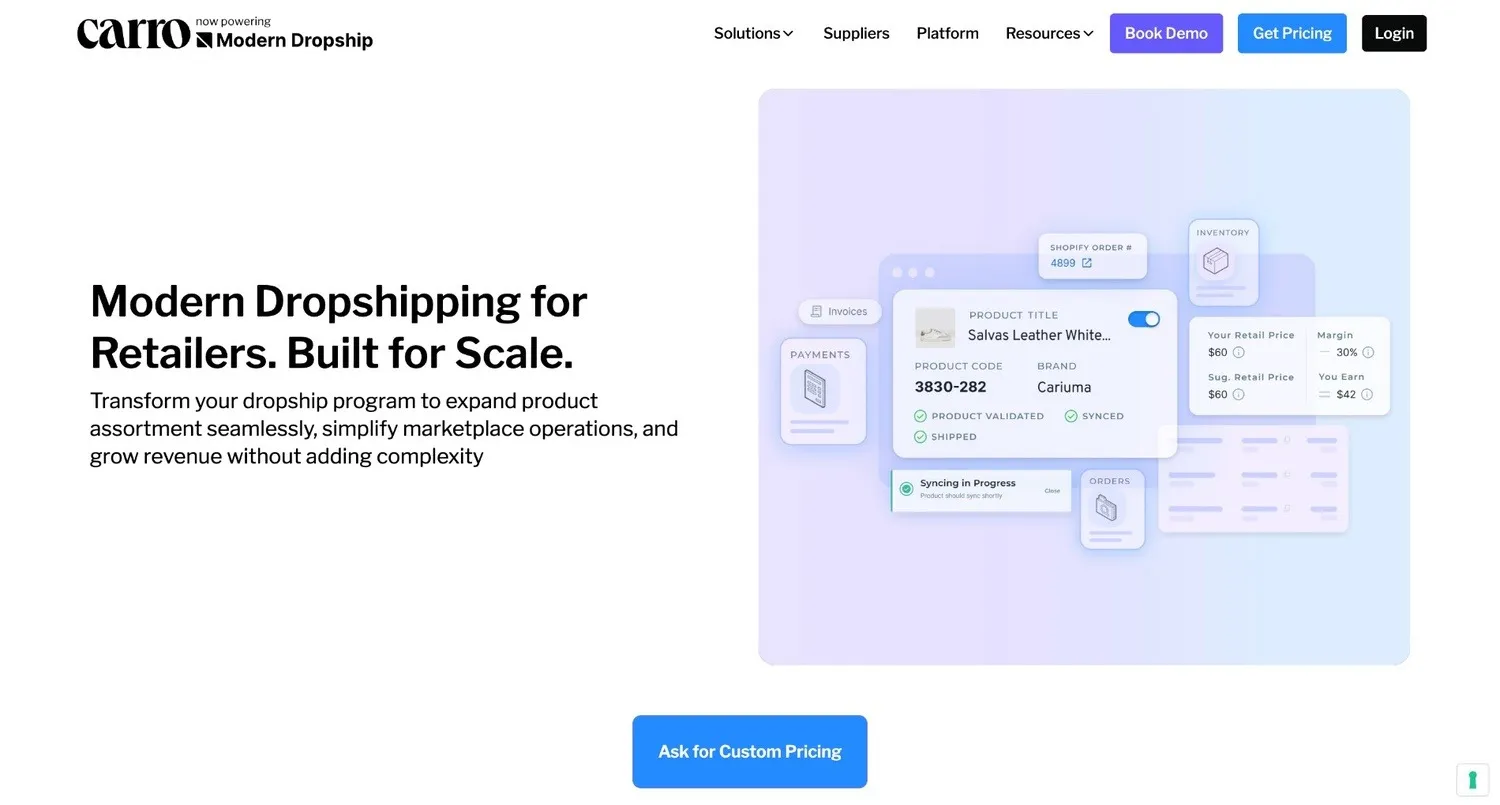
Carro (now powering Modern Dropship) is a dropship platform built specifically for retailers and marketplace operators who want to grow their product catalog without buying inventory. We connect retailers with vetted brand partners, automate order routing and fulfillment, and sync inventory and pricing in real time, all from one platform.
The core problem we solve is one that Spocket doesn't fully address: how do you expand your assortment and grow GMV at scale, without the operational sprawl that usually comes with managing dozens or hundreds of supplier relationships? Our answer is end-to-end automation paired with human-curated supplier matching.
Retailers using Carro have seen up to 3.5x revenue growth, up to 180% AOV improvement, and up to 3x catalog expansion – results that reflect what happens when you remove inventory constraints from a growing store. Our platform supports Shopify, WooCommerce, BigCommerce, and Magento, as well as EDI and SFTP connections for more complex operations.
Ideal For
- Established retailers looking to expand their product catalog without inventory risk
- Online marketplace operators managing multiple brand and distributor relationships
- DTC brands that want to distribute through vetted retail partners
- E-commerce teams that need real-time supplier sync without manual intervention
- Retailers testing new categories before committing to inventory
Top Features
- Hand-Matched Supplier Network: Our Account Managers connect retailers with complementary brands based on category fit, audience alignment, and brand positioning; not just catalog size. This results in higher-quality partnerships and better product performance.
- Automated Order Routing: When a customer places an order, it routes automatically to the correct supplier for fulfillment. No manual forwarding, no spreadsheets, no errors.
- Real-Time Sync & Integrations: Product pricing, inventory levels, and catalog data stay current across your storefront. Integrations with Shopify, WooCommerce, BigCommerce, Magento, plus EDI and SFTP ensure compatibility across commerce stacks.
- Seamless Catalog Expansion: Add new products and categories without any warehousing, balance sheet risk, or additional headcount.
- Automated Payments & Payouts: Supplier settlement is handled automatically, removing the reconciliation burden that grows quickly as your partner network scales.
Why We're the Best Spocket Alternative?
Spocket is a supplier directory with a product importer. We're a supplier orchestration platform. That's not a subtle difference – it defines what you can actually do as you scale. With Spocket, you browse a catalog, import products, and manage orders yourself. With Carro, your supplier relationships are curated by our team, orders route automatically, inventory stays synced in real time, and payouts settle without manual reconciliation.
The entire operational layer is handled, which is what makes us a genuinedropship and marketplace infrastructure platform rather than just another sourcing app. For retailers comparing tools: if your goal is adding a few products to a Shopify store, Spocket may be sufficient. If your goal is building a scalable, multi-supplier catalog with operational controls that don't break as you grow, we're the stronger fit.
Pros
- No inventory risk; curated brand partnerships with established, vetted suppliers
- Full-stack automation: order routing, inventory sync, and supplier payouts in one platform
- Retailers see up to 3.5x revenue growth and up to 180% AOV lift
- Broad integration support – Shopify, WooCommerce, BigCommerce, Magento, EDI, SFTP
- Human-touch supplier matching, not just a self-serve directory
Cons
- Not designed for solo hobbyist dropshippers who want to browse and test a few products
- Revenue-share model is designed for retailers with active transaction volume — not early-stage stores testing product-market fit
Pricing
Carro operates on a revenue-share model. The ‘Standard’ plan starts at 5% of sales and includes integrations with Shopify, Magento, BigCommerce, and WooCommerce, plus end-to-end dropship automation. Note that the Standard Plan does not include a dedicated support plan.
The ‘Growth’ plan adds autonomous merchandising, a hand-matched supplier network, and priority support on top of all Standard Plan features. All plans include unlimited transactions, full platform access, automated payments, basic performance insights, and access to 1.5M+ products from top brands.
Final Verdict
Carro is the right call for retailers and marketplace operators who need more than a product importer. The combination of curated supplier discovery, end-to-end automation, and a revenue-share model that scales with your business makes it the strongest overall Spocket alternative on this list. If you're running or building a multi-supplier commerce operation and want to grow without adding operational overhead, this is where we'd point you.
2. Doba
Overview
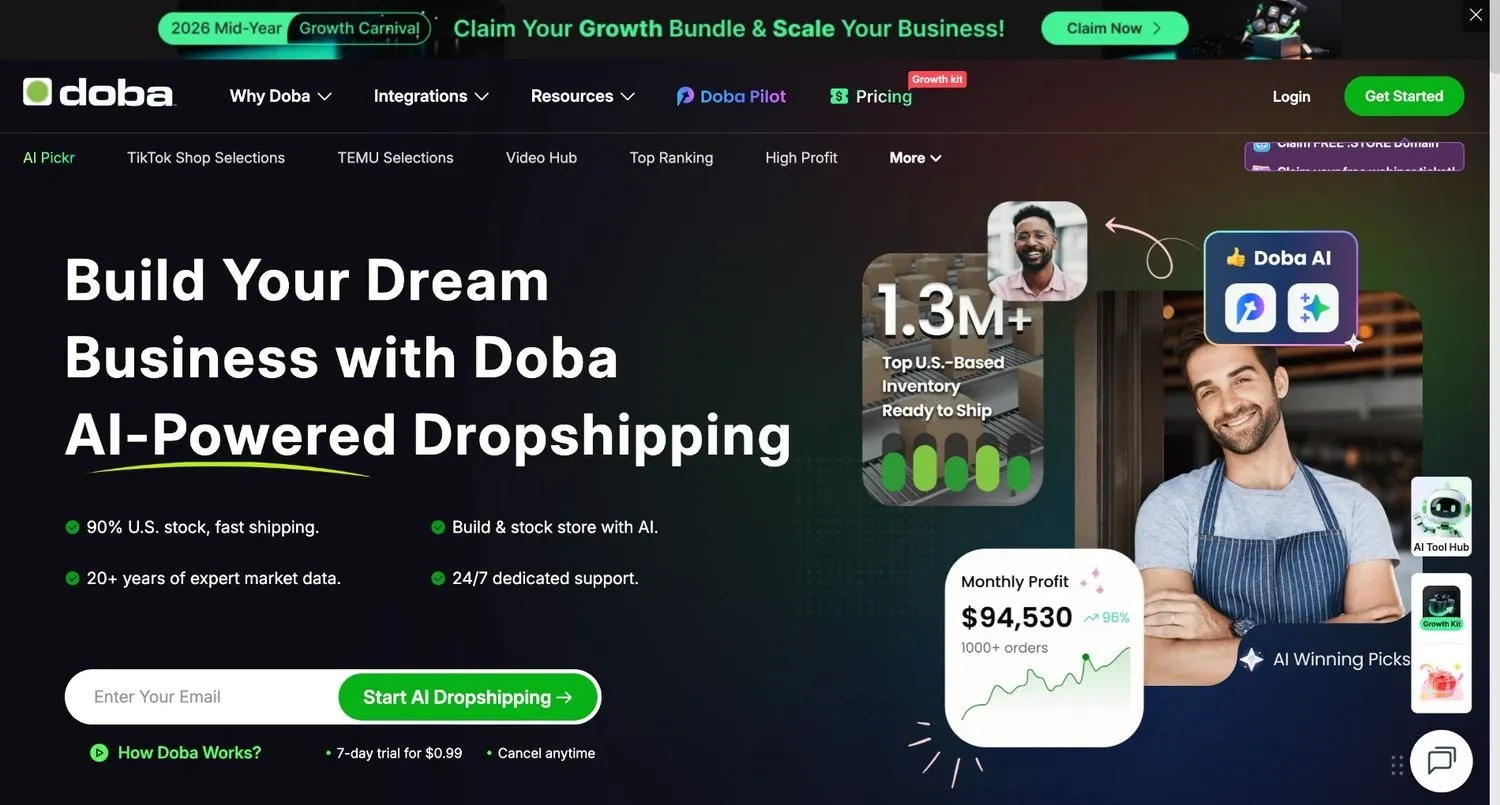
Doba is one of the longer-standing names in the US dropshipping space. Founded in 2002, it operates as a supplier aggregator – connecting retailers to a large directory of wholesale suppliers and manufacturers, primarily based in the United States.
The platform is positioned as a research and sourcing hub, giving store owners access to millions of products across categories like home goods, electronics, health, beauty, and apparel. While Spocket emphasizes a curated set of US/EU suppliers, Doba goes broader, offering volume over curation.
It integrates with major e-commerce platforms including Shopify, WooCommerce, BigCommerce, and Amazon, and provides inventory automation tools to keep product data current across connected storefronts.
Ideal For
- Mid-volume US-focused dropshippers who want a wide product selection
- Sellers on multiple platforms (Shopify, Amazon, eBay) looking for centralized sourcing
- Retailers who want to test large categories before narrowing supplier relationships
- Store owners who value US-based supplier access and domestic shipping timelines
Top Features
- Large US Supplier Directory: Access to millions of products from US-based wholesalers and manufacturers across a wide range of categories.
- Inventory Automation: Sync product data, pricing, and stock levels across connected storefronts automatically, reducing manual update work.
- Multi-Platform Integration: Native connections with Shopify, WooCommerce, BigCommerce, and Amazon allow retailers to manage sourcing from one dashboard.
- Retailer-to-Supplier Communication: Direct messaging tools let you contact suppliers for custom arrangements or order-level questions.
Why It's a Strong Spocket Alternative?
Doba is one of the stronger choices for US-centric dropshippers who want breadth over curation. Its supplier directory covers categories that Spocket's network misses, and its multi-platform integration means you're not locked into Shopify. For sellers managing volume across several channels, Doba's centralized sourcing dashboard reduces the friction of juggling separate supplier relationships.
Pros
- Long-established platform with a large US supplier network
- Multi-platform support (Shopify, Amazon, eBay, WooCommerce, BigCommerce)
- Inventory automation keeps product data current without manual updates
- Good category diversity compared to Spocket's fashion-heavy catalog
Cons
- Supplier quality varies across the directory; curation is limited compared to Spocket or Carro
- Pricing tiers can feel expensive relative to automation depth
- Not designed for marketplace operators or multi-supplier fulfillment at scale
- Customer support quality has been inconsistently reviewed
Pricing
Doba offers a 14-day free trial. Paid plans start at approximately $28.66/month billed quarterly on the Limited plan. Higher tiers scale up for growing or high-volume sellers and unlock more store integrations, automation, and higher product limits.
Final Verdict
Doba is a practical choice for mid-volume US-based dropshippers who need category breadth and domestic supplier access. It's less ideal if you want a tightly curated network or need marketplace-grade infrastructure. The platform is better suited to research and product discovery than deep operational automation.
3. Modalyst
Overview
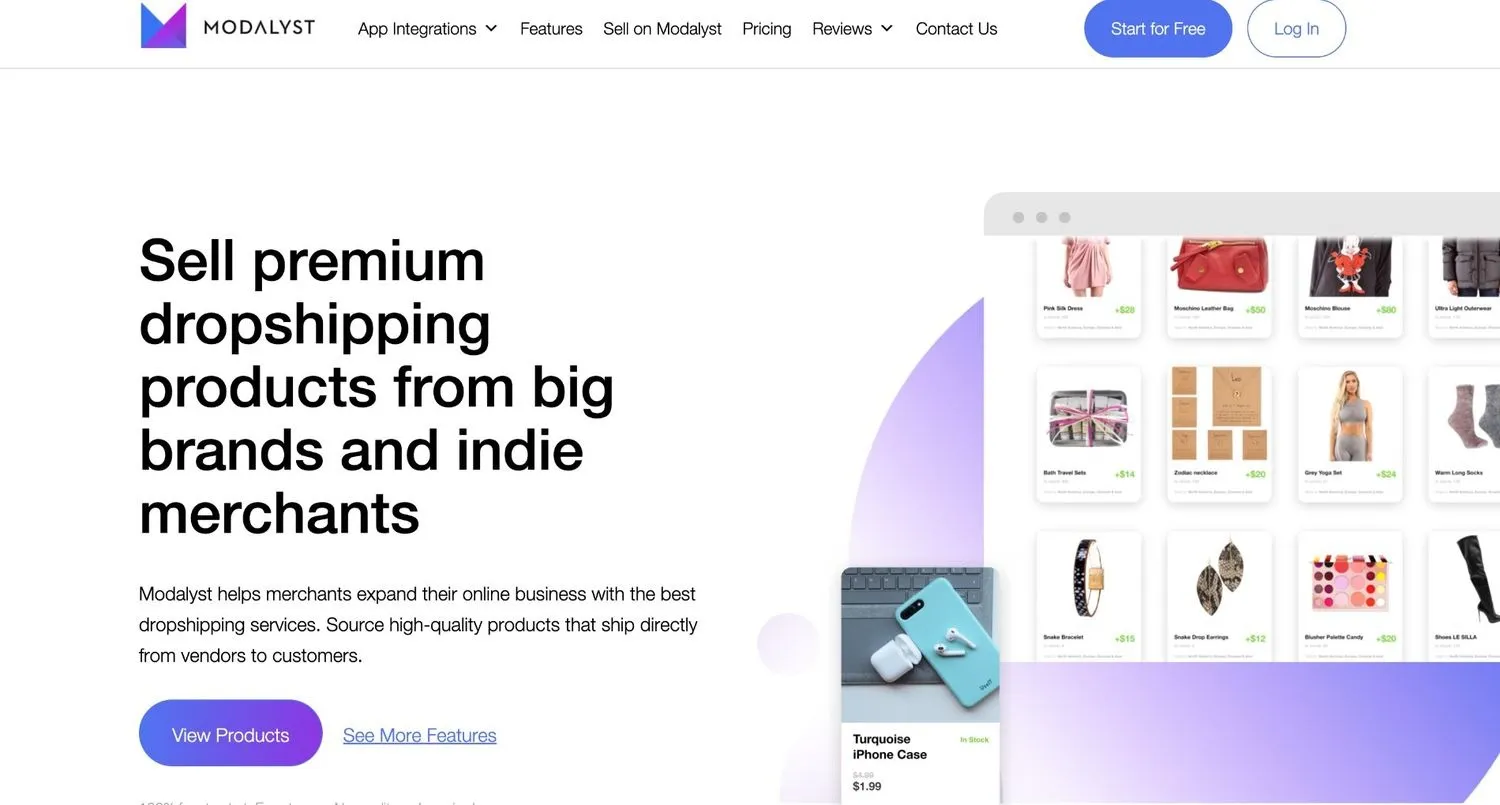
Modalyst is a dropship supplier marketplace focused on independent brands and premium products. It originally built its reputation as the sourcing platform of choice for fashion and lifestyle stores, offering access to independent designers and established brands primarily from the US and Europe.
Acquired by Wix in 2021, Modalyst now integrates closely with Wix's e-commerce ecosystem while maintaining compatibility with Shopify. The platform emphasizes product quality and brand prestige over raw catalog volume, making it a natural comparison point for Spocket users who care about supplier credibility.
Ideal For
- Fashion and lifestyle stores that need access to premium, independent brands
- Shopify and Wix store owners who want a clean, curated catalog
- Retailers who want to build a brand-forward product selection with quality US/EU sourcing
- Stores where product aesthetics and brand alignment matter to their customer base
Top Features
- Curated Brand Marketplace: Access to independent designers and premium brands that fit fashion, home, beauty, and lifestyle categories.
- One-Click Product Import: Add products to your store directly from the Modalyst catalog with pricing and inventory data synced automatically.
- US & EU Supplier Focus: Like Spocket, Modalyst emphasizes faster domestic and European shipping timelines over generic AliExpress sourcing.
- Inventory Sync: Automatic updates keep your store's product data, stock levels, and pricing current across connected platforms.
Why It's a Strong Spocket Alternative?
For fashion and lifestyle stores, Modalyst is one of the closest functional alternatives to Spocket. The emphasis on premium brands, US/EU shipping, and clean product imagery gives it a similar value proposition, while the Wix acquisition has brought more investment into platform development.
If Spocket's brand catalog didn't meet your category needs, Modalyst's independent designer access is worth exploring.
Pros
- Strong brand selection for fashion, lifestyle, and home categories
- Familiar setup for Spocket users – similar focus on US/EU supplier quality
- Clean product data and imagery suitable for brand-forward stores
- Free plan gives limited but functional access before upgrading
Cons
- Pricing jumps significantly at the Starter tier ($199/month) – steep for early-stage stores
- Category depth outside fashion and lifestyle is limited
- Post-acquisition, Wix integration has received more development focus than Shopify -- worth monitoring if Shopify is your primary platform
- Not suited for marketplace operators or multi-supplier at-scale operations
Pricing
Modalyst offers a free plan that allows you to view all suppliers, preview product feeds, and access supplier contact info. The ‘Starter’ plan is $199/month and the ‘Power Seller’ plan is $499/month, both unlocking full catalog access, higher product limits, and additional automation features.
Final Verdict
Modalyst earns its place as a strong Spocket alternative for fashion-focused stores that want premium brand access without the Spocket pricing structure.
However, the jump from free to paid is significant, and the platform's narrow category focus limits its usefulness outside lifestyle verticals. Teams running multi-brand or multi-category operations will likely hit its ceiling quickly.
4. Inventory Source
Overview
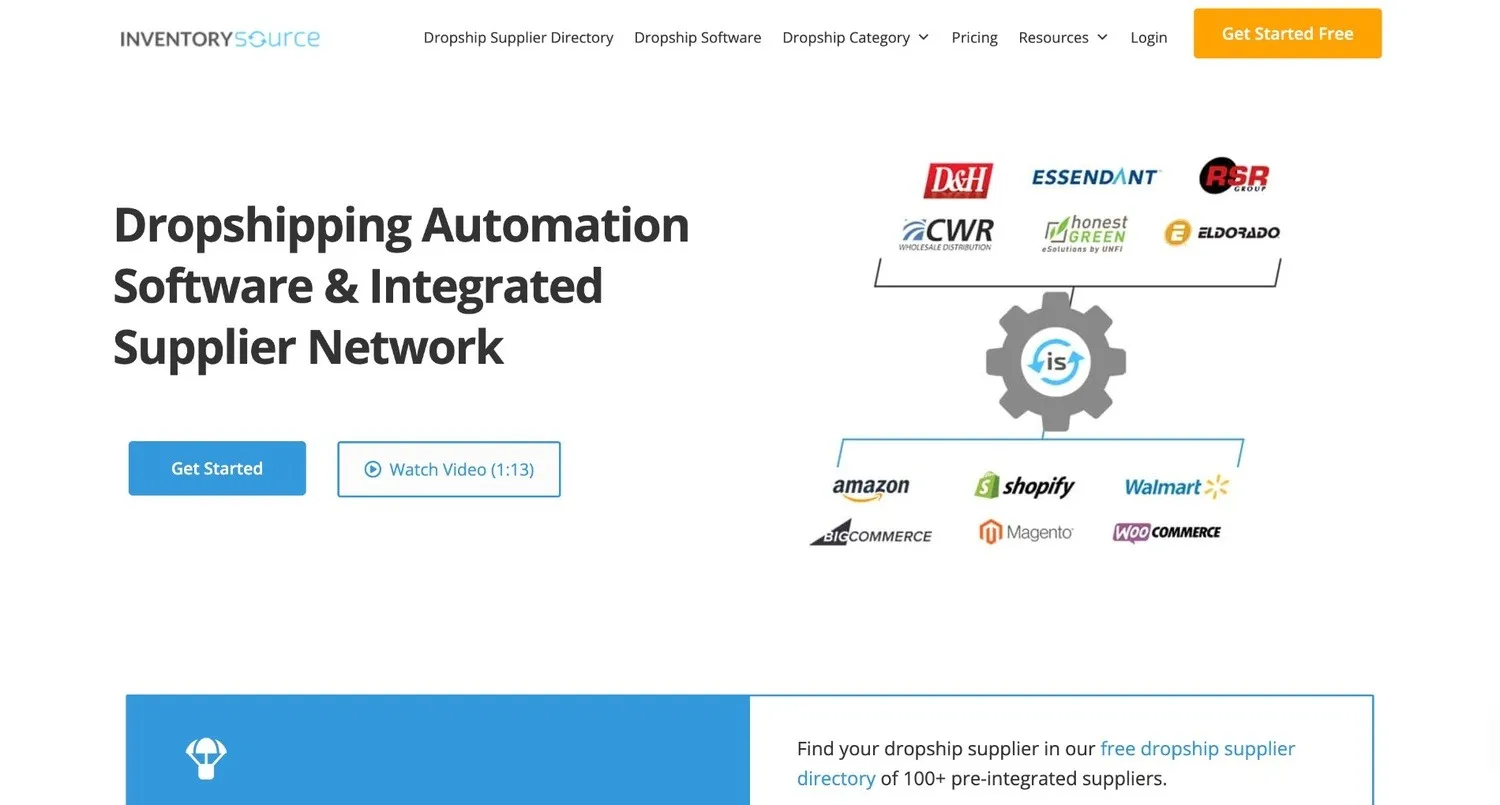
Inventory Source takes a different approach to the dropship sourcing problem. Rather than being a supplier marketplace itself, it acts as an automation layer that connects your store to a large network of pre-integrated US suppliers – syncing inventory data, automating order routing, and managing product feeds across multiple platforms.
The platform is built for retailers who already have supplier relationships (or want to build them) and need the infrastructure to manage product data and orders at scale. With over 230 pre-integrated suppliers and compatibility with more than 25 e-commerce platforms and marketplaces, Inventory Source is one of the more technically capable tools on this list for multi-channel dropshipping.
Ideal For
- Retailers managing multiple existing supplier relationships who need automation
- Multi-channel sellers on Shopify, BigCommerce, Amazon, eBay, or Walmart
- Store owners who want a supplier directory plus automation in one tool
- Teams with higher product volumes that need reliable inventory sync
Top Features
- 230+ Pre-Integrated Suppliers: A broad network of vetted US suppliers across categories including electronics, sporting goods, fashion, and home goods, all pre-connected for faster setup.
- Inventory Automation: Automatically syncs product data, pricing, and stock levels from suppliers to your storefront, reducing manual updates and out-of-stock issues.
- Full Order Management Automation: Higher-tier plans include automatic order routing to suppliers, tracking updates, and fulfillment status management.
- Multi-Platform Compatibility: Integrates with Shopify, BigCommerce, WooCommerce, Amazon, eBay, Walmart, and more – useful for multi-channel retailers.
Why It's a Strong Spocket Alternative?
Inventory Source is one of the strongest options for retailers who need serious automation infrastructure rather than a curated supplier marketplace. If Spocket felt too limited in its supplier options or too light on automation depth, Inventory Source's broader network and multi-platform support make it a credible upgrade path – particularly for stores already operating across multiple channels.
Pros
- Over 230 pre-integrated US suppliers across diverse categories
- Strong multi-platform support for omnichannel retailers
- Reliable inventory sync reduces overselling and manual update work
- Full order automation available on higher tiers
Cons
- No built-in product discovery marketplace – you're working with existing supplier connections
- Higher starting price compared to simpler alternatives on this list
- Interface can feel technical; less beginner-friendly than Spocket or Zendrop
- Not designed for marketplace operators managing partner networks at scale
Pricing
Inventory Source offers tiered pricing. ‘Inventory Automation Only’ starts at $99/month, while ‘Full Automation’ (including order management) starts at $150/month. Custom plans are available for higher-volume operations.
Final Verdict
Inventory Source is a solid pick for multi-channel retailers who need reliable automation across existing supplier relationships. It's less suited to store owners who want a curated discovery experience like Spocket, and it won't replace marketplace-grade infrastructure for teams managing dozens of brand partners. Best for mid-to-high volume operators who want technical depth.
5. Zendrop
Overview
Zendrop launched as a faster, more US-friendly alternative to AliExpress-based sourcing. Its core pitch is simple: access to US-based and global suppliers, faster fulfillment than typical China-based dropshipping, and an interface optimized for Shopify stores.
The platform targets beginner to intermediate dropshippers who want a straightforward sourcing setup with some automation – auto-fulfillment, order tracking, and basic product sourcing – without needing deep technical knowledge. Zendrop also offers print-on-demand and subscription box features, giving it a slightly broader use case than a standard supplier directory.
Ideal For
- Beginner and intermediate Shopify dropshippers who want a clean, easy setup
- Store owners switching from AliExpress who want faster US shipping options
- Sellers who want auto-fulfillment without complex integrations
- Stores exploring print-on-demand or subscription product models
Top Features
- US Warehouse Fulfillment: Access to US-stocked products for faster domestic shipping, addressing one of the main limitations of AliExpress-based sourcing.
- Auto-Fulfillment: Orders route automatically to the supplier once placed, removing manual order-forwarding from the workflow.
- Product Sourcing Requests: Submit a product you want to source and Zendrop's team will try to find it – useful for stores with specific inventory needs.
- Print-on-Demand Integration: Built-in POD capabilities let stores offer custom-branded products alongside standard dropship items.
Why It's a Strong Spocket Alternative?
Zendrop sits in a similar market position to Spocket; beginner-friendly, Shopify-focused, with an emphasis on US fulfillment – but starts at a lower price point with a free plan. For stores that found Spocket's pricing unjustifiable at early stages, Zendrop's free tier and lower Pro pricing make it one of the more accessible alternatives to Spocket on this list.
Pros
- Free plan available for early-stage stores
- Lower pricing than Spocket at comparable tiers
- US warehouse access improves shipping times for domestic customers
- Auto-fulfillment reduces manual order work
Cons
- Heavily Shopify-focused; limited utility outside the Shopify ecosystem
- Supplier network is smaller and less curated than Spocket or Modalyst
- Not suited for multi-supplier marketplace operations or larger catalog expansion
- Print-on-demand and subscription features are add-ons, not core strengths
Pricing
Zendrop offers a free plan for basic access. Paid plans start at $49/month for ‘Pro’ and $79/month for ‘Plus’, with annual discounts available. Higher tiers unlock more automation features and scaling capabilities.
Final Verdict
Zendrop is a reasonable entry point for Shopify-first dropshippers who want US fulfillment and auto-ordering without committing to Spocket's pricing. It doesn't offer the supplier depth or platform flexibility that growing stores need, but for early-stage operations testing product-market fit, it covers the basics affordably.
6. AutoDS
Overview
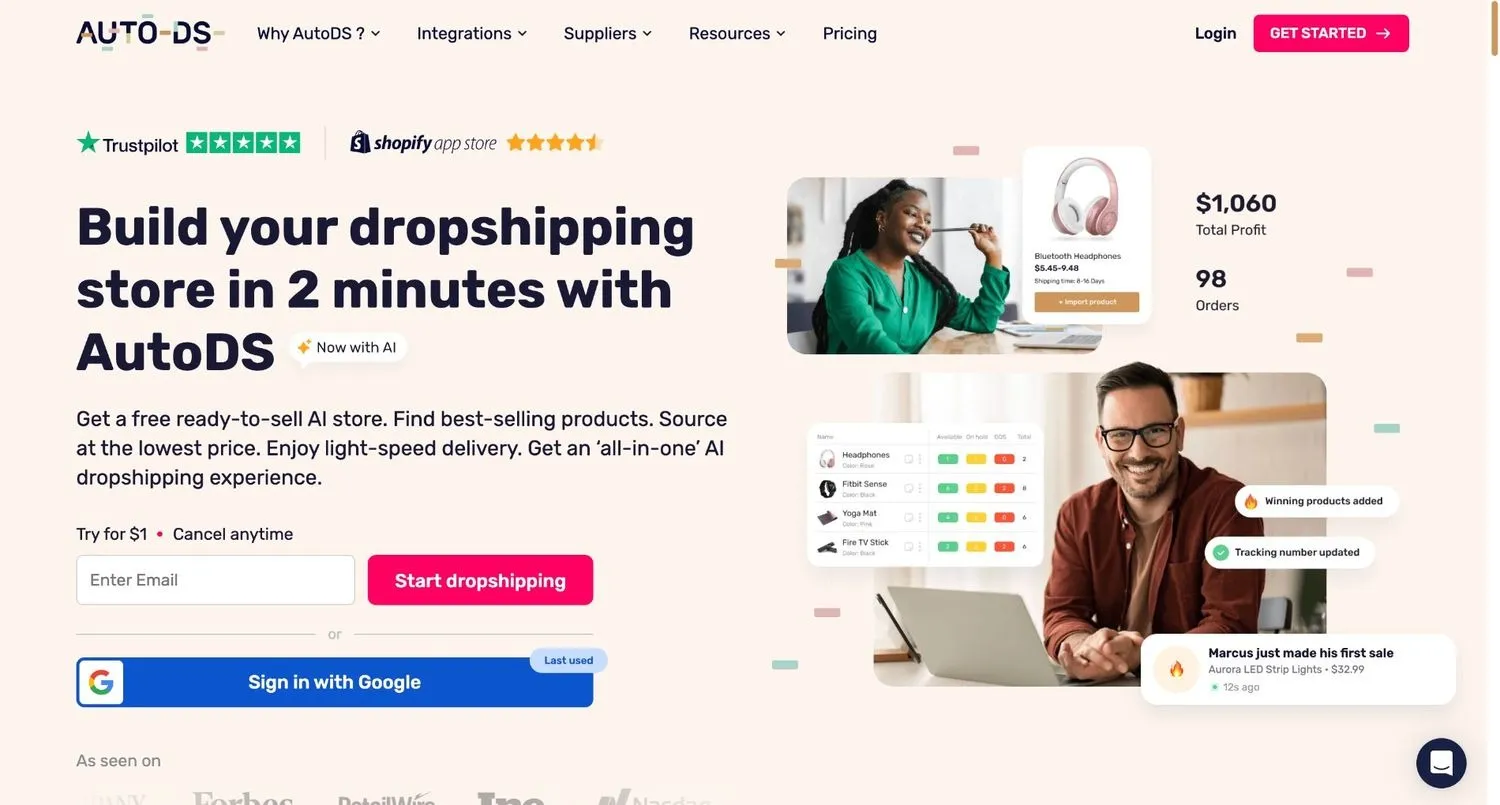
AutoDS is an automation-first dropshipping platform that targets mid-to-high volume sellers who need to manage product research, listing, pricing, and order fulfillment across multiple platforms.
Originally built around eBay automation, it has expanded to support Shopify, Amazon, Facebook Marketplace, Etsy, Wix, WooCommerce, and TikTok Shop. The platform emphasizes breadth: a large product marketplace, AI-assisted product descriptions, bulk listing tools, price and stock monitoring, and an automated order fulfillment system called "Fulfilled by AutoDS." It's positioned as an end-to-end dropshipping management suite rather than just a supplier directory.
Ideal For
- High-volume dropshippers managing multiple platforms and supplier sources
- Sellers on eBay, Amazon, or Facebook Marketplace who need multi-channel automation
- Store owners who want AI-assisted product research and listing optimization
- Dropshippers scaling fast who need bulk operations and automated repricing
Top Features
- AutoDS Marketplace: A built-in product discovery tool with trending products, hand-picked items, and connections to global suppliers including AliExpress, Amazon, Walmart, and more.
- Fulfilled by AutoDS: Automatic order fulfillment that routes and processes orders without manual intervention, including tracking number updates back to the buyer.
- Price & Stock Monitoring: Continuously monitors supplier prices and stock levels, adjusting your listings automatically to protect margins and avoid overselling.
- Multi-Platform Support: Works across Shopify, eBay, Amazon, Etsy, Facebook Marketplace, WooCommerce, Wix, and TikTok Shop – one of the broadest platform footprints in the category.
Why It's a Strong Spocket Alternative?
AutoDS earns its place for sellers who need serious automation across multiple channels. While Spocket is Shopify-first and supplier-focused, AutoDS covers more ground – more platforms, more automation depth, and more built-in product research tools.
For sellers who felt limited by Spocket's channel support or manual workflows, AutoDS offers significantly more operational leverage.
Pros
- Broadest multi-platform support of any tool on this list
- Strong automation depth: repricing, stock monitoring, and order fulfillment all included
- AI tools for product titles, descriptions, and research reduce manual content work
- Entry pricing is low, making it accessible for sellers scaling up
Cons
- Can be complex to configure; steeper learning curve than Spocket or Zendrop
- Costs can compound as you add more stores and features
- Supplier quality varies; relies heavily on AliExpress and Amazon as source platforms
- Not designed for curated brand partnerships or marketplace operator use cases
Pricing
AutoDS has a subscription model with plans starting around $12.90/month, scaling up by the number of stores and automation features needed. Higher tiers unlock more integrations and advanced controls.
Final Verdict
AutoDS is one of the stronger picks for high-volume, multi-platform dropshippers who need automation across their full operation. It's not the right fit for stores that want curated brand access or for marketplace operators – but for sellers running active stores on eBay, Shopify, and Amazon simultaneously, it's one of the most capable alternatives to Spocket on this list.
7. Syncee
Overview
Syncee is a global B2B marketplace and dropship sourcing platform that connects retailers with suppliers from North America, Europe, Australia, and Asia. It operates through two core tools: the ‘Syncee Marketplace’ (for browsing and importing products) and the ‘DataFeed Manager’ (for managing custom product feeds from any supplier).
A standout feature is its built-in supplier communication tool, which lets retailers message suppliers directly before importing products – something most sourcing platforms don't offer. Syncee integrates with Shopify, BigCommerce, Wix, Squarespace, EcwidByLightspeed, and others.
Ideal For
- Retailers who want geographic diversity in their supplier base
- Stores that want to evaluate suppliers through direct messaging before committing
- Multi-platform sellers on Shopify, BigCommerce, Wix, or Squarespace
- Retailers managing custom product feeds from existing suppliers
Top Features
- Global Supplier Marketplace: Access to suppliers across North America, Europe, Australia, and Asia, with location filters to find partners by region and shipping capability.
- Supplier Messaging: Built-in chat lets retailers contact suppliers directly before importing – useful for vetting quality and terms before committing.
- DataFeed Manager: Upload and manage custom supplier feeds via CSV, XML, or URL, which is useful for retailers with existing supplier relationships who want Syncee's automation layer.
- Broad Platform Integrations: Shopify, BigCommerce, Wix, Squarespace, EcwidByLightspeed, and more – covering more storefronts than most alternatives on this list.
Why It's a Strong Spocket Alternative?
Syncee is one of the stronger Spocket alternatives for retailers who want global supplier access and more transparency in the vetting process. The supplier messaging feature removes a gap that frustrates many sourcing platform users: you can't evaluate a supplier properly from a product listing alone.
For stores that want geographic diversity beyond the US and EU, Syncee's international network adds meaningful reach.
Pros
- Strong geographic coverage across multiple continents
- Supplier messaging for direct pre-import communication
- DataFeed Manager covers custom feeds, not just the built-in marketplace
- Wide platform support beyond just Shopify
Cons
- Interface can feel less polished than Spocket or Zendrop
- Premium US brand access is more limited than on Modalyst
- Scaling pricing by product count (rather than flat tiers) can be unpredictable at growth stage
- No order routing automation at the level of Carro or AutoDS
Pricing
Syncee offers a free plan for basic access. Paid plans scale by the number of products managed rather than a flat tier structure. This applies to both the Syncee Marketplace and DataFeed Manager products.
Final Verdict
Syncee is a solid middle-ground option – more geographically diverse than Spocket, with better supplier transparency through direct messaging. It works well for stores wanting global reach and the ability to manage custom feeds. It's not the right fit for teams that need deep marketplace infrastructure or highly curated brand partnerships.
8. Dripshipper
Overview
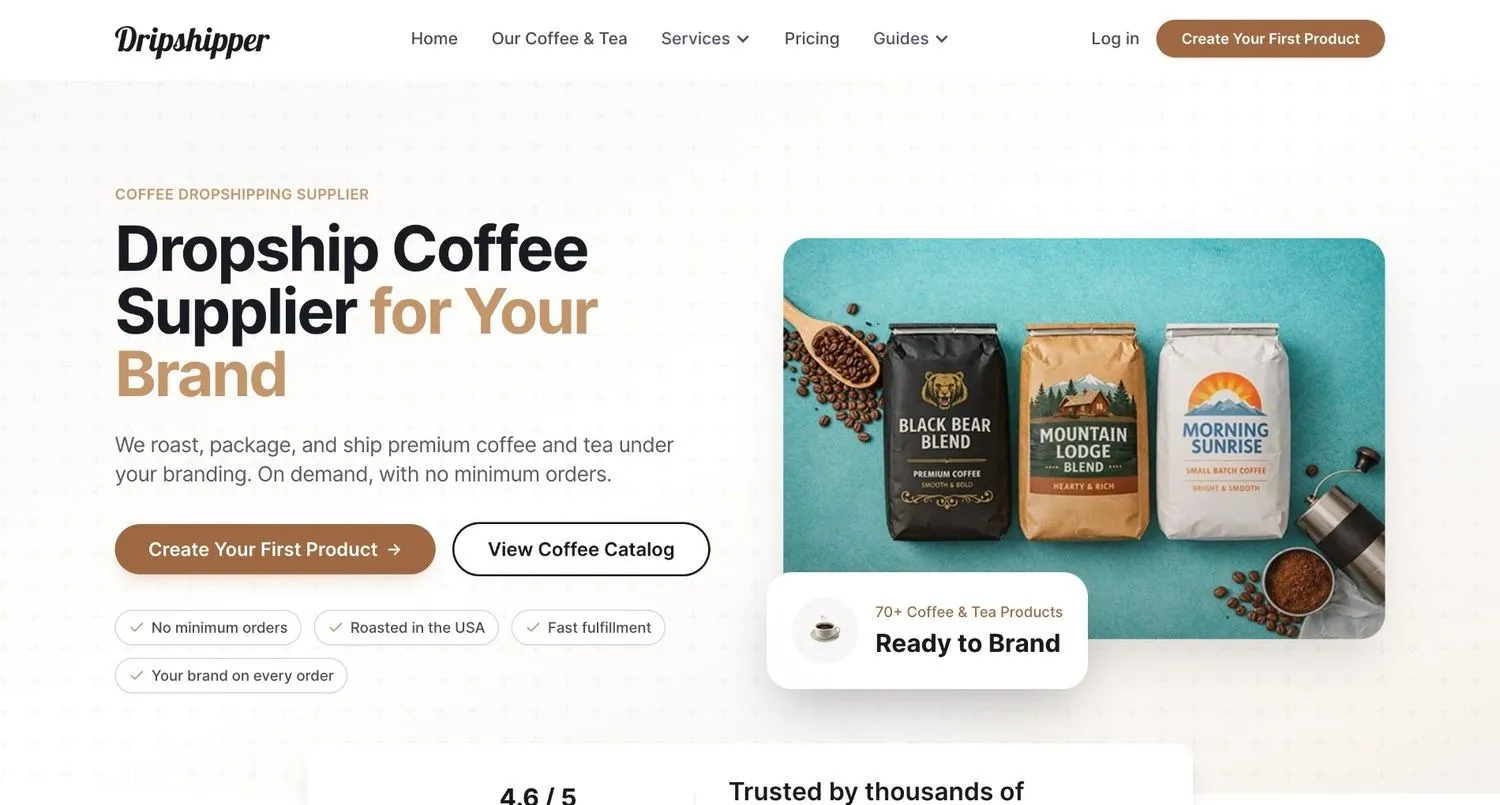
Dripshipper is a niche dropshipping platform with a clear and narrow focus: private-label coffee. It allows Shopify store owners to sell custom-branded coffee products under their own label, with Dripshipper handling roasting, packaging, and fulfillment from US-based roasters.
It’s not a general Spocket alternative, but involves one problem well and nothing else. But for store owners, or brands – looking to launch a private-label coffee line without sourcing or holding inventory, it solves a specific problem that no other tool on this list addresses. Dripshipper is the type of purpose-built niche supplier platform that sits alongside a broader dropship setup rather than replacing it.
Ideal For
- Lifestyle, wellness, or food brands that want to add private-label coffee to their catalog
- Shopify store owners building a niche around coffee or specialty beverages
- Entrepreneurs exploring white-label product businesses in the food space
- Stores already using a broader dropship platform who want to add a branded coffee SKU
Top Features
- Private Label Coffee Products: Sell coffee under your own brand, with custom labeling and packaging handled by Dripshipper's US roasters.
- US-Based Fulfillment: Products roast and ship from the United States, keeping shipping timelines short for domestic customers.
- Custom Branding Options: Design and apply your own labels, packaging styles, and product names to create a fully branded product experience.
- Shopify Integration: Direct integration with Shopify makes setup straightforward for store owners already on the platform.
Why It's a Strong Spocket Alternative?
Dripshipper isn't competing with Spocket on breadth – it's a niche tool for a specific product category. But for stores that were using Spocket to source coffee or specialty food products without success, Dripshipper offers a genuinely differentiated option: a private-label product that you can brand and sell as your own, with no inventory held.
Pros
- Unique private-label model gives stores a branded product differentiated from generic catalogs
- US roasting and fulfillment means fast domestic shipping
- Simple Shopify integration; low barrier to getting started
- 14-day free trial to test before committing
Cons
- Extremely narrow scope; sources coffee products only
- Not a general-purpose Spocket replacement for stores selling across multiple categories
- Monthly fee is charged separately from the product cost (wholesale price per order applies additionally)
- Limited to Shopify; not suitable for other platforms
Pricing
Dripshipper offers a 14-day free trial. Plans start at $30/month, with higher tiers adding more features and support. Product costs (wholesale price per order) are separate from the monthly plan fee.
Final Verdict
Dripshipper is recommended specifically for stores that want to sell private-label coffee without inventory. It's not a general Spocket alternative – it solves one problem well and nothing else. If coffee isn't in your roadmap, skip it. If it is, there's nothing else on this list that does what Dripshipper does.
9. DSers
Overview
DSers is the official AliExpress dropshipping solution, built specifically to manage high-volume AliExpress orders at scale. Originally a third-party tool, DSers became AliExpress's recommended partner platform after the deprecation of Oberlo (Shopify's original dropshipping app). It's designed for stores that source from AliExpress and need to manage bulk orders, supplier mapping, and fulfillment tracking in one place.
Where Spocket moves away from AliExpress toward US/EU suppliers, DSers moves fully into the AliExpress ecosystem. That's a deliberate trade-off: lower product costs, but longer shipping times, and more variability in supplier quality.
Ideal For
- AliExpress-based dropshippers who need to manage high-volume orders efficiently
- Shopify and WooCommerce store owners scaling their existing AliExpress operation
- Beginners who want a free starting point with broad product access
- Sellers who want to map multiple suppliers to a single product for backup fulfillment
Top Features
- Bulk Order Management: Place hundreds of AliExpress orders simultaneously with one click, removing the manual bottleneck that slows high-volume stores.
- Supplier Optimizer: DSers automatically identifies the most cost-effective supplier for each product across your catalog, improving margins without manual research.
- Multiple Suppliers per Product: Map backup suppliers to each SKU, so you can switch sources instantly if your primary supplier goes out of stock.
- Automatic Order Tracking: Tracking numbers sync back to your Shopify or WooCommerce store automatically once the order ships.
Why It's a Strong Spocket Alternative?
DSers earns its place as a strong alternative for AliExpress-based sellers who want to scale their operation without paying Spocket's pricing. The free plan covers most basic needs, and the bulk ordering system genuinely solves a pain point that Spocket doesn't address for high-volume, price-sensitive sellers.
If your operation depends on AliExpress pricing, DSers is the most capable tool for managing it.
Pros
- Free plan available with enough functionality for smaller operations
- Official AliExpress partner status means reliable integration and feature updates
- Bulk ordering is a major efficiency gain for high-volume stores
- Supplier mapping and backup supplier features reduce stock-out risk
Cons
- Entirely AliExpress dependent – if your strategy is moving away from AliExpress, DSers isn't the answer
- Longer shipping times than Spocket's US/EU supplier network
- Product quality more variable than curated alternatives
- Not designed for marketplace operators or stores wanting branded partner relationships
Pricing
DSers offers a free plan with core functionality. Paid plans start at approximately $19/month, with higher tiers adding more automation and order management features for higher-volume operations.
Final Verdict
DSers is the right pick if your business runs on AliExpress and you need to manage it efficiently. It's not a competitor to Spocket's core value proposition – it's the opposite end of the sourcing spectrum. For stores that want to scale an AliExpress-based operation without paying for features they don't need, DSers is one of the most pragmatic alternatives to Spocket on this list.
10. CJDropshipping
Overview
CJDropshipping is a Chinese-origin, end-to-end dropshipping service that combines product sourcing, warehousing, quality inspection, and fulfillment under one roof. It operates its own warehouses across China, the US, Europe, and Southeast Asia, and offers custom sourcing for products not already in its catalog.
CJDropshipping's model is more vertically integrated than most alternatives on this list: it sources products directly from manufacturers, holds inventory in its own warehouses, and ships to customers on your behalf. This gives it more control over quality and shipping times than a pure marketplace model, though still with more variability than a curated US/EU supplier directory like Spocket or Carro.
Ideal For
- Sellers who want flexible product sourcing beyond a fixed catalog
- Stores that need custom product sourcing or private-label manufacturing
- Mid-volume dropshippers who want global warehousing with no monthly platform fee
- Sellers exploring print-on-demand alongside standard dropship products
Top Features
- Custom Product Sourcing: Submit a sourcing request for any product not already in the CJ catalog, and their team will locate and quote it within 24–48 hours.
- Global Warehouse Network: Warehouses in China, the US, Germany, Indonesia, and Thailand give options for faster regional shipping depending on your target market.
- Print on Demand: Create custom-branded products including apparel, accessories, and homeware – a useful complement to standard dropshipping.
- No Monthly Fee for Basic Access: The base CJDropshipping platform is free to use, with CJ Prime unlocking additional perks as you scale.
Why It's a Strong Spocket Alternative?
CJDropshipping is one of the stronger Spocket alternatives for stores that need sourcing flexibility, the ability to find products that no standard marketplace carries, or to get custom quotes on private-label production.
The absence of a mandatory monthly fee also makes it accessible for stores at earlier stages of growth. For sellers who found Spocket too narrow in product selection, CJ's sourcing reach is a meaningful upgrade.
Pros
- No mandatory monthly platform fee for basic access
- Custom product sourcing covers items outside the standard catalog
- Global warehousing improves shipping times for non-US markets
- Print-on-demand adds a customizable product line without extra tooling
Cons
- Product quality more variable than curated platforms; requires supplier vetting
- Customer support can be slow to respond during high-volume periods
- Shipping times from China still lag US/EU warehouse competitors for domestic orders
- Interface can feel cluttered; steeper learning curve than Spocket or Zendrop
Pricing
CJDropshipping's base platform is free to use. The CJ Prime paid plan is designed to unlock extra sourcing, product access, coupons, and fulfillment support as you scale. Pricing for CJ Prime starts from approximately $15.99/month, functioning more as a growth add-on than a core platform fee.
Final Verdict
CJDropshipping is a credible pick for stores that want sourcing flexibility and don't want to pay a monthly base fee while they're still building volume. The custom sourcing feature is genuinely useful for stores with specific product needs.
It's less appropriate for retailers who want a curated, quality-controlled partner network, or for marketplace operators managing structured supplier relationships.
Why Carro Works Across Multiple Use Cases?
Established Retailers Expanding Their Catalog
When an established retailer wants to grow their product range, the default assumption is that more products means more inventory. We break that assumption. Retailers using Carro add complementary products through curated brand partnerships – no purchasing, no warehousing, no balance sheet risk.
Orders route automatically to the right supplier, and the customer experience stays consistent. The result is catalog growth that actually improves margins rather than diluting them.
Online Marketplace Operators
Marketplace operators face a different set of problems than solo store owners. They're managing dozens of supplier relationships simultaneously, dealing with inventory accuracy across a distributed network, and trying to keep customer experience consistent as GMV scales.
Traditional inventory management solution tools weren't built for that complexity. Our platform, on the other hand, handles supplier onboarding, catalog ingestion, order routing, fulfillment tracking, and automated payouts in one connected system – so marketplace teams can focus on growth, not firefighting.
Retailers Launching New Categories
Testing a new product category without buying inventory is one of the most useful things Carro enables. Retailers can add new products through brand partnerships, validate demand with real transactions, and make inventory decisions based on actual performance data – not forecasts.
This changes the risk profile of category expansion significantly.
Brands Seeking New Distribution
For brands that supply through retail channels, Carro offers a different kind of value: curated access to retailers whose audiences already match your target customer. You approve each retail partner, define your pricing and margin structure, and get paid automatically when products sell.
No long wholesale negotiations, no upfront inventory commitments from the retailer, no cash-flow delays.
Teams That Need Real-Time Operational Control
Spocket's automation is limited to basic order processing: supplier reconciliation, payout management, and multi-supplier operational controls; all require manual handling or separate tools.
We automate the full layer, including real-time inventory sync, order routing, and structured payout settlement – so your team isn’t spending time on tasks that don’t require human judgment. For teams with limited headcount managing growing catalog and order volume, that automation layer is what makes scale possible.
What Makes a Good Spocket Alternative?
1. Supplier Quality and Curation
A good Spocket alternative should give you access to suppliers that meet a quality bar – not just a large directory of unknown vendors. Look for platforms that vet their suppliers, whether through manual curation (like Carro's hand-matched model) or through established vetting criteria (like Modalyst's brand review process).
Volume without quality creates more problems than it solves.
2. Automation Depth
Product importing is table stakes. A genuine alternative should automate order routing, inventory sync, and fulfillment tracking without requiring manual intervention. If you're still forwarding orders by hand or updating product prices yourself, the platform isn't saving you the operational overhead that justified switching from Spocket in the first place.
3. Platform Integration Breadth
Your store exists somewhere: Shopify, WooCommerce, BigCommerce, Magento, or a multi-channel setup that includes Amazon or eBay. A good alternative should fit into your existing commerce stack without forcing a rebuild. Check integration support before committing.
4. Pricing Transparency and Scalability
Spocket's pricing model frustrates many users because costs increase quickly as you add products and orders. Look for alternatives where the pricing model scales proportionally with the value you receive – whether that's a percentage of sales (like Carro's revenue-share model), a flat tier with clear caps, or a free base with paid add-ons.
Avoid platforms where fees compound in ways that aren't obvious upfront.
5. Support for Your Stage of Growth
A beginner running their first Shopify store has different needs than a marketplace operator managing 200 suppliers.
The best alternative is one that fits your current stage and has a credible path as you scale. Single-store tools like Zendrop and DSers work well early. Platforms like Carro are designed for operations that have moved past the beginner phase and need something built for scale.
How to Choose the Right Spocket Alternative for Your Needs?
1. Define Your Supplier Geography Requirement
If fast US shipping is non-negotiable, prioritize platforms with US-stocked inventory: Carro (curated brand partners), Modalyst, Zendrop (US warehouse), or Dripshipper (US roasters for coffee). If you're comfortable with China-based fulfillment for lower product costs, DSers and CJDropshipping open up more options.
2. Assess Your Operational Scale
How many orders are you processing per month? How many supplier relationships do you manage? Single-store sellers with light volume can get by with free or low-cost tools like Zendrop or DSers. Once you're managing meaningful volume across multiple suppliers, you need automation infrastructure, which is where Inventory Source, AutoDS, or Carro become worth the investment.
3. Match the Tool to Your Commerce Platform
Don't assume every tool supports every platform equally. Zendrop and DSers are Shopify-first. Inventory Source and AutoDS offer broader multi-platform support. Carro supports Shopify, WooCommerce, BigCommerce, and Magento, plus EDI and SFTP for more complex operations. Verify before you commit.
4. Calculate Total Cost of Ownership
Compare the full cost: monthly fees, transaction fees, per-product costs, and any incremental charges that apply as you scale. Spocket's $24–$299/month range is often cited as a reason to switch. Carro's 5% revenue share may look higher on paper, but the absence of upfront cost and the automation layer it replaces often make the math work in favor of the revenue-share model at meaningful sales volumes.
5. Evaluate Supplier Relationship Depth
There's a meaningful difference between accessing a supplier directory and building actual brand partnerships. If brand alignment and supplier quality matter to your store's positioning, choose a platform that facilitates direct relationships, not just anonymous catalog access. Carro's hand-matched model and Modalyst's brand marketplace sit at one end of this spectrum; AliExpress-based tools sit at the other.
Everything You Need to Know About Spocket Alternatives
| Category | Key Considerations |
|---|---|
| Top 3 Alternatives | Carro (best overall for retailers and marketplace operators); Modalyst (best for fashion/premium brands); AutoDS (best for multi-platform automation) |
| Best Overall Option | Carro — end-to-end supplier orchestration, curated brand partnerships, automated order routing, and no upfront cost |
| Why Look for Spocket Alternatives? | High pricing at scale, limited category diversity, no marketplace infrastructure, constrained supplier relationships |
| How to Choose? | Define your geography requirement, operational scale, platform, total cost, and desired supplier relationship depth |
| Price Range | Free (DSers, CJDropshipping, Zendrop basic) to $499/month (Modalyst Power Seller); Carro on 5% of sales revenue share |
| Ease of Switching | Most platforms offer product importers and Shopify/WooCommerce integrations; switching is generally low-friction for stores with under 1,000 SKUs |
| Must-Have Features | Automated order routing, real-time inventory sync, platform integration, reliable supplier quality, transparent pricing |
| Mistakes You Shouldn't Make | Choosing based on price alone without evaluating automation depth; not verifying platform compatibility; overestimating how far a free plan will take you |
Ready to Move On from Spocket? Try Carro
Carro is built for one specific kind of growth: expanding your product catalog and increasing revenue without taking on inventory risk or adding operational overhead. We handle the full supplier relationship, from curated discovery and onboarding to automated order routing, real-time sync, and structured payouts, so your team can focus on what actually drives the business.
Retailers using Carro see up to 3.5x revenue growth, up to 180% AOV improvement, and up to 3x catalog expansion. That's not from adding more SKUs to a spreadsheet - it's from building curated brand partnerships through a platform designed to run the operational layer automatically.
If you're a retailer, online marketplace, or brand looking to grow through trusted partner relationships without the complexity that typically comes with multi-supplier operations, this is where to start.
Frequently asked questions
What is Spocket used for?
Spocket is used for dropshipping, specifically for connecting online stores (primarily Shopify and WooCommerce) with US and European suppliers to source and sell products without holding inventory. It's designed for individual store owners who want access to faster-shipping suppliers compared to AliExpress, particularly in fashion, beauty, and home goods categories. Spocket's free plan offers limited access, and paid plans start at $24/month.
What are the best Spocket alternatives in 2026?
The best Spocket alternatives in 2026 are Carro (best overall for retailers and marketplace operators looking for catalog growth), Modalyst (best for fashion and premium brands), AutoDS (best for multi-platform automation), Zendrop (best for Shopify beginners), and DSers (best for AliExpress-based stores). Each serves a different operational profile, so the right choice depends on your scale, platform, and supplier requirements.
How to choose the best Spocket alternative for your needs?
To choose the best Spocket alternative, start by defining four things: your geography requirement (US, EU, global), your operational scale (single store vs. multi-supplier marketplace), your commerce platform (Shopify, WooCommerce, BigCommerce, etc.), and your total cost tolerance including monthly fees and per-transaction costs. Match those criteria against the tools in this comparison, and prioritize platforms that offer automation at the depth your current volume requires.
Is it easy to switch from Spocket to an alternative?
Switching from Spocket to an alternative is generally straightforward for stores with under 500 active SKUs. Most platforms on this list offer product importers and native Shopify or WooCommerce integrations that allow you to migrate product listings without rebuilding from scratch. The primary consideration is re-mapping your products to the new supplier network, which can take anywhere from a few hours to a few days depending on catalog size.
Does Carro work for brands, not just retailers?
Yes. Carro connects brands with vetted retail partners who already reach the audience they want. Brands can access curated retailer opportunities, approve each partner individually, define their pricing and margin structure, and receive automated payouts when products sell. This makes Carro useful on both sides of the supplier-retailer relationship, not just for retailers expanding their catalog, but for brands that want to grow distribution without traditional wholesale friction.