Best Canto Alternatives in 2026 (Feature & Pricing Comparison)
Looking for the best Canto alternatives? Compare the top tools to understand why Carro is the right choice for your store’s catalog growth & management.

Key Takeaways (TL;DR)
- Who Canto Is For: Mid-market marketing and product teams that need to centralize product data and link it to digital assets, primarily in North American markets.
- Why Seek a Canto Alternative: Canto is a newer add-on, not a standalone PIM. It lacks deep syndication, supplier management, and channel distribution capabilities that growing commerce teams require.
- Best Overall Alternative: Carro is the best overall alternative for retailers and marketplace operators who've realized their real problem isn't organizing product data – it's growing their catalog. While PIM tools like Canto help teams manage what they already have, Carro enables inventory-free assortment expansion, automated supplier orchestration, and real-time product sync across commerce platforms, the operational layer no PIM on this list provides.
- What Sets Carro Apart: Carro is the only solution on this list that connects retailers to a live supplier network and automates the full order lifecycle; letting retailers expand assortment and route orders without ever holding inventory
- How to Choose: Consider your team's primary need (data enrichment vs. channel distribution vs. catalog expansion), your existing commerce stack (Shopify, BigCommerce, etc.), and how many supplier relationships you need to manage at scale.
Top Canto Alternatives in 2026 at a Glance
| Tool | Best For | Key Features | Pros | Cons | Pricing Starts |
|---|---|---|---|---|---|
| Carro | Inventory-free catalog expansion & marketplace operations | Supplier network, automated order routing, real-time sync (Shopify, BigCommerce, WooCommerce, Magento) | No inventory risk, end-to-end automation, multi-platform integrations | Not a traditional PIM data enrichment tool | 5% of sales (Standard); custom (Growth) |
| Akeneo PIM | Enterprise product data management | Multi-channel enrichment, validation workflows, open-source option | Highly flexible, strong integrations | Steep learning curve, high cost | Free (Community); $45,000/yr (Growth) |
| Salsify PXM | Digital shelf management for large retailers | Channel syndication, digital shelf analytics, workflow automation | Best-in-class syndication | Expensive, complex onboarding | Custom pricing |
| Plytix | SMBs needing an affordable, easy PIM | Unlimited users, media management, product feeds | Quick setup, affordable | Limited for large enterprises | Free (up to 1,000 SKUs); ~€499/mo (Pro) |
| Sales Layer | Multichannel publishing without IT support | Bulk editing, data validation, channel connectors | User-friendly, fast to deploy | Third-party implementation often needed | Custom pricing (Scale, Premium, Enterprise) |
| Pimcore | Open-source flexibility & custom development | Open-source PIM + DAM, API-first, highly extensible | Free to start, fully customizable | Requires technical expertise | Free (Community); $9,900/yr (Professional) |
| Inriver PIM | Complex product catalogs at enterprise scale | Data modeling, governance, omnichannel publishing | Strong data governance | High cost, long implementation | Custom pricing (4 tiers) |
| Syndigo | Retailer-brand content syndication | Content validation, retail network syndication | Strong retail network | Limited outside North American retail | $165–$255/item (per-item model) |
| Bluestone PIM | API-first flexibility for technical teams | 700+ API endpoints, headless architecture, cloud-native | Exceptional connectivity | Requires developer resources | Custom pricing |
| Apimio | Shopify merchants and SMBs | Shopify-native PIM, real-time two-way sync, completeness scoring | Fast setup (30 min), affordable | Limited for non-Shopify stacks | $199/month (Basic) |
Why Consider Canto Alternatives?
What Canto Does Well
Canto built its reputation as a digital asset management (DAM) platform, and its PIM capabilities, added more recently – benefit from that foundation. Canto PIM centralizes product data and links it directly to related digital assets, which is genuinely useful for teams managing brand content and product catalogs in one place.
Teams can share curated catalogs internally and externally, maintain consistent product records across departments, and reduce errors from disconnected systems.For North American marketing teams that already use Canto for DAM and want a lightweight product data layer without switching platforms, the PIM add-on covers the basics: product records, collaborative editing, and catalog management.
Canto also integrates with tools like Adobe Creative Cloud, Shopify, Canva, and Dropbox, which gives content teams a familiar workflow.
Where Canto Falls Short?
The core limitation is scope. Canto’s PIM feature is an add-on, not a purpose-built software. Teams with serious product information management needs quickly run into its ceiling.
Here are some key areas where Canto currently falls short:
- Geographic restriction: Canto PIM is currently available only to North American users. That immediately rules it out for any team with international operations or a global distribution strategy.
- No channel syndication: Dedicated PIM platforms like Salsify and Akeneo are built to push product data to dozens of retail channels, marketplaces, and commerce platforms simultaneously. Canto lacks the syndication depth needed for multi-channel retail at scale.
- Thin supplier and distribution tooling: Canto has no mechanism for managing supplier relationships, onboarding brand partners, or automating order routing. Teams trying to expand their assortment or run marketplace operations need an entirely different category of tooling, and that's exactly the gap Carro is built to fill.
- Pricing opacity: Canto's pricing is custom and contact-based. Organizations exploring PIM options often find that the total cost, especially with PIM as an add-on to an existing DAM contract – is higher than purpose-built alternatives.
- Not built for commerce operators: Retailers running dropship programs or managing distributed supplier networks need real-time inventory sync, automated fulfillment workflows, and performance controls. None of those exist inside Canto.
Best Canto Alternatives in 2026: In-Depth Review & Comparison
1. Carro
Overview
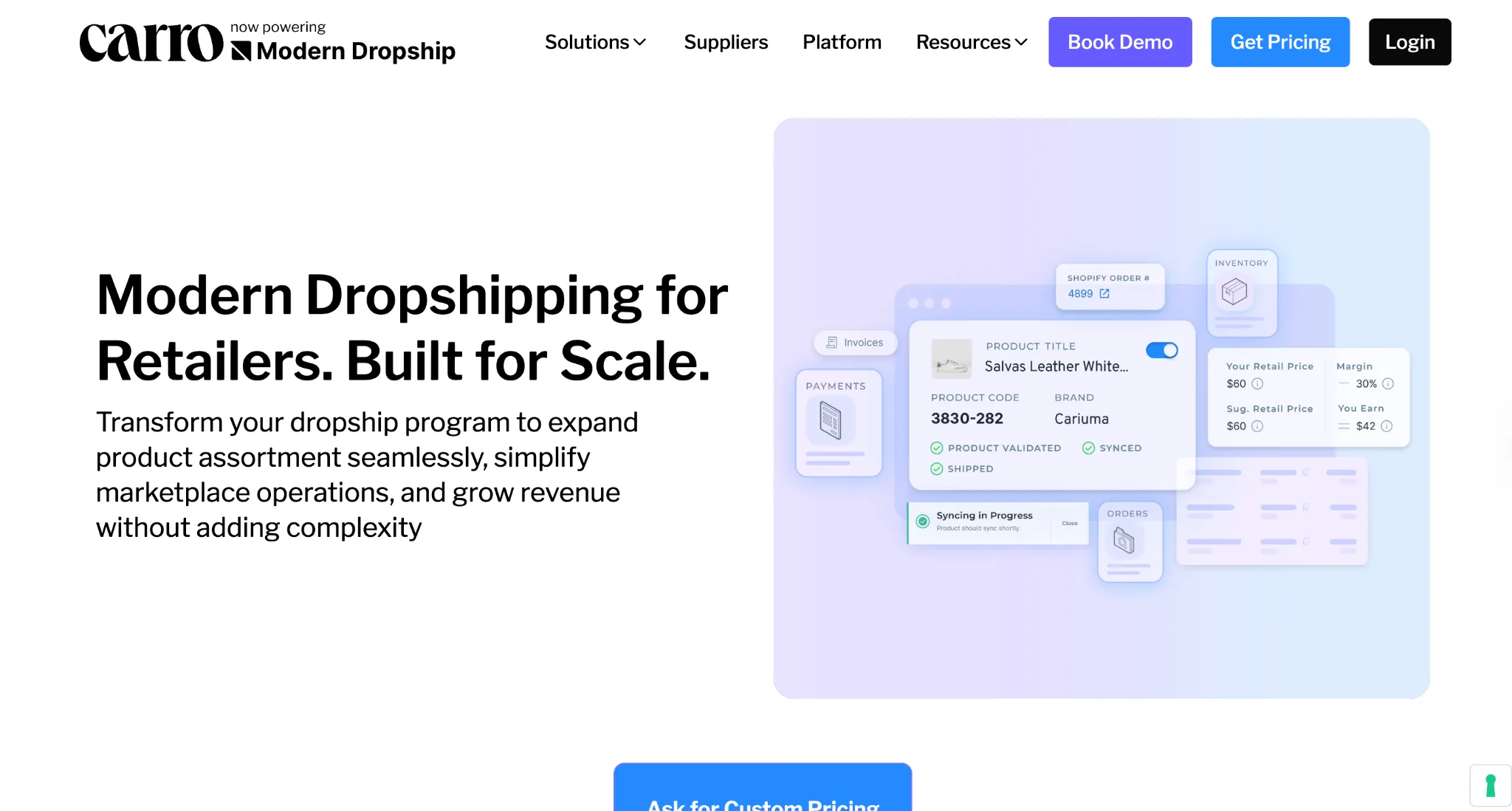
Carro (now powering ‘Modern Dropship’) is a dropship automation platform built for retailers and marketplace operators who need to grow their product catalog without holding inventory.
We connect retailers to a network of vetted brand partners, automate order routing and fulfillment, and sync product data in real time – all through a single platform that integrates with Shopify, WooCommerce, BigCommerce, and Magento.
Our platform addresses a problem that catalog and data management tools, including Canto's PIM add-on, were never designed to solve: “how do you expand your assortment, manage supplier relationships, and fulfill orders at scale without adding headcount, building custom integrations, or taking on inventory risk?" Carro powers what we call distributed retail: a commerce model where inventory lives with brand partners, orders are routed automatically, and the customer experiences a seamless checkout.
Retailers who move from catalog-management-only tools to Carro's growth infrastructure usually see the results that PIM tools alone can't drive: up to 3.5x revenue growth, 180% AOV growth, and up to 3x catalog expansion. We work with retailers across categories including home, lifestyle, fashion, and specialty goods, and serve both established brands looking for new distribution and retailers building out assortment programs.
Our account managers hand-match retailers with brand partners whose products fit their audience and positioning – something no automated PIM tool provides.
Ideal For
- Retailers on Shopify, BigCommerce, Magento or WooCommerce looking to expand their catalog without purchasing inventory
- Marketplace operators managing multi-supplier networks who need automated order routing and settlement
- DTC brands seeking new sales channels through trusted retailer partnerships
- E-commerce teams that need real-time product data sync across platforms without manual catalog maintenance
- Operators launching new marketplaces who want composable infrastructure without building custom technology
Top Features
- Hand-matched supplier network: Account managers connect retailers with complementary brands based on category, audience, and price point – giving catalog expansion a curated, strategic quality that spreadsheet-driven PIM tools can't match.
- Automated order routing: When a partner product sells, the order routes directly to the supplier for fulfillment with no manual steps, eliminating the operational overhead that makes multi-supplier retail complicated.
- Real-time sync across integrations: Product data, pricing, and inventory from brand partners updates automatically across Shopify, WooCommerce, BigCommerce, and Magento – plus EDI and SFTP for more complex stacks.
- Seamless catalog expansion: Retailers can add hundreds of products from partner brands without warehousing, forecasting, or balance sheet exposure – enabling faster category tests and assortment growth.
- End-to-end supplier orchestration: From partner onboarding and catalog ingestion to order tracking, payout automation, and performance reporting – all in one place.
Why We're the Best Canto Alternative?
Canto PIM helps teams manage the product information they already have. We help retailers get more products to sell – and handle everything that comes after. For retailers and marketplace operators, the biggest bottleneck isn't organizing product data; it's sourcing and managing the supplier relationships that fuel catalog growth. Canto doesn't address that at all.
Carro handles the full lifecycle: finding brand partners, onboarding them, syncing their product data in real time, routing orders automatically, and managing payouts – without requiring retailers to hold a single unit of inventory.
Our integrations are native and deep: Shopify, BigCommerce, WooCommerce, Magento, plus EDI and SFTP for partners with legacy systems. And where Canto's PIM is limited to North America, Carro supports US and international brand partnerships, giving retailers access to a broader distribution network. For teams whose goal is growing revenue through expanded assortment, not just organizing the data they already have – Carro is a fundamentally stronger fit.
Pros
- Inventory-free catalog expansion removes balance sheet risk entirely
- Automated order routing and payouts reduce operational overhead dramatically
- Hand-curated brand matching ensures partner products align with retailer audience and positioning
- Native integrations with Shopify, BigCommerce, WooCommerce, and Magento; plus EDI and SFTP
- Real-time sync means product data is always accurate without manual maintenance
Cons
- Not a traditional PIM for teams whose primary need is data enrichment and validation workflows
- Best suited for retailers and marketplace operators, not manufacturers or pure B2B catalog managers
Pricing
Carro offers two plans. The Standard plan costs 5% of sales and includes end-to-end dropship automation with integrations for Shopify, Magento, BigCommerce, and WooCommerce.
The Growth plan, with custom pricing, adds autonomous merchandising, a hand-matched supplier network, and priority support on top of all Standard plan features. Both plans provide unlimited transactions, full platform access, automated payments, and access to 1.5M+ products from top brands.
Final Verdict
Carro is the right choice for retailers and marketplace operators who need to grow their catalog, manage supplier relationships, and automate fulfillment without holding inventory.
If your challenge is finding and managing brand partners – not enriching metadata, Carro solves a bigger, more commercially valuable problem than Canto PIM does. For teams building assortment programs, launching marketplaces, or scaling dropship operations, no other tool on this list covers that ground as completely.
2. Akeneo
Overview
Akeneo is one of the most established names in product information management. Founded in 2013 and headquartered in Nantes, France, Akeneo has grown into a global PIM leader serving mid-market to enterprise retailers and brands. The platform centralizes product data, supports multi-channel enrichment, and connects to virtually every major commerce stack through its extensive integration ecosystem.
Akeneo's core value proposition is helping teams eliminate product data silos, maintain consistency across channels, and accelerate time to market for product launches. Its open-source Community Edition makes it accessible to organizations with technical resources, while the Growth and Enterprise tiers offer managed SaaS with more support and advanced features.
Akeneo counts major retailers and global brands among its customer base and is consistently rated a leader in the Gartner PIM market. It's particularly strong in complex catalog environments: large SKU counts, multi-locale requirements, and intricate product hierarchies.
Ideal For
- Mid-market to enterprise retailers with large, complex product catalogs spanning multiple categories
- Brands managing omnichannel presence across e-commerce, wholesale, and physical retail
- Organizations with in-house technical teams that can handle open-source implementation and maintenance
- Global businesses needing robust multi-locale and multi-currency support
- Teams with complex data models – variant hierarchies, reference entities, and custom attribute sets
Top Features
- Multi-channel catalog enrichment: Manage product attributes, variants, and localized content for different channels – website, marketplace, print, wholesale; from one data model, reducing duplication and inconsistency.
- Validation workflows and data quality rules: Define completeness thresholds and validation criteria per channel, flagging gaps before products go live and preventing poor data from reaching customers.
- Open-source Community Edition: Akeneo's free tier gives technical teams full access to the core PIM without licensing fees, making it a low-cost entry point for organizations with developer resources.
- App store and integrations: Native connectors to Salesforce, Magento, BigCommerce, Shopify, and hundreds of other platforms – plus a developer ecosystem with system integrators worldwide.
- Advanced rights management: Granular role-based permissions allow different teams (product, marketing, local markets) to work on the same catalog without conflicting edits.
Why It's a Strong Canto Alternative?
Akeneo is one of the strongest Canto alternatives for organizations that need a purpose-built, standalone PIM – not a DAM add-on. Where Canto's PIM is limited to North America and bundled into a DAM contract, Akeneo serves global teams with complex data needs.
Its open-source flexibility and deep integration ecosystem make it one of the most adaptable PIM platforms available.
Pros
- Purpose-built PIM with deep feature coverage for complex catalogs
- Strong global support with multi-locale and multi-currency capabilities
- Flexible open-source option reduces initial software costs
- Large ecosystem of system integrators and app connectors
- Solid data quality and validation tooling
Cons
- Implementation can take 4+ months, particularly for complex enterprise setups
- Growth Edition starts at $45,000/year – significantly more than lighter alternatives
- Not designed for dropship or marketplace supplier management
- Steeper learning curve for non-technical users
Pricing
The free Community Edition is available at no license cost for non-production use, academic settings, non-profits, and businesses with under $5M in revenue. The Growth package starts at $45,000/year. Advanced and Enterprise tiers use custom pricing – contact the Akeneo sales team for a quote.
Final Verdict
Akeneo is a good Canto alternative for organizations with large, complex product catalogs and in-house or dedicated technical teams. It's among the most capable PIM platforms available.
However, it's not a fit for SMBs needing a quick setup, teams without technical resources, or retailers whose primary need is catalog expansion through supplier partnerships rather than data enrichment.
3. Salsify
Overview
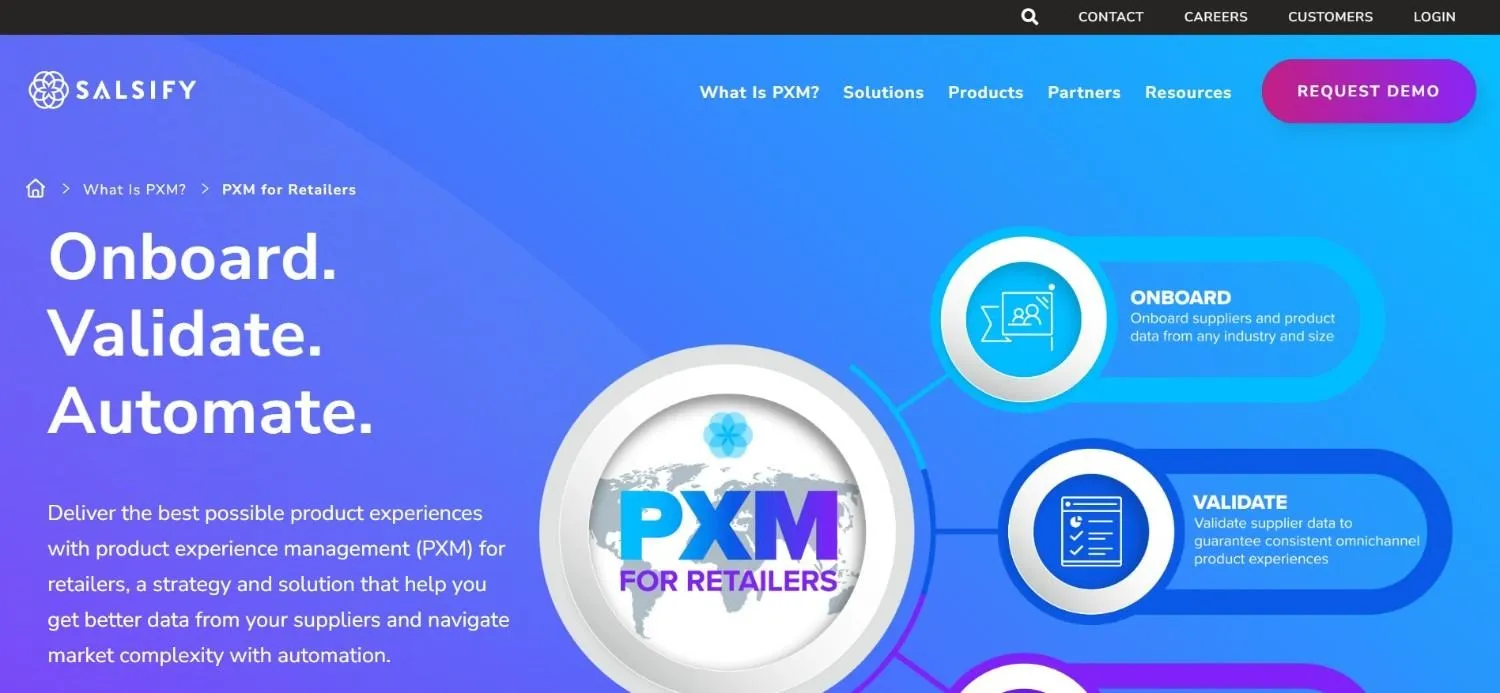
Salsify positions itself as a Product Experience Management (PXM) platform, which extends beyond traditional PIM into digital shelf management, content syndication, and channel analytics.
It serves large brands and retailers that sell through demanding, high-volume retail channels: Amazon, Home Depot, Walmart, and similar – where each retailer has unique data format requirements.
Founded in 2012, Salsify has grown into an enterprise-grade platform used by Fortune 500 companies managing thousands of SKUs across dozens of channels simultaneously. Its core differentiation is syndication depth: the ability to push tailored product content to each retail channel in the exact format that channel requires.
Ideal For
- Large consumer brands selling through major retailers and online marketplaces with unique data requirements
- Enterprise teams with complex workflow and approval processes across global markets
- Organizations prioritizing digital shelf analytics to track content performance across channels
- Retailers and brands managing hundreds of channels simultaneously
- Teams with existing enterprise budgets that can absorb Salsify's pricing model
Top Features
- Channel syndication at scale: Salsify connects to a wide network of retailers and marketplaces, translating product data into the exact format each channel requires – reducing manual formatting and improving content accuracy.
- Digital shelf analytics: Track content performance, review counts, and data completeness across retailer channels to identify gaps and optimize product pages.
- Workflow automation: Configurable approval workflows and task management allow large teams and multiple stakeholders to collaborate on product content without bottlenecks.
- Content repository with asset management: Centralize product copy, images, and rich media alongside product records, supporting end-to-end content lifecycle management.
- Readiness scores: Automated scoring shows which products are ready for specific channels and which have data gaps, prioritizing enrichment work.
Why It's a Strong Canto Alternative?
Salsify is one of the strongest Canto alternative options for enterprise brands whose primary need is getting product content to retail channels accurately and efficiently.
While Canto's PIM add-on lacks syndication entirely, Salsify is arguably the most capable channel syndication platform available. Teams moving away from Canto because of limited channel distribution will find Salsify a significant step up.
Pros
- Best-in-class syndication for complex retail channels and marketplaces
- Strong digital shelf analytics give visibility into content performance
- Robust workflow and approval tools for large, distributed teams
- Extensive retailer and marketplace network
Cons
- Pricing is not publicly disclosed and tends to run high – expect custom enterprise quotes
- Implementation is typically 4-8+ months for large deployments
- Complexity can be excessive for SMBs or teams with simpler needs
- Not suited for teams needing supplier management or dropship operations
Pricing
Salsify does not publish standard pricing. Plans are customized based on catalog size, number of channels, SKU count, and enterprise feature requirements. Expect enterprise-level investment; contact their sales team directly for a custom quote.
Final Verdict
Salsify is a strong choice for large enterprise brands managing complex retail channel requirements. For most small to mid-market teams, the cost and implementation complexity make it difficult to justify.
4. Plytix
Overview
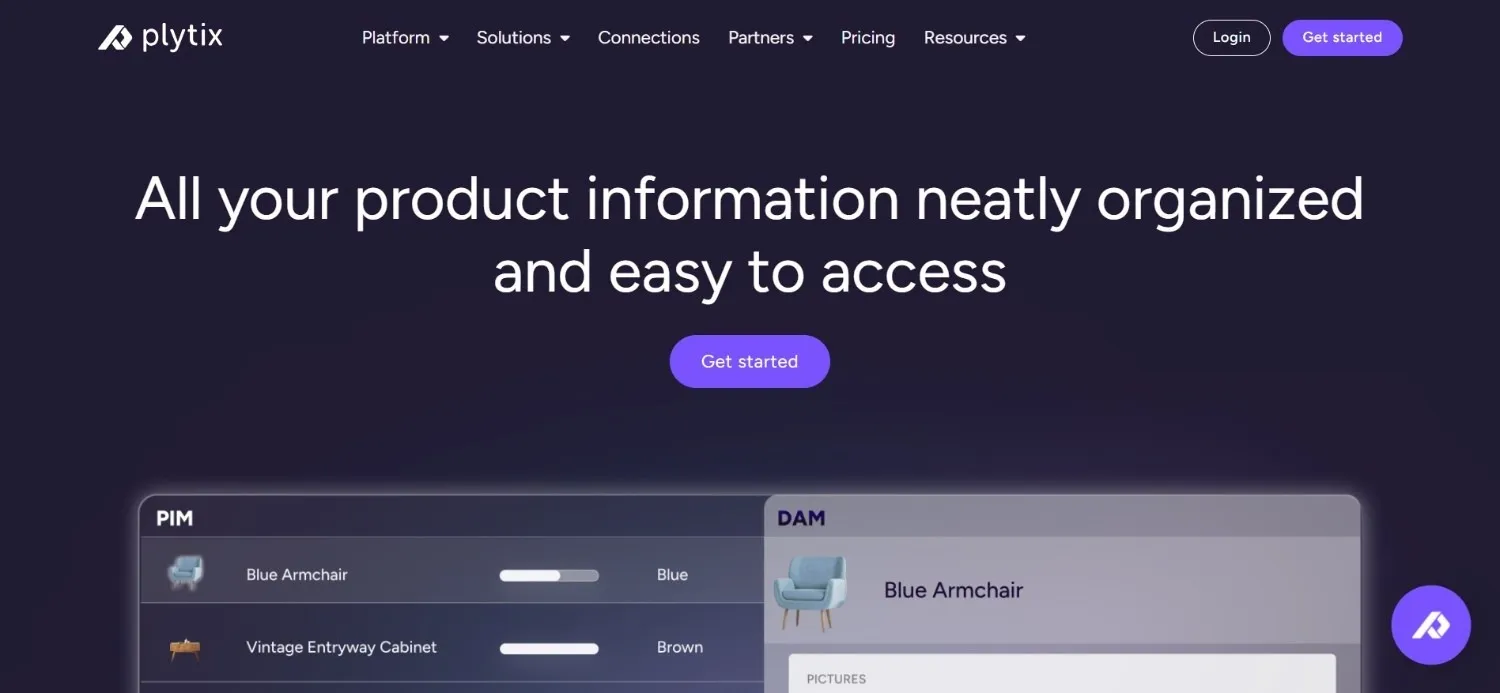
Plytix is a cloud-based PIM built specifically for small to mid-sized businesses. It occupies a deliberate positioning in the market: powerful enough to handle serious product information management, priced and designed for teams that aren't Fortune 500 enterprises.
The platform includes unlimited users on all plans – a meaningful differentiator versus platforms that charge per seat. Plytix focuses on speed to value. Implementation is done in weeks, not months, and the team imports your product data for you, reducing the friction of switching from spreadsheets or another PIM.
G2 rates Plytix's customer satisfaction at 99%, which reflects the platform's emphasis on usability and support.
Ideal For
- SMBs and growing brands managing product catalogs across multiple channels without a dedicated IT team
- E-commerce and DTC brands that need a clean, user-friendly PIM without technical complexity
- Teams switching from spreadsheets or lightweight tools who need fast onboarding
- Businesses that collaborate across large teams and want to avoid per-user pricing
- Retailers managing product content for websites, marketplaces, and print catalogs simultaneously
Top Features
- Unlimited users on all plans: Every team member: marketing, product, sales – can work in the PIM without the cost scaling with headcount, enabling broader collaboration.
- Done-for-you data import: Plytix's team handles the initial data migration, reducing the time and effort required to get up and running from a spreadsheet or another system.
- Media and digital asset management: Products and their associated images, videos, and files are managed together, reducing the need for a separate DAM for teams with moderate asset volumes.
- Channel feeds and product sheets: Generate tailored product data exports and formatted product sheets for specific channels, distributors, or retailers without manual reformatting.
- Data completeness scoring: Visual completeness indicators flag which products are missing required attributes, helping teams prioritize enrichment work before publishing.
Why It's a Strong Canto Alternative?
Plytix is one of the more practical Canto alternatives for smaller teams that found Canto's PIM add-on either too expensive or limited.
It's a standalone PIM with transparent pricing, fast implementation, and a satisfaction rate that consistently outperforms larger platforms. For teams whose primary need is a clean, affordable product data hub, Plytix delivers solid value.
Pros
- Transparent, affordable pricing with unlimited users
- Fast implementation – weeks, not months; with data migration handled by the Plytix team
- Consistently high customer satisfaction and support ratings
- Combines PIM and DAM in one platform for teams with moderate asset volumes
Cons
- Limited for large enterprises with highly complex data models or massive SKU counts
- Channel syndication depth doesn't match enterprise platforms like Salsify
- May require additional connectors for some commerce stacks
- Not designed for supplier management or dropship operations
Pricing
Plytix uses usage-based pricing built around SKU count, AI credits, and optional add-ons. The Standard plan is free for up to 1,000 SKUs (no outputs included).
The Pro plan starts at approximately €499/month (~$549/month) and includes up to 50,000 SKUs, unlimited users, and advanced team management. The Enterprise plan is custom-priced for unlimited SKUs, custom API calls, and multi-account management. All plans are billed monthly with no long-term commitment required.
Final Verdict
Plytix is recommended for SMBs and mid-market brands that need an affordable, user-friendly PIM without the complexity of enterprise platforms.
Plytix is a genuine step up from spreadsheets or a lightweight tool, and its done-for-you onboarding removes a major barrier to adoption. It's not the right fit for enterprise teams with complex data requirements or teams needing supplier and order management.
5. Sales Layer

Overview
Sales Layer is a PIM designed for marketing and e-commerce teams that need to manage product content across multiple channels without relying on IT or developers. It's a SaaS platform with a strong emphasis on usability, built-in channel connectors, and automated data publishing.
The platform supports bulk editing, data validation, localization, and digital asset management – covering most of what a mid-market product team needs in a single interface.Sales Layer positions itself as a fast-to-deploy solution. Teams can connect their catalog to supported channels, enrich product data with custom attributes, and publish updates without writing code or waiting for technical resources.
Ideal For
- Marketing and e-commerce teams that need to manage product content without technical support
- Mid-market retailers and brands selling across multiple channels – e-commerce, wholesale, and marketplace
- Teams looking to reduce time-to-market for product launches and catalog updates
- Organizations with multichannel distribution that need tailored content per channel
Top Features
- No-code channel publishing: Connect product data to supported channels and marketplaces without developer support, reducing time-to-market for catalog updates.
- Bulk editing and data validation: Edit thousands of product attributes simultaneously and apply validation rules that catch errors before data goes live.
- Localization support: Manage product content in multiple languages and regional formats from a single platform, supporting international distribution.
- Digital asset management: Store and associate product images and media files alongside product records, keeping content organized.
- Data quality scoring: Track completeness across attributes and channels, giving teams a clear view of where enrichment effort is needed.
Why It's a Strong Canto Alternative?
Sales Layer covers a similar target audience as Canto PIM: marketing teams managing product content – but as a standalone, purpose-built platform rather than an add-on. For North American teams that outgrew Canto's PIM or international teams for whom Canto PIM isn't available, Sales Layer offers a more capable and independently deployable option.
Pros
- User-friendly interface accessible without technical expertise
- Fast deployment with no custom development required
- Strong multichannel publishing with built-in channel connectors
- 30-day free trial for evaluation
Cons
- Complex implementations often require third-party support, adding cost and timeline
- Less suited for very large enterprise catalogs or highly complex data hierarchies
- Pricing is custom and not publicly listed – harder to evaluate against alternatives
- Not designed for supplier management or inventory-free catalog expansion
Pricing
Sales Layer uses a flexible, quote-based model with four tiers: Scale, Premium, Enterprise, and Enterprise Plus. Pricing depends on the number of users, SKUs, and features required. A free 30-day trial is available, with annual or monthly billing options.
Final Verdict
Sales Layer is a solid Canto alternative for marketing-led teams that need a standalone, non-technical PIM for multichannel publishing. It's more capable and independently deployable than Canto's PIM add-on. The main limitation is that complex implementations often need third-party help, which adds cost worth factoring into any budget comparison.
6. Pimcore

Overview
Pimcore is an open-source platform that combines PIM, DAM, MDM (Master Data Management), and e-commerce capabilities in a single, highly extensible architecture. It's used by enterprises with specific customization requirements or complex data environments that no off-the-shelf platform can easily accommodate.
Because Pimcore is open-source, the software itself is free – but implementation, hosting, and ongoing maintenance require developer resources. It's popular among technical teams and system integrators who need full control over data models, workflows, and integrations.
Ideal For
- Technical teams and development-led organizations with in-house resources to implement and maintain a complex platform
- Large enterprises with highly custom data requirements that no standard SaaS PIM can accommodate
- Organizations needing PIM, DAM, and MDM in one platform without licensing multiple products
- Teams building complex B2B commerce environments where product data and customer data need to be managed together
Top Features
- Open-source architecture: Full access to source code enables unlimited customization, data model flexibility, and integration with any system – a significant advantage for organizations with specific requirements.
- Unified data platform: Manages product data (PIM), digital assets (DAM), and master data (MDM) in a single system, reducing data duplication and integration complexity.
- API-first design: Headless architecture supports modern commerce stacks, allowing product data to be published to any frontend or channel without tight coupling.
- Extensive integration support: Connect to any ERP, CMS, e-commerce platform, or third-party system through robust APIs, supporting complex enterprise architectures.
Why It's a Strong Canto Alternative?
Pimcore is one of the most capable Canto alternatives for organizations with high customization needs.
While Canto's PIM is a rigid add-on, Pimcore can be shaped into virtually any data management configuration. For technical teams that need a platform that adapts to their requirements, not the other way around – Pimcore offers unmatched flexibility.
Pros
- Free open-source license lowers initial software cost
- Extraordinary flexibility and customization depth
- Combines PIM, DAM, and MDM in one system
- API-first architecture supports any commerce stack
Cons
- Requires significant technical resources for implementation and ongoing maintenance
- Total cost of ownership can be high when developer time is factored in
- Not suitable for non-technical teams or organizations needing fast deployment
- No out-of-the-box supplier or order management functionality
Pricing
Pimcore offers a free Community Edition. Commercial plans start at $9,900/year for Professional, $29,900/year for Enterprise, and $39,900/year for PaaS. Paid editions include LTS and 24/7 support; the PaaS plan adds all-inclusive hosting and operations.
Final Verdict
Pimcore is recommended for large organizations with complex data requirements and dedicated technical teams. It's not a fit for SMBs, marketing-led teams without IT support, or anyone needing fast deployment. For the right technical organization, it's one of the most powerful and cost-efficient options in the market – but the operational cost of running it is real.
7. Inriver PIM
Overview
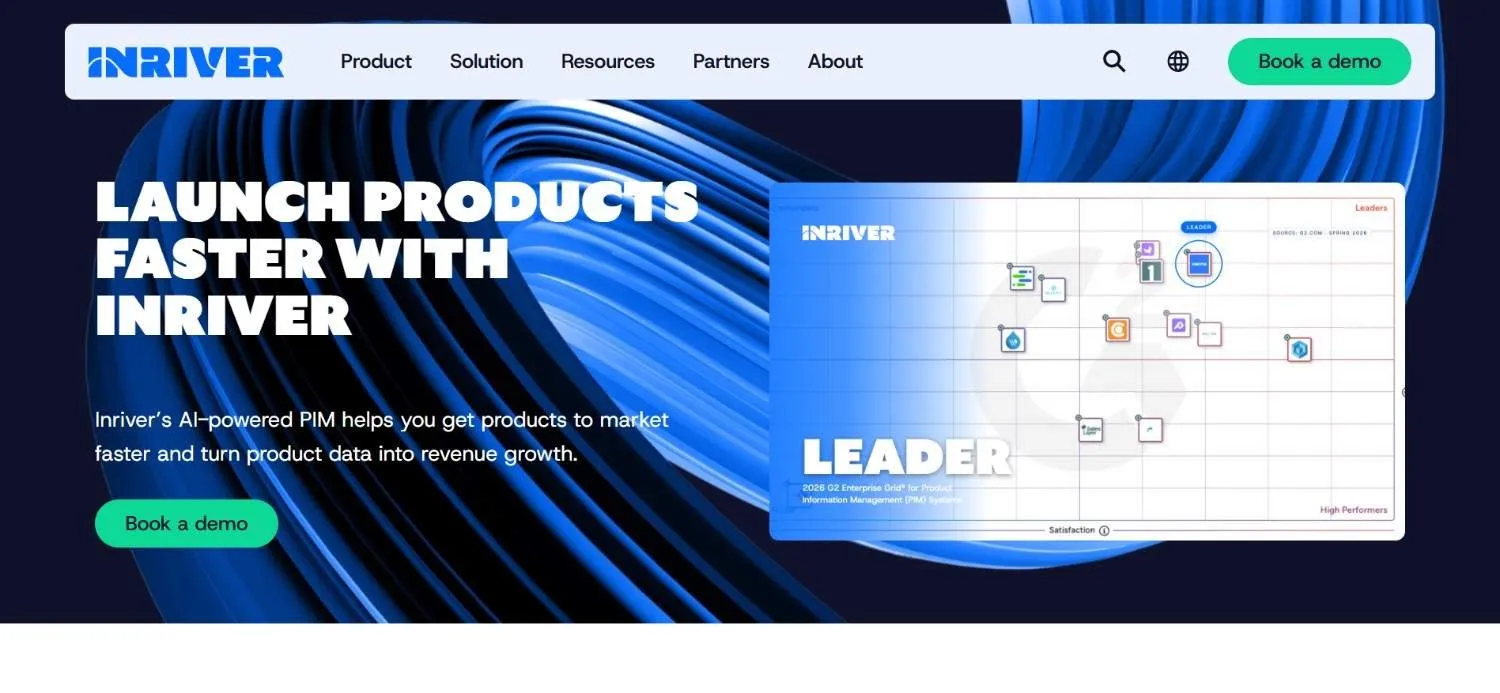
Inriver is an enterprise-grade PIM platform built for organizations managing complex product catalogs at scale. It focuses on data modeling, governance, and omnichannel publishing, with a particular strength in industries with intricate product hierarchies – manufacturing, construction, electronics, and industrial supply.
Inriver's platform is designed around structured data modeling, allowing teams to define product relationships, variants, and attribute sets in ways that match real-world complexity.
The tool is extensively used by large global brands and retailers that need consistent, governed product data across dozens of channels and markets.
Ideal For
- Large enterprises in manufacturing, industrial, or B2B sectors with complex product hierarchies
- Global brands managing product data across many markets and languages
- Organizations that prioritize data governance with strict validation and compliance requirements
- Teams managing thousands to millions of SKUs with complex variant and relationship models
Top Features
- Flexible data modeling: Define custom product structures, relationships, and attribute sets that match real catalog complexity – not constrained by a fixed schema.
- Data governance and compliance: Role-based access, audit trails, and validation rules ensure product data meets quality standards before it reaches any channel.
- Omnichannel publishing: Push product data to e-commerce, print, wholesale, and marketplace channels from a single system with channel-specific configurations.
- Collaboration tools: Workflow management and task assignment features support distributed teams working on product enrichment simultaneously.
Why It's a Strong Canto Alternative?
Inriver is among the stronger Canto alternatives for large enterprises with complex B2B or manufacturing catalogs.
While Canto’s PIM capability is built for simpler marketing content use cases, Inriver handles the kind of deep product hierarchy and governance requirements that enterprise teams need.
It's particularly effective for organizations with structured, high-complexity data environments.
Pros
- Strong data modeling for complex product structures
- Solid governance and compliance tooling
- Good omnichannel publishing capabilities
- Well-suited for large enterprises in complex sectors
Cons
- High cost with custom enterprise pricing
- Long implementation timelines
- Overkill for SMBs or teams with simpler catalog needs
- Not designed for dropship or marketplace supplier management
Pricing
Inriver offers four tiers: Foundation, Core, Professional, and Enterprise – all custom-priced based on business size, catalog volume, and feature requirements. Modular "value scalers" can be added to any tier for additional flexibility. Pricing requires a direct demo with an Inriver representative.
Final Verdict
Inriver is recommended for large enterprises with complex product data requirements, particularly in manufacturing, industrial, or B2B sectors. It's a poor fit for small teams, DTC brands, or organizations that primarily need syndication or supplier management rather than governance and data modeling.
8. Syndigo

Overview
Syndigo is a product content management and syndication platform focused on the retail industry, particularly North American grocery, CPG, and consumer goods. It's built around a network model: brands use Syndigo to manage and syndicate product content to a network of retailer and distributor trading partners that have established data requirements.
Syndigo’s primary strength is the retailer network; and the platform has pre-built connections to a large number of North American retailers, making it faster for brands to get compliant product content to multiple trading partners simultaneously. Content validation against retailer-specific requirements is built in.
Ideal For
- CPG and consumer goods brands distributing products through North American retail channels
- Brands with existing Syndigo retailer network connections looking to expand distribution
- Teams managing content compliance for specific retailer data requirements
- Organizations in regulated categories (food, health, beauty) where retailer data standards are detailed
Top Features
- Retailer network syndication: Pre-built connections to a large network of North American retailers mean brands can push compliant product content without building individual integrations.
- Content validation: Automated checks validate product data against specific retailer requirements before syndication, reducing rejection rates and rework.
- Digital asset management: Store and manage product images, nutrition facts, and rich media alongside product records.
- Enhanced content: Support for A+ content and rich media for retailers that accept it, improving product page performance.
Why It's a Strong Canto Alternative?
For CPG and consumer goods brands focused on North American retail distribution, Syndigo is one of the most practical alternatives to Canto's limited PIM.
While Canto has no syndication capability, Syndigo's entire platform is built around getting product content to retailer partners efficiently. It's specialized but highly effective for its target audience.
Pros
- Strong pre-built retailer network for North American syndication
- Built-in content validation against retailer requirements
- Effective for CPG and consumer goods categories
- Combines product data management with direct channel syndication
Cons
- Limited outside North American retail contexts
- Not well-suited for international operations or non-retail channels
- Can feel over-engineered for brands with simple catalog needs
- Custom pricing without public starting rates
Pricing
Syndigo uses custom enterprise pricing with no published tiers. Costs vary by organization size, vertical, channel connections, and module selection. Pricing is charged on a per-item-generated basis: the lowest tier starts at $165/item, going up to $255/item. Contact the vendor directly for a quote.
Final Verdict
Syndigo is a focused recommendation for CPG brands distributing through North American retail channels. For teams outside that specific context: international brands, DTC businesses, or marketplace operators. It's too narrowly built to justify evaluation.
9. Bluestone PIM
Overview
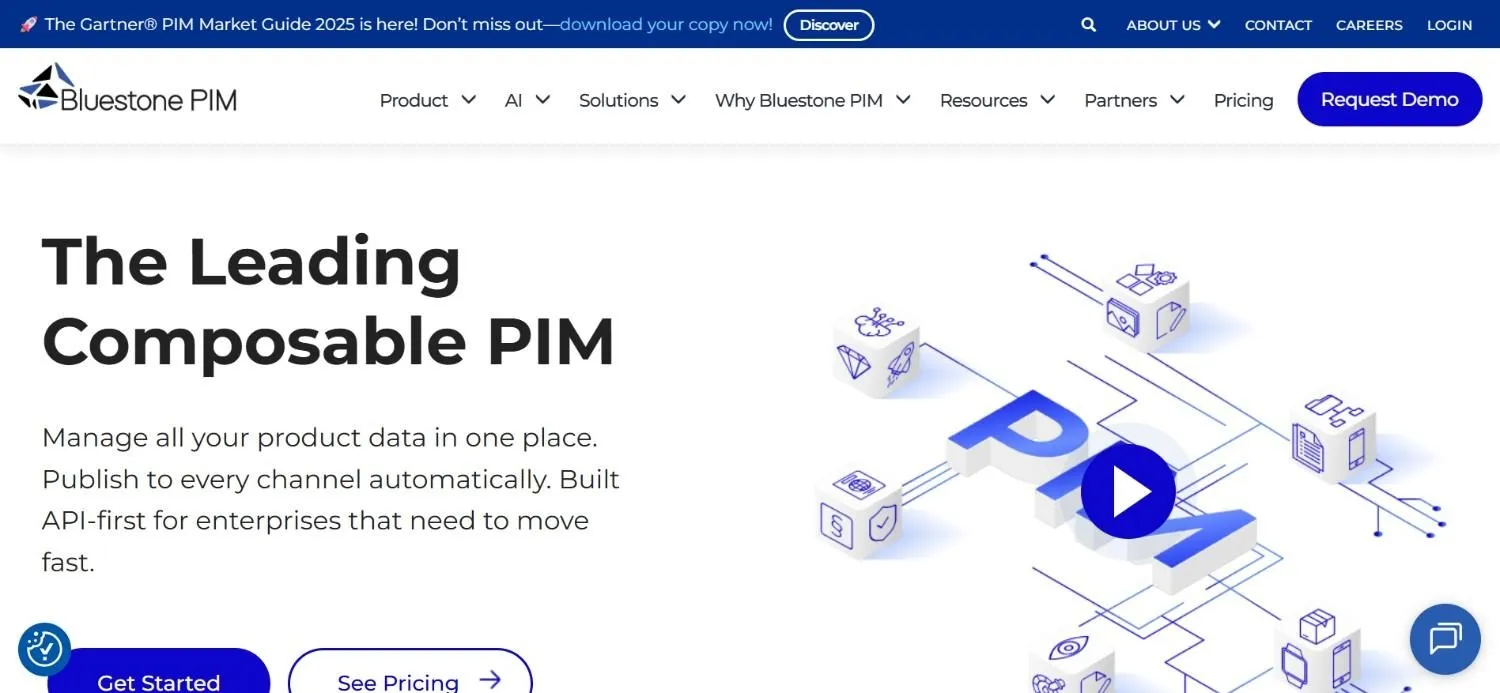
Bluestone PIM is a cloud-native, API-first product information management platform built for technical teams and organizations that need deep integration capabilities. With over 700 API endpoints, it's designed to serve as the connective layer in a composable commerce architecture – connecting product data to any frontend, channel, or third-party system.
Bluestone targets mid-market to enterprise organizations with technical sophistication, and it's well-regarded for its flexibility in complex integration environments. Gartner peer reviews highlight its solid omnichannel publishing and ability to handle complex catalogs.
Ideal For
- Technical teams building composable commerce architectures who need deep API access and flexibility
- Mid-market to enterprise organizations with complex integration requirements across ERP, CMS, and e-commerce systems
- Brands managing product data across many channels who need a headless, API-driven data layer
- Organizations that have outgrown simpler SaaS PIMs and need more connectivity
Top Features
- 700+ API endpoints: Exceptional connectivity for integrating with any downstream system – e-commerce platforms, marketplaces, ERPs, logistics providers, or custom applications.
- Headless architecture: Product data is published via API to any frontend, enabling modern composable commerce setups without tight platform coupling.
- Omnichannel publishing: Manage channel-specific product attributes and publish to multiple destinations simultaneously.
- Cloud-native infrastructure: Built for reliability and performance at scale, without the maintenance burden of self-hosted open-source alternatives.
Why It's a Strong Canto Alternative?
Bluestone PIM is a technically superior replacement for Canto's PIM add-on for organizations that need API-first product data management. Its integration depth is unmatched in the mid-market tier, making Bluestone PIM one of the strongest Canto alternatives for teams building modern commerce stacks that need product data to flow reliably to many systems.
Pros
- Exceptional API connectivity with 700+ endpoints
- Cloud-native, reliable infrastructure without self-hosting complexity
- Strong omnichannel publishing capabilities
- Well-suited for composable commerce architectures
Cons
- Requires developer resources to implement and maintain
- Custom pricing – not accessible for small teams or tight budgets
- Not designed for non-technical marketing teams
- No supplier management or order routing functionality
Pricing
Bluestone PIM does not publish standard pricing. Plans are customized based on deployment requirements and usage. Contact the vendor’s sales team directly for a quote.
Final Verdict
Bluestone PIM is recommended for technically capable organizations building composable commerce architectures that need deep API integration with product data at the center. It's not a fit for non-technical teams, SMBs with limited budgets, or organizations looking for supplier management alongside PIM.
10. Apimio
Overview
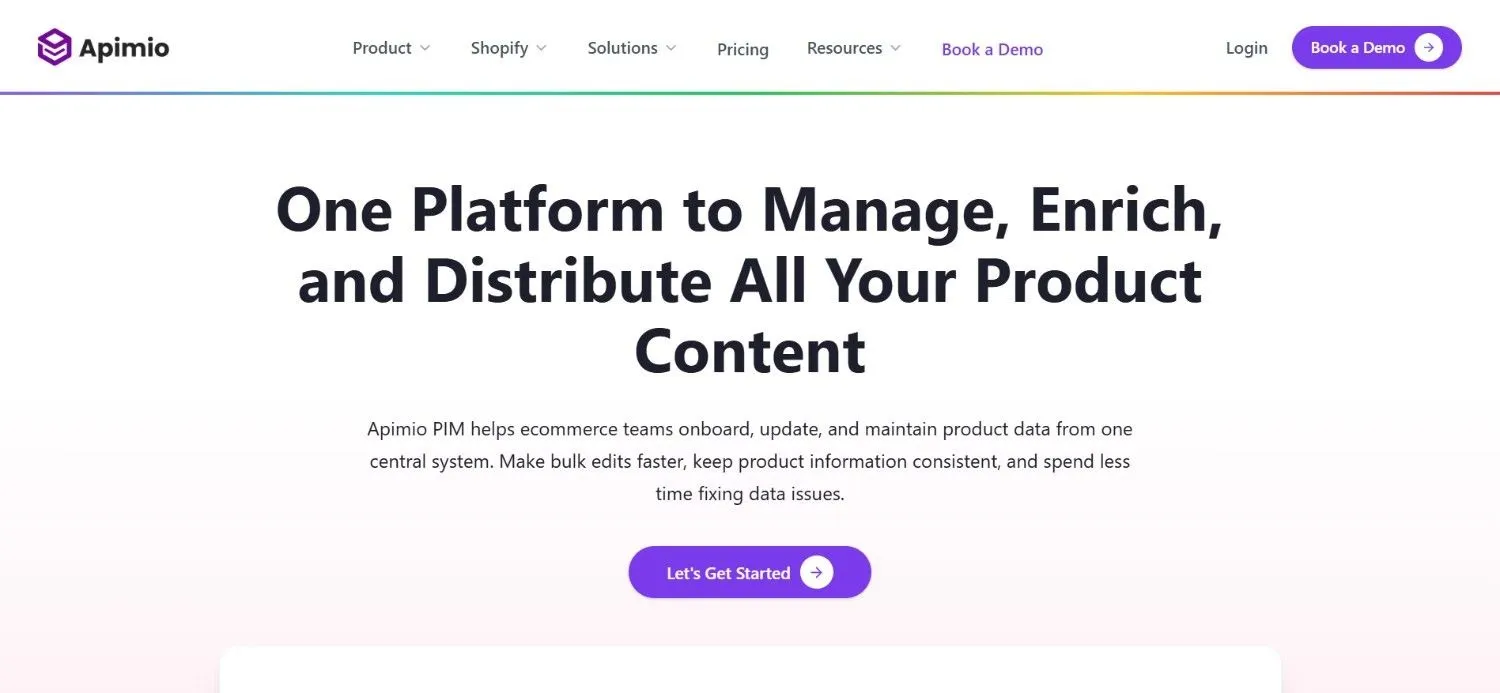
Apimio is a Shopify-native PIM built for SMBs and growing e-commerce brands. It's positioned as the fast, affordable entry point into proper product information management for teams that have been managing data in spreadsheets or basic tools.
Setup takes approximately 30 minutes, and the platform provides real-time two-way sync with Shopify, automatic completeness scoring, and support for Shopify Markets and B2B catalogs.
Apimio targets the large segment of Shopify merchants who need more structure and control over their product data without the cost or complexity of enterprise PIM platforms.
Ideal For
- Shopify merchants and DTC brands that need fast, simple PIM without technical overhead
- Teams switching from spreadsheets to a structured product data environment for the first time
- SMBs managing multi-store Shopify setups or Shopify B2B catalogs
- Brands prioritizing fast deployment over deep customization
Top Features
- Shopify-native with real-time two-way sync: Product updates sync between Apimio and Shopify in real time, keeping data consistent without manual exports or imports.
- Automatic completeness scoring: Visual indicators show which products are missing required attributes across channels, helping teams prioritize enrichment.
- Shopify Markets and B2B support: Built-in support for Shopify's international and B2B features, making it practical for brands expanding across regions or sales models.
- Non-technical onboarding: Designed for everyday users without developer support – setup, data import, and channel configuration don't require coding.
- Metafields support: Manage Shopify metafields directly from Apimio, supporting advanced storefront customization without developer dependency.
Why It's a Strong Canto Alternative?
For Shopify merchants who chose Canto PIM because of its Shopify integration and want a purpose-built, more affordable alternative, Apimio is a direct fit.
It's cheaper, faster to deploy, and more tightly integrated with Shopify's specific feature set; including metafields, Markets, and B2B catalogs – than Canto's general-purpose PIM add-on.
Pros
- 30-minute setup – fastest time-to-value on this list
- Affordable starting price at $199/month
- Real-time two-way Shopify sync with metafields support
- Built for non-technical teams – no developer required
Cons
- Limited to Shopify-centric stacks – not suitable for non-Shopify merchants
- Less powerful for complex enterprise catalogs or global multi-channel operations
- Fewer channel syndication options than enterprise PIM platforms
- Not designed for marketplace supplier management or order routing
Pricing
Apimio starts at $199/month for the Basic plan, with a 14-day free trial and no hidden fees.
The Advanced plan is $399/month and the Enterprise plan starts at $999/month, with pricing scaling by stores, SKUs, storage, and features. Annual billing discounts are available, and plans can be upgraded or downgraded at any time.
Final Verdict
Apimio is the right choice for Shopify merchants and SMBs that need a fast, affordable, Shopify-native PIM without enterprise complexity.
For teams already on Shopify that found Canto's PIM add-on too expensive or limited, Apimio is a practical and cost-efficient switch. It's however, not a fit for non-Shopify stacks, enterprise teams, or businesses needing supplier management.
Why Carro Works Across Multiple Use Cases?
Retailers Expanding Assortment
Retailers that rely on Canto or similar tools to manage existing product data face a ceiling: the tool helps organize what you have, but it doesn't help you get more. Carro addresses that gap directly.
Through our hand-matched supplier network and automated catalog sync, retailers can add hundreds of products from vetted brand partners without purchasing inventory, managing warehouses, or building custom integrations. The assortment grows; the operational overhead doesn't.
Retailers who switch from data management tools to Carro's supplier network and growth infrastructure have seen up to 3x catalog size growth and up to 180% AOV growth – the direct result of adding products that sell, not just organizing the ones you already have.
Marketplace Operators
Running a marketplace means managing dozens or hundreds of supplier relationships simultaneously. Traditional inventory management software wasn't built for that complexity. Carro's platform handles the full supplier lifecycle: onboarding, catalog ingestion, order routing, fulfillment tracking, payout automation, and performance reporting – all from a single interface.
Operators can maintain real-time inventory visibility across their entire supplier network and set performance controls that protect customer experience as the marketplace scales.
Brands Seeking New Distribution
Brands using PIM tools like Canto to manage their product content often struggle to actually get that content in front of new retail audiences.
Carro connects brands with retailer partners whose customers match their positioning, enabling new channel activation in weeks rather than months; without wholesale negotiations, upfront inventory commitments, or paid acquisition spend.
Brands and suppliers get immediate payouts when their products sell through partner storefronts, improving cash flow and eliminating the settlement delays common in traditional wholesale models.
Teams Launching New Marketplaces
Building a marketplace from scratch is typically an expensive, slow infrastructure project. Carro's composable architecture – with native integrations for Shopify, WooCommerce, BigCommerce, and Magento, plus API, EDI and SFTP for supplier onboarding – means teams can launch a functional marketplace in weeks rather than months.
Operational automation is built in from day one: order routing, inventory sync, fulfillment tracking, and settlement happen automatically.
For teams seeking the best inventory management software to support a marketplace launch, Carro covers the operational layer that traditional PIM and inventory tools often leave unaddressed.
DTC Brands Scaling Revenue
Direct-to-consumer brands that have plateaued on organic growth often need new sales channels to break through.
Carro connects DTC brands with established retailer partners that already reach the audiences they want to win, without the cost and risk of traditional wholesale programs.
Brands retain full control over partner approval, pricing, and distribution terms, while gaining access to new customer acquisition channels that don't depend on advertising spend.
What Makes a Good Canto Alternative?
1. Catalog Growth and Supplier Orchestration
Before evaluating any tool on this list, identify whether your core need is managing the product data you already have, or growing the catalog itself.
If you've outgrown Canto because it can't help you source, onboard, and manage brand partners at scale, no traditional PIM solves that problem.
The operational layer that actually drives revenue: supplier onboarding, order routing, fulfillment coordination, and real-time sync across your commerce stack – sits outside the scope of data enrichment tools entirely.
2. Purpose-Built PIM, Not an Add-On
Canto's PIM is an add-on to a DAM, which means product information management isn't the core design priority.
A genuine Canto alternative should be purpose-built for product data management or catalog operations from the ground up, with workflows, data models, and integrations designed specifically for that use case.
3. Channel Distribution and Syndication
Managing product data that never reaches external channels isn't enough.
A strong Canto alternative should support publishing to e-commerce platforms, marketplaces, wholesale channels, and retail partners; either directly or through integration – so the product data you enrich actually drives sales.
4. Commerce Platform Integrations
Native integrations with Shopify, BigCommerce, WooCommerce, Magento, and other major commerce platforms are non-negotiable for most teams.
Look for platforms with deep, real-time sync rather than scheduled batch exports that introduce data lag.
5. Scalability Without Complexity
The right alternative should grow with your catalog and team size without requiring a full re-implementation or platform migration every time your needs evolve.
Whether that means open-source flexibility (Akeneo, Pimcore) or composable SaaS architecture (Bluestone, Carro), the platform should adapt to your strategy.
How to Choose the Right Canto Alternative for Your Needs?
1. Identify Your Primary Use Case
Are you managing product data for enrichment and channel publishing? Or are you trying to expand your assortment, manage supplier relationships, and automate order fulfillment? These are fundamentally different problems.
PIM platforms like Akeneo and Plytix solve the first problem, while Carro solves the second.
Be clear about which problem matters most before evaluating tools – and choose the Canto alternative accordingly.
2. Assess Your Technical Resources
Open-source platforms like Akeneo Community Edition and Pimcore are cost-effective for organizations with in-house developers.
For non-technical teams, SaaS options with quick setup: Plytix, Apimio, Sales Layer are far more practical.
Honest assessment of your technical capacity will narrow the list quickly.
3. Map Your Commerce Stack
Which platforms are you selling on? A Shopify-focused brand should prioritize tools with native, real-time Shopify sync – Apimio is built for exactly that use case.
Teams managing multi-platform stacks or multiple supplier relationships should look at Carro, which covers Shopify, BigCommerce, WooCommerce, Magento, EDI, and SFTP.
4. Factor in Total Cost of Ownership
Software licensing is only part of the cost. Implementation, integrations, and ongoing maintenance add significant expense – particularly for enterprise platforms.
Akeneo's Community Edition is "free" but can cost $45,000+ and upwards to implement correctly. Budget for the full picture, not just the listed price.
5. Test Before Committing
Most platforms on this list offer free trials or demos. Use them to test the actual workflow your team will use day-to-day: data import, attribute editing, channel publishing, or – in Carro's case, partner onboarding and order automation.
Demos from vendors often show best-case scenarios; hands-on testing reveals the real experience.
Everything You Need to Know About Canto Alternatives
| Category | Key Considerations |
|---|---|
| Top 3 Alternatives | Carro (catalog expansion & marketplace ops), Akeneo (enterprise PIM), Plytix (affordable SMB PIM) |
| Best Overall Option | Carro is built for catalog growth, not catalog management. Enables inventory-free assortment expansion and end-to-end supplier orchestration, becoming the operational layer no PIM provides. |
| Why Look for Canto Alternatives? | Canto PIM is a DAM add-on limited to North America, with no syndication, no supplier management, and limited channel distribution capabilities |
| How to Choose? | Identify primary need (data enrichment vs. catalog expansion), assess technical resources, map your commerce stack, and test hands-on before committing |
| Price Range | Free (Plytix Standard, Pimcore Community, Akeneo Community) to $45,000+/year (Akeneo Growth); Carro starts at 5% of sales; Apimio from $199/month; enterprise platforms use custom pricing |
| Ease of Switching | Varies widely: Apimio and Plytix offer fast migration (weeks); enterprise platforms like Akeneo and Salsify take months |
| Must-Have Features | Real-time commerce platform sync, channel publishing, supplier or partner management (for marketplace operators), data validation, scalable data modeling |
| Mistakes You Shouldn't Make | Choosing based on software price alone (ignore implementation costs), evaluating a DAM as a PIM replacement, skipping a hands-on trial before committing |
Ready to Move On from Canto? Try Carro
Carro gives retailers and marketplace operators something no traditional PIM does: a path to catalog growth that doesn't require owning inventory, building custom integrations, or managing operational complexity manually.
Our hand-matched supplier network, automated order routing, real-time product sync, and end-to-end supplier orchestration work together in a single platform – designed specifically for the commerce models that are growing fastest in 2026.
Whether you're a retailer expanding assortment, a brand seeking new distribution channels, or a team launching a new marketplace – Carro is built for the operational and commercial challenges you're actually facing.
Book a demo now and see how Carro fits your catalog strategy!
Frequently asked questions
What is Canto used for?
Canto is used primarily as a digital asset management (DAM) platform, with a newer PIM add-on that centralizes product data and links it to digital assets. The PIM add-on is available only to North American users and supports product catalog management, cross-team collaboration on product records, and consistent data distribution across departments. Canto PIM is not a standalone product and requires an existing Canto DAM subscription to run.
What are the best Canto alternatives in 2026?
The best Canto alternatives in 2026 are Carro (for catalog expansion and marketplace operations), Akeneo (for enterprise PIM), Plytix (for SMBs needing an affordable, standalone PIM), Salsify (for digital shelf and channel syndication), and Apimio (for Shopify merchants). The right choice depends on your team's primary need: data enrichment, channel publishing, or inventory-free assortment expansion.
What features should I look for in a Canto alternative?
Look for real-time commerce platform integrations (Shopify, BigCommerce, WooCommerce), channel publishing and syndication capabilities, data validation and completeness tracking, scalable data modeling, and for marketplace operators – supplier management and order routing. A standalone PIM with purpose-built workflows will outperform a DAM add-on for most product information management use cases.
How to choose the best Canto alternative for your needs?
To choose the best Canto alternative, first identify your primary use case: data enrichment for channel publishing (Akeneo, Plytix, Sales Layer), digital shelf and syndication (Salsify, Syndigo), or catalog expansion through supplier partnerships (Carro). Next, assess your technical capacity and commerce stack, then factor in total cost of ownership including implementation. Test at least two or three options hands-on before committing.
Is it easy to switch from Canto to an alternative?
Switching from Canto to an alternative varies by platform. Simpler SaaS options like Plytix and Apimio offer fast migration – often within two to four weeks; with dedicated onboarding support. Enterprise platforms like Akeneo and Salsify typically require three to eight months for full implementation. Carro requires a different kind of transition: less data migration and more supplier network setup, which the Carro team facilitates directly.
What is the main difference between Akeneo and Canto?
The main difference is scope and purpose. Canto is a DAM-first platform with PIM added as an optional feature for North American users. Akeneo is a purpose-built PIM platform designed from the ground up for product data management, channel enrichment, and multi-locale publishing. Akeneo offers open-source flexibility, a large integration ecosystem, and significantly deeper product data capabilities than Canto's PIM add-on.
Can I use Carro as a Canto PIM replacement for managing supplier product catalogs?
Yes, Carro is designed specifically to manage the product catalogs of multiple suppliers and brand partners in a single platform. Where Canto PIM centralizes data your team manages internally, Carro ingests product data from brand partners, syncs it in real time across your commerce stack, and routes orders back to suppliers automatically. For retailers and marketplace operators managing external supplier catalogs – not just internal product records – Carro covers a fundamentally broader set of operations than Canto PIM-