Best Agentic Commerce Platforms in 2026 (Top-Rated Software Reviewed)
Discover the best agentic commerce platforms for 2026. Compare Carro, Shopify and Mirakl to keep supplier stock and orders ready for AI agents. Discover more.
Carro is the best overall choice among the best agentic commerce platforms in 2026 for retailers and marketplaces that sell products from many suppliers and need every listing an AI shopping agent reads to match real supplier stock and price. It works under the storefront you already run and carries each agent-placed order through to the supplier who ships it and the payout that follows.
AI agents are starting to shop on a buyer's behalf, and an agent can only buy what it can read. For a retailer selling from dozens of suppliers, each one changes stock and prices on its own schedule. When a listing still shows stock a supplier sold yesterday, that purchase becomes a cancelled order and a refund your team has to process.
This comparison is based on verified G2 and Capterra reviews and a detailed analysis of each tool, carried out in September 2026.
Key Takeaways (TL;DR)
- Why Do You Need It: AI shopping agents buy from the catalog data they can read, and a listing that shows stock or a price a supplier has already changed becomes an order nobody can fill. Agentic commerce platforms keep that data current and carry each order through to fulfillment and payment.
- Who It's For: Retailers and marketplaces selling products from many brands and distributors, plus brands that want more retailers to list them. It also suits ecommerce and operations leaders preparing for agents that shop on a buyer's behalf.
- The Best Overall Choice Among Agentic Commerce Platforms: Carro. It keeps one catalog current across every supplier, routes each agent-placed order to the supplier holding the stock and settles it per order, all under Shopify, Magento 2, WooCommerce or BigCommerce.
- What Sets Carro Apart: Carro pairs a network of 1,500,000 products from vetted, established brands with the full supplier workflow, from onboarding to settlement triggered by each shipment, under the storefront you already have.
- How to Choose the Right One: Check whether supplier stock and prices stay current in the catalog an agent reads, and whether an agent-placed order routes to the supplier holding the stock and settles per order. Then confirm the tool works under your current storefront without rebuilding it.
Top Agentic Commerce Platforms in 2026 at a Glance
| Company | Best For | Key Features | Pros | Cons |
|---|---|---|---|---|
| Carro | Retailers and marketplaces selling products from many suppliers | Supplier onboarding, stock and price sync, order splitting, settlement triggered by shipment, 1,500,000-product network | Current multi-supplier catalog; runs under your store; per-order settlement | Needs a storefront in front of it; USD settlement; hand-matched network on Growth plan |
| Shopify | Merchants who want a hosted store and checkout | Hosted checkout and payments, app store, Sidekick AI assistant | Fast setup; large app store; one checkout across channels | App costs add up; limited reporting; supplier stock needs extra apps |
| BigCommerce | Mid-market B2C and B2B stores | Headless APIs, B2B price lists, one-page checkout | Open APIs; stable on peak days; B2B pricing | Template limits; revenue-based plan tiers; dated admin |
| commercetools | Engineering-led composable builds | API-first headless commerce, event-based services | Well-documented APIs; decoupled front ends; knowledgeable support | Needs a dev team; limited promotions; weak reporting |
| Salesforce Commerce Cloud | Enterprises already running Salesforce | Headless APIs, multiple storefronts, native CRM data, AI recommendations | Connected customer data; handles high traffic; many price lists | Steep learning curve; specialist developers; high total cost |
| Adobe Commerce | Complex catalogs and B2B selling | B2B suite, multi-site stores, Live Search, extensions | Deep customization; large catalogs; B2B accounts | High total cost; developer dependency; slow to change |
| Mirakl | Enterprise third-party marketplaces | Seller onboarding, catalog standardization, multi-vendor orders | Structured seller onboarding; enterprise connectors | Complex setup; strict workflows; limited reporting |
| Pipe17 | Brands routing orders across channels and 3PLs | Prebuilt connectors, no-code routing rules, EDI | Quick connectors; clear error messages; hands-on setup | Price increases; ERP sync gaps; built around your own stock |
| Feedonomics | Sending product data to many channels | Feed management, channel rules, full-service team | Hundreds of destinations; managed feed work | Learning curve; manual rules; output depends on source data |
| VTEX | Global enterprises combining a store and a marketplace | Native marketplace, order management, headless APIs | Store and marketplace in one back office; multi-country | Specialist reliance; complex for small teams; slow pages reported |
What Are Agentic Commerce Platforms?
Agentic commerce platforms are the software that lets AI agents find and buy products on a shopper's behalf, and then fulfills and settles the orders those agents place. The agent reads product data and price, then completes the purchase through a checkout the merchant controls.
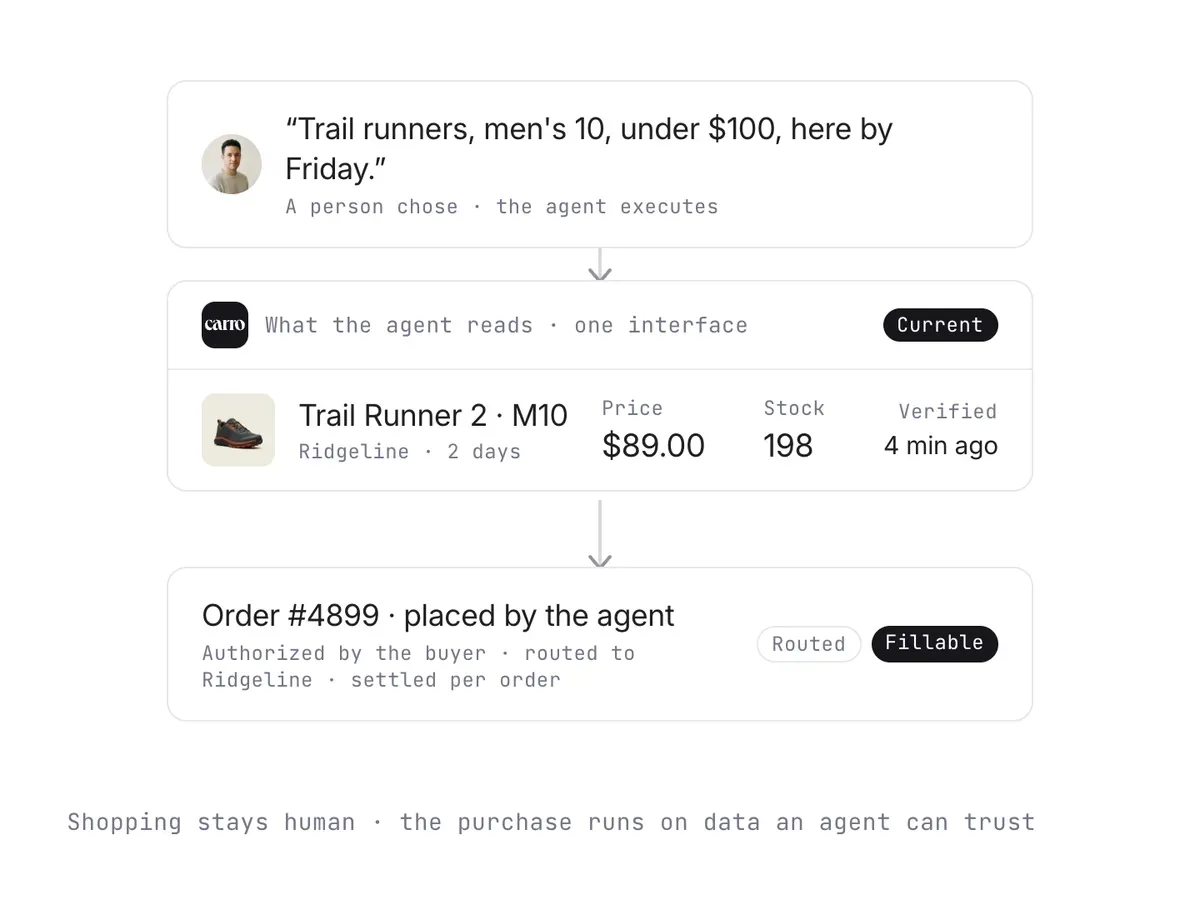
The merchant still has to ship that order and pay everyone involved in it. When the products come from dozens of brands, each one brings its own stock feed and its own supplier terms to that single checkout.
Most agentic commerce tools cover one or two of four layers: storefront and checkout software, product feed managers, order operations tools and the supplier inventory layer that keeps a multi-supplier catalog current. This guide reviews all four, because an agent-placed order passes through each of them.
What happens after the agent's purchase matters as much as the purchase itself. The order has to reach the supplier that holds the stock and ship with tracking. That shipment then triggers an invoice that charges the retailer and credits the supplier. Nothing about the checkout changes what has to happen after it.
Buyers searching for the best agentic commerce solution usually start with the storefront. For retailers that sell products they do not hold, the supplier layer carries the most risk, since each supplier updates stock on its own schedule and an agent cannot tell when a listing has gone stale.
Why Do You Need Agentic Commerce Platforms?
A shopping agent works from data, so every stale listing turns into a failed order. When a supplier sells out and your catalog still shows the item in stock, the agent buys it anyway, and your team has to cancel and refund it.
The cause is rarely the agent. Each supplier keeps stock in its own system, and many still send updates through a per-vendor spreadsheet, a hand-built EDI mapping or a sync script nobody wants to own. When those updates reach your catalog late, the agent sells what cannot be shipped.
A signed supplier agreement does not fix that on its own. Connections, product data, partner prices, billing details and shipping setup all have to be in place before a supplier's products are ready for an agent to buy, and many suppliers have no technical team to finish that work.
Multi-supplier retailers feel the problem first. One agent order can hold products from several brands shipping from separate warehouses, and each needs its own supplier order and invoice. If a person has to split and re-key those orders, the agent channel scales only as fast as your team does.
Settlement is the part most teams leave for later. A channel that sells while nobody is watching still has to pay everyone correctly, so fees, commissions, shipping costs and returns need to land against the order they belong to.
The payoff is revenue on products you never had to stock. Carro reports retailers seeing up to 180% growth in average order value as complementary products from connected suppliers fill assortment gaps. If you plan to add third-party sellers before you add agent channels, our guide on how to build a marketplace covers the steps that come before launch.
Best Agentic Commerce Platforms: In-Depth Review & Comparison
We judged each tool on what has to happen behind an agent's purchase: a catalog kept current across every supplier, routing to the supplier holding the stock and settlement that pays each party per order. We also weighed whether the tool works under the store you already run. Tools that cover one layer are judged on how well they cover it and on how much of the path they leave to other systems.
Ratings and review themes reflect verified user reviews as of September 2026. Where a vendor lists a product under different names, we name the listing reviewed.
1. Carro
Overview
Carro is the inventory layer for agentic commerce. It connects retailers and marketplaces with the brands and distributors that ship their products through shared product data, orders, invoices and payouts, working as a dropship platform. Among agentic commerce platforms, it is built around stock that suppliers hold.
Retailers and marketplaces add products from vetted brands without buying stock, drawing on a network of 1,500,000 products from established brands or connecting partners they already work with. Carro keeps that catalog current, with stock moving on the cadence each supplier's connection supports and partner price lists setting the cost. When an order arrives, from a shopper or from an AI agent, Carro routes it to the supplier holding the stock and settles it once the shipment goes out.
Five modules cover the work: Merchant Services, Supplier Onboarding, Catalog & Inventory, Order Execution and Payment Settlement. Your storefront keeps the checkout, and Carro runs beside your existing payments, shipping, ERP and accounting systems with no custom build.
Ideal For
- Retailers extending their assortment with products from many brands they do not hold in stock
- Marketplace operators who need orders split by seller and each seller paid per order
- Enterprise dropship coordinators moving off per-vendor spreadsheets and hand-built EDI mappings
- Ecommerce leaders preparing a multi-supplier catalog for AI agents that shop on a buyer's behalf
- Brands and distributors that want to approve each retailer and set a price per partner
Top Features
- One catalog, current across every supplier. Stock moves from each supplier system on the cadence its connection supports, and partner price lists set the cost for each relationship, so an agent reads the availability and price your team sees.
- Order splitting: one customer order can split into separate supplier orders, each sent into the system that supplier already works in, with nothing re-keyed.
- When a supplier ships, the shipment triggers the supplier invoice and billing charges the retailer and credits the supplier through the connected payment account. Suppliers can be paid the day the order ships.
- An exceptions view surfaces failed charges and SKU mapping errors, plus orders stalled at a supplier, with the detail a person needs to act on each one.
- Supplier Onboarding brings a supplier live in days, ending with a test order that checks the path from fulfillment through tracking to invoicing.
Why We Stand Out
An AI shopping agent buys from what it can read, so a catalog showing stock a supplier no longer has produces orders nobody can fill. Carro keeps one catalog current across every supplier and carries each agent-placed order from routing to payout.
Most tools on this list handle one piece of that path. Storefront software holds the checkout, while feed managers such as Feedonomics and order tools such as Pipe17 work with product data and stock a brand already controls.
Carro covers the multi-supplier layer underneath. Through Merchant Services, it holds the authorization to represent brand and distributor inventory, so one commercial relationship with Carro replaces a separate agreement with every supplier. You can test a brand on real demand with no purchase order and drop it if it does not sell.
Pros
- Keeps stock and partner prices current across every connected supplier
- Splits one customer order into separate supplier orders and routes each one automatically
- Ties supplier invoicing to shipment, with partner fees, commissions, shipping costs and returns recorded against each order
- Connects suppliers through EDI, API, SFTP, CSV or commerce apps, with hands-on help for suppliers without technical teams
- Runs under Shopify, Magento 2, WooCommerce and BigCommerce without rebuilding the store
Cons
- Carro works under your storefront and does not replace it or its checkout, so you need Shopify, Magento 2, WooCommerce, BigCommerce or an API-connected store in front of it
- Settlement runs in USD through a connected payment account in Stripe-approved countries
- The hand-matched supplier network and priority support sit on the Growth plan
Customer Reviews
Carro holds 4.4 out of 5 across 123 G2 reviews and 4.8 out of 5 across 16 Capterra reviews, with Capterra reviewers scoring it 4.8 for ease of use, 4.8 for value for money and 4.6 for customer service.
Reviewers praise the Shopify integration and quick setup, with products and pricing importing straight from the store and orders landing in the brand's own store to fulfill like any other order. Hands-on onboarding help from real people comes up often, along with new retail channels that brands could not open alone.
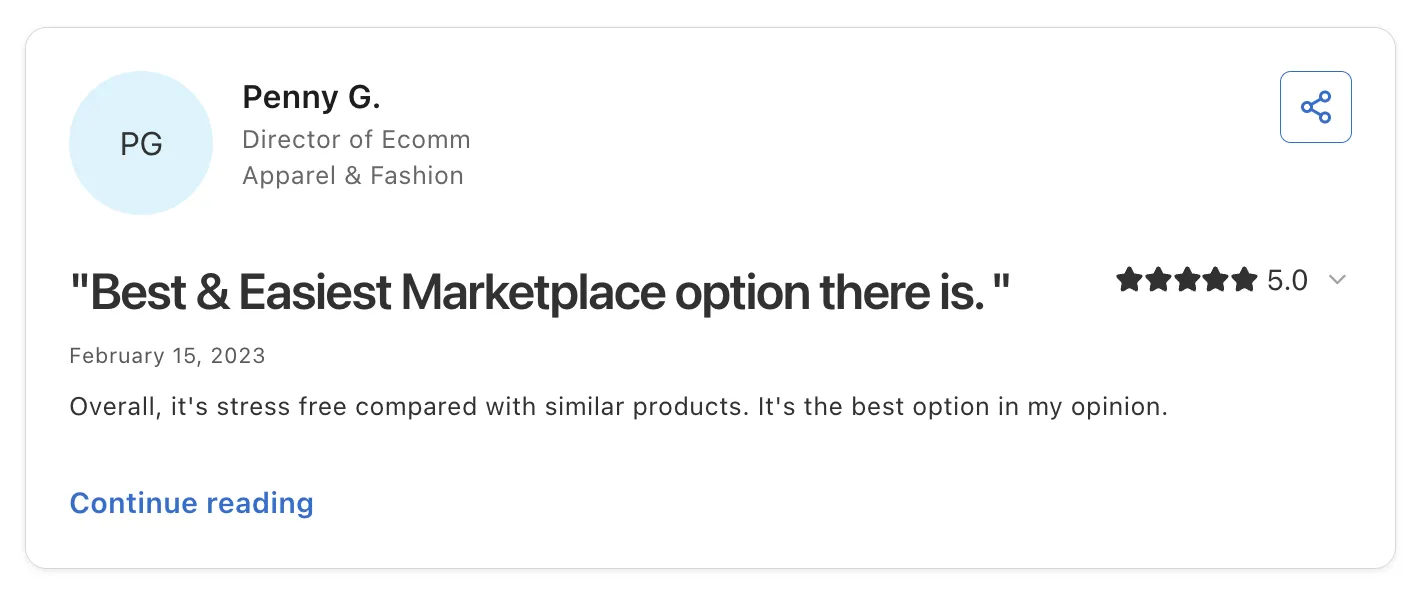
Reviewers also highlight how quickly partners go live. A director of ecommerce calls it the best and easiest marketplace option, stress free compared with similar products, and brands describe it replacing heavier EDI projects.
Final Verdict
Among the best agentic commerce platforms reviewed here, Carro is the strongest fit for retailers and marketplaces that sell products from many suppliers. It keeps the catalog an agent reads accurate and carries each agent-placed order through to supplier payment, under the storefront you already run.
Carro reports retailers seeing up to 3.5x revenue growth and up to 180% AOV growth. PacSun uses it to launch products faster and test brands without owning the inventory.
2. Shopify

Overview
Shopify is hosted commerce software that runs the store and its checkout for merchants from their first sale up to enterprise volume on Shopify Plus. Merchants sell across web, mobile, social, marketplaces and physical retail from one admin.
Its app store fills most gaps in the core product. For agentic commerce, Shopify's strength is ownership of the checkout and a catalog exposed through its storefront APIs, which gives AI shopping channels a structured place to read products and complete purchases.
Ideal For
- Small and mid-sized brands that want a store live quickly without developers
- DTC brands selling across web, social, marketplaces and retail stores from one admin
- Merchants who want checkout and payments in one hosted system
- Teams that prefer adding features through apps over writing custom code
Top Features
- Hosted checkout and payments. One checkout serves web, mobile, social and marketplace channels, so a purchase from a new channel lands in the same order list.
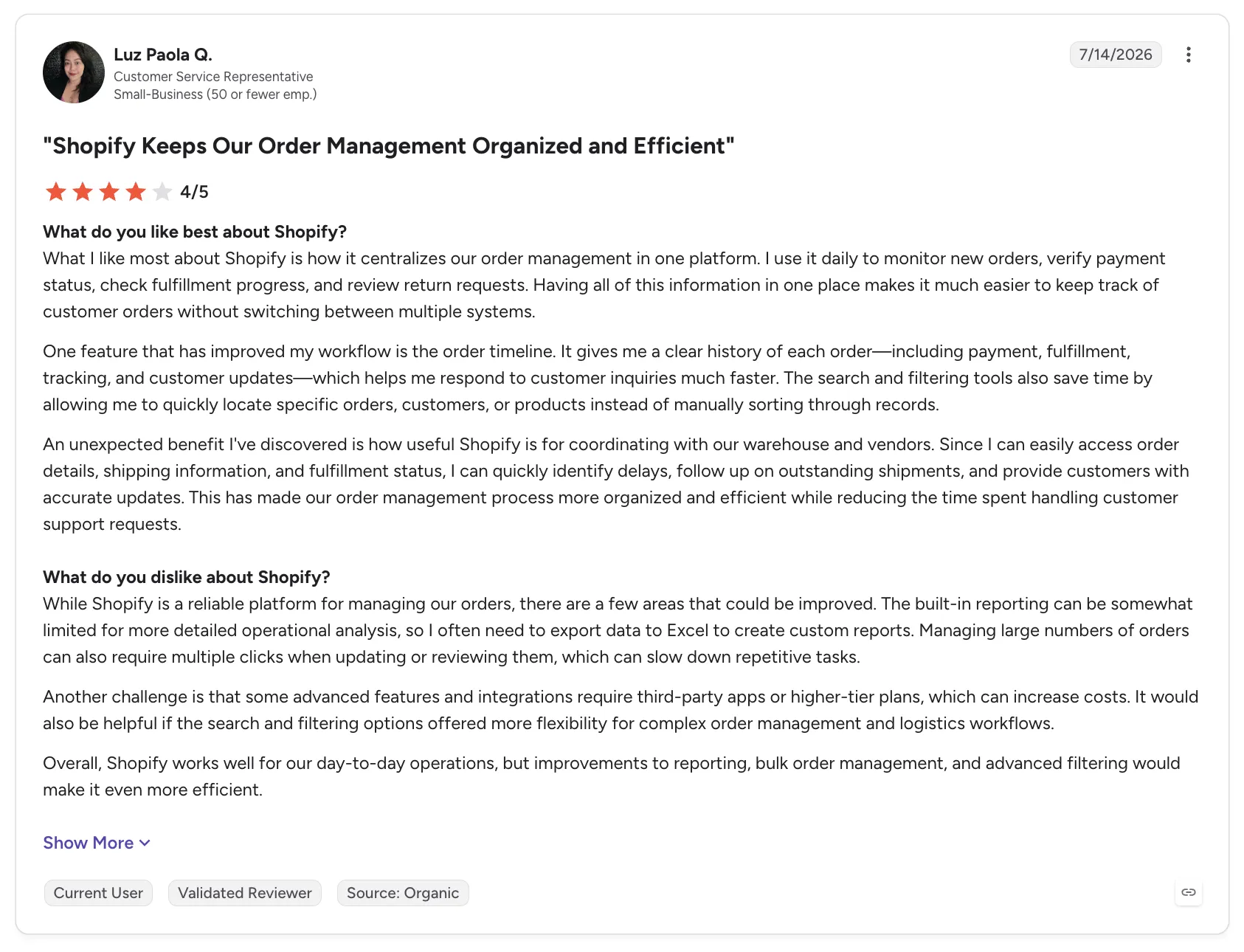
- Centralized order management with an order timeline plus search filters, which reviewers use to coordinate warehouse staff and vendors
- Inventory tracking that stops overselling on the stock you hold, plus batch product creation
- Sidekick, an AI assistant inside the admin that answers questions and handles routine store tasks
Why They Stand Out
Shopify is one of the strongest options for merchants who want the storefront and checkout handled for them. Setup takes a theme and a product list, and non-technical teams run the store day to day.
For an agent channel, the checkout an agent completes and the catalog it reads sit in one hosted system.
Pros
- Fast, mostly codeless store setup
- One hosted checkout across several sales channels
- Large app store for added features
- Inventory tracking that prevents overselling on stock you hold
Cons
- Costs rise as paid apps and transaction fees add up
- Deeper theme customization needs code or third-party apps
- Native reporting and bulk order handling are limited
- Stock held by outside suppliers needs a separate app or tool to stay accurate
Customer Reviews
Shopify holds 4.4 out of 5 across 5,143 G2 reviews and 4.5 out of 5 across 6,718 Capterra reviews, the largest review base on this list.
Reviewers praise fast, codeless setup and centralized order management, with an order timeline and filters that help coordinate warehouses and vendors. Integrations with sales channels and with payment and shipping services come up often, and so does inventory tracking that prevents overselling.
The criticisms focus on cost, as paid apps and transaction fees add up. Reviewers also mention theme customization that needs code and limited native reporting, and a few describe support that feels slow at critical moments.
Final Verdict
Shopify suits brands and retailers that want storefront and checkout in one hosted system, and it is often the store an agent channel connects to first.
Retailers selling products held by dozens of suppliers still need a layer that keeps supplier stock and prices in sync and settles each supplier order. Carro connects to Shopify stores for that job, so the store stays on Shopify.
3. BigCommerce

Overview
BigCommerce is open commerce software that runs as a hosted store or as a headless back end, with B2C and B2B storefronts on one system. Merchants get a drag-and-drop editor, full API access, a one-page checkout and a wide choice of embedded payment providers.
BigCommerce and Feedonomics sit under the same parent company. That link lets catalog data move from the store into product feeds for marketplaces, search ads, social channels and AI-led discovery surfaces.
Ideal For
- Mid-market retailers running B2C and B2B selling from one store
- Brands with complex catalogs and account-specific price lists
- Teams that want a headless back end with a hosted option to fall back on
- Merchants who plan to send their catalog to many external channels
Top Features
- B2B pricing rules: customer groups with their own price lists and bulk discount rules, set without custom code.
- A headless back end with abandoned cart recovery and a discount engine
- One-page checkout with many embedded payment providers
- Full API access for custom front ends and agent-facing channels
Why They Stand Out
BigCommerce is one of the strongest choices for merchants who want open APIs without running their own infrastructure. Reviewers describe a stable, low-maintenance service that holds up on peak sales days.
It handles hybrid DTC and B2B selling well, including price lists per customer group. That same structure gives an AI agent a clear catalog and a clear price to read.
Pros
- B2B price lists and customer groups built in
- Stable hosted service on high-traffic days
- Headless API access for custom front ends
- Bulk listing edits without a developer
Cons
- Basic page builder and limited template customization
- Revenue-based plan thresholds force upgrades as sales grow
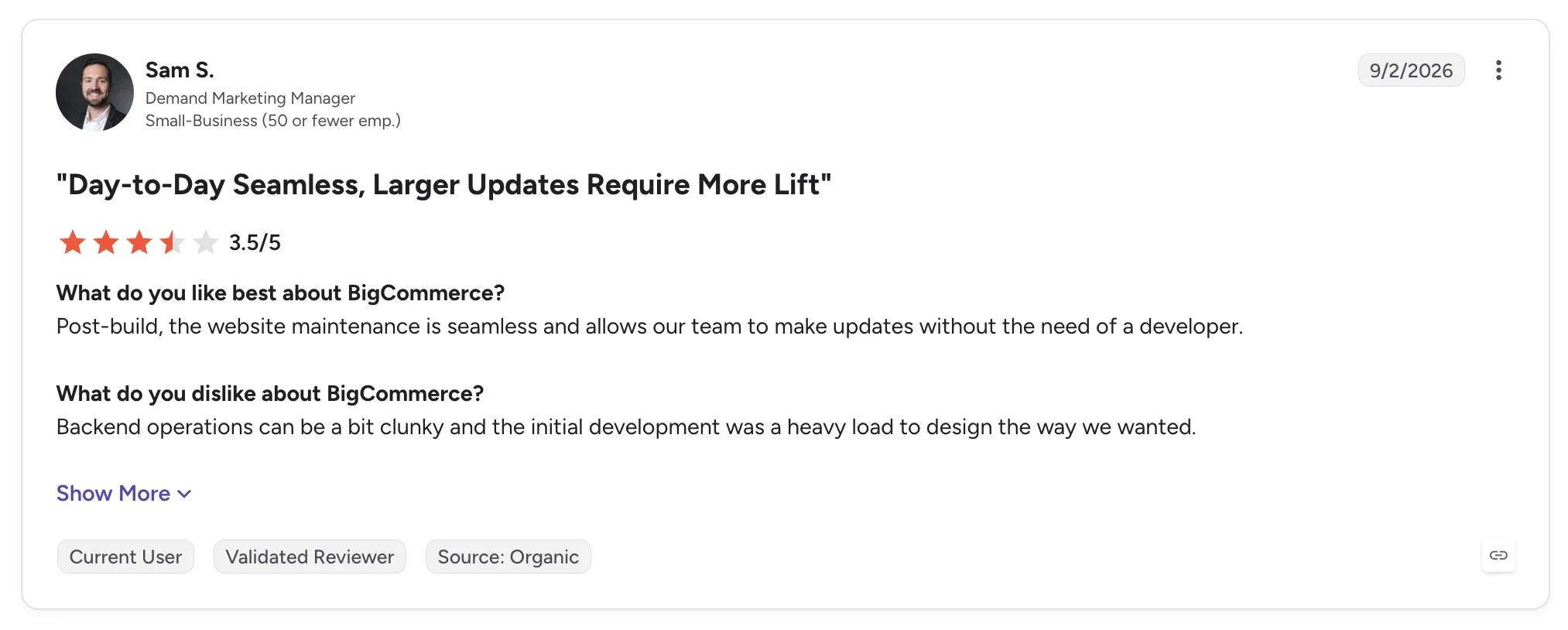
- Admin feels dated to some reviewers, and the first build is heavy
- Missing native integrations often call for a developer
Customer Reviews
BigCommerce holds 4.2 out of 5 across 582 G2 reviews and 4.4 out of 5 across 341 Capterra reviews.
Reviewers praise ease of use and responsive support, along with B2B pricing rules for customer groups and bulk discounts. Several describe a stable service on peak days and a back end that handles complex catalogs for hybrid DTC and B2B stores.
The criticisms center on limited template customization and plan thresholds tied to trailing 12-month revenue. Some reviewers find the admin clunky, and a few moved to a larger app network after outgrowing the native integrations.
Final Verdict
BigCommerce suits mid-market merchants with complex catalogs and B2B price lists who want open APIs on a hosted service.
Its catalog covers the products you list, and stock that sits with outside suppliers needs its own sync. Carro connects to BigCommerce stores for that supplier layer, including order routing and payouts.
4. commercetools
Overview
commercetools is API-first, headless commerce software built on MACH principles: microservices, API-first design, cloud-native delivery and headless front ends. It serves B2C and B2B programs, including DTC brands, where the front end and back end are decoupled.
Teams compose the back end from services for catalog, cart, pricing and orders, then build any front end on top. For agentic commerce, an agent-facing app can call the same APIs a website does, as long as a development team builds and runs that layer.
Ideal For
- Enterprises with in-house engineering teams building composable stacks
- Retailers replacing a monolithic suite one service at a time
- Brands running many front ends and regions from one back end
- Architects who want event-based links to inventory and billing systems
Top Features
- Fast, documented APIs. Custom fields and types cover most data models without changes to the core.
- An event-based, modular design that pushes changes into connected inventory and billing systems as they happen
- Decoupled front and back ends, so a new channel reuses the same catalog and cart
- Cloud SaaS delivery that removes server upkeep for the commerce core
Why They Stand Out
commercetools is one of the strongest options for engineering-led teams that want every commerce function available through an API. Reviewers praise stable, well-documented APIs and knowledgeable support staff.
The composable approach also helps large organizations connect legacy systems piece by piece. For agent-facing channels, the API surface is already in place.
Pros
- API-first headless design
- Event-based sync with surrounding systems
- Decoupled front ends that share one catalog
- Reachable, knowledgeable support
Cons
- A dedicated development team is needed to build and run the storefront
- Basics such as returns can require custom code
- Onboarding is steep for non-technical staff, and native reporting is weak
- Supplier onboarding and supplier payouts need separate tools
Customer Reviews
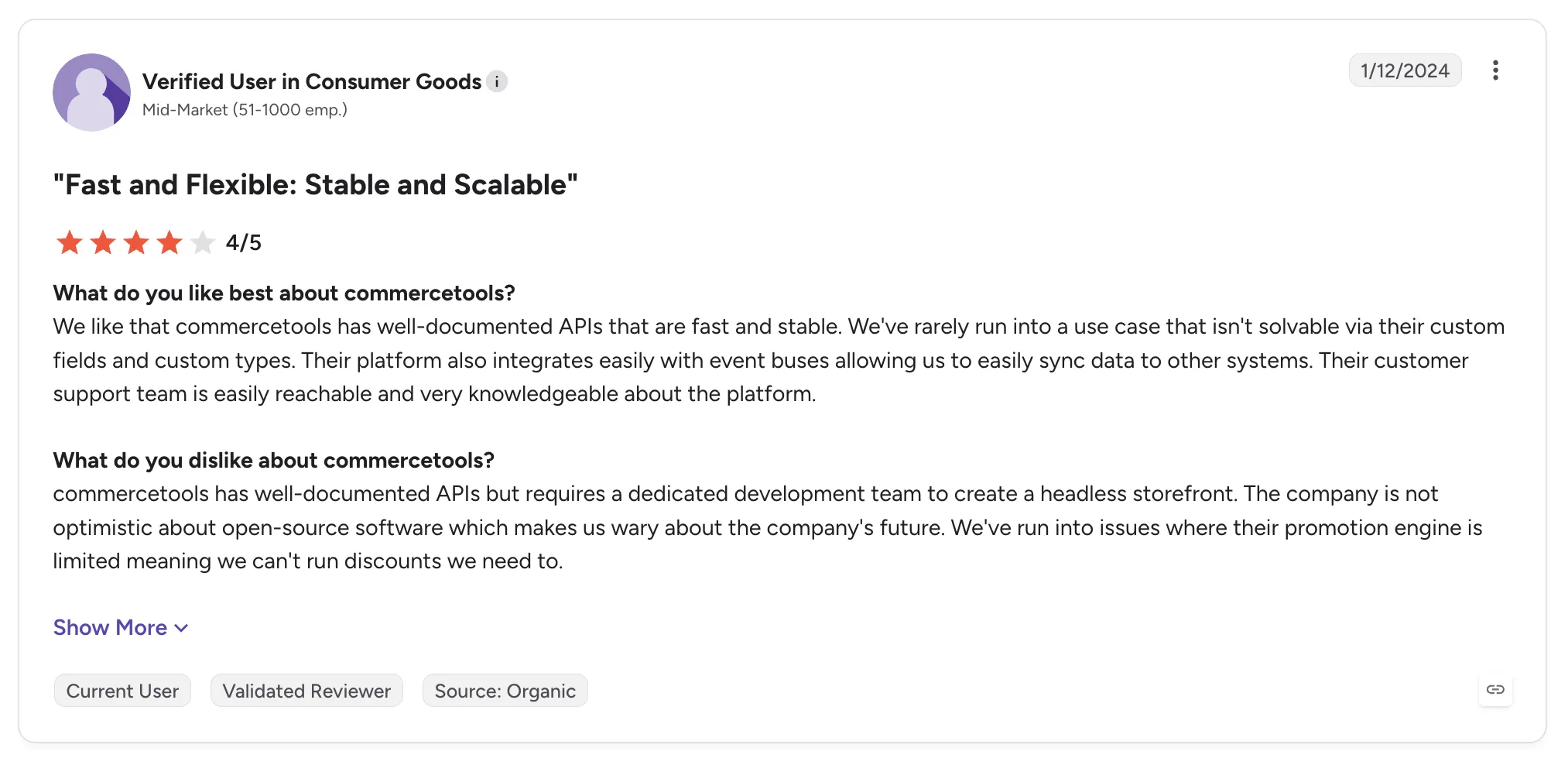
commercetools holds 4.5 out of 5 across 17 G2 reviews and 4.6 out of 5 across 17 Capterra reviews, both small samples.
Reviewers praise fast, stable APIs and a modular architecture that connects to inventory and billing systems. Support staff get credit for being reachable, and some describe quick configuration for tactical projects.
The criticisms focus on the need for a dedicated development team, with returns and other basics requiring code. Reviewers also mention a limited promotion engine and weak native reporting. One describes a core that is hard to extend.
Final Verdict
commercetools suits enterprises with engineering capacity that want full control over every commerce service and every front end.
Everything above the API is yours to build, including supplier onboarding and supplier payouts. Retailers adding brands they do not stock usually want those workflows ready-made.
5. Salesforce Commerce Cloud
Overview
Salesforce Commerce Cloud is enterprise commerce software for building branded storefronts and connecting shopping with marketing and service data. Retailers can start from templates or go headless through its APIs and PWA Kit.
It connects natively to Salesforce Marketing Cloud, Service Cloud, Data Cloud and Order Management. That gives merchandisers one view of each customer and AI-led product recommendations, and Salesforce has been adding AI features for shoppers and merchandisers across its commerce products.
Ideal For
- Enterprise retailers already running Salesforce for marketing and service
- Brands operating many storefronts and price lists across regions
- Merchandising teams that want personalization and AI recommendations
- Organizations with Salesforce Commerce developers or a consulting partner
Top Features
- Headless and composable options, including PWA Kit and Managed Runtime for custom front ends
- Native connection to Salesforce Marketing, Service, Data Cloud and Order Management, which puts customer and order data in one place
- Multiple storefronts and price lists on one instance
- Merchandising tools with AI-led product recommendations and promotion controls
Why They Stand Out
Salesforce Commerce Cloud is one of the strongest options for enterprises that already run Salesforce. Customer and commerce data connect without a separate integration project.
Reviewers describe it handling high-volume traffic along with complex catalogs and promotions. For an agent channel, that means one set of customer and order records behind every storefront.
Pros
- Native links to Salesforce marketing and service products
- Handles high traffic and complex catalogs
- Headless APIs and front-end tooling
- Many storefronts and price lists on one instance
Cons
- Steep learning curve, with documentation spread across several places
- Specialized developers raise build time and cost
- High licensing and total cost of ownership
- Legacy architecture slows local development and sandbox work
- Complexity grows with every added ERP or logistics connection
Customer Reviews
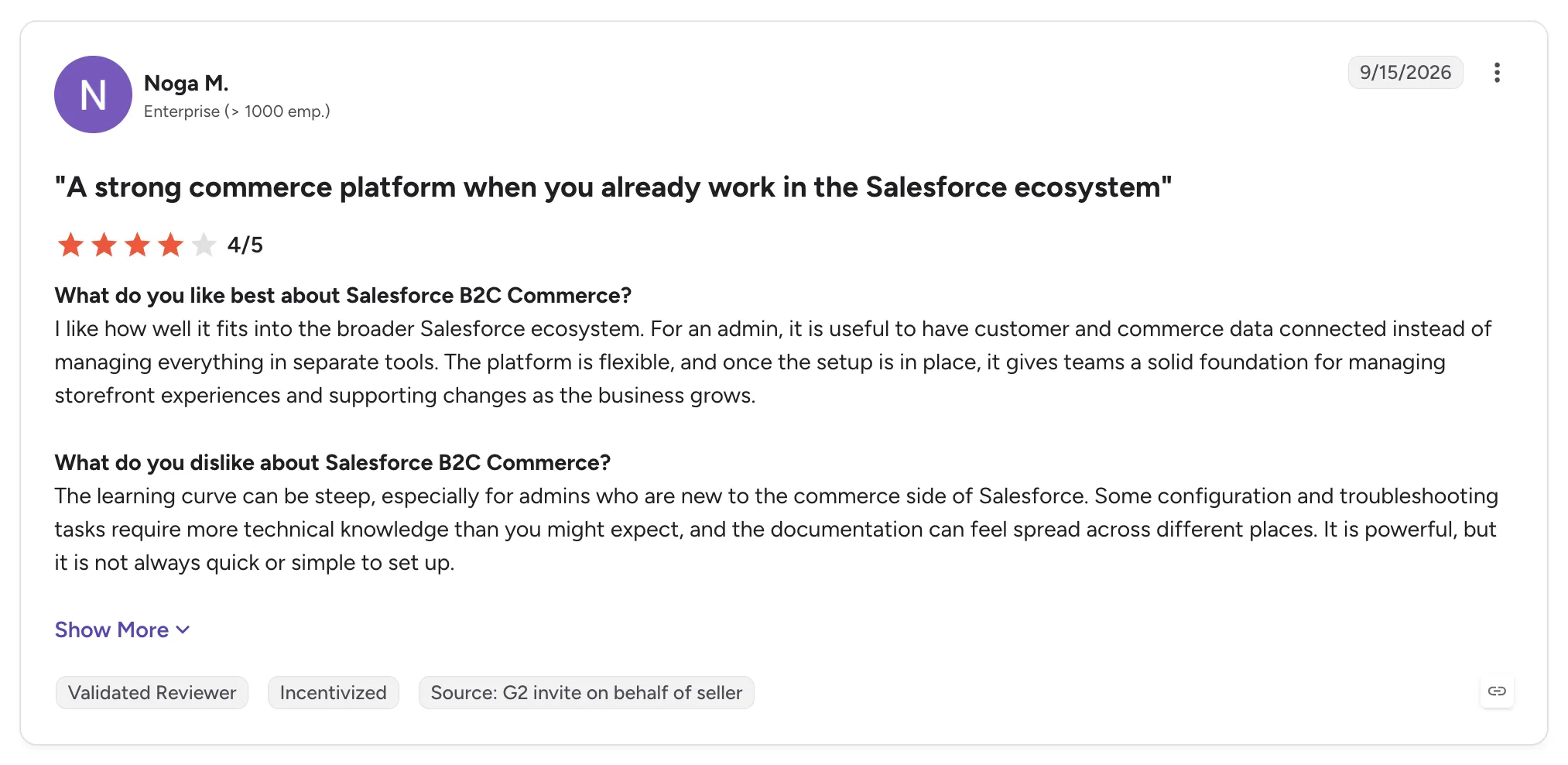
Salesforce Commerce Cloud, listed on G2 as Salesforce B2C Commerce, holds 4.3 out of 5 across 704 G2 reviews and 4.5 out of 5 across 102 Capterra reviews. Some Capterra reviews appear to describe Salesforce CRM more broadly.
Reviewers praise the native connection to Salesforce Marketing, Service, Data Cloud and Order Management for unified customer data. Others credit its handling of high traffic and its support for multiple storefronts with separate price lists.
The criticisms focus on a steep learning curve and the need for specialized developers. Reviewers also mention high licensing costs and slow sandbox loops on older architecture. Complexity grows as more systems connect.
Final Verdict
Salesforce Commerce Cloud suits large retailers that already run Salesforce and have the budget for specialist developers.
It runs the storefront and the customer record, and the supplier side of an extended assortment still needs its own system. Most retailers reading this guide will find its cost and complexity out of proportion to an agent channel alone.
6. Adobe Commerce

Overview
Adobe Commerce, formerly Magento Commerce, is enterprise commerce software for complex catalogs and B2B selling across many sites. Adobe positions it for catalogs running into millions of SKUs, with multi-language and multi-brand stores.
It now ships as Adobe Commerce as a Cloud Service, with an AI-assisted storefront and generative AI content tools. Live Search and product recommendations use AI to match shoppers to products.
Ideal For
- Enterprises with large, complex catalogs and custom pricing
- B2B sellers that need company accounts, shared catalogs, quotes and custom pricing
- Multi-brand, multi-region retail groups
- Teams with in-house or agency Magento developers
Top Features
- B2B suite. Company accounts, shared catalogs, quotes and custom pricing for complex buyers.
- Multi-site, multi-currency stores from one installation
- Live Search and product recommendations that use AI to rank results
- Extensions and integrations for ERP, CRM, PIM and payment systems
Why They Stand Out
Adobe Commerce is one of the strongest options for enterprises that need deep customization on a large catalog. Reviewers describe it handling massive catalogs and complex B2B buying under high traffic.
Its modular architecture connects to ERP, CRM, PIM and payment systems. For agent channels, a structured catalog with rich attributes gives an agent more to read.
Pros
- Deep customization through a modular architecture
- Handles large catalogs and traffic spikes on cloud hosting
- Complete B2B tooling for company accounts and quotes
- AI search and recommendations
Cons
- High total cost, with hosting and developer time on top of licensing
- Developer dependency even for routine changes
- Steep learning curve and long setup times
- Upgrades and extension compatibility add maintenance work
Customer Reviews
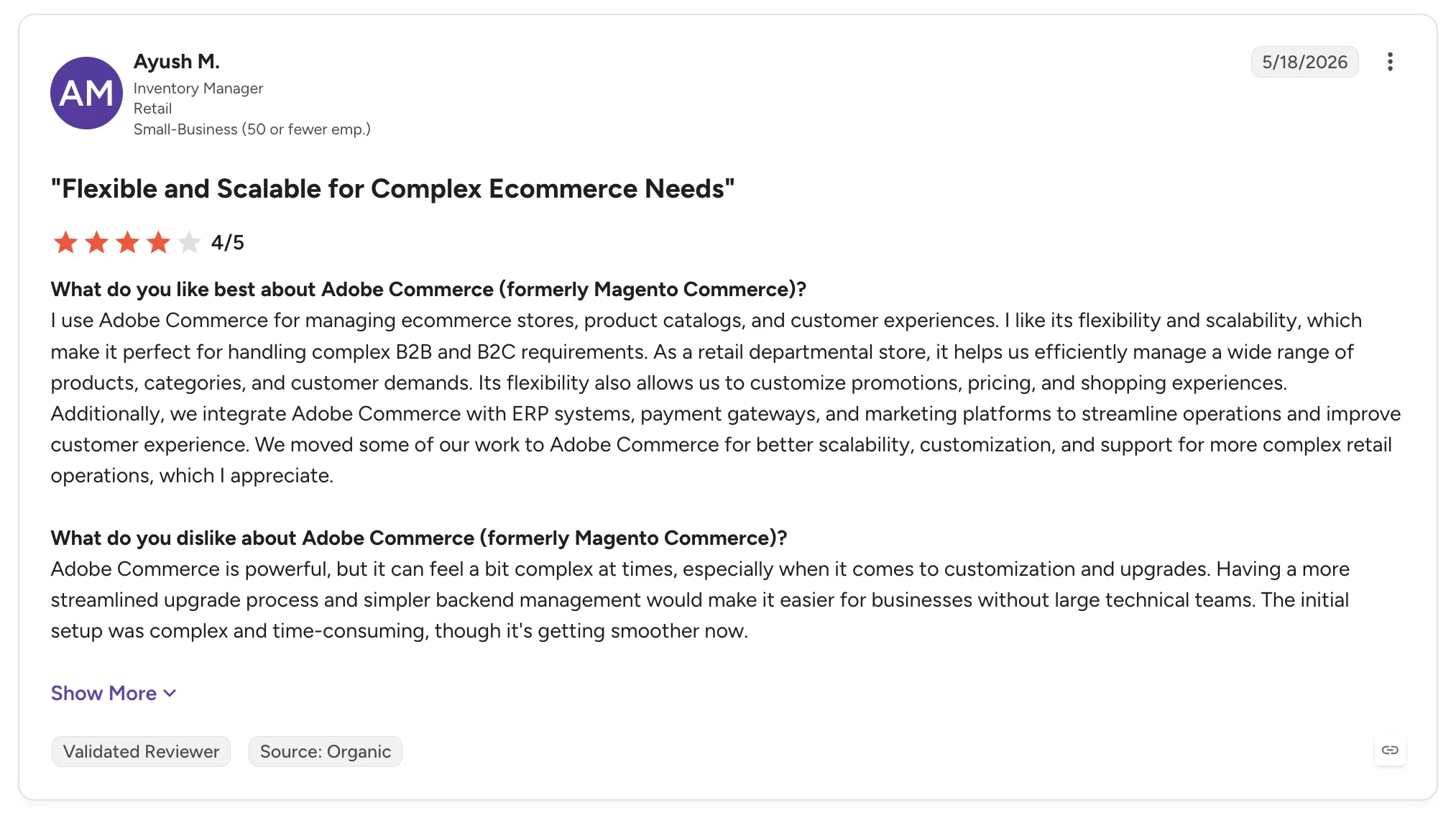
Adobe Commerce holds 4.0 out of 5 across 622 G2 reviews and 4.3 out of 5 across 662 Capterra reviews.
Reviewers praise flexibility and customization, along with its handling of massive catalogs and complex B2B setups. Content staging and AI tools such as Live Search also earn credit.
The criticisms center on high total cost of ownership and developer dependency for routine changes. Reviewers also describe a steep learning curve and months to launch changes. Upgrades take extra work when extensions conflict.
Final Verdict
Adobe Commerce suits enterprises with complex catalogs and B2B buyers, backed by a technical team to run it.
The cost and developer time are hard to justify for retailers whose main gap is supplier stock and supplier payouts. Carro connects to Magento 2 stores and handles that supplier layer without changes to the store build.
7. Mirakl
Overview
Mirakl is marketplace software for enterprise B2B and B2C organizations that want third-party sellers on their site. Operators approve sellers as they onboard, then route each order to the seller who ships it.
It connects to enterprise commerce stacks such as SAP and Salesforce Commerce Cloud. Mirakl has added AI features for catalog standardization and automated product and order flows.
Ideal For
- Enterprise retailers launching a large third-party marketplace
- B2B distributors opening seller programs
- Operators with long seller lists who need structured onboarding
- Organizations running SAP or Salesforce Commerce Cloud
Top Features
- Seller onboarding and approval. Structured workflows bring sellers live and approve their offers.
- Catalog standardization that maps seller data to the operator's product model
- Multi-vendor order management with APIs for connected systems
- Seller connectivity that links one seller to several marketplaces run on Mirakl
Why They Stand Out
Mirakl is one of the strongest options for enterprises running a large third-party seller program. Reviewers credit fast, structured seller onboarding and multi-vendor management at scale.
Its connectors to enterprise commerce stacks shorten integration for large retailers. For agent channels, standardized seller catalogs give an agent consistent data across sellers.
Pros
- Structured seller onboarding and approval
- Catalog standardization across sellers
- Multi-vendor order management at scale
- Connectors to major enterprise commerce software
Cons
- Complex interface with a learning curve during setup
- Strict marketplace workflows need workarounds or development
- Integration friction from unbundled APIs and unclear documentation
- Limited custom reporting without external tools
Customer Reviews
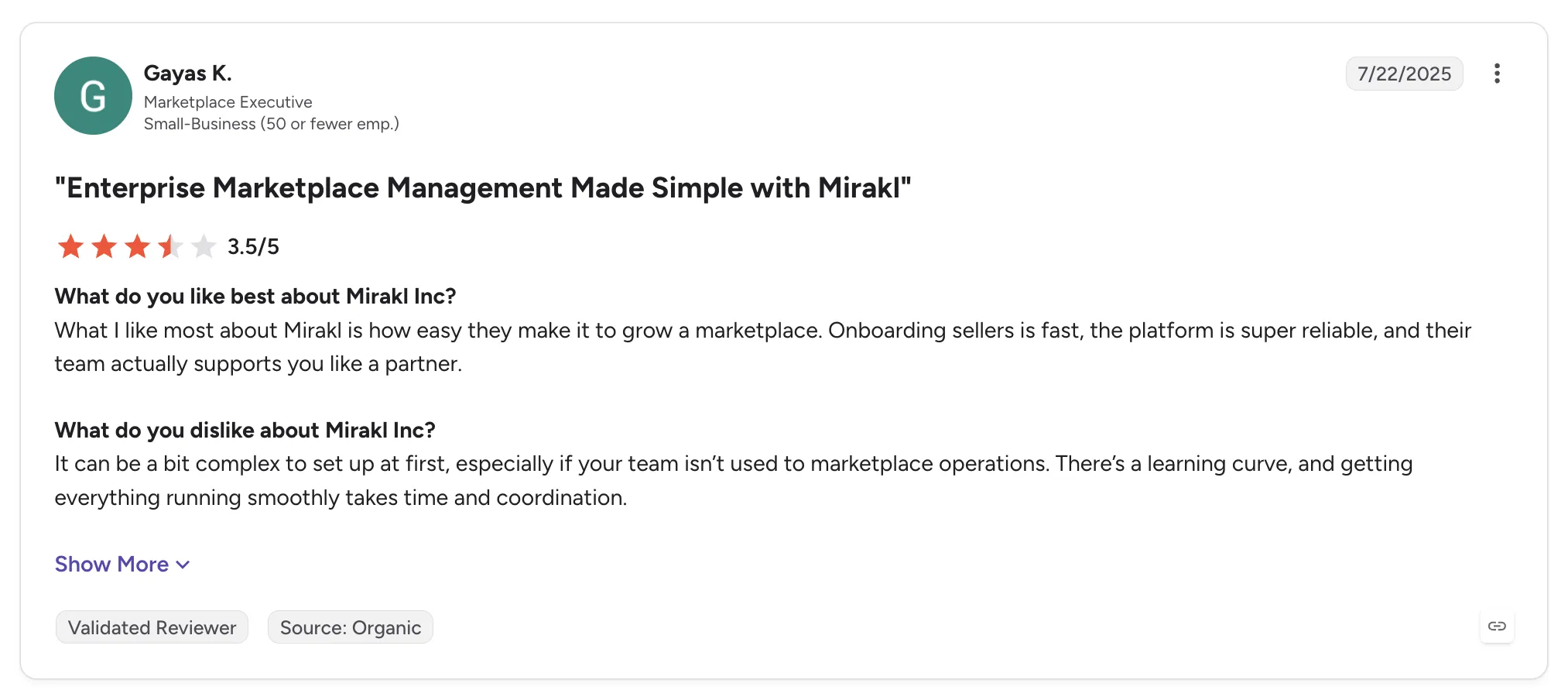
Mirakl holds 4.1 out of 5 across 14 G2 reviews, where it is listed as Mirakl Inc, and 4.5 out of 5 across 20 Capterra reviews. Both are small samples, and several reviewers appear to be sellers on Mirakl-run marketplaces.
Reviewers praise fast, structured seller onboarding and catalog standardization, along with API integrations and support that feels like a partner. Some value its fit with enterprise stacks such as SAP and Adobe Commerce.
The criticisms point to a complex interface and a learning curve during setup. Reviewers also mention strict workflows and limited custom reporting, and one describes integration friction from unbundled APIs.
Final Verdict
Mirakl suits large enterprises that want a big third-party marketplace and have a team to run it. Lighter options sit alongside it in our guide to multi-vendor marketplace software.
Agentic commerce tools such as Carro run under the store you already have, and a marketplace can open on it in weeks. Through Merchant Services, one commercial relationship with Carro covers the brand and distributor inventory it is authorized to represent, and each order settles when it ships.
8. Pipe17
Overview
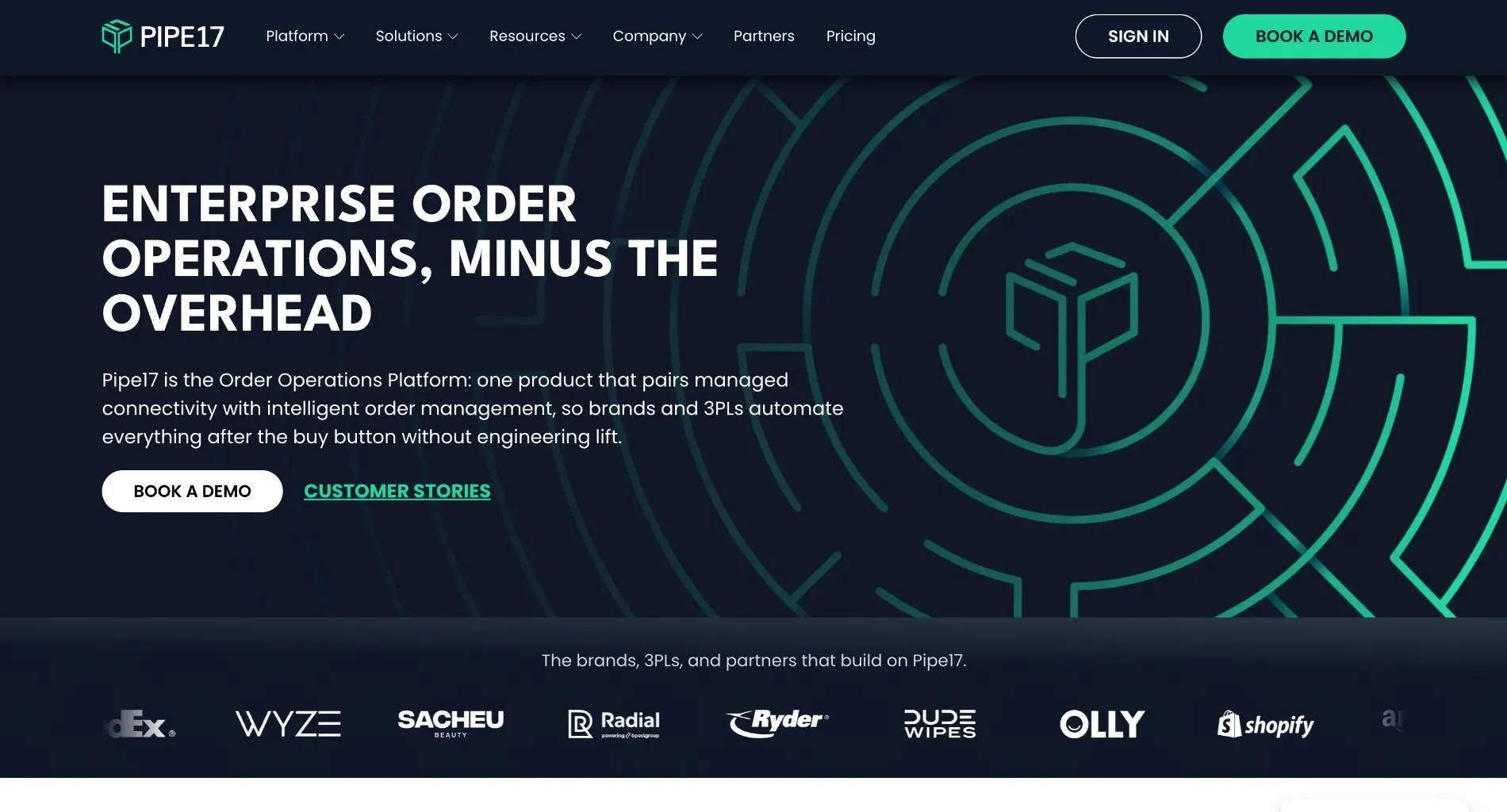
Pipe17 is AI-native order operations software that connects orders, inventory, products and fulfillment between selling channels and the ERPs and fulfillment locations behind them. Its channel list covers DTC, B2B, retail and agentic channels.
No-code routing rules send each order to the right warehouse or 3PL. An implementation team maps those rules and trains staff during setup.
Ideal For
- DTC and omnichannel brands running an ERP with one or more 3PLs
- Operations leads without developers who manage order routing
- Brands selling on marketplaces and through retail EDI
- Teams adding agentic channels to an existing order flow
Top Features
- Prebuilt connectors for storefronts, marketplaces, returns apps, ERPs and 3PLs
- No-code routing rules that send each order to the right fulfillment location
- Plain-language error messages. Non-technical staff can see what failed and fix it.
- EDI and inventory sync that grow from a single marketplace connection
Why They Stand Out
Pipe17 is one of the strongest options for brands whose orders arrive from many channels and ship from several locations they control. Reviewers describe connectors that go live quickly and routing rules set without developers.
The hands-on implementation team gets consistent credit. For agent channels, Pipe17 treats agentic orders as one more channel feeding the same routing.
Pros
- Quick setup of prebuilt channel, marketplace, ERP and 3PL connectors
- No-code order routing rules
- Error messages that non-technical staff can act on
- Hands-on implementation and responsive support
Cons
- Reviewers report price increases and a cost above other connectors
- ERP sync gaps around refunds, cancellations, bins and fulfillment locations
- Advanced setup and customization can be complicated
- Built around stock you own or control, with no supplier network or supplier payout workflow
Customer Reviews
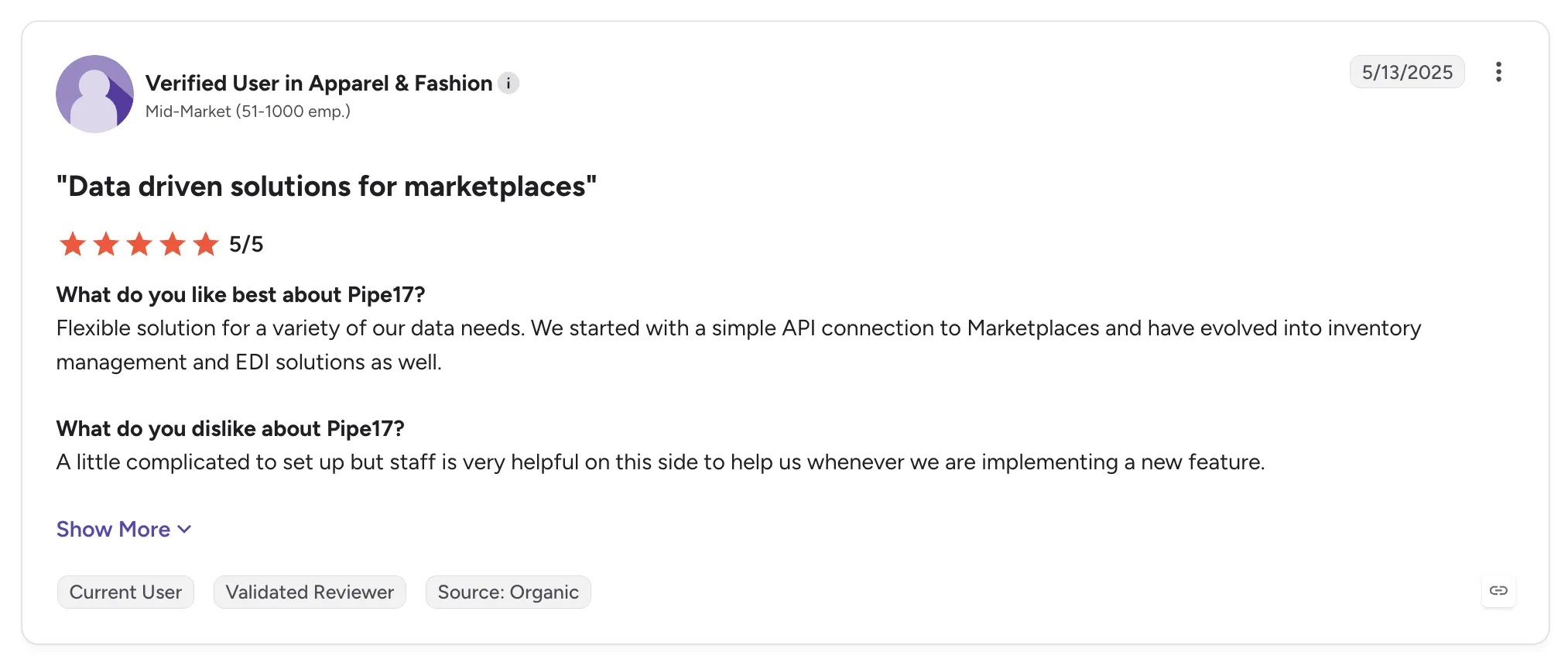
Pipe17 holds 4.6 out of 5 across 29 G2 reviews, a small sample.
Reviewers praise out-of-the-box connectors and no-code routing rules, with implementation staff who map rules and train teams. Plain-language error messages and responsive support also come up often.
The criticisms focus on price increases and ERP sync gaps around refunds, cancellations, bins and fulfillment locations. Some reviewers describe unpolished UI details and setup that gets complicated for advanced cases.
Final Verdict
Pipe17 suits brands that hold their own inventory and need orders from many channels routed to warehouses and 3PLs.
It routes orders for stock you control, and it does not source products from outside brands or pay suppliers. Retailers extending assortment need inventory management software that tracks supplier stock as well.
9. Feedonomics
Overview
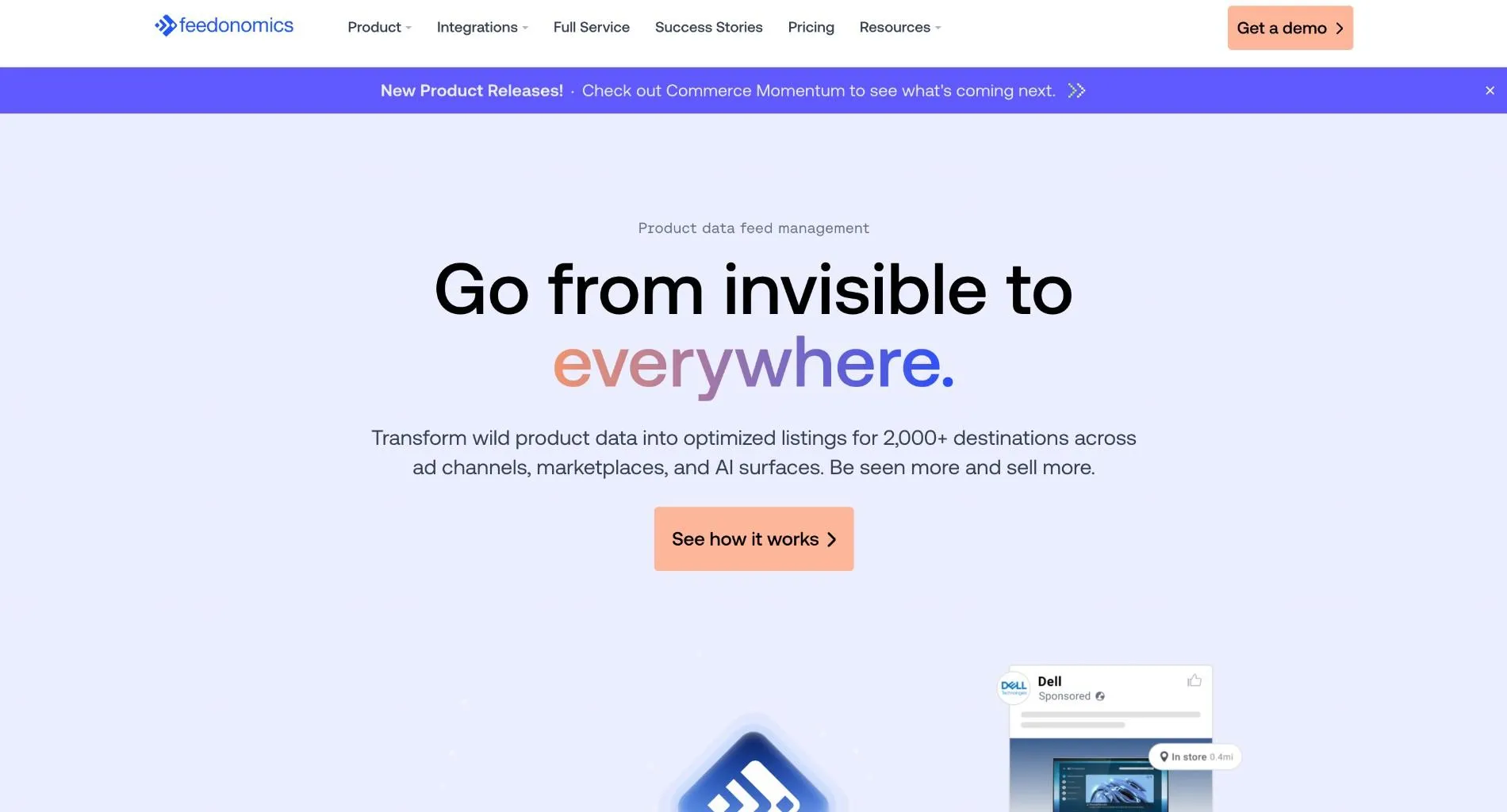
Feedonomics manages product feeds, reshaping one catalog into the format each channel expects across hundreds of marketplaces, search engines, social channels and AI-led discovery surfaces. It pairs the software with a full-service team that cleans data and builds feeds on request.
It also offers order orchestration that brings marketplace orders back into the store. Feedonomics sits under the same parent company as BigCommerce and works with other commerce software too.
Ideal For
- Retailers with large catalogs selling across many channels
- Brands that want product data ready for AI shopping surfaces and search ads
- Teams that prefer to hand feed work to a managed service
- Marketing teams running shopping campaigns across several networks
Top Features
- One feed, many destinations. New exports reuse the same source catalog.
- Rules that rewrite titles and attributes for each channel
- A full-service team for data cleansing and feed builds
- Order orchestration that pulls marketplace orders into the store
Why They Stand Out
Feedonomics is one of the strongest options for getting product data into shape for every channel a shopper or an agent might search. Reviewers describe sending and reshaping one feed for many destinations with little effort.
The managed service sets it apart from self-serve feed tools. For agent channels, clean attributes and titles make products easier for an AI to match to a request.
Pros
- Hundreds of channel destinations from one catalog
- Flexible feed rules for inventory and attributes
- Full-service team handles data work on request
- Responsive, knowledgeable support
Cons
- Steep learning curve and a menu structure some find confusing
- Rules can get convoluted and must be applied manually
- Support response times vary across time zones
- Feed accuracy depends on the stock and prices in the source data
Customer Reviews
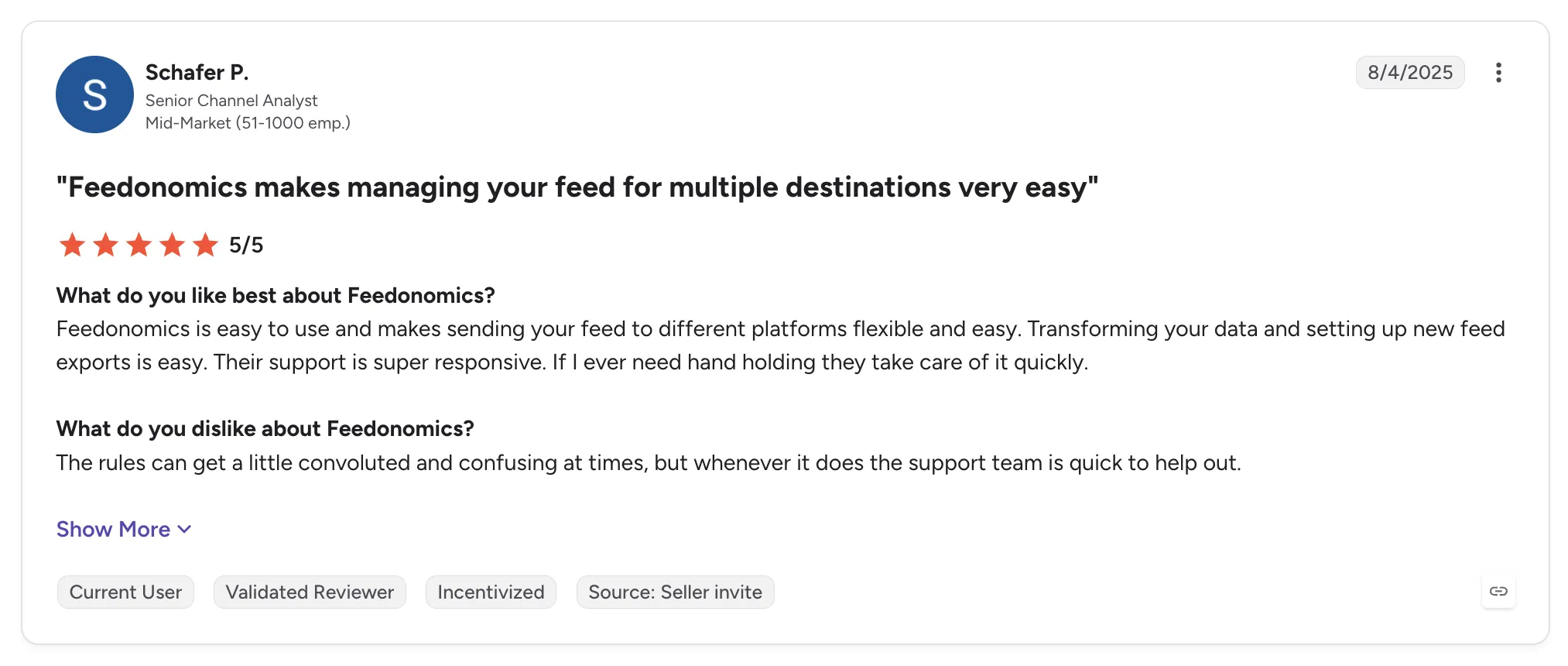
Feedonomics holds 4.4 out of 5 across 376 G2 reviews and 4.6 out of 5 across 19 Capterra reviews, the second a small sample.
Reviewers praise easy multi-destination feeds and a full-service team that handles data cleansing on request. Responsive support gets frequent credit, as does flexible handling of inventory feeds.
The criticisms focus on a steep learning curve and a confusing interface. Reviewers also mention convoluted rules that must be applied manually. Support timing varies, and a few call it expensive.
Final Verdict
Feedonomics suits retailers that need product data formatted for many channels, including AI shopping surfaces.
A feed can only be as accurate as the stock and prices behind it. For retailers selling supplier-held products, the sync from each supplier into the catalog has to happen first.
10. VTEX
Overview
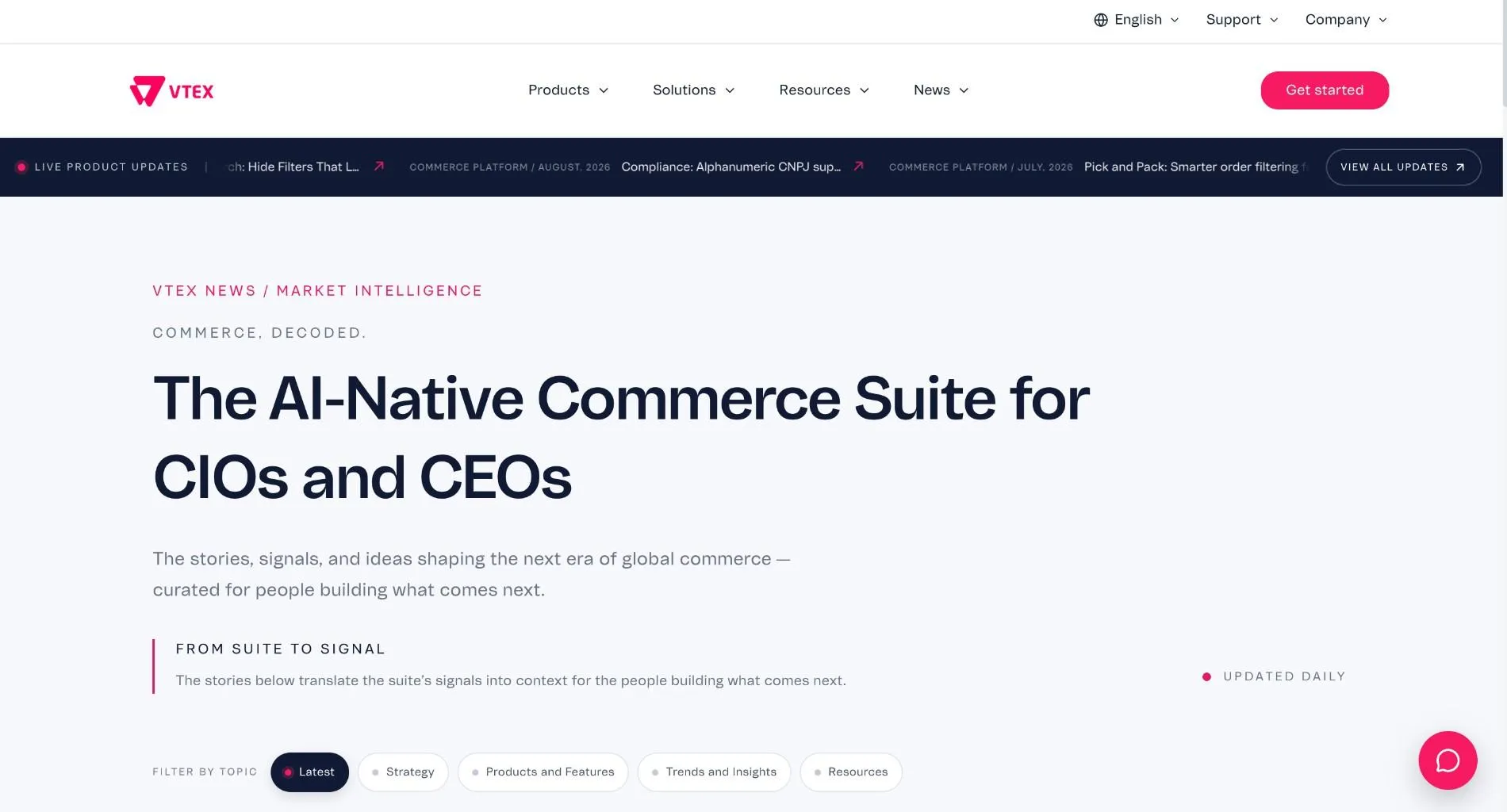
VTEX is enterprise commerce software for large retailers and manufacturers that combines storefront commerce and order management with native marketplace features. Retailers can add third-party sellers or sell on external marketplaces from the same back office.
Its headless, API-first design suits multi-country and large-catalog projects. VTEX has a strong base in Latin America alongside global enterprise accounts.
Ideal For
- Enterprise retailers selling across many countries
- Brands that want first-party selling and a marketplace in one system
- B2B manufacturers with large catalogs
- Teams working with VTEX-specialized agencies or partners
Top Features
- Native marketplace and seller management alongside first-party selling
- Order management with tracking across channels
- Headless, API-first architecture. Custom front ends and agent-facing apps call the same APIs.
- Multichannel administration with straightforward connectors
Why They Stand Out
VTEX is one of the strongest options for enterprises that want first-party commerce and a marketplace in one back office. Reviewers describe smooth multichannel administration and stable operation over years.
Its API-first design handles multi-country and B2B projects. For agent channels, first-party and seller products sit in one catalog.
Pros
- Store and marketplace in one back office
- Headless, API-first architecture
- Order management across channels
- Built for multi-country operations
Cons
- Complexity and heavy reliance on VTEX-specialized profiles
- Pricing and setup are complex for smaller businesses
- Some reviewers report slow page loads
- Local payment integration gaps in some Latin American markets
Customer Reviews
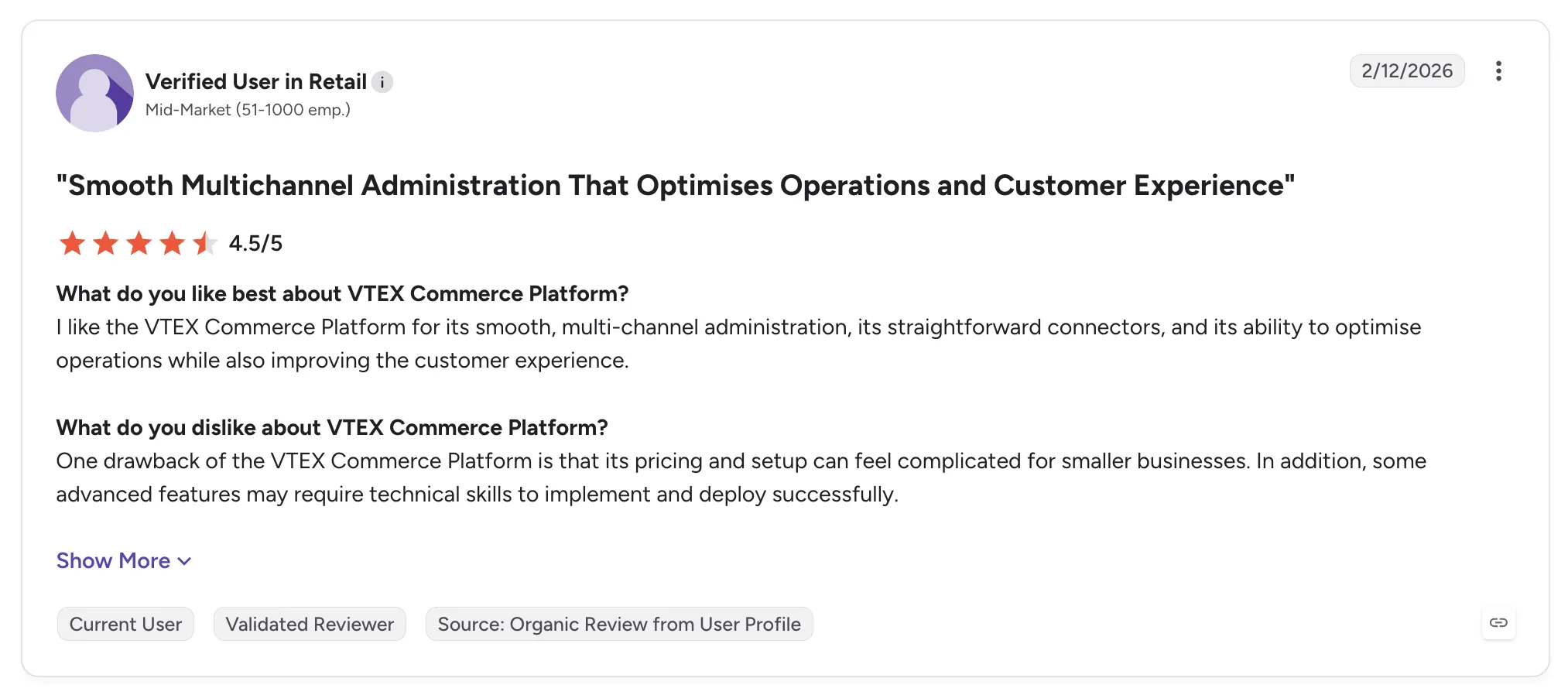
VTEX holds 4.5 out of 5 across 37 G2 reviews and 4.8 out of 5 across 20 Capterra reviews. Both are small samples, and many reviews are translated from Portuguese or Spanish.
Reviewers praise the headless, API-first architecture for complex projects and smooth multichannel administration. Order tracking and marketplace management also earn credit.
The criticisms center on complexity and dependence on VTEX specialists. Reviewers also mention pricing and setup that are hard for smaller businesses. Some report slow page loads and gaps in local payment options.
Final Verdict
VTEX suits global enterprises that want a store and a marketplace in one system and have specialist partners to run it.
For a retailer adding supplier brands to an existing Shopify, Magento 2, WooCommerce or BigCommerce store, moving to VTEX is a large project for one channel. A supplier layer under the current store gets there with less risk.
How to Choose the Best Agentic Commerce Platforms (What To Consider)?
The best agentic commerce platforms for your store depend on where your products come from. If most of them ship from suppliers, these six checks show whether an order an agent places will reach a supplier who can fill it, and whether everyone gets paid afterward.
1. Keep One Catalog Current Across Every Supplier
An agent trusts the catalog it reads, so supplier stock and prices have to reach that catalog as they change. Ask each vendor how stock moves from a supplier system into your catalog, and how often each connection type updates it.
Look for a partner price list per supplier, so a cost change reaches your catalog without anyone re-entering it. Validation that flags bad product data before launch matters too. Choose inventory management software that tracks supplier stock alongside your own, since a warehouse system only sees what sits on your shelves.
2. Confirm Agent-Placed Orders Route to the Supplier Holding the Stock
An agent does not know which brand ships which item. One basket can hold products from several suppliers, and the software has to split it into separate supplier orders and send each one into the system that supplier already works in, without anyone re-keying it.
Ask for a demo order across two suppliers on different connections, one on an app and one on EDI or files. Good dropship automation software tracks each supplier order from confirmed to shipped with tracking, and puts stalled orders and SKU mapping errors in front of the right person.
3. Check That Settlement Is Worked Out per Order
An agent channel can sell at any hour, so billing has to follow each shipment without someone assembling invoices by hand. The cleanest setup lets the shipment trigger the supplier invoice, charge the retailer and credit the supplier through a connected payment account.
Check where commissions, shipping costs, return credits and processing fees land. When they sit against the order, retailer and supplier read the same record. A failed charge should still surface for a person to act on, and return acceptance should stay a separate step under the terms agreed with each supplier.
4. Make Sure It Works Under the Storefront You Already Run
Rebuilding the store to get ready for agents puts the whole business at risk for a channel that is still growing. The supplier layer should connect to the store you have and leave it in place.
Favor tools that connect to Shopify, Magento 2, WooCommerce or BigCommerce through an app or API and run beside your payments, shipping, ERP and accounting systems. A move between dropship tools should change the connection under the store and leave the store itself where it is.
5. Ask How Suppliers Get Onboarded Before Agents Can Buy
Many suppliers have no technical team, so a tool that accepts one connection type leaves those brands out of your catalog and out of an agent's reach. Ask which methods are supported, such as EDI, API, SFTP, CSV files and commerce apps.
Then ask who does the setup with a supplier that has none of them in place. A defined sequence (account details, connection, product data, partner price list, test order, go live) shows where each supplier stands. The test order matters most, because it checks fulfillment, tracking and invoicing before an agent can buy that supplier's products.
6. Widen the Catalog Without Buying Stock
An agent can only buy from the products your catalog lists. Adding vetted brands with no purchase order widens that list, and you keep only what sells.
Check whether the vendor brings a curated network of established brands or leaves sourcing to you, and whether one commercial relationship covers many suppliers. Carro reports retailers growing catalog size by up to 3x, and The Gents Store added 2,500+ products with no inventory requirement.
Everything You Need to Know About Agentic Commerce Platforms
| Company | Pros | Cons | Ease of Use | Integrations | Support | Multi-Supplier Catalog Sync | Supplier Routing and Settlement |
|---|---|---|---|---|---|---|---|
| Carro | Current multi-supplier catalog; order splitting and routing; settlement tied to shipment | Needs a storefront in front; USD settlement; hand-matched network on Growth plan | ⭐⭐⭐⭐ | ⭐⭐⭐⭐ | ⭐⭐⭐⭐ | ⭐⭐⭐⭐⭐ | ⭐⭐⭐⭐⭐ |
| Shopify | Fast setup; hosted checkout; large app store | App costs; limited reporting; supplier stock needs apps | ⭐⭐⭐⭐⭐ | ⭐⭐⭐⭐⭐ | ⭐⭐⭐ | ⭐⭐ | ⭐ |
| BigCommerce | Open APIs; B2B price lists; stable at peak | Template limits; revenue-based tiers; dated admin | ⭐⭐⭐⭐ | ⭐⭐⭐⭐ | ⭐⭐⭐⭐ | ⭐⭐ | ⭐ |
| commercetools | Well-documented APIs; event-based sync; decoupled front ends | Dev team required; limited promotions; weak reporting | ⭐⭐ | ⭐⭐⭐⭐ | ⭐⭐⭐⭐ | ⭐⭐ | ⭐ |
| Salesforce Commerce Cloud | Connected customer data; high-traffic ready; many price lists | Steep learning curve; specialist developers; high cost | ⭐⭐⭐ | ⭐⭐⭐⭐ | ⭐⭐⭐⭐ | ⭐⭐ | ⭐⭐ |
| Adobe Commerce | Deep customization; large catalogs; B2B tooling | High total cost; developer dependency; long setup | ⭐⭐⭐ | ⭐⭐⭐⭐⭐ | ⭐⭐⭐ | ⭐⭐ | ⭐⭐ |
| Mirakl | Seller onboarding; catalog standardization; enterprise connectors | Complex setup; strict workflows; limited reporting | ⭐⭐⭐ | ⭐⭐⭐⭐ | ⭐⭐⭐⭐ | ⭐⭐⭐⭐ | ⭐⭐⭐⭐ |
| Pipe17 | Quick connectors; no-code routing; clear errors | Price increases; ERP sync gaps; own stock only | ⭐⭐⭐⭐ | ⭐⭐⭐⭐ | ⭐⭐⭐⭐ | ⭐⭐⭐ | ⭐⭐ |
| Feedonomics | Hundreds of channels; managed feed work; responsive support | Learning curve; manual rules; depends on source data | ⭐⭐⭐ | ⭐⭐⭐⭐⭐ | ⭐⭐⭐⭐ | ⭐⭐ | ⭐ |
| VTEX | Store and marketplace together; API-first; multi-country | Specialist reliance; complex for small teams; slow pages reported | ⭐⭐⭐ | ⭐⭐⭐⭐ | ⭐⭐⭐⭐ | ⭐⭐⭐ | ⭐⭐⭐ |
Get Every Supplier's Catalog Ready for AI Agents with Carro
Sell where an AI agent shops on a buyer's behalf, with a multi-supplier catalog the agent can trust. A shopping agent that reads a stale catalog sells what you cannot ship, so Carro keeps stock and prices current across every supplier, under the storefront you already run.
An order an agent places is then an order that can be filled. Carro routes it to the supplier holding the stock and tracks it to the door. Fees, commissions, payouts and returns are worked out per order, while return acceptance stays with the supplier under agreed terms and a failed charge surfaces for your team to act on.
Suppliers onboard in days, and a test order checks fulfillment, tracking and invoicing before their products go live, so the catalog and settlement are in place before you open an agent channel. Each brand you add is tested on real demand with no purchase order.
Carro counts PacSun, eBay, NBCUniversal and Huckberry among its customers, and it has moved the customer bases of Modern Dropship and Onport onto its own system. The Carro success stories show how retailers and brands run it day to day.
Book a demo with Carro and bring the supplier list you want AI agents to sell from.
Frequently asked questions
What are agentic commerce platforms used for?
Agentic commerce platforms are used for selling to AI shopping agents that find and buy products on a buyer's behalf, and for fulfilling and settling the orders those agents place. They keep stock and prices current so an agent reads accurate listings, then pass each order through checkout to whoever holds the stock. For retailers selling from suppliers, the same software splits one order into separate supplier orders and pays each supplier after shipment. Carro, for example, keeps a network of 1,500,000 products current across suppliers and can pay a supplier the day an order ships.
What are the best agentic commerce platforms in 2026?
The best agentic commerce platforms in 2026 are Carro for multi-supplier catalogs and order settlement, Shopify and BigCommerce for hosted storefronts and checkout, Salesforce Commerce Cloud, Adobe Commerce, commercetools and VTEX for enterprise builds, and Mirakl for third-party marketplaces. Two specialists round out the list: Pipe17 for order routing across channels and 3PLs, and Feedonomics for product feeds. Carro ranks first for retailers and marketplaces selling from many suppliers because it keeps supplier stock and prices current and settles each order when it ships. It draws on a network of 1,500,000 products and runs under Shopify, Magento 2, WooCommerce and BigCommerce.
What should I consider when choosing the right agentic commerce platform for me?
When choosing the right agentic commerce platform for you, consider whether one catalog stays current across every supplier, with stock and partner prices reaching the listings an agent reads. Check that an agent-placed order splits into separate supplier orders and routes to the supplier holding the stock, with each order tracked from confirmed to shipped. Confirm that settlement is worked out per order, with the shipment triggering the supplier invoice and fees and returns recorded against that order. Make sure the tool works under the Shopify, Magento 2, WooCommerce or BigCommerce store you already run, then test a real order across two suppliers before you sign.
What features should I look for in agentic commerce platforms?
The features to look for in agentic commerce platforms are stock and price sync from every supplier, partner price lists, order splitting and routing, an exceptions view and settlement triggered by shipment. Supplier onboarding that ends with a test order keeps new brands away from agents until fulfillment, tracking and invoicing are proven. Connections through EDI, API, SFTP, CSV and commerce apps let every supplier join, including those without technical teams. Carro combines these features across a network of 1,500,000 products from established brands, under the storefront you already run.
How does Carro differ from similar alternatives?
Carro differs from similar alternatives by acting as the inventory layer for agentic commerce, under the storefront you already have. Storefront tools such as Shopify and Adobe Commerce hold the checkout, and feed or order tools such as Feedonomics and Pipe17 work with data and stock a brand already controls. Carro keeps one catalog current across every supplier, drawing on a network of 1,500,000 products from established brands. An order an agent places routes to the supplier holding the stock, and settlement follows the shipment, with fees and returns worked out per order and a failed charge surfaced for a person to act on.
How do I get started with Carro?
You get started with Carro by booking a demo and bringing the supplier list you want AI agents to sell from, plus a real order path to walk through. Carro connects to your Shopify, Magento 2, WooCommerce or BigCommerce store, and each supplier then moves through a defined sequence: account details, connection, product data, partner price list, test order and go live. Suppliers onboard in days, and the test order checks fulfillment, tracking and invoicing before an agent can buy those products. Pricing is scoped per program through a custom pricing request.
How easy is it to switch to Carro?
It is easy to switch to Carro, because the migration changes the connection under your storefront and leaves the storefront where it is. Carro has moved the customer bases of Modern Dropship and Onport onto its system, and sellers can follow the retailer across. It connects through API, EDI, SFTP or a commerce app and runs beside your payments, shipping, ERP and accounting systems. The Carro team works directly with brands that have no technical staff, as it did for The FairGround's move from Onport, and once connected the same catalog serves shoppers and AI agents alike.
Can Carro work with the storefront and checkout I already run?
Carro works with the storefront and checkout you already run, through apps for Shopify, Magento 2, WooCommerce and BigCommerce and through API, EDI, SFTP or file connections for other systems. Your store keeps the checkout that a shopper or an AI agent uses, and Carro keeps supplier stock and prices current behind it, on the cadence each supplier's connection supports. Orders route to the supplier holding the stock, and settlement follows each shipment through a connected payment account in USD. Payments, shipping, ERP and accounting systems stay in place with no custom build.