Composable Commerce Explained: What It Is, How It Works, and Why Assortment Is the Missing Piece
MACH, PBCs, events, and the supply layer most stacks still hand-build: see how composable commerce holds up once suppliers join. Read the 2026 guide.
Open any composable commerce architecture diagram and you'll find the same boxes: a front end, a commerce engine, a PIM, search, payments, and an order management system. APIs wire each box to the others.
Now trace a product that a brand ships from its own warehouse on your behalf. None of those boxes onboards that brand, pulls its stock, sends it the order, or pays it when the parcel leaves.
That gap is where plenty of composable projects turn into custom builds. A team swaps its search in one quarter and its CMS in the next.
Then it spends month after month writing supplier connectors, stock sync scripts, order-splitting logic, and invoice reconciliation jobs that no vendor on the diagram was asked to cover.
You can plan that layer from day one and skip the rebuild. This guide covers what the term means, where MACH and packaged business capabilities come from, how the layers talk, and how composable compares with monolithic and headless builds.
It also covers supply, the layer most diagrams leave blank. If your assortment includes products from brands and distributors you don't stock, that layer needs a component with a clear owner for every record it touches.
Carro is that supply layer for retailers, marketplaces, brands, and shopping platforms. The final sections show exactly where it plugs in.
Key Takeaways (TL;DR)
- What it is: composable commerce builds your store from independent components (front end, commerce engine, PIM, search, payments, order management) connected through APIs, so you can swap one without rebuilding the rest.
- Built on MACH: composable-ready software usually follows four principles, microservices, API-first, cloud-native SaaS and headless, so each component can be deployed and replaced on its own.
- Headless is one ingredient: separating the front end from the back end is the H in MACH, and a headless store can still sit on a monolithic back end.
- Running costs: every benefit comes with extra vendors and contracts, integrations to monitor, and a team that has to own the data model between them.
- AI returns: in the MACH Alliance 2026 Enterprise Technology Report, 78% of fully composable organizations achieved measurable AI ROI, against 13% of those in early planning.
- AI agents read your APIs: the Agentic Commerce Protocol (Stripe and OpenAI) and the Universal Commerce Protocol (Shopify and Google) both depend on catalogs with accurate stock and prices.
- The missing layer: supplier onboarding, catalog sync, order routing, and settlement for products you don't stock usually end up as custom code.
- Where Carro fits: as that supply layer, running beside your payments, shipping, ERP, and accounting systems, with suppliers connected by EDI, API, SFTP, CSV, or platform apps and no replatform.
Composable Commerce: at a Glance
Here are the building blocks of a composable stack, and what each one changes for your team.
| Building block | What it means | What it changes for you |
|---|---|---|
| Microservices | Small, independent services, each doing one job | You update or replace one service without redeploying the whole store |
| API-first | Every function is exposed through an API before any interface is built | Any front end, app, or AI agent can call the same capability |
| Cloud-native SaaS | Vendor-hosted software that scales and updates on the vendor's side | Upgrades stop being projects your team schedules and staffs |
| Headless | The front end is decoupled from the back-end systems | Design and channel changes ship without touching checkout or catalog |
| Packaged business capabilities | A deployable unit covering one business function, such as cart or search | You buy and swap capabilities as units, each with its own data and logic |
| Events and webhooks | Systems notify each other when a record changes | Stock, order, and price changes reach other layers without waiting for a nightly batch |
| Supply layer | Supplier onboarding, catalog sync, order routing, and settlement for products you do not stock | Decides whether a product you list can be shipped and paid for |
That seventh row decides whether your extended assortment runs on software or on a spreadsheet per supplier.
What Is Composable Commerce?
Composable commerce is an approach to building a digital store from separate, specialized components. Each one owns a single business capability and connects to the others through APIs.
A traditional suite runs storefront, catalog, cart, checkout, search, and order management inside one product from one vendor. In a composable build, you pick a component for each job and connect them yourself or through an integration partner.
The approach organizes your stack around the jobs your customers need done, from finding a product to paying for it. Each job maps to a packaged business capability, which you'll meet in a moment.
The Four MACH Principles
Composable-ready software usually follows four principles, known together as MACH. Vendors use the acronym to signal that a component will plug into a composable stack.
- Microservices: small, independent components that can be combined into larger systems and deployed on their own.
- API-first: APIs are the primary way components communicate.
- Cloud-native SaaS: software run as a cloud service, with scaling and upgrades handled by the vendor.
- Headless: the user interface is decoupled from the underlying system.
The MACH principles apply to individual components. Your stack can still be composable when some of its parts meet only two or three of them, which is common with older ERP and OMS systems.
Packaged Business Capabilities
A packaged business capability, or PBC, is an independently deployable module that holds its own business data, logic, and process. It talks to other modules through APIs and event channels.
Cart, promotions, product search, and payments are typical examples. A PBC sits one level above a microservice: one capability might hold several microservices under the hood, and you buy and replace it as a unit.
The idea pays off in planning, because your roadmap turns into a list of capabilities with owners. Replacing search becomes a scoped project with a clear boundary, and the rest of the stack keeps selling while it happens.
How Composable Commerce Works
A composable stack runs on two kinds of traffic. Requests travel over APIs, such as a storefront asking for a price or a checkout asking payments to authorize a card.
The second kind is events, which announce that a record changed: a supplier's stock drops to zero, or an order moves to shipped.
Here's how the layers usually divide the work.
| Layer | Its job | Records it owns | How it connects |
|---|---|---|---|
| Storefront or front end | Renders pages, apps, and channel feeds | Page content, sessions, layout | Calls every other layer through APIs |
| Commerce engine | Cart, checkout, pricing, promotions | Carts, price rules, orders at creation | APIs, order-created events |
| PIM | Governs product content you author | Attributes, copy, assets, translations | Publishes product updates to the engine and channels |
| Search and merchandising | Query handling, ranking, filters | Search index, ranking rules | Re-indexes when catalog events arrive |
| Payments | Authorizes, captures, and refunds | Charges, refunds, payment status | APIs plus payment webhooks |
| Order management (OMS) | Allocates orders and follows them through fulfillment | Order state, allocations, shipments | Order events in, fulfillment events out |
| Supply layer | Onboards suppliers, syncs their catalogs and stock, routes their orders, settles invoices | Supplier connections, partner price lists, supplier orders, invoices | EDI, API, SFTP, CSV, platform apps, webhooks |
| ERP and accounting | Financial records and reporting | Ledger entries, cost, tax | Exports from payments and settlement |
The supply layer row only exists in stacks where somebody planned for it. Everywhere else, its work is spread across scripts, inboxes, and a finance team rebuilding invoices by hand.
Follow One Order Through the Stack
Picture a customer who buys a trail running shoe and a 28-liter pack, each from a different brand your store doesn't stock. Checkout calls payments to authorize the card, and the commerce engine emits an order-created event.
From there, the order splits into two supplier orders, each sent into the system that brand already uses. Each brand ships its own parcel with its own tracking number.
Each shipment should then trigger that supplier's invoice. If no layer owns the supplier side of that chain, a person owns it, usually with a spreadsheet open.
Composable vs Monolithic vs Headless
The three terms often get used interchangeably. This table separates them by what changes for the team running your store.
| Dimension | Monolithic | Headless | Composable |
|---|---|---|---|
| How it is built | One suite runs front end and back end | Front end separated from one back-end suite | Front end and back end split into independent components |
| Changing one function | Customize or upgrade the suite | Front end changes freely, back end changes like a monolith | Swap the component that owns that function |
| Vendors to manage | One | Usually two | One per capability you choose to buy |
| Upgrades | Vendor-scheduled, often a project | Split between your front end and the suite | Continuous, per component |
| Integration work | Low, handled inside the suite | Front end to back-end APIs | High, since every component pair needs an agreed contract |
| Suits teams that | Run a standard catalog with a small team | Need design and channel speed above all | Have engineering capacity and distinct needs per capability |
| Supply for products you do not stock | Plugins or custom code | Same as the back-end suite | A separate component, if you plan for one |
Headless is the H in MACH, and many teams go headless first because the front end is where the pressure shows. A headless store on a monolithic back end still upgrades its catalog, cart, checkout, and orders as one unit.
Composable goes further and splits the back end too. Neither step is mandatory, and plenty of retailers run a well-configured suite for years before one capability forces the question.
Key Benefits of Composable Commerce, and What They Cost
The key benefits of composable commerce show up in the returns. In the MACH Alliance 2025 Global Annual Research Report, 9 in 10 organizations that had implemented some MACH technology said it met or exceeded their ROI expectations.
The same survey of 561 enterprise IT leaders found 54% naming greater automation through improved systems and process integration as a top benefit.
Each benefit also carries a running cost that rarely makes the pitch. Budget for both lines before you sign the first contract.
1. Replace One Capability Without Rebuilding the Rest
When search stops keeping up, you replace search. Checkout, catalog, pricing, and order management keep running while the new component is tested behind the same API contract.
The cost is migration work at every swap. Data moves to the new service, and every component that called the old one needs its contract retested.
2. Pick the Right Tool for Each Job
Pair a search engine built for large catalogs with an OMS built for split shipments, then add a PIM and a payments provider chosen the same way. Each vendor competes on one capability, and you get the depth that comes with that focus.
The running cost: six components can mean six contracts. Each has its own renewal date, support queue, security review, and data processing agreement.
3. Ship Front-End Changes Faster
With a headless front end, your designers and developers release page changes on their own schedule. A campaign landing page goes live without waiting for a back-end release window.
In return, hosting, performance monitoring, accessibility, and front-end security become your team's job.
4. Open New Channels From the Same Back End
A mobile app, a marketplace listing, a social storefront, and an AI agent can all read the same catalog and write to the same order flow. You add a channel by adding a consumer of APIs you already run.
The flip side is that every data error travels to every channel at once. A wrong partner price reaches the storefront, the app, the marketplace feeds, and any agent-facing endpoint before anyone spots it.
5. Scale the Busy Parts Independently
On a peak weekend, search and checkout take the load while the rest of the stack idles. A composable stack scales those components on their own, and cloud-native SaaS vendors handle most of that scaling for you.
When an order stalls, the fault could sit in any of six services. You need monitoring that follows one order across all of them.
Across all five, composable commerce moves cost from the license line to the integration and operations lines. Plan for that shift up front, and the benefits keep paying out.
Why Composable Commerce Matters in 2026
Why composable commerce matters in 2026 comes down to who, or what, is reading your stack. Three shifts are converging, and each one rewards clean APIs and accurate data.
If you plan to sell where AI agents shop this year, start with the first shift. The third one applies once your growth plan adds products you never stock, because it puts supplier data inside your stack.
1. AI Shopping Agents Buy Through APIs
On September 29, 2025, Stripe and OpenAI released the Agentic Commerce Protocol, an open standard for purchases that AI agents complete on a buyer's behalf. It launched alongside Instant Checkout in ChatGPT.
In January 2026, Shopify and Google introduced the Universal Commerce Protocol, an open standard for agents to connect and transact with merchants. It covers capabilities such as checkout, orders, and catalog.
Both protocols assume a merchant exposes accurate products, prices, and order status through an interface a machine can call. A composable stack already works that way, and that's why composable commerce is important for retailers selling where agents shop.
Composable adopters are already turning that readiness into AI returns. In the MACH Alliance 2026 Enterprise Technology Report, 78% of fully composable organizations achieved measurable ROI on their AI investments.
Only 13% of organizations still in early planning could say the same, across a survey of 600 enterprise technology decision-makers.
The weak point is the data behind the interface. A shopping agent that reads a stale catalog sells what you can't ship, and our guide to Shopify agentic commerce walks through why AI skips products whose data it can't trust.
2. More Channels Read the Same Catalog
Your storefront, your app, marketplace feeds, and agent-facing endpoints now read from one catalog at the same time. Every channel inherits the accuracy of that catalog, good or bad.
Stocked products are covered by your own OMS. The harder case is a product a brand ships, where your catalog is only as current as the last stock and price update that brand sent.
3. Assortment Growth Without Buying Stock
Retailers and marketplaces keep adding products they don't hold, because a category tested on real demand needs no purchase order up front. That model depends on supplier data flowing into the stack and orders flowing back out.
Agentic channels raise the stakes further. An order an agent places has to route to the supplier holding the stock and settle correctly, with nobody watching the checkout.
Carro built its agentic checkout use case around exactly that job.
Why Assortment Is the Missing Piece
Most composable commerce content is written for the products you own. It explains how to swap a CMS, replace search, split checkout from the catalog, or put a new front end on the same cart.
That advice assumes every product came from your warehouse, and extended assortment breaks the assumption. The moment a brand or distributor ships on your behalf, your stack picks up a set of jobs the usual components were never designed to run.
| Supply job | What it involves | Why the usual components skip it |
|---|---|---|
| Choosing and approving suppliers | Finding brands that fit your audience, agreeing terms and channel rights | A PIM or commerce engine starts after the relationship exists |
| Connecting each supplier's system | One supplier runs a Shopify app, another sends EDI documents over SFTP | Each format needs its own mapping and monitoring |
| Mapping product data | Descriptions, images, and variants arriving in the supplier's structure | A PIM governs content you author, and supplier feeds change shape without warning |
| Keeping stock and partner prices current | Availability moving when the brand sells elsewhere, price lists changing | Your OMS holds your stock and knows nothing about the brand's |
| Splitting and routing orders | One basket becoming several supplier orders, each sent to the right system | The commerce engine creates one order and stops there |
| Tracking fulfillment per supplier | Separate parcels and tracking numbers for one customer | An order-level shipped flag is wrong for part of the basket |
| Returns under supplier terms | Requests the supplier accepts or rejects under agreed refund settings | Return rules differ per supplier relationship |
| Invoicing and settlement | Supplier invoices, partner fees, commissions, and payouts per order | Payments captures the customer charge and leaves the supplier side to finance |
These jobs belong to a different category of software. They also produce the data every other layer in your stack consumes.
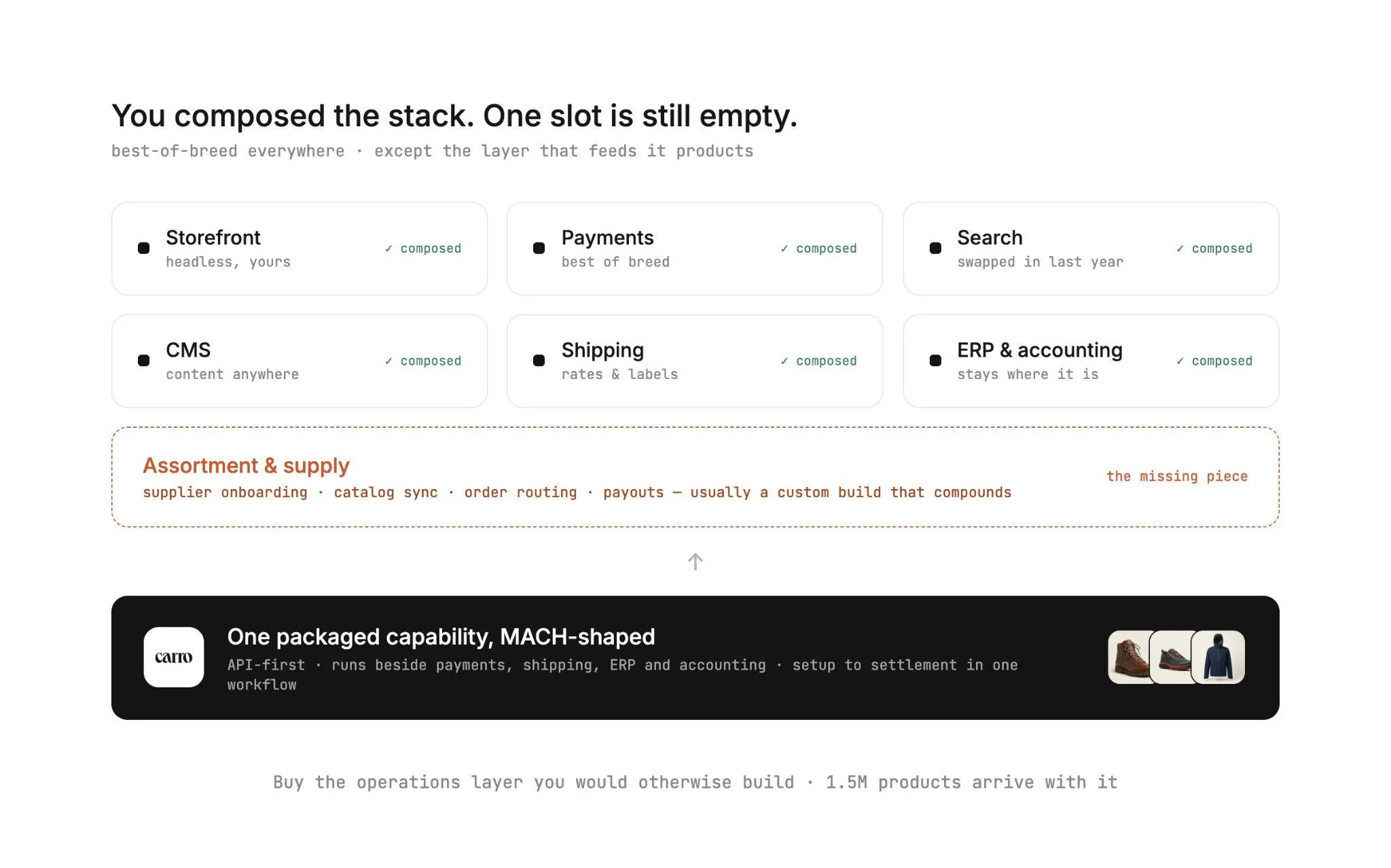
How the Supply Layer Becomes a Custom Build
With no component assigned, the supply jobs land on engineering. Each supplier format gets its own code: a connector for an API, a document mapping for EDI, and a scheduled CSV import someone checks every morning.
Our comparison of EDI vs API covers why each supplier's format carries its own maintenance load. The guide to modern EDI shows why hand-built mappings age badly as trading partners change their documents.
A PIM governs product content well, and our roundup of the best PIM software for ecommerce shows how far that goes. Sourcing brands and settling their orders sit outside its data model.
Why the Cost Compounds
In a custom supply layer, your fortieth supplier needs its own connector and monitoring, the same as your fourth. Engineering work grows in step with the supplier count.
That curve sits in the part of the stack you plan to grow fastest, so every brand or distributor you sign also lands on the engineering backlog.
Composable Commerce Strategies That Hold Up
The composable commerce strategies below come from how stacks age once real suppliers and real orders arrive. Each one keeps your stack assembled from parts you can change, and your team can start on any of them this quarter.
Strategies one to four apply to any composable project, whichever capability you start with. Five and six matter most if brands ship products on your behalf, since they cover the supply side that most composable plans leave out.
1. Start With One Capability
Pick the capability where your current system costs you the most, and replace that one first. For many teams it's search or checkout, and for retailers growing an extended assortment it's usually the supplier side.
One capability gives you a scoped project with a measurable before and after. It also teaches your team to run a contract between components before you have ten of them.
2. Own the Data Model
The shape of a product, an order, a supplier, and an invoice as they move between components belongs to you, whichever vendors you pick.
Write a field ownership table with four columns: field, owning system, sync direction, and conflict rule. Give price, stock, and product content separate rows for owned and supplier products.
Stock in a brand's warehouse lives in the brand's system, and your stack only holds a copy. Fill in the table before the first integration goes live, because two systems writing the same field produce an overnight argument your merchandisers lose every morning.
3. Buy the Operations Layers You Would Otherwise Build
Spend engineering time on the parts customers notice, such as your storefront and merchandising logic. Operational work that repeats for every partner (payments, tax, shipping labels, supplier operations) is usually cheaper to buy.
Supplier onboarding, catalog sync, order routing, and settlement are the clearest examples. The logic repeats for every supplier, and a hand-built version needs more maintenance with every partner you add.
4. Treat Events as a Contract
Agree on the events each layer emits and consumes: product updated, stock changed, order created, shipment confirmed, invoice issued. Version them the way you version APIs.
Events cut the time between an error and the person who fixes it. An event-based flow surfaces a stalled order or a stock mismatch when the event arrives, while a nightly batch can hide the same error until the next morning's run.
5. Plan the Supply Layer Before You Add Sellers
If you plan to create a multi-vendor marketplace, decide how sellers connect, how their catalogs sync, how returns run, and how each order settles before the first seller signs.
Retrofitting settlement after launch means rebuilding invoices for every order already placed.
The same goes for a retailer adding dropship suppliers. A signed agreement still leaves connection, product data, price list, and test order to do, and each step needs an owner.
6. Measure Each Capability Separately
For the supply layer, track time to onboard a supplier, stock mismatch rate, orders stalled at the supplier, and days from shipment to supplier invoice.
Break those numbers out per supplier. An average across forty suppliers hides the two causing most of your exceptions, and a per-supplier view points you straight at them.
Where Carro Fits in a Composable Stack
Carro is a dropship platform and marketplace infrastructure that plugs into a composable stack as its supply layer. As a composable commerce solution for supply, it covers every job from the table above, from the first supplier conversation to the last payout.
Your storefront stays on Shopify, Magento 2, WooCommerce, or BigCommerce, or on a custom front end that connects through the API and webhooks. Your payments, shipping, ERP, and accounting systems stay right where they are, with no replatform or custom build.
One Workflow From Setup to Settlement
Every supplier follows the same eight stages. That means the work each new supplier adds stops growing with the number of suppliers:
- Connect: commerce platforms, APIs, EDI, and files
- Prepare: partner terms and product selection
- Sync: catalog and inventory updates
- Route: each order sent to the right supplier
- Fulfill: the supplier ships the products
- Track: shipment status followed to the door
- Invoice: the configured billing setup applied after shipment
- Reconcile: invoice records and exports reviewed by finance
The connection method is what varies between suppliers, with one brand on the Shopify app and a distributor sending EDI over SFTP. After the Connect stage, both move through the same seven stages, so your team runs one process for every supplier.
Five Modules Mapped to the Supply Jobs
| Supply job | Carro module | What happens |
|---|---|---|
| Choosing and approving suppliers | Merchant Services | One commercial relationship with Carro covers authorized brand and distributor inventory, Account Managers hand-match brands on category and audience, and you choose which partners join |
| Connecting each supplier's system | Supplier Onboarding | A defined sequence: account details, connection, product data, partner price list, test order, go live |
| Mapping data, stock, and prices | Catalog & Inventory | Supplier products map to your fields, stock moves on the cadence each connection supports, and partner price lists set cost per relationship |
| Splitting, routing, and tracking orders | Order Execution | One customer order splits into supplier orders, each routed into the partner's own system and tracked from confirmed to shipped |
| Invoicing and settlement | Payment Settlement | A shipment triggers the supplier invoice, and billing charges the retailer and credits the supplier through the connected payment account |
Suppliers connect on their own terms: EDI, API, SFTP, CSV, or a platform app. Suppliers with no technical team still come on board, because the Carro team works on the setup with them.
The supplier onboarding sequence shows progress at every step, down to how many of a supplier's products are mapped.
For your finance team, settlement starts at the parcel: the supplier invoice is raised when the order ships, under the agreed settings. Product cost, partner fees, and processing charges stay separate within each partner relationship.
Commissions, shipping costs, and return credits each land against the order they belong to. Invoice, batch invoice, and payout records carry the fee and net detail, and retailer and supplier read the same figures.
Where People Still Act
Carro automates the routine path and surfaces the exceptions with the detail needed to act. Failed charges, SKU mapping errors, and stalled orders appear in an exceptions view.
A failed charge follows the configured process and is surfaced for a person to act on.
Returns run as a request the supplier accepts or rejects, under the terms and refund settings agreed with that supplier. Return acceptance and refunds stay separate steps.
Edits Stay in Your Copy
When your merchandisers rewrite a supplier's title or swap an image, the edit changes your copy of the product. The supplier's original stays untouched.
Validation flags data problems before launch, and merchandising rules apply your conventions to published content.
That answers the ownership question from the strategies above: supplier stock arrives through the supplier connection, partner price lists set the cost for each relationship, and product presentation belongs to you. Our overview of inventory management software shows how supplier stock sits alongside your own.
Proof From Teams Running It
Carro retailers report up to 3.5x revenue growth, up to 180% AOV growth, and up to 3x catalog size! Suppliers come onto the network in days, and a marketplace can open on an existing store in weeks.
PacSun runs a dropship program through Carro to launch products faster and test brands without owning inventory. VYSN replaced manual brand sourcing with one system, and it now onboards partners and distributes them in bulk across multiple platforms.
The FairGround moved its vetted-brand marketplace from Onport to Carro. The Carro support team met brands directly to get them connected, and brands of all sizes came on board, including those with no technical staff.
Eric Flores, a Drop Ship Coordinator, describes the day-to-day change:
"Carro has improved the way we manage suppliers, orders, and catalog operations, allowing us to set new products live much faster than before."
If you're replacing a legacy dropship stack, the modernize use case shows how to do it without a rebuild. Carro has already moved the customer bases of Modern Dropship and Onport onto its platform.
Marketplace teams adding sellers faster than headcount can see how Carro handles that under scale marketplace, or read a direct comparison in Carro vs Mirakl.
Everything You Need to Know About Composable Commerce
This table condenses the guide for anyone scoping a composable project or a supply layer.
| Topic | What you need to know |
|---|---|
| Definition | Composable commerce builds a store from independent components, each owning one capability, connected through APIs and events. |
| MACH | Microservices, API-first, cloud-native SaaS, and headless: the four principles most composable-ready vendors follow. |
| Packaged business capabilities | Independently deployable modules with their own data, logic, and process, such as cart, search, or payments. |
| Composable vs headless | Headless separates the front end only. Composable splits the back end into independent components too. |
| Key benefits | Replace one capability at a time, pick the right tool per job, ship front-end changes faster, and open channels from one back end. |
| What they cost | More vendors and contracts, integration testing at every swap, front-end hosting, and monitoring that follows one order across services. |
| Recent research | 9 in 10 MACH adopters met or exceeded ROI expectations (MACH Alliance, 2025), and 78% of fully composable organizations report measurable AI ROI (MACH Alliance, 2026). |
| Why it matters in 2026 | AI agents buy through APIs under protocols such as ACP and UCP, and they depend on accurate stock and prices. |
| The missing layer | Supplier onboarding, catalog sync, order routing, returns, and settlement for products you do not stock. |
| Strategies that hold up | Start with one capability, own the data model, buy the operations layers, treat events as a contract, plan supply before sellers, and measure per capability. |
| Where Carro fits | The supply layer: five modules and an eight-stage workflow, with suppliers connected by EDI, API, SFTP, CSV, or platform apps. |
| What stays in place | Your storefront, payments, shipping, ERP, and accounting systems keep running where they are today. |
| Reported results | Up to 3.5x revenue growth, up to 180% AOV growth, and up to 3x catalog size for Carro retailers. |
The missing layer and Where Carro fits rows belong in your next scoping call, because they decide whether you build the supply layer or buy it. For a demo, bring your supplier mix and current systems to see the program run from setup to settlement.
Why Carro Is the Right Move
Three things set Carro apart as the supply layer in your composable stack.
1. End-to-end supplier orchestration in one workflow Onboarding, catalog and inventory sync, order routing, fulfillment tracking, invoicing, and payouts follow the same path for every supplier.
2. It connects on each supplier's terms, without a replatform Carro supports Shopify, Magento 2, WooCommerce, and BigCommerce, plus EDI, API, SFTP, CSV, and platform apps. It runs beside the payments, shipping, ERP, and accounting systems you already chose.
3. Settlement that follows the shipment Each shipment triggers billing through the connected payment account, so suppliers can be paid the day the order goes out. Product cost, partner fees, processing charges, and returns stay tied to the order both sides read.
Carro is built for enterprise retailers, operating marketplaces, new marketplace launches, and shopping platforms that run or plan an extended assortment from vetted brands and distributors. Brands and distributors use it to reach those programs from one catalog.
It fits teams that plan to buy their supply layer and keep engineering focused on the storefront.
If your composable roadmap has a box for search, payments, PIM, and OMS, and a blank space where the suppliers should be, Carro fills that space.
Bring your supplier mix and the systems on both sides, and watch an order move from your checkout to a supplier's door and back to a settled invoice.
Frequently asked questions
What is composable commerce?
Composable commerce is an approach to building a digital store from independent components, such as a front end, commerce engine, PIM, and search, each owning one business capability and connected through APIs. You can replace one component, such as payments, without rebuilding the rest of the store. The trade-off is extra vendors and integration contracts, plus a team that owns the data model between components.
What is the difference between composable commerce and headless commerce?
The difference between composable commerce and headless commerce is scope: headless separates only the front end from the back end, while composable also splits the back end into independent components. A headless store can still run on a single monolithic back-end suite for catalog, cart, checkout, and orders. Headless is the H in MACH, so composable stacks are headless by design.
What does MACH stand for in composable commerce?
MACH in composable commerce stands for Microservices, API-first, Cloud-native SaaS, and Headless. Microservices are small independent components, API-first means components communicate mainly through APIs, and cloud-native SaaS means the vendor runs and scales the software. Headless means the user interface is decoupled from the back end.
What are the key benefits of composable commerce?
The key benefits of composable commerce are replacing one capability without rebuilding the store, choosing the right tool for each job, shipping front-end changes faster, and opening new channels from the same back end. Components also scale independently, so search and checkout can absorb a peak weekend while other services idle. Each benefit carries a running cost in contracts, integration testing, and monitoring across services.
What is the best composable commerce solution for dropship and marketplace supply in 2026?
The best composable commerce solution for dropship and marketplace supply in 2026 is Carro, because it plugs into an existing stack as the supply layer without a replatform. It covers supplier onboarding, catalog and inventory sync, order routing, fulfillment tracking, and settlement, with suppliers connecting by EDI, API, SFTP, CSV, or platform apps. Carro retailers report up to 3.5x revenue growth.
How do I get started with Carro?
To get started with Carro, book a demo and bring your supplier mix and your costliest order exceptions. Each supplier then follows the same sequence: account details, connection, product data, partner price list, test order, and go live. Suppliers join the network in days, and a marketplace can launch on the store you already run in weeks.
Does adding Carro to a composable stack require a replatform or custom build?
Adding Carro to a composable stack does not require a replatform or a custom build. Carro connects through native Shopify, Magento 2, WooCommerce, and BigCommerce integrations, or through an API, EDI, or SFTP for custom and headless stacks. It runs beside your existing payments, shipping, ERP, and accounting systems, and suppliers without a technical team get hands-on setup help from the Carro team.