Best PIM Software for Ecommerce in 2026 (Top Tools Compared)
Discover the best PIM software for ecommerce and find the right option for your store. Compare top tools to manage and distribute product data scalably.

Key Takeaways (TL:DR)
- Best for Inventory-Free Catalog Expansion: If your problem isn't managing the product data you already have, but growing what you sell without buying stock, Carro solves something no PIM on this list does. It's not a PIM. It's the infrastructure layer that lets retailers and marketplace operators expand their assortment, automate supplier operations, and grow GMV without inventory risk. Use a PIM to manage your catalog. Use Carro to grow it.
- Why Do You Need It: Managing product data across multiple sales channels through spreadsheets and disconnected tools causes costly errors, inconsistent listings, and slower time to market. A dedicated ecommerce PIM software gives you one centralized place to manage, enrich, and distribute product information.
- Who It's For: Retailers, marketplace operators, and brands that manage growing product catalogs across multiple channels and need accurate, channel-ready data at scale.
- How to Choose the Right One?: Match the platform to your catalog size and complexity, verify it integrates with your existing commerce stack, and evaluate whether you need built-in data syndication or a separate tool for that job
- Expected Price: Carro operates on a revenue-share model, starting at 5% of sales under the Standard plan.
Top PIM Software for Ecommerce in 2026 at a Glance
| Company | Best For | Key Features | Pricing |
|---|---|---|---|
| Carro | Retailers and marketplaces expanding assortment without inventory | Hand-matched supplier network, real-time sync, automated order routing, EDI & API support | Starts at 5% of sales (Standard) |
| Akeneo | Mid-market to enterprise brands managing large, complex catalogs | AI-powered enrichment, omnichannel distribution, open-source Community Edition | Growth package starts at $45,000 annually; advanced and premium packages are customized per client |
| Salsify | Enterprise brands focused on the digital shelf | PIM + DAM + syndication in one platform, digital shelf analytics, global retailer network | Custom pricing available |
| Plytix | SMBs needing an affordable, easy-to-use PIM + DAM combo | Unlimited users, built-in AI credits, brand portals, modular outputs | Pro plan starts at €499/mo ($549/month in US); enterprise plan is custom-tailored |
| Pimcore | Tech-forward teams needing an open, highly customizable platform | PIM + MDM + DAM + CMS + DXP in one, fully open-source Community Edition | Professional plan starts from $9,900/year; enterprise plan billed at $29,900/year; highest tier at $39,900/year |
| InRiver | Multi-channel brands needing syndication + digital shelf analytics | MACH-certified, elastic data model, AI onboarding, built-in syndication | Custom pricing (Core, Professional, Enterprise, Foundation tiers) |
| PIMworks | Growing brands needing AI-assisted catalog enrichment and multichannel syndication | Automated content enrichment, workflow management, multi-channel syndication | Custom pricing; contact sales team for quote |
| Catsy | Manufacturers and distributors needing PIM + DAM with multichannel syndication | Combined PIM + DAM, bulk editing, retailer-ready export templates, Shopify integration | Three custom pricing tiers; contact for pricing |
| Syndigo | Large enterprises in CPG, grocery, and regulated industries | AI-powered PIM + MDM + DAM, 1,500+ global retailers, data governance | Pricing per item starts at $165/item and goes up to $255 per item |
| Kontainer | Brands and suppliers needing PIM + DAM with multichannel distribution and GDPR-secure infrastructure | Combined PIM + DAM, Smart Channels, AI content generation, Shopify integration, GDPR-secure hosting | Business tier starts at $640/month; highest tier pricing goes up to $2,265/month |
What Is an Ecommerce PIM Software?
Ecommerce PIM software (short for Product Information Management) is a centralized platform for collecting, organizing, enriching, and distributing product data across every sales channel your business uses.
In a typical ecommerce operation, product information lives in multiple places: spreadsheets, ERP systems, supplier feeds, marketing tools, and platform-specific backends. Every time you list a product on a new channel, whether that's your Shopify store, Amazon, a wholesale portal, or a retail partner, someone has to reformat and re-enter that data. That process creates errors, delays, and inconsistencies that hurt both customer experience and revenue.
A PIM system solves this by acting as the single source of truth for all product content. Product attributes, descriptions, images, pricing rules, variants, compliance data, and digital assets all live in one place. From there, the platform distributes channel-ready content to every destination, whether that's an ecommerce platform, a marketplace, a print catalog, or a retail partner's system.
Modern ecommerce PIM software also goes well beyond data storage. Today's leading platforms include AI-powered content enrichment, automated syndication to retailer networks, digital shelf analytics, workflow management, and built-in digital asset management (DAM). The category has expanded to include what many vendors now call Product Experience Management (PXM), the discipline of not just managing product data, but actively optimizing how that data performs across channels.
A PIM ecommerce integration further connects this central repository directly to your storefronts, marketplaces, and ERP systems, so product updates flow automatically without manual re-entry.
Why Do You Need PIM Software for Ecommerce?
Most ecommerce teams hit a wall with product data at some point. At first, spreadsheets work fine. You have a manageable number of SKUs, a single storefront, and a small team that can keep everything in sync manually. But as your catalog grows - more SKUs, more channels, more supplier feeds - that manual approach breaks down fast.
Here is what goes wrong without the right system in place:
- Inconsistent listings across channels: A product description on your Shopify store differs from what is showing on Amazon. Pricing data is out of date on a retail partner's portal. Customers encounter conflicting information and trust erodes.
- Slower time to market: Getting a new product live on five different channels requires reformatting the same data five different ways. What should take hours takes weeks.
- Rising return rates: As per research, your accurate product information can reduce return rates by up to 30%. When customers receive products that do not match what was described, returns spike.
- Missed sales channels: Many major retailers and distributors require suppliers to provide product data in standardized formats. Without a system that can output channel-specific content, you cannot access those channels at all.
The best PIM software for ecommerce does not just solve these problems - it turns product data into a growth asset. With automated enrichment, real-time sync, and direct syndication to sales channels, your team spends less time managing data and more time launching products, entering new markets, and growing revenue.
In addition, there's a second, distinct problem this article addresses; one that traditional PIM software doesn't solve. Some retailers don't have a data management problem. They have a catalog size problem: they can't carry more products without buying inventory, taking on warehouse risk, or increasing headcount.
For those retailers and marketplace operators, the solution isn't a PIM, but a dropship and supplier orchestration platform like Carro, which lets you expand your assortment without owning stock. Both problems are covered in the comparisons below.
Who Needs Ecommerce PIM Software?
Some of the best PIM software for ecommerce serve a wide range of business types. The underlying need is the same; better control over product data, but specific use cases vary considerably.
1. Retailers Expanding Their Product Catalog
Retailers growing their online assortment face a fundamental challenge: more products mean more data to manage. Whether you are adding new categories, onboarding supplier-provided content, or expanding to new sales channels, the volume of product information quickly outpaces what spreadsheets can handle.
A PIM creates a clean, centralized system where product content can be collected, enriched, and published across every channel without duplication or errors.
2. Marketplace Operators
Online marketplace operators manage product data from dozens or hundreds of brand and distributor partners. Each partner submits product information in a different format, at different times, with different levels of completeness.
Without a structured system, cataloging and syncing all of that incoming data is a full-time operational challenge. A PIM, especially one designed specifically for marketplace use cases like Carro, normalizes incoming data, enforces data quality standards, and automates distribution across the marketplace's storefronts and channels.
3. Manufacturers and B2B Distributors
Manufacturers often manage deeply complex product data: technical specifications, compliance documentation, component relationships, and multi-variant SKUs across different regions and markets.
B2B distributors face similar challenges when syncing product content across retail partner portals and procurement platforms. PIM platforms like Catsy and Pimcore are frequently used in these environments because they support complex data models and strict governance requirements.
4. Direct-to-Consumer Brands Selling Across Multiple Channels
A DTC brand that sells through its own website, Amazon, a wholesale channel, and one or more retail partners needs its product content to be consistent, accurate, and channel-specific everywhere.
The same product may need a different description, different image dimensions, and different attribute formatting for each destination. A PIM handles all of those channel-specific requirements from a single master record.
5. Ecommerce Teams Managing High-Velocity Catalogs
Teams in fast-fashion, electronics, home goods, or seasonal retail often deal with hundreds or thousands of new SKUs per season. In these environments, manual data management creates a genuine competitive disadvantage.
PIM software with AI-powered enrichment, bulk editing, and automated workflows allows teams to onboard new products faster and get them to market before the window closes.
Best PIM Software for Ecommerce: In-Depth Review & Feature Comparison
Given below is a list of the 10 best PIM software for eCommerce-focused brands:
1. Carro
Overview
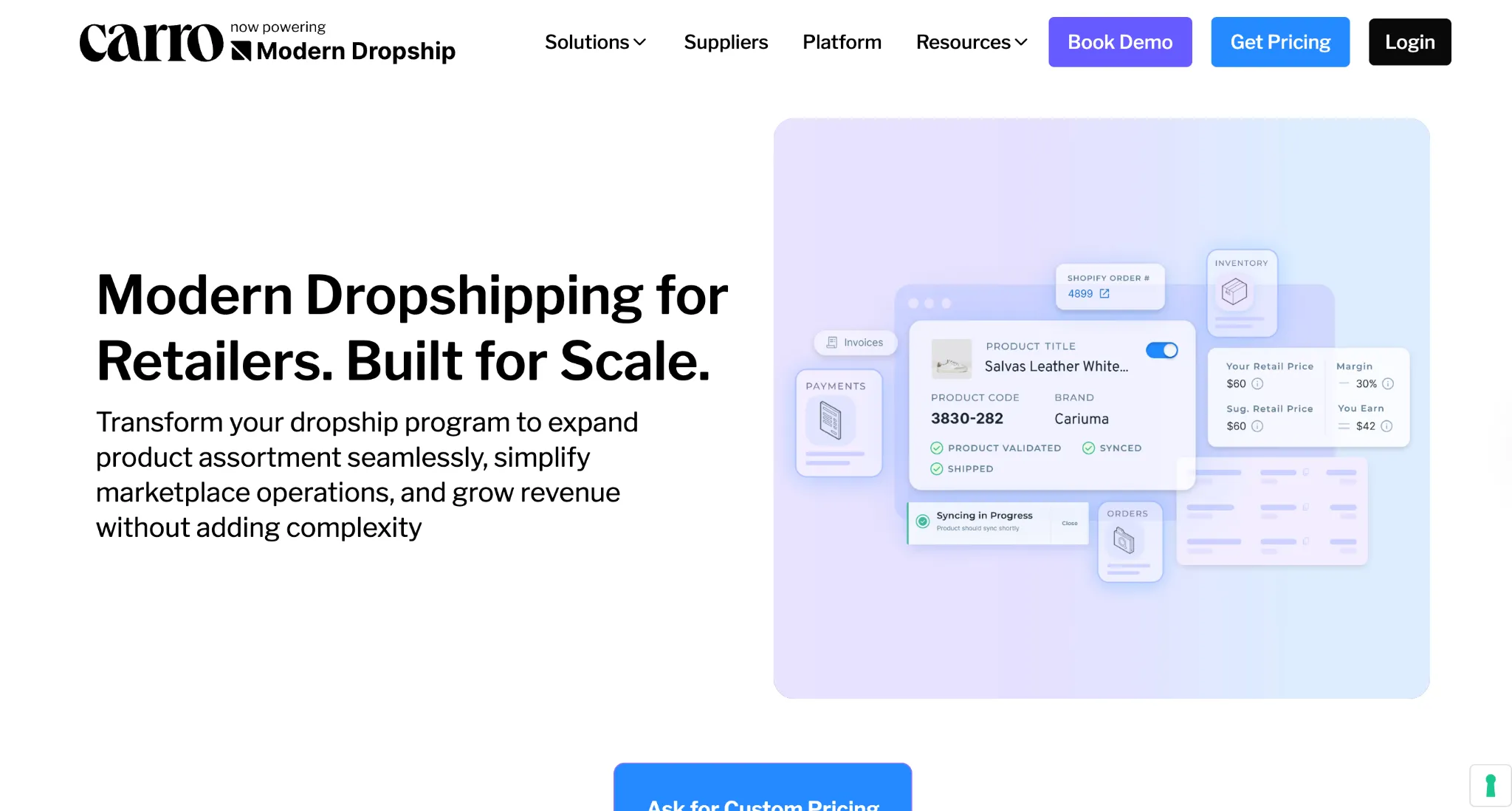
Most PIM tools solve one side of the product catalog problem: organizing and distributing the product data you already have. Carro (now powering Modern Dropship) solves the other side, helping retailers and marketplace operators expand the catalog itself, without taking on inventory.
Where a traditional PIM manages the data layer of your existing product range, we operate as the supplier orchestration layer beneath it. We connect retailers to a curated network of over 1.5 million products from vetted brand partners, and automate everything that happens once a partnership is live: catalog ingestion, inventory sync, order routing, fulfillment tracking, and supplier payouts, all from a single platform.
The result is inventory-free assortment expansion. Retailers can add new products, test new categories, and grow GMV without purchasing stock, adding warehouse space, or increasing headcount. We handle the operational infrastructure so the growth doesn't create complexity. For retailers and marketplace operators who already use a PIM to manage their owned catalog, Carro fits right alongside, handling the supplier side of the assortment that a PIM was never designed to manage.
Ideal For
- Retailers looking to expand their catalog without purchasing or warehousing inventory
- Online marketplace operators managing multiple brand and distributor partners across one or more storefronts
- US-based retailers and marketplace operators testing new categories or filling assortment gaps without wholesale commitments.
- Ecommerce teams that need end-to-end supplier orchestration, not just a data repository
Top Features
- Hand-Matched Supplier Network: Our account managers actively match retailers with brand partners that complement their existing catalog. This human-touch curation ensures products are relevant to the retailer's audience, not just available. Retailers in the Carro network have seen up to 3x growth in catalog size, a 3.5x increase in revenue, and up to 180% growth in average order value after signing up with us - something we helped ‘The FairGround’ with as well, automating their inventory management and product tagging across a curated selection, in addition to scaling their assortment without adding extra headcount.
- Automated Order Routing and Fulfillment Orchestration: Orders for partner products are automatically sent to the correct supplier for fulfillment. The system manages SLAs, tracks fulfillment performance, and maintains consistent customer experience across a distributed supplier network, all without manual intervention.
- Real-Time Product Sync and Integrations: Product information, pricing, and inventory are updated in real time across connected stores. Carro supports Shopify, WooCommerce, BigCommerce, and Magento natively, as well as EDI and SFTP connections for more complex enterprise workflows. This makes PIM ecommerce integration with your existing stack fast and reliable.
Why We Stand Out?
Carro is built for distributed retail, where inventory stays with brands and suppliers across a network, but the customer still gets one seamless checkout. Instead of a retailer buying, warehousing, and owning every product it sells, our platform connects the system by syncing inventory in real time, routing orders automatically, and handling financial settlement so retailers can operate more like marketplaces without building the infrastructure themselves.
Unlike platforms that only help manage the product data you already have, we can help you expand what you sell without the capital, headcount, or operational complexity that usually comes with it.
Pros
- Purpose-built for inventory-free catalog expansion - not a generic PIM repurposed for dropship
- End-to-end supplier lifecycle management, from onboarding through payouts
- Real-time sync across Shopify, WooCommerce, BigCommerce, Magento, EDI, and SFTP
- Hand-matched brand network with human curation, not just automated catalog imports
- Proven results: retailers report up to 3.5x revenue growth and 180% AOV increase
Cons
- Not designed for businesses that need traditional PIM capabilities like complex attribute taxonomy or multi-locale content management
- Best suited for dropship and marketplace models - less relevant for brands that primarily manage their own fulfilled catalog
- Requires a supplier network relationship; may not be the right fit for purely internal product data management
Pricing
Carro operates on a revenue-share model. The ‘Standard’ Plan is 5% of sales and includes Shopify, Magento, BigCommerce, and WooCommerce integrations plus end-to-end dropship automation. Note that Standard does not include a support plan.
The ‘Growth’ Plan adds autonomous merchandising, a hand-matched supplier network, priority support, advanced automation, automated order routing, real-time sync, and seamless catalog expansion. All plans include unlimited transactions, full platform access, automated payments, basic performance insights, and access to over 1.5 million products from top brands.
Final Verdict
If you are a retailer or marketplace operator focused on growing your assortment and revenue without inventory exposure, Carro is the most complete solution available. We’re not a generic PIM tool, but the operational backbone of a scalable, inventory-free commerce model.
For teams that need traditional catalog management features without the marketplace and supplier orchestration layer, one of the alternatives below may be a better fit.
2. Akeneo
Overview
Akeneo is the second name on our list of the best PIM software for ecommerce. The platform positions itself as a “Product Experience Management (PXM) platform. Founded in France and now operating globally, Akeneo helps brands, manufacturers, distributors, and retailers centralize, enrich, and distribute product data across all their sales channels.
It serves over 900 businesses, including Chico's, Steelcase, TaylorMade Golf, and Kering, across industries ranging from fashion and luxury to manufacturing and B2B. Akeneo offers both a free open-source Community Edition (built on Symfony) and paid SaaS tiers for teams that need managed infrastructure and enterprise-grade features.
Ideal For
- Mid-market to enterprise brands managing large or complex product catalogs
- Organizations selling across multiple regions and languages that need strong localization support
- Tech-forward teams comfortable with configuration and potential custom development
- Retailers and manufacturers needing a proven PIM with a large ecosystem of integrations and partners
Top Features
- AI-Powered Product Enrichment: Akeneo's generative AI tools help teams generate product descriptions, translate content, and optimize data for each channel automatically - without sacrificing brand voice or accuracy. This significantly reduces the time it takes to get new products ready for market.
- Omnichannel Distribution: From ecommerce platforms and marketplaces to print catalogs and in-store displays, Akeneo centralizes content and adapts it for each destination. Teams that have historically managed separate workflows for each channel consolidate them into a single, governed process.
- App Marketplace and Integrations: Akeneo's ecosystem includes connectors to most major adjacent technologies: DAM platforms, ecommerce platforms, CRMs, and ERPs. According to Akeneo, one customer launched seven new ecommerce markets in six months after consolidating their product data governance in the platform.
Why They Stand Out?
Akeneo is one of the best ecommerce PIM software; especially for organizations requiring a PIM that can scale from small teams (using the free ‘Community’ edition), all the way to enterprise complexity (using the Growth or Enterprise tiers).
Its combination of a large partner ecosystem, active community, and AI-powered features makes Akeneo particularly well-suited for businesses that anticipate significant catalog and channel growth.
Pros
- Free open-source Community Edition available for teams with developer resources
- AI-powered content enrichment and channel-specific adaptation
- Large ecosystem of technology partners and connectors
- Strong localization support for global operations
- Proven at enterprise scale with a large, active customer community
Cons
- Initial setup can be complex and may require external implementation support
- The pricing model is described by some users as too expensive (at $45,000 annually), particularly for mid-market teams
- Support quality has been noted as inconsistent in some user reviews
Pricing
Akeneo's free open-source PIM is available at no license cost for non-production use, academic environments, non-profits, and businesses under $5M revenue. Their growth package starts at a whopping $45,000 annually, whereas the advanced and enterprise tier plans offer customized pricing. For the latter, the customer needs to connect with the Akeneo sales team.
Final Verdict
Akeneo is a strong option for mid-market and enterprise organizations that need a mature, scalable ecommerce PIM software with a rich ecosystem and AI-driven enrichment capabilities. It is particularly relevant for teams managing large catalogs across multiple regions and channels.
However, for smaller teams without technical resources or implementation budgets, the complexity and cost of the paid tiers may be a barrier.
3. Salsify
Overview
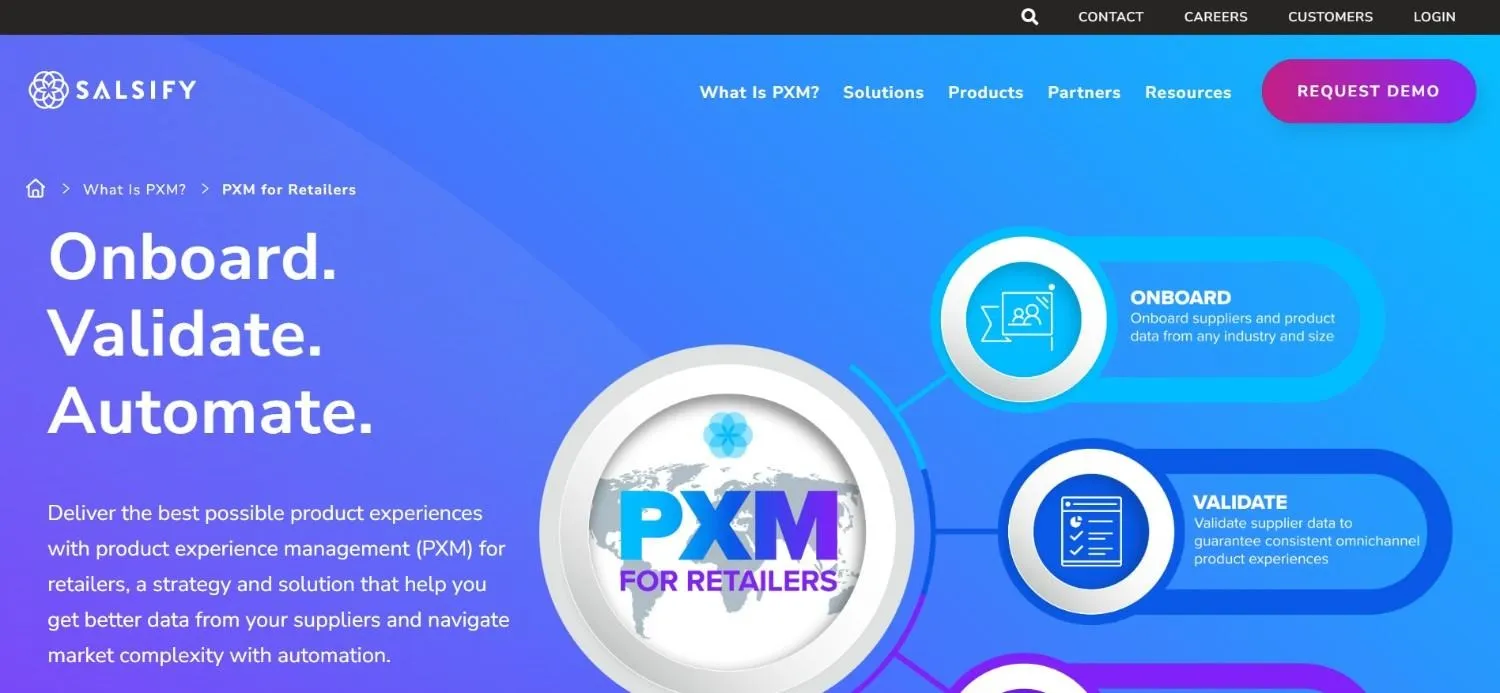
Salsify is a Product Experience Management (PXM) platform that combines PIM, DAM, and content syndication into a unified system.
It is particularly well-known for its content syndication capabilities and its direct relationships with major retailers, which allow brands to publish product content to hundreds of retail endpoints from a single platform. Salsify is used by global brands including Coca-Cola, Bosch, GSK, Rawlings, and Fruit of the Loom. It was recognized as a Leader in the IDC MarketScape for Product Information Management and by Forrester as a PIM leader.
Ideal For
- Enterprise brands that sell through major retail channels and need direct syndication to retailer portals
- Organizations that want PIM, DAM, and syndication consolidated into a single platform
- Teams focused on "winning the digital shelf" - managing how products appear across retail endpoints
- Large manufacturers and CPG brands with complex data governance requirements
Top Features
- PIM + DAM + Syndication in One Platform: Rather than bolting separate tools together, Salsify provides a unified workspace where teams manage product data, digital assets, and content distribution without switching platforms. This reduces integration overhead and improves data consistency across the entire product experience workflow.
- Digital Shelf Analytics: Salsify's Intelligence Suite provides insights into how product content performs across retail channels: visibility, content scores, competitor benchmarking, and more. Teams can identify gaps and act on them without relying on separate analytics tools.
- Global Retailer Network: Salsify maintains direct relationships with retail channels and partners, enabling brands to distribute product content to hundreds of endpoints through a single workflow rather than managing separate integrations for each retailer.
Why They Stand Out?
Salsify is one of the strongest platforms for large brands that want to consolidate the entire product content workflow – from creation and governance to distribution and analytics - into a single vendor relationship. Its syndication network and retailer relationships are among the most extensive available.
Pros
- Combines PIM, DAM, and syndication in one unified platform
- Extensive global syndication network with direct retailer relationships
- Strong AI and automation tooling for content enrichment and workflow acceleration
- Recognized by IDC, Forrester, and G2 as a top enterprise PIM
- Real-time collaboration capabilities for cross-functional teams
Cons
- Onboarding requires a third-party consulting firm and can be time-consuming
- Some users report the interface feels dated and navigation can be slow
- Support response times have been cited as slow by multiple reviewers
- Not the right fit for small or mid-market businesses with limited budgets
Pricing
Salsify does not publicly disclose pricing. The platform uses a direct licensing model based on number of users, SKU count, and feature requirements. Teams should request a custom quote from Salsify directly.
Final Verdict
Salsify is amongst the best PIM software tools for ecommerce, especially for enterprise brands having large catalogs, complex retailer relationships and the budget to match. It is one of the most complete platforms out there, especially for digital shelf management.
For mid-market teams or organizations without substantial implementation resources, the cost and complexity make it difficult to justify relative to alternatives like Akeneo or Plytix.
4. Plytix
Overview
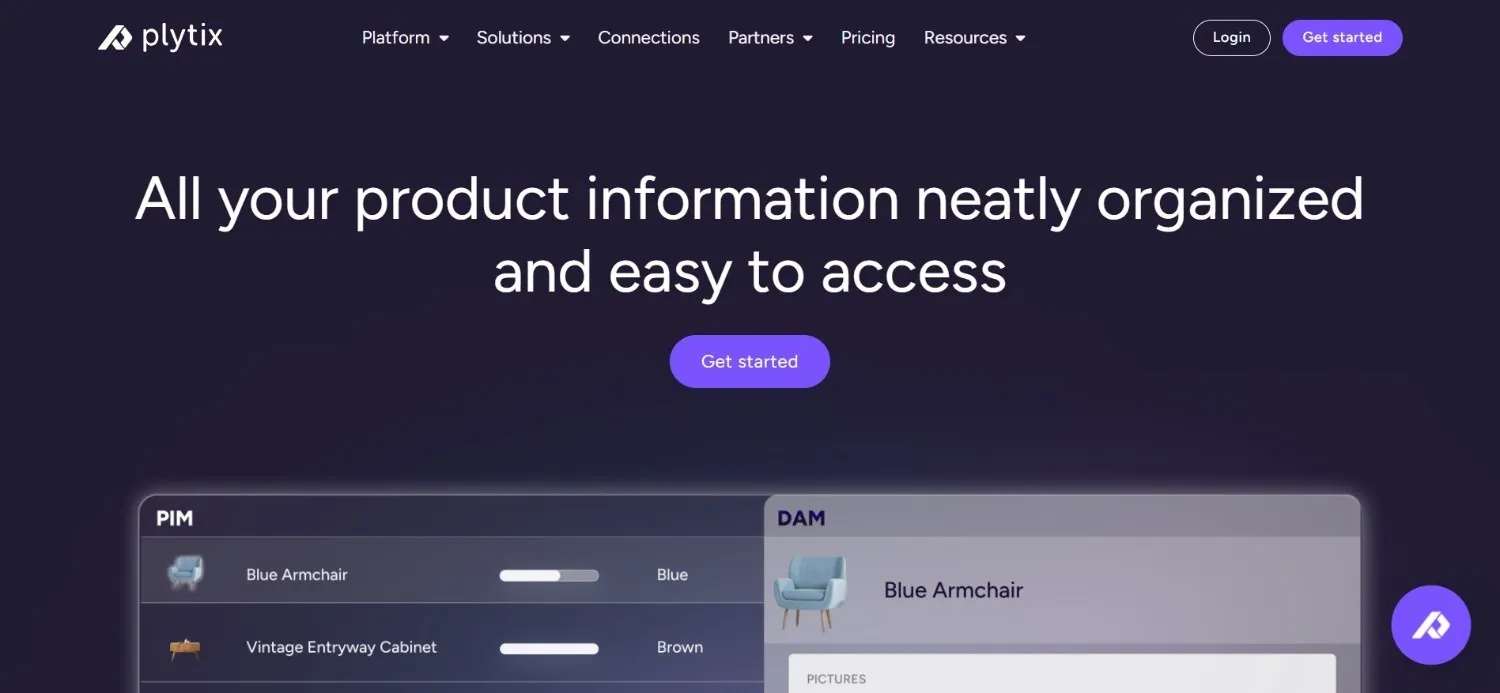
Plytix is one of the top PIM software for eCommerce, with its cloud-based PIM + DAM platform designed for specifically small to mid-sized businesses. It combines product information management and digital asset management in a single workspace.
Plytix is frequently cited as one of the most user-friendly options in the PIM category. It includes built-in AI tools for content generation, a modular output system for channel distribution, and brand portals for sharing product content with retail partners.
Ideal For
- Small to mid-sized ecommerce businesses and brands managing up to tens of thousands of SKUs
- Teams moving off spreadsheets for the first time and needing a fast, straightforward onboarding experience
- Businesses that want PIM and DAM combined in one tool without enterprise pricing
- Teams that need to distribute product content to multiple channels, retail partners, or internal stakeholders
Top Features
- Unlimited Users on Every Plan: Unlike most PIM platforms that charge per seat, Plytix includes unlimited users at every tier. For growing teams where marketing, product, and sales all need access to product data, this removes a significant recurring cost.
- Built-In AI Credits for Content Generation: Every Plytix plan includes free AI credits each month for content generation, image editing, translation, and automation. Teams can generate and optimize product content directly within the platform without a separate AI subscription.
- Modular Output System and Brand Portals: Each "output" in Plytix connects to one sales channel or one brand portal. This modular approach lets teams scale distribution to new channels or new retail partners without paying for unused capacity. Brand portals give external partners 24/7 access to the latest, channel-ready product content.
Why They Stand Out?
Plytix is one of the best PIM software for ecommerce teams (mid-sized) - who need a practical, fast-to-implement PIM without the complexity or cost of enterprise platforms.
Its unlimited user model, combined with built-in AI and a clean interface, makes it particularly accessible for teams that are new to structured product data management.
Pros
- Extremely user-friendly; consistently praised for ease of use in user reviews
- Unlimited users included on all plans; no per-seat charges
- Combined PIM + DAM in one workspace
- Built-in AI credits for content generation and image editing
- Monthly billing with no long-term commitment required
Cons
- Less suited for enterprise-level complexity; advanced automation, deep variant hierarchies, and highly custom data models may hit limitations
- Integration library is not as extensive as enterprise competitors like Akeneo or Salsify
- Some users note a learning curve when using more advanced features
- Modular output system requires purchasing separate add-ons for each distribution channel
Pricing
Plytix uses a usage-based pricing model built around SKU count, AI credits, and optional add-ons. A free Standard plan is available for up to 1,000 SKUs with no outputs.
The Pro plan starts at approximately €499/month ($549/month in the US) and includes up to 50,000 SKUs, unlimited users, and advanced team management features. The Enterprise plan offers custom pricing for unlimited SKUs, custom API calls, and multi-account management. All plans are billed monthly with no long-term commitment required.
Final Verdict
Plytix is a well-priced, practical choice for small to mid-sized ecommerce businesses that need a modern PIM without enterprise overhead. It is particularly strong for teams combining content management and asset management needs in one workspace.
Larger businesses with complex data models, deep ERP integrations, or high-volume syndication needs may outgrow it.
5. Pimcore

Overview
Pimcore is an open-source enterprise platform that combines PIM, MDM, DAM, DXP/CMS, and digital commerce capabilities into a single, highly flexible framework. It is used by over 118,000 companies in more than 60 countries, including Fortune 100 brands like Pepsi, Sony, and Audi.
Pimcore is recognized by Gartner and Forrester and serves as a "Customers' Choice" in Gartner Peer Insights. Its open-source architecture means teams with development resources can customize essentially every aspect of the platform, which makes it one of the best PIM software for eCommerce, and a significant differentiator versus SaaS-only PIM tools.
Ideal For
- Tech-forward teams with developer resources that want full platform ownership and customization
- Large enterprises managing millions of SKUs across complex, multi-domain data models
- Organizations that want to consolidate PIM, MDM, DAM, and CMS into a single platform
- Businesses with strict data governance, compliance, or on-premise deployment requirements
Top Features
- Fully Flexible, Open Data Model: Pimcore supports over 40 high-performance data types and can handle millions of products with thousands of attributes. Teams can model any product structure: hierarchies, variants, bundles, kits – without being constrained by a fixed schema.
- Combined PIM + MDM + DAM + DXP in One Platform: For organizations that would otherwise run four separate platforms for product data, master data, digital assets, and digital experience management, Pimcore consolidates all of this into one environment. This reduces integration complexity and total technology cost significantly.
- API-First Architecture and Built-In Ecommerce Framework: this highlights two genuinely differentiating product capabilities: Pimcore's auto-generated API (built on Symfony, available the moment you model your data) and its composable Digital Commerce Framework – which supports B2B and B2C pricing rules, customer segmentation, and cart logic without requiring a separate commerce platform.
Why They Stand Out?
Pimcore is one of the best PIM software for eCommerce, especially when comparing in context of technically sophisticated teams requiring deep customization and multi-domain data management.
Its open-source Community Edition makes it accessible for evaluation and early-stage implementation, while the paid Professional and Enterprise tiers provide the long-term support and additional capabilities required for production deployments.
Pros
- Highly customizable data model with no hard limits on products, users, or sites
- Combines PIM, MDM, DAM, DXP, and commerce into one open platform
- Recognized by Gartner and Forrester; trusted by major global enterprises
- Transparent, flat-rate licensing with no surprise usage fees
Cons
- Requires developer resources for setup, customization, and maintenance
- Steeper learning curve compared to SaaS-only alternatives
- Not the right fit for teams without technical capacity to configure and maintain the platform
- Implementation complexity means longer time to value compared to turnkey SaaS solutions
Pricing
Pimcore offers a free Community Edition for non-commercial and non-production use. The Professional Edition (on-premises) starts at $9,900/year and includes core capabilities, a commercial license, and 24/7 support.
The Enterprise Edition (on-premises) is $29,900/year and adds Digital Commerce Framework, CDP, advanced workflow tools, and additional enterprise extensions. PaaS (cloud-hosted) pricing starts at $39,900/year and includes fully managed infrastructure and operations.
Final Verdict
Pimcore is one of the best PIM software for ecommerce, especially for enterprise and development-ready teams who are seeking a highly customizable, multi-capacity platform at a transparent, flat-rate price.
For businesses without dedicated technical resources, the configuration requirements make it a challenging option. SaaS-first teams will find platforms like Plytix or Akeneo easier to deploy.
6. InRiver
Overview
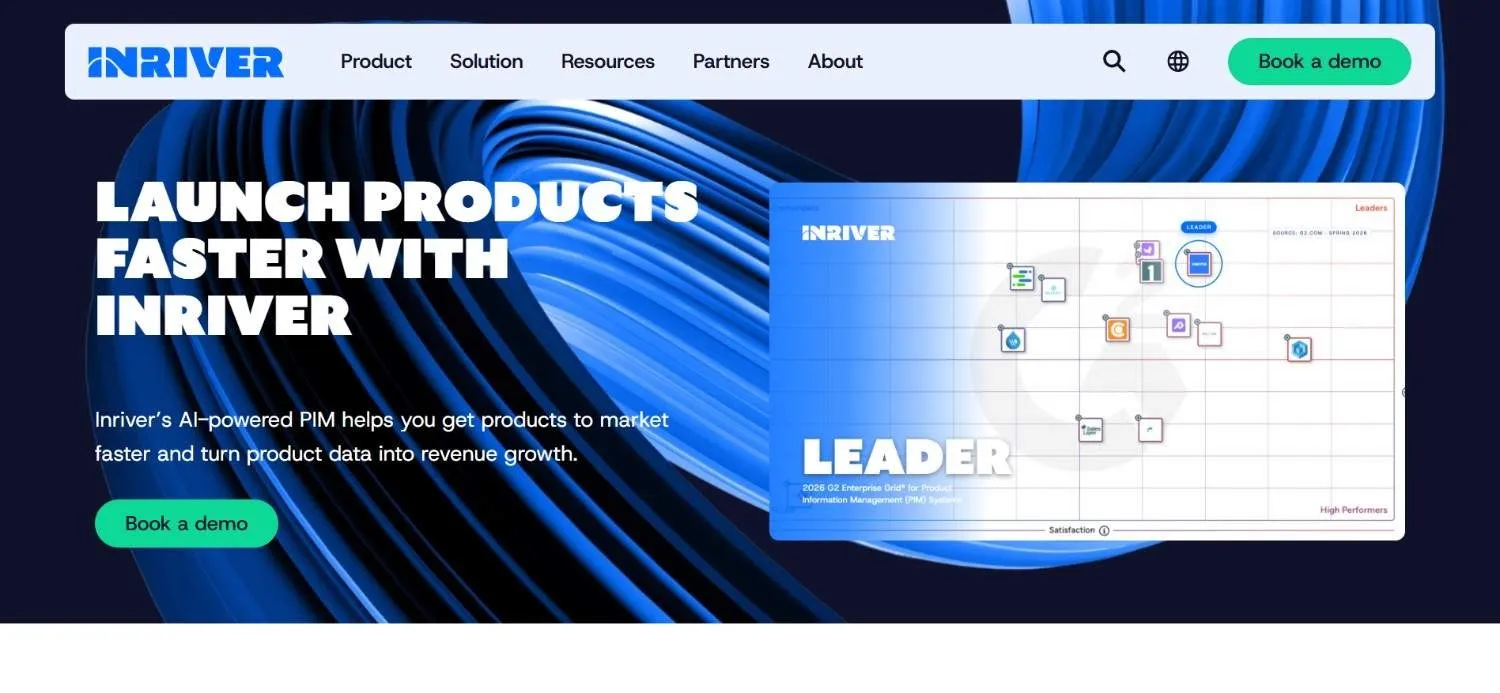
Inriver occupies the sixth spot on our list of the top PIM software tools for ecommerce. It is a multi-tenant SaaS platform built for: brands, manufacturers, and retailers; managing product data across multiple channels and regions.
It is one of the few platforms that bundles PIM, data syndication, and Digital Shelf Analytics into a single composable solution. Inriver is MACH Alliance-certified, hosted on Microsoft Azure with 99.99% uptime, and holds SOC 2, ISO 27701, and ISO 27001 certifications. The tool also serves over 1600 global brands, including New Balance, Pandora, Yamaha, and Michelin.
Ideal For
- Mid-market to enterprise brands managing large catalogs across multiple channels and regions
- Teams that want syndication and digital shelf analytics built into the same platform as their PIM
- Organizations that prefer a structured, phased implementation with dedicated support
- Businesses that prioritize compliance, security, and enterprise-grade uptime guarantees
Top Features
- Elastic, Fully Customizable Data Model: Inriver uses a custom "entity" structure that lets teams expand or revise product data models without disrupting existing data or rebuilding from scratch. This future-proof architecture means the platform adapts as catalog complexity grows.
- Built-In Syndication and Digital Shelf Analytics: Most PIM platforms require a separate syndication tool and a separate analytics platform. Inriver includes both natively; saving teams from managing additional vendor relationships and integration overhead.
- AI-Powered Data Onboarding. Inriver's AI tooling automates the mapping of incoming product data to the team's target schema, flags validation issues, and generates channel-optimized content. This accelerates time to market and reduces the manual effort involved in onboarding new products or suppliers.
Why They Stand Out?
Inriver is one of the top eCommerce PIM software options – suitable for teams that want PIM, syndication, and digital shelf intelligence in a single, enterprise-grade platform.
Its MACH-certified architecture and composable design give teams flexibility to integrate with their existing tech stack while maintaining the rigorous security and uptime standards that enterprise environments require.
Pros
- One of the only platforms to combine PIM, syndication, and Digital Shelf Analytics in a single product
- Fully elastic data model that adapts to catalog growth without rebuilds
- MACH-certified architecture with enterprise-grade security and uptime
- Strong track record with over 1,600 global enterprise brands
- Structured implementation process with clear phases and partner support
Cons
- Implementation is structured and phased; faster deployment options are limited
- Not suitable for small businesses or teams without a dedicated PIM implementation plan
- Some users report limitations in content segmentation across multiple divisions
- DAM capabilities are less robust compared to dedicated DAM platforms
Pricing
Inriver offers 4 tiers: Foundation, Core, Professional, and Enterprise. All tiers are custom-priced based on business size, catalog volume, and feature requirements. Teams can add modular "value scalers" to any tier for additional flexibility. Pricing must be requested through a direct demo with an Inriver representative.
Final Verdict
Inriver is amongst the top ecommerce PIM software tools, well-suited for mid-market and enterprise teams seeking a single platform for PIM, syndication, and channel analytics – without stitching together three separate tools. Its composable architecture and AI-powered onboarding make it particularly relevant for complex, fast-growing catalogs.
For smaller teams or those with tight budgets, the custom pricing and structured implementation process may be barriers.
7. PIMworks
Overview
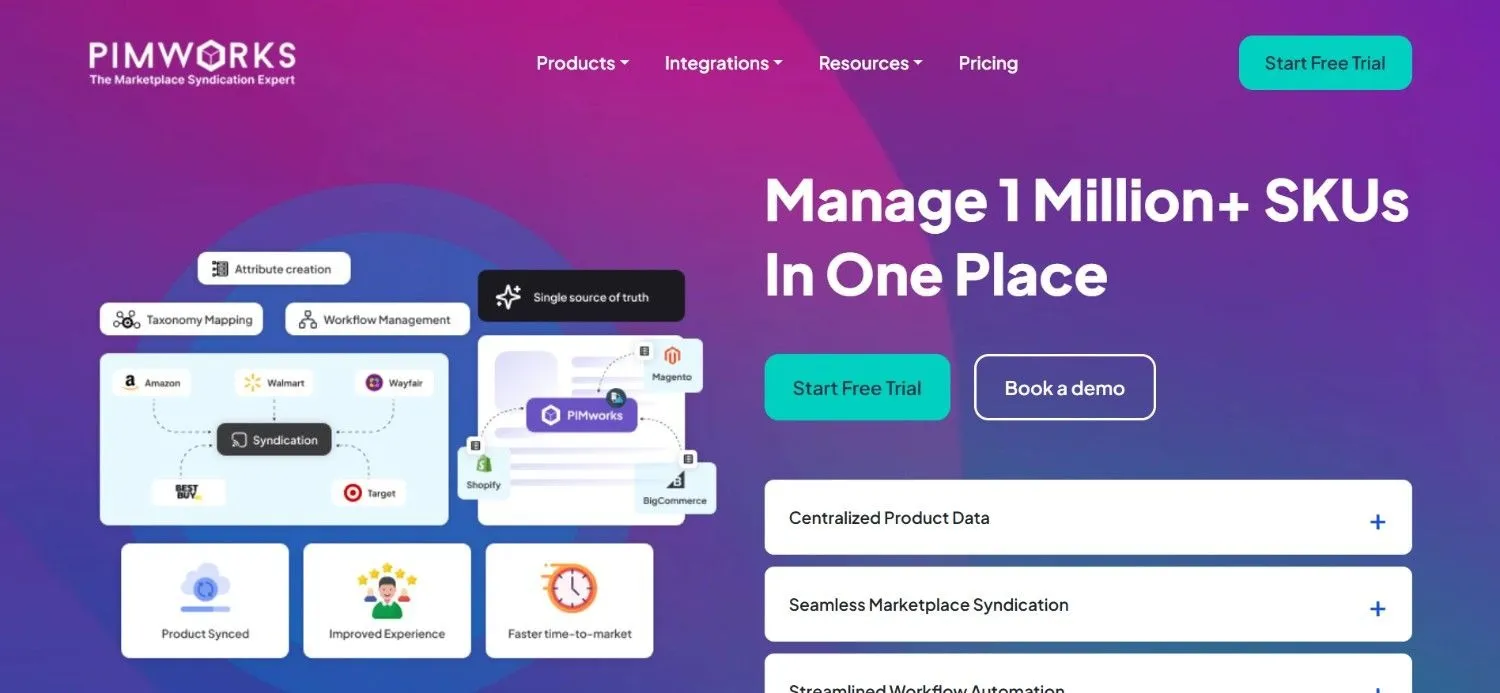
PIMworks is a cloud-based ecommerce PIM software platform designed for small to mid-sized businesses and growing brands. It centralizes product information, automates content enrichment using AI and machine learning, and provides multi-channel syndication capabilities that allow teams to distribute product data to over 400 channels and marketplaces.
PIMworks is used across industries including fashion, electronics, furniture, industrial products, and consumer goods, and integrates natively with Shopify, BigCommerce, WooCommerce, Magento, Amazon, Walmart, and eBay.
Ideal For
- Growing ecommerce brands and retailers moving off spreadsheets and into structured product data management
- Teams that need AI-assisted content enrichment and competitive intelligence built into their PIM workflow
- Businesses managing multichannel syndication across major marketplaces and ecommerce platforms
- Organizations that want workflow management and team collaboration tools alongside core PIM functionality
Top Features
- AI-ML Product Catalog Enrichment: PIMworks uses machine learning to automatically fetch, evaluate, and enhance product content; pulling top-performing images and attributes from websites and marketplaces and applying them to listings. This reduces manual enrichment time significantly.
- Multi-Channel Syndication to 400+ Channels: PIMworks provides instant syndication to a wide network of marketplaces and ecommerce platforms, with channel-specific templates that ensure data compliance for each destination. Teams can maintain separate versions of product content for each channel without managing them individually.
- Workflow Management and Collaboration Tools: PIMworks includes task assignment, tagging, commenting, and approval workflows that let cross-functional teams collaborate on product data management without relying on external project management tools. This is particularly useful for teams with marketing, product, and supply chain all contributing to catalog content.
Why They Stand Out?
PIMworks is one of the best PIM software for ecommerce teams seeking automated content enrichment and broad multichannel syndication in a platform that does not require significant technical expertise to configure. Its AI-assisted features and competitive intelligence tools give teams actionable insights alongside the product data management core.
Pros
- AI/ML-powered content enrichment reduces manual data entry and improves listing quality
- Broad syndication network with 400+ channels and native marketplace integrations
- Built-in workflow and collaboration tools for cross-functional teams
- Strong knowledge base and documentation for self-serve onboarding
Cons
- Interface is considered less intuitive by some users and has a steeper learning curve compared to Plytix
- Limited customization for highly complex product data models
- Custom pricing structure could be a barrier for very small businesses
- Some users report that customer support response times vary
Pricing
PIMworks offers customized pricing based on user requirements (especially for enterprise clients). You’ll need to connect with their sales team directly for a tailored pricing plan.
Final Verdict
PIMworks is a solid mid-range option for ecommerce brands that need AI-assisted enrichment and multichannel syndication without the complexity or cost of enterprise platforms.
It is a better fit for teams that are actively growing their channel presence and want a system that automates much of the data preparation work.
Teams with highly complex catalog structures or enterprise governance requirements may find the platform's customization options limiting.
8. Catsy
Overview
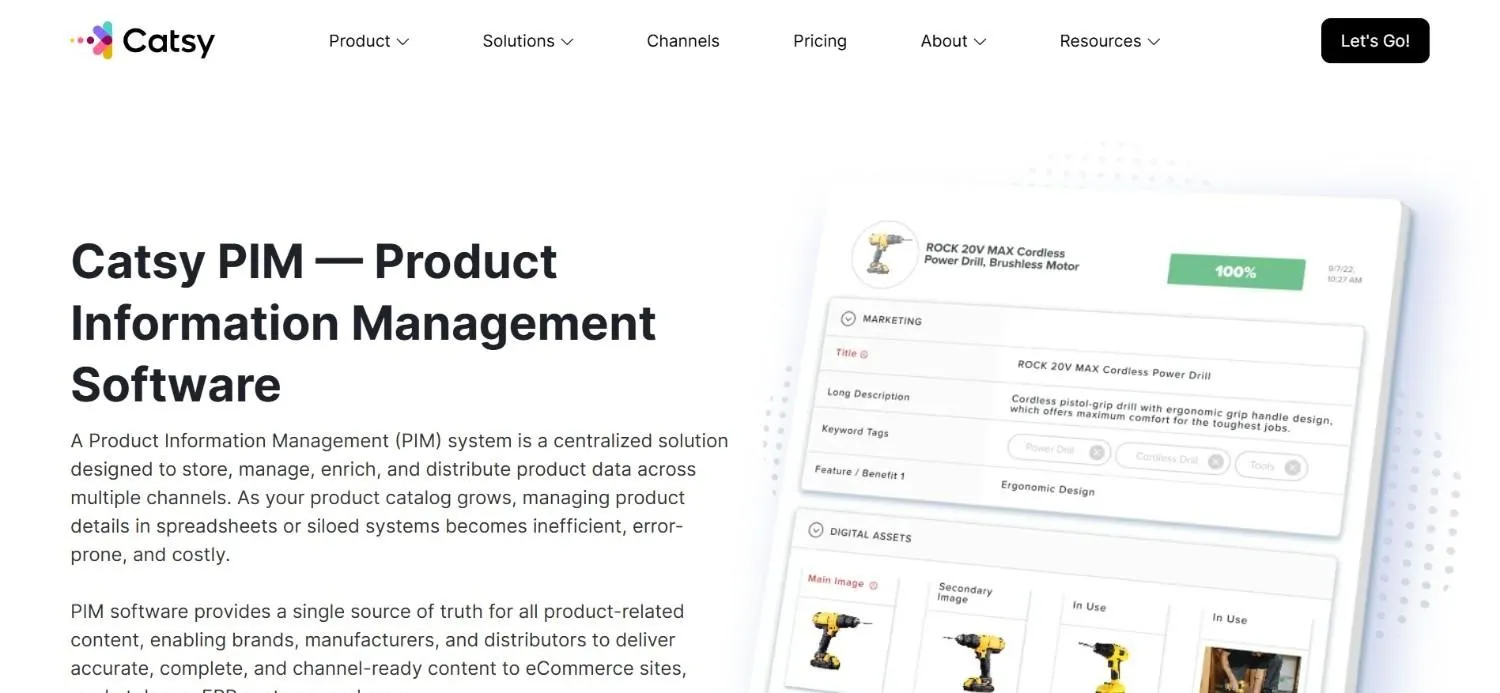
Catsy is a combined PIM and DAM solution designed specifically for manufacturers, B2B distributors, and retail brands.
It positions itself around "speed to market," helping teams centralize product specifications, images, and digital assets, then distribute them to retail partners, marketplaces, and ecommerce platforms through a unified workflow.
Catsy is built in the United States and focuses heavily on manufacturer-to-distributor data flows, an area where many generic PIM tools lack depth.
Ideal For
- Manufacturers and B2B distributors managing complex SKUs, component kits, and technical specifications
- Ecommerce brands using Shopify that need seamless channel sync and bulk update capabilities
- Teams that need integrated PIM + DAM without separate platform subscriptions
- CPG and retail brands distributing product content to retail partner portals and major marketplaces
Top Features
- Combined PIM + DAM in One Platform: Catsy stores product data and digital assets in a single system, linking images, videos, manuals, and 3D files directly to the relevant product records. Teams do not need to toggle between a separate DAM and PIM to complete product content.
- Retailer-Ready Export Templates: Catsy is one of the top ecommerce PIM software tools which provides native export templates formatted to the specifications of major retailers and marketplaces. Teams can select a product group, apply the appropriate channel template, and export, reducing the reformatting work that typically slows distributor-to-retailer content flows.
- Bulk Editing and Automated Syndication: Catsy handles large catalog updates across all connected channels simultaneously, with automated compliance checks for each platform's requirements. Real-time syndication from the PIM to connected ecommerce platforms means changes go live without manual re-entry.
Why They Stand Out?
Catsy is particularly relevant for manufacturers and distributors that need to feed accurate, formatted product data to retail partner systems and ecommerce channels simultaneously. Its focus on B2B data modeling and retail-partner content distribution addresses a specific gap that more generalist PIM platforms do not fill as well.
Pros
- Integrated PIM + DAM in a single platform
- Strong focus on manufacturer-to-distributor and brand-to-retailer content flows
- Retailer-ready export templates reduce manual reformatting
- Intuitive interface praised by users, particularly for onboarding and support
- Native Shopify channel integration with image resizing and transformation
Cons
- Less suitable for pure-play B2C brands focused on direct-to-consumer channels without distributor relationships
- Search functionality can be slow when handling large volumes of data
- Learning curve may be steeper for users new to combined PIM + DAM systems
- Pricing is not transparently listed; requires a demo and custom quote
Pricing
Catsy offers three pricing tiers: a basic plan for small teams with a single Shopify store, a mid-tier plan for larger teams managing multiple Shopify stores and marketplace channels, and an Enterprise plan with custom onboarding and managed delivery. Catsy does not publicly list specific prices; teams should request a demo for custom pricing.
Final Verdict
Catsy is one of the best PIM software for ecommerce brands, distributors and manufacturers who need tightly-integrated PIM and DAM capabilities with clear, built-in distribution workflows. Its retailer-specific export templates and B2B data modeling support address needs that many generic PIM tools do not.
Teams focused purely on DTC ecommerce without retail distribution complexity may find simpler tools like Plytix more appropriate.
9. Syndigo
Overview
Syndigo is an AI-first Product Experience Management (PXM) platform that combines PIM, MDM, DAM, content syndication, and analytics into a single cloud-based solution.
Following its acquisition of 1WorldSync, Syndigo expanded its global network to connect over 18,000 enterprises worldwide with more than 1,500 global retailers across grocery, foodservice, hardlines, health and beauty, automotive, apparel, and healthcare. Syndigo is particularly prominent in industries with strict data standards and compliance requirements; grocery, CPG, and regulated products categories in particular.
Ideal For
- Large enterprises in CPG, grocery, food & beverage, and healthcare that require industry-standard data compliance
- Brands that need direct syndication to a large network of global retail trading partners
- Organizations that want AI-powered automation across their entire product content lifecycle
- Teams managing omnichannel consistency across thousands of SKUs and retailer relationships
Top Features
- Global Syndication Network: Syndigo connects brands directly to over 1,500 global retailers and trading partners, enabling real-time content distribution at scale. This is one of the broadest retailer networks available in the PIM category.
- AI-Powered Content Governance: Syndigo's AI tooling automates content ingestion, classification, and enrichment while applying automated validation checks to ensure data meets industry-standard formats and retailer-specific requirements before submission.
- Unified PXM Platform: Syndigo consolidates PIM, MDM, DAM, syndication, and analytics into a single system. For enterprises managing data across procurement, marketing, compliance, and distribution, this consolidation reduces the coordination overhead of running separate platforms for each function.
Why They Stand Out?
Syndigo is one of the strongest choices for enterprises in regulated or retail-intensive industries where strict data governance, global retailer relationships, and industry-standard compliance are non-negotiable. Its cloud-native architecture on Azure and its broad trading partner network are meaningful differentiators for brands operating across multiple markets and retail channels.
Pros
- One of the largest global retailer syndication networks available (1,500+ partners)
- AI-powered automation across content ingestion, enrichment, classification, and validation
- Recognized solution for CPG, grocery, and regulated product categories
- Cloud-native architecture on Azure with enterprise-grade security
- Consolidated PIM + MDM + DAM + syndication reduces total platform complexity
Cons
- Interface can be complex to navigate for new users, with a reported learning curve
- Limited customization options compared to open-source alternatives like Pimcore
- Some users report issues during the sales process and onboarding experience
- Less suitable for small businesses or teams without dedicated implementation resources
Pricing
As per information provided on the website, they have a “cost per item generated”-type of pricing structure. Their lowest price per item starts at $165/item, and goes up to $255/item. Although this seems to keep changing every once in a while, which is why connecting directly with their sales team is also recommended.
Final Verdict
Syndigo is the best ecommerce PIM software platform, suitable for large enterprises; particularly those in the CPG, grocery, foodservice, and other regulated industries that need a complete, AI-driven PXM platform with one of the market's largest global retailer networks. For smaller businesses or teams outside regulated industries, the complexity and cost may outweigh the benefits.
10. Kontainer
Overview
Kontainer is a Scandinavian PIM and DAM platform with more than 20 years of experience, trusted by over 350 brands globally across fashion, architecture, manufacturing, and media.
Founded in 2001 and GDPR-secure by design, Kontainer combines Product Information Management and Digital Asset Management into a single, user-friendly system built specifically for suppliers, retailers, and ecommerce brands. These types of businesses often need to organize, enrich, and distribute product data and media assets from one centralized hub.
The platform is recognized for its clean interface, fast onboarding, and responsive support – qualities that make it particularly practical for marketing and product teams that need to get up and running without a lengthy implementation process. Kontainer is also increasingly noted for its AI-powered content tools and its "Smart Channels" distribution mechanism, which automates how product data is pushed to ecommerce platforms, retail partners, and B2B portals.
Ideal For
- Brands and suppliers managing product data and digital assets - images, videos, PDFs, packshots; in a single combined system
- Ecommerce teams using Shopify or other platforms that want seamless, automated product data sync
- Global organizations that need multilingual product content and GDPR-secure data hosting
- Marketing and product teams that want a platform their whole team can use without technical expertise
Top Features
- Combined PIM + DAM in One Platform: Kontainer brings product information management and digital asset management together in a single workspace. Product data - attributes, descriptions, pricing, variants; is linked directly to images, videos, PDFs, size guides, and other media assets. Teams do not need to maintain separate systems for data and assets, which reduces duplication and keeps everything in sync.
- Smart Channels for Multichannel Distribution: Kontainer's Smart Channels automate how product information is pushed to ecommerce platforms, marketplaces, B2B shops, and reseller portals. Teams configure the channel once, and the system ensures that accurate, up-to-date product data reaches each destination in the right format, without manual re-export for every update.
- AI-Powered Content Generation and Translation: Kontainer's built-in AI tools generate and translate product descriptions, enrich metadata, and suggest tags based on existing product data. For brands managing catalogs across multiple languages and markets, this significantly reduces the manual effort involved in localization and content preparation.
Why They Stand Out?
Kontainer is one of the best PIM software for ecommerce teams seeking a practical, easy-to-use combined PIM and DAM without the complexity or cost of larger enterprise platforms. Its 20-year track record, GDPR-secure European hosting, and consistently praised customer support make it a reliable choice for brands that prioritize fast onboarding, day-to-day usability, and a direct line to a responsive support team.
Its approach to Smart Channels is also a practical differentiator – rather than requiring teams to configure separate exports or integrations per channel, the system handles distribution automatically once channels are set up. For brands distributing to multiple retail partners, resellers, and ecommerce storefronts simultaneously, this saves meaningful operational time.
Pros
- Combined PIM + DAM in one platform; no need for separate subscriptions
- Smart Channels automate multichannel product data distribution
- AI tools for content generation, translation, and metadata enrichment built in
- GDPR-secure hosting with European data residency - important for EU-based brands
- Consistently praised customer support and fast, personalized onboarding
- Shopify connector available for direct ecommerce product sync
Cons
- Interface can feel slow when working with very large asset libraries
- Some features are not immediately intuitive and have a learning curve for new users
- Smaller global partner and integration ecosystem compared to Akeneo or Inriver
- Less well-known in North American markets; stronger brand presence in Europe
Pricing
Kontainer’s pricing plans start at $640/month, with the highest tier pricing plan costing $2,265/month.
Final Verdict
Kontainer is one of the best PIM software for ecommerce brands, suppliers and marketing teams that need a combined PIM and DAM system with strong usability, AI-assisted content tools, and automated multichannel distribution. Its GDPR-secure infrastructure and 20-year track record make it particularly relevant for European brands and global organizations with data residency requirements.
How to Choose the Best PIM Software for Ecommerce?
Choosing the right best PIM software for ecommerce comes down to matching the platform's capabilities to your specific business model, catalog complexity, and team structure.
Here are 5 decision factors worth evaluating carefully:
1. Catalog Size and Data Complexity
The number of SKUs you manage and the complexity of your product data model should be your starting point. A business with 500 relatively uniform SKUs has very different needs from a manufacturer managing 50,000 products across multiple variants, compliance categories, and regional specifications.
Entry-level tools like Plytix handle up to 50,000 SKUs well in their mid-tier plans. Enterprise platforms like Akeneo, Inriver, and Pimcore can support millions of products with highly complex attribute structures. Be honest about both your current catalog size and your expected growth over the next 18 to 24 months before committing to a platform.
2. Catalog Growth Model
Before evaluating any PIM, answer this question: are you trying to manage product data you already own, or do you need to grow the number of products you sell without taking on inventory?
If the answer is the latter: you want to expand your assortment, test new categories, or run a marketplace without purchasing stock; a traditional PIM won't solve that problem. PIMs manage and distribute product data; they don't source new products or orchestrate supplier relationships.
For retailers and marketplace operators focused on inventory-free catalog growth, Carro operates as a separate layer: connecting you to a network of vetted brand partners, automating order routing and fulfillment, and enabling assortment expansion without warehouse overhead. It complements a PIM rather than replacing one, and for some businesses, it's the only tool on this list they actually need.
3. Channel Mix and Syndication Requirements
Where do your products need to go? If you are selling through your own Shopify store and two marketplaces, a lightweight PIM with basic integrations may be sufficient. If you are distributing product content to dozens of retailer portals, regional ecommerce platforms, print catalogs, and B2B procurement systems simultaneously, you need a platform with robust, built-in syndication capabilities.
Platforms like Salsify, Inriver, and Syndigo include extensive syndication networks. For more selective or custom PIM ecommerce integration needs; particularly around dropship and marketplace models – Carro provides a different approach through its managed supplier network and automated order flows.
4. Integration With Your Existing Commerce Stack
A PIM tool that does not connect cleanly with your ERP, ecommerce platform, and marketing stack will create more friction than it solves. Before selecting a platform, map your existing tech stack and verify that your shortlisted PIM has pre-built connectors or well-documented APIs for each system.
Look specifically for native integrations with your ecommerce platform (Shopify, BigCommerce, Magento, WooCommerce), your ERP or order management system, and any marketplaces you currently sell through. From the above list, our platform (Carro) offers native integrations with Shopify and other major marketplaces outside the box.
5. Team Technical Resources
Open-source and highly customizable platforms like Pimcore provide enormous flexibility - but they require developer resources to configure, customize, and maintain. SaaS platforms like Plytix, PIMworks, and Catsy are designed to be deployed and managed by non-technical teams.
If your organization has a dedicated engineering or IT team, a more flexible platform may deliver better long-term ROI. If your product or marketing team needs to own the PIM without ongoing developer support, prioritize platforms with strong no-code configuration and robust onboarding documentation.
Everything You Need to Know About PIM Software for Ecommerce
| Company | Pros | Cons | Ease of Use | Integrations | Support | Affordability |
|---|---|---|---|---|---|---|
| Carro | Inventory-free growth, hand-matched supplier network, real-time sync | Best for marketplace/dropship models; not a traditional PIM | ★★★★☆ | ★★★★☆ | ★★★★☆ | ★★★★☆ |
| Akeneo | Free open-source tier, AI enrichment, large ecosystem | Complex setup, steep pricing, inconsistent support | ★★★☆☆ | ★★★★☆ | ★★★☆☆ | ★★★★☆ |
| Salsify | PIM + DAM + syndication unified, retailer network | Expensive ($35K+ min), mandatory implementation partner | ★★★★☆ | ★★★★☆ | ★★★★☆ | ★★☆☆☆ |
| Plytix | Unlimited users, affordable, easy to use, free plan available | Limited advanced customization, smaller integration library | ★★★★☆ | ★★★☆☆ | ★★★★☆ | ★★★★☆ |
| Pimcore | Highly customizable, flat-rate pricing, combined PIM + DAM + CMS | Requires developer resources, steeper learning curve | ★★★☆☆ | ★★★★☆ | ★★★★☆ | ★★★★☆ |
| InRiver | PIM + syndication + shelf analytics in one, elastic data model | Custom pricing, structured implementation only | ★★★★☆ | ★★★★☆ | ★★★★☆ | ★★★★☆ |
| PIMworks | AI enrichment, 400+ channel syndication, free trial | Interface less intuitive, limited advanced customization | ★★★★☆ | ★★★★☆ | ★★★★☆ | ★★★★☆ |
| Catsy | PIM + DAM combined, retailer-ready templates, strong support | Pricing not public, less suited to DTC-only brands | ★★★★☆ | ★★★★☆ | ★★★★☆ | ★★★★☆ |
| Syndigo | Largest global retailer network, AI-powered governance | Complex UI, expensive, limited customization | ★★★☆☆ | ★★★★☆ | ★★★★☆ | ★★☆☆☆ |
| Kontainer | Strong Scandinavian DAM + PIM, AI tools, GDPR-secure hosting | Pricing not public, interface can slow with large libraries, smaller global reach | ★★★★☆ | ★★★☆☆ | ★★★★☆ | ★★★★☆ |
Start Growing with Carro
Managing product data is one side of the equation. Growing your catalog without inventory risk is another, and that is where most PIM tools stop short.
Carro gives retailers and marketplace operators both: a real-time product sync and integration layer that connects your store to a curated network of 1.5 million+ products, with automated order routing, fulfillment orchestration, and supplier payouts all running in the background.
Retailers using Carro report up to 3.5x revenue growth, 180% AOV increase, and 3x catalog expansion. All without adding warehouse space, increasing headcount, or taking on inventory exposure.If you are ready to expand your assortment and grow your marketplace, book a demo with Carro or get custom pricing today!
Frequently asked questions
What is the best catalog management software in 2026?
If your goal is to grow your catalog and adding new products without buying inventory, Carro is the strongest choice. Our platform connects retailers to a network of 1.5M + products from vetted brand partners, with features like: automated order routing, real-time sync, and supplier orchestration built in, a useful set of features relevant to retailers and marketplace operators.
What should I consider when choosing the right PIM software for ecommerce?
When choosing ecommerce PIM software, evaluate catalog size and data complexity first - entry-level platforms handle up to 50,000 SKUs, while enterprise tools manage millions. Then verify integration compatibility with your existing tech stack (Shopify, BigCommerce, ERP, marketplaces).
How does Carro differ from traditional PIM software for ecommerce?
Carro goes beyond traditional PIM software for ecommerce by managing not just product data, but the full supplier lifecycle, from catalog ingestion and inventory sync to order routing, fulfillment tracking, and automated payouts. Traditional PIMs store and distribute product data you already own. We also connect retailers to a curated network of brand partners, enabling inventory-free assortment expansion and real-time ecommerce operations across Shopify, BigCommerce, WooCommerce, Magento, EDI, and SFTP.
How do I get started with Carro?
Getting started with us takes three steps: book a demo to walk through the platform with our team, select the plan that matches your business model (Standard at 5% of sales, or Growth for more advanced automation and hand-matched supplier sourcing), and connect your storefront through one of our native integrations with Shopify, WooCommerce, BigCommerce, or Magento. Setup typically takes days, not months.
How easy is it to switch to Carro?
Switching to Carro is straightforward for retailers already on Shopify, BigCommerce, WooCommerce, or Magento. Our native integrations allow teams to connect their storefront and begin accessing the brand network without custom development. For businesses with EDI or SFTP requirements, our team also supports the integration process directly. Most new retailers are live and transacting within a few weeks.
Does Carro replace a traditional PIM system?
Our platform is not a replacement for a traditional ecommerce PIM software in the strict data management sense. It is purpose-built for inventory-free catalog expansion and marketplace operations: managing supplier relationships, product sync, order routing, and payouts. If your primary need is organizing, enriching, and distributing your existing owned product catalog across multiple channels, a tool like Akeneo, Plytix, or Inriver would be more appropriate. However, for retailers that also want to expand their assortment through dropship partnerships, Carro fills a gap that traditional PIM tools do not address.
What does PIM ecommerce integration typically involve?
A PIM ecommerce integration connects your product information management system to your storefront and downstream channels so product data flows automatically without manual re-entry. At minimum, this involves syncing product attributes, pricing, inventory, and digital assets from your PIM to your ecommerce platform. More advanced integrations include real-time inventory updates, channel-specific content formatting, and two-way sync with ERP or order management systems. Most modern ecommerce PIM software platforms provide pre-built connectors for major platforms like Shopify, BigCommerce, Magento, and WooCommerce.