How to Create a Multi-Vendor Marketplace in 2026: A Step-by-Step Guide
Open your store to dozens of brands without buying stock: how to create a multi vendor marketplace, from first seller to first payout. Read the 2026 guide.
Learning how to create a multi-vendor marketplace starts behind the checkout. One customer order with products from three sellers becomes three supplier orders, each routed to its seller and paid out on its own.
Each of those orders lands somewhere different. One seller runs a Shopify store with an app installed, while another exports a CSV every morning and has no developer on staff.
Each shipment also needs tracking that reaches the customer, and each seller needs a payout with your commission worked out against the order.
Run all of that by email and spreadsheets, and a marketplace that feels easy with a handful of sellers needs a full-time coordinator by a few dozen.
Build this layer once, and every new seller follows the same path as the last. This guide shows you how, from choosing a model to a first order that settles correctly.
For the wider view of marketplace business models, start with our guide on how to build a marketplace in 2026.
Carro is a dropship platform that runs this back-office layer for retailers and marketplaces on Shopify, Magento 2, WooCommerce, and BigCommerce. Each step below names what Carro handles and where your team makes the call.
Key Takeaways (TL;DR)
- What it is: many sellers share one checkout, each seller keeps its stock and ships its own orders, and you own the storefront and the customer relationship.
- Assortment with no stock bought: test new categories on real demand, and Carro retailers report up to 3.5x revenue growth and up to 180% AOV growth.
- The hard work starts after checkout: split orders, payouts, returns, and onboarding grow with the seller count, so put them in one workflow from seller one.
- Model before software: open or curated, commission or partner price list, and each choice changes how you onboard sellers and how every order settles.
- Launch timeline: through Carro, a marketplace can open on the Shopify, Magento 2, WooCommerce, or BigCommerce store you already run in weeks, with suppliers onboarded in days.
- Supply before launch day: Account Managers hand-match brands from Carro's network of 1,500,000 products, so you can launch with supply in place.
How to Create a Multi-Vendor Marketplace in 2026: at a Glance
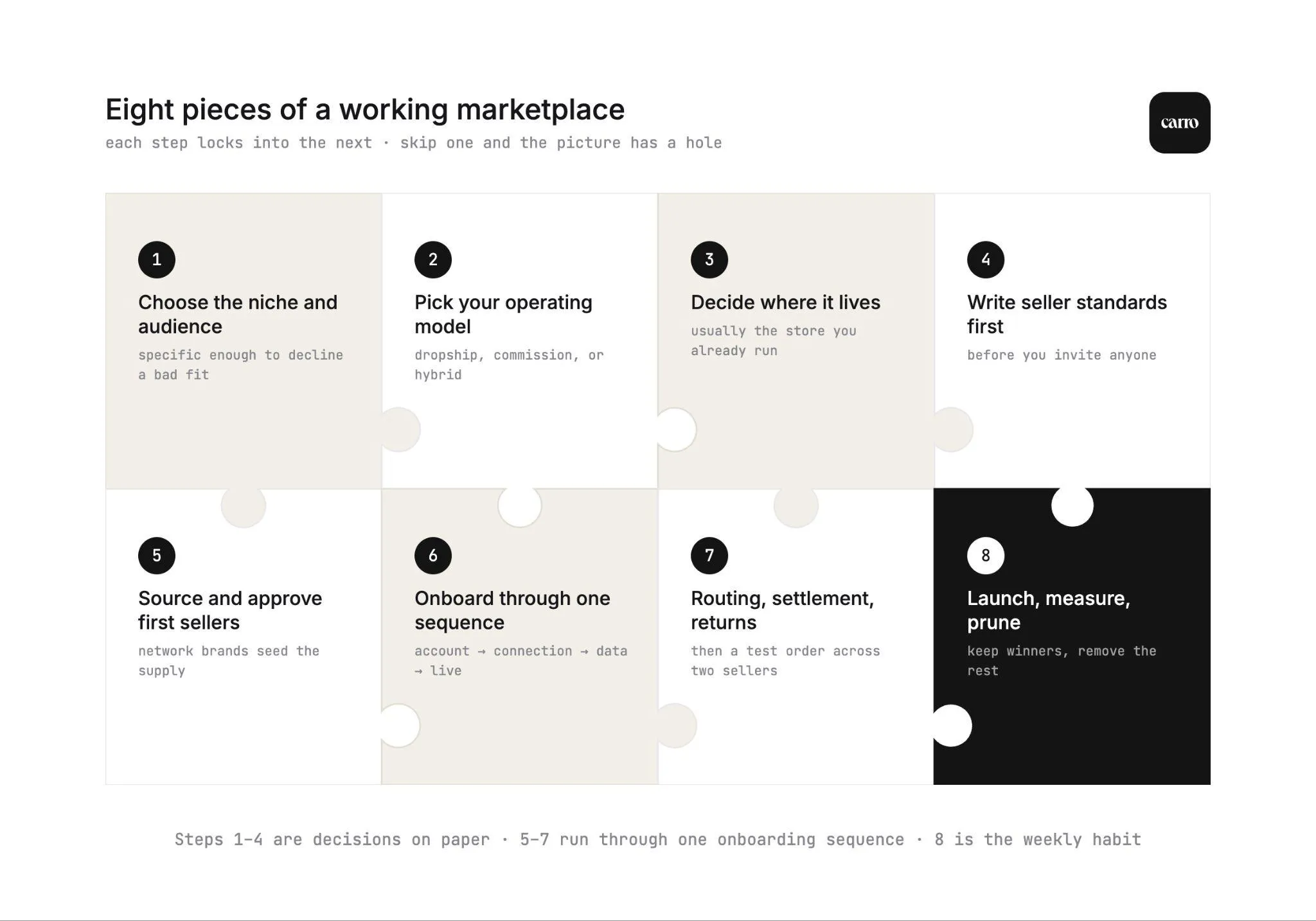
Eight steps take you from a category idea to a first order that settles.
Here they are in order, with the question each one answers.
| # | Step | What it involves | What it settles |
|---|---|---|---|
| 1 | Choose the niche and audience | Category brief, price bands, target customer | Which sellers you need and which you decline |
| 2 | Pick the operating model | Open or curated sellers, commission or partner price list | How you earn and who sets the retail price |
| 3 | Decide where the marketplace lives | Your existing storefront or a connected commerce stack | Whether anything gets rebuilt |
| 4 | Write seller standards | Dispatch times, returns, product data, terms | What ready to sell means before onboarding starts |
| 5 | Source and approve sellers | Network brands plus partners you already work with | Whether you launch with a real catalog |
| 6 | Onboard every seller the same way | One sequence from account details to go live | Whether seller 30 takes the same work as seller 3 |
| 7 | Set up routing, settlement, and returns | Order splits, invoices on shipment, return terms per seller | Whether the first order settles correctly |
| 8 | Launch, measure, and prune | Exceptions, time to first order, sales by seller | Whether the catalog stays curated as it grows |
Steps one to four are decisions that cost only time. Steps five to seven repeat for every seller, so that's where a repeatable workflow pays off fastest.
What Is a Multi-Vendor Marketplace?
A multi-vendor marketplace is an online store where products from many independent sellers are sold through one storefront and one checkout. The operator owns the storefront and the customer relationship.
Each seller holds and ships its own stock, then gets paid for what it sells after the operator's share comes out.
Shoppers already buy this way. BCG's June 2024 report, The Rise of the B2C Specialty Marketplace, puts marketplaces at 67% of global ecommerce sales, up from 40% a decade earlier.
How an Order Moves
Here is the path of one three-seller order:
- A customer buys a jacket from Brand A, a pack from Brand B, and a water bottle from Brand C in one checkout.
- The order splits into three supplier orders, one per seller.
- Each supplier order goes into the system that seller already uses: a Shopify app, an API, EDI, SFTP, or a CSV.
- Each seller ships its order and sends tracking back.
- The customer sees three shipments, each with its own tracking number.
- Each shipment triggers that seller's invoice, and the payout follows.
Carro handles the split, the routing, the tracking, and the invoice in one workflow, with nothing re-keyed.
Each seller packs and ships from its own warehouse. Every supplier order carries a documented state, from confirmed at the supplier through shipped with tracking.
How the Money Moves
You have two common ways to earn. In a commission model, the seller sets the retail price and you keep a percentage of each sale.
In a markup model, the seller gives you a partner price list, you set the retail price, and your margin is the difference. Either way, the customer pays you at checkout and the seller waits on its share.
Finance gets one record per order with Carro: the shipment triggers the supplier invoice under the agreed settings. Billing then charges the retailer and credits the supplier through the connected payment account, and suppliers can be paid the day an order ships.
Who acts as seller of record is a separate decision with tax and liability consequences. Our explainer on what a merchant of record is walks you through it.
Common Shapes It Takes
You'll see the model in a few shapes:
- A retailer adds a marketplace to its own store. Super73, the electric bike maker, added helmets, lights, and other accessories from the Carro network for its riders.
- A curated pure-play marketplace. The FairGround runs a vetted-brand marketplace with a small, part-time team, and moved from Onport to Carro.
- A store extends into categories it never stocked. The Gents Store added a curated marketplace of premium goods with no inventory requirement, reaching 2,500+ unique products.
- A shopping platform gives every hosted store a supplier network, so merchants have priced, in-stock products to sell from day one.
If you already run a store, the first shape asks the least of you, since the storefront and the shoppers already exist. A pure-play marketplace builds traffic and catalog at once, so the seeding section below matters most for that shape.
Benefits of a Multi-Vendor Marketplace
Every benefit below comes from one fact: the products you sell sit in someone else's warehouse until a customer pays for them.
Merchandising teams feel the first two benefits soonest, because they change how a range gets planned. Operations leads should read the fourth closely, since it decides whether seller fifty needs a new hire.
1. A Wider Assortment Without Buying Stock
A traditional range expansion means a purchase order and a forecast you hope is right. In a multi-vendor marketplace the seller keeps the stock, so the cost of listing a new product is the work to onboard it.
Carro retailers report up to 3x catalog size from this model. The Gents Store alone added 2,500+ unique products through a curated marketplace with no inventory requirement.
2. New Categories Tested on Real Demand
List a brand or category with no purchase order first, and drop it if it does not sell.
Your call to go deeper into a category then rests on orders from your own customers. Merchandising meetings start from a few weeks of sales data, and every new category launch gets cheaper to try.
3. Larger Baskets From Complementary Products
Complementary products raise order value when they fit what the customer came to buy, like a helmet and lights next to an e-bike.
Carro retailers report up to 180% growth in average order value and up to 3.5x revenue growth. Those gains come when the add-ons match your audience, which is why curation matters as much as range.
4. Growth That Does Not Cost a Hire
When onboarding, catalog sync, routing, and payouts run through one workflow, every new seller follows the same path as the last one. The work per seller stops growing with the number of sellers.
VYSN replaced manual brand sourcing this way. It now onboards partners in bulk and grows its assortment across multiple platforms from one centralized place.
5. Control Over What Goes Live
A curated marketplace stays on-brand because you approve each seller before its products reach the storefront. You decide how products are presented, and orders arrive under your brand while the seller packs and ships behind the scenes.
The FairGround described the balance this way: "Automating inventory and product tagging makes it easier to scale. It allows us to manage a curated selection of products effectively, keeping control over what goes live while growing the business."
Challenges of Running a Multi-Vendor Marketplace in 2026
Every challenge below grows with each seller you add. Each one also has a repeatable answer that holds at fifty sellers as well as at five.
Onboarding and catalog quality decide whether a seller ever reaches its first order, so they come first below. Payouts and returns start after launch, and they are the two your finance team will ask about first.
1. Seller Onboarding
A signed seller agreement still leaves a lot to do before the first order: a connection, product data, a price list, billing details, and shipping setup.
Many small brands have no technical team for their half, so that work lands on your desk.
How it gets handled: Carro runs partner setup as a defined sequence with visible progress, so you see who is stuck and where.
Each connection matches the seller's actual setup (a commerce app, an API, or files on a schedule). The Carro team works on the setup directly with sellers who have no technical staff.
2. Catalog Quality
Sellers send product data in whatever shape their system produces. Titles follow different conventions from brand to brand, and one seller's variants are another seller's separate products.
How it gets handled: partner products arrive through each seller's connection, with descriptions, images, and variants mapped to the fields that connection supports. Validation flags data problems before launch.
Merchandising rules then apply your conventions to published content. Your edits change your copy of the product and leave the supplier's original untouched.
3. Split Orders
A basket with products from four sellers becomes four orders, each with its own confirmation and tracking number. Forwarding each line to its seller by hand falls behind once peak-week volume arrives.
How it gets handled: Carro splits the customer order into supplier orders and routes each one into the system that seller already works in.
When something goes wrong, you catch it early. Failed charges, SKU mapping errors, and stalled orders land in an exceptions view with the detail needed to act on them.
4. Payouts and Fees
A seller's statement has to net out commissions, processing charges, shipping costs, and return credits. When operator and seller keep separate spreadsheets, month-end turns into a negotiation.
How it gets handled: billing follows each shipment. Product cost, partner fees, and processing charges stay separate, and every commission, shipping cost, and return credit is recorded against its own order.
A failed charge follows the configured process and is surfaced for a person on your team to act on.
5. Returns
A return in a multi-vendor marketplace puts the seller who shipped the item between you and the customer's refund. Without agreed terms per seller, every return becomes its own email thread.
How it gets handled: a return runs as a request the seller accepts or rejects, under the terms and refund settings agreed with that seller. Return acceptance and refunds stay separate steps.
6. The Chicken-and-Egg Supply Problem
A new marketplace has few shoppers to show sellers and few products to show shoppers, so each side waits on the other.
How it gets handled: seed supply before launch, using network brands while your own seller pipeline fills. The section on seeding supply further down shows you how.
7. Seller Support
Sellers ask about orders, stock errors, and payouts, and a small operations team can spend its whole week answering them.
How it gets handled: partners see orders, inventory, returns, and payouts through the integration method that works for them. Carro's team gives hands-on help with onboarding and technical integrations.
The FairGround credited that help for getting brands with no IT resources connected.
Multi-Vendor Marketplace Models
A handful of choices shape every multi-vendor marketplace. Make them early and everything downstream gets easier to set up.
| Choice | Option A | Option B | What it changes for you |
|---|---|---|---|
| Who can sell | Open: any seller meeting basic rules signs up | Curated: you invite and approve each seller | Catalog quality and how much moderation you need |
| Commercial model | Marketplace: the seller lists and sets the price | Dropship: you list partner products and set the price | Who controls the retail price and the product page |
| How you earn | Commission: a percentage of each sale | Markup: the gap between the partner price list and your price | How each order's settlement is calculated |
| Seller onboarding | Self-serve signup and a help center | Guided setup through a defined sequence | How fast a seller reaches its first order |
| Typical fit | Large platforms with moderation teams | Launch-stage and niche marketplaces, retailers extending their range | Where you should start |
Most launch-stage operators do best with curated sellers. Open signup needs a moderation team and traffic that few new marketplaces have on day one.
You can also combine both commercial models, and Carro supports that mix. Partner price lists set the cost for each relationship, and commissions land against the order they belong to.
Our breakdown of marketplace vs dropship goes through the trade-offs line by line.
What Runs Under the Storefront
Five jobs run under the storefront on every order and for every seller. Give each one an owner before launch.
| Job | What it covers | Carro module |
|---|---|---|
| Seller onboarding | Account details through test order and go live | Supplier Onboarding |
| Catalog and stock | Product data mapped to your fields, stock and prices from each seller | Catalog & Inventory |
| Order split and routing | Supplier orders routed into each seller's system | Order Execution |
| Payouts | Invoice on shipment, retailer charged, supplier credited | Payment Settlement |
| Returns | Seller accepts or rejects under agreed terms, credit tied to the order | Order Execution and Payment Settlement |
Carro connects these jobs in one eight-stage workflow: Connect, Prepare, Sync, Route, Fulfill, Track, Invoice, Reconcile. Merchant Services keeps every merchant account and its terms in one place.
Stock and Prices Across Sellers
Stock drift causes the most visible damage. When a seller sells its last unit on its own site while your storefront still shows it as available, the next order turns into a cancellation.
Carro's inventory management software moves stock from each seller's system on the cadence its connection supports. Partner price lists set the cost for each relationship, so nobody re-enters numbers when a seller changes them.
What Stays Where It Is
Carro runs beside the payments, shipping, ERP, and accounting systems you already have, and your storefront stays exactly as it is.
If your stack is already assembled from separate services, our guide to composable commerce shows where a supply layer like this one fits next to search, content, and payments.
Build, Buy, or Add to the Store You Already Run
You have three ways to get the marketplace layer in place. They differ most in how much you rebuild and who maintains the connection to each seller.
| Route | What you get | What it asks of you | Fits when |
|---|---|---|---|
| Custom build | Exactly the logic you specify | Developers for the build and every seller integration after it | Your model is unusual and engineering is a core strength |
| Standalone marketplace software | A packaged product with seller and commission logic | Often a new storefront or longer implementation | You are starting from nothing |
| Carro on the store you already run | Onboarding, catalog sync, routing, and settlement under your storefront | Connecting your store and agreeing seller terms | You sell on Shopify, Magento 2, WooCommerce, or BigCommerce, or have API, EDI, or SFTP access |
A custom build handles the sellers you know on the day it ships. Each later seller on a different system, such as SFTP files or a WooCommerce store, then needs its own mapping and someone to maintain it.
For a retailer with an existing store, the third route skips the replatform entirely. Carro connects through a platform app, API, EDI, or SFTP, and your marketplace can open on the store you have in weeks!
The page on launching a marketplace with Carro sets out what that setup includes. If you are weighing named vendors, our Sharetribe vs Mirakl vs Carro comparison puts three different approaches side by side.
How to Create a Multi-Vendor Marketplace (Step by Step)
Each step below pairs the decision you make with the work Carro takes on for you.
Bring your merchandising and finance leads into steps one to four, since those choices set the seller terms and the payout math. On Carro, each supplier comes onto the network in days, and a marketplace can open on your existing store in weeks.
Step 1: Choose the Niche and the Audience
Write a one-page category brief before you talk to a single seller. Name the customer, the categories you will carry, and the price bands you sell into.
Then list the products customers already search for on your site and fail to find. Those searches become your first seller shortlist.
The brief filters every introduction that follows, and a seller outside it is one you decline.
Carro's Merchant Services starts from the same inputs. For example, filter by audience (outdoor, 25 to 44) and category (trail footwear), then mark two fitting brands to test with no purchase order.
Step 2: Pick Your Operating Model
Decide between open and curated sellers, and between commission and partner price lists, using the models table above. For most launches the answer is curated, because you need catalog quality before you have the traffic to attract sellers on your terms.
Write the choice into your seller terms now. It decides who sets the retail price and how each payout is calculated.
Step 3: Decide Where the Marketplace Lives
If you already run a store on Shopify, Magento 2, WooCommerce, or BigCommerce, the marketplace can live right there. Customers keep the checkout they know, and your team gets no second platform to maintain.
Marketplaces running their own commerce stack connect Carro through an API, EDI, or SFTP, as the Carro for marketplaces page shows.
Step 4: Write Seller Standards Before You Invite Anyone
Standards give sellers a checklist they can pass or fail. Cover dispatch time, return terms and refund settings, the product data fields you require, image standards, and the shipping setup you expect.
Agree these per seller during onboarding. Carro's return handling and billing follow the terms and refund settings you set with each one.
Step 5: Source and Approve Your First Sellers
Draw on two sources: the brands and distributors in the Carro network, and the partners you already work with. Carro's Account Managers hand-match brands on category and audience fit from a network of 1,500,000 products, and you approve each one before it lists.
Approve fewer sellers than you think you need, and go deep in the core category. Depth gives shoppers a reason to come back and keeps onboarding manageable for a small team.
Step 6: Onboard Every Seller Through One Sequence
Run every seller through the same sequence: account details (contacts, terms, returns), connection, product data, partner price list, test order, go live.
Visible progress shows you who is stuck and where. A seller with its Shopify app installed and 128 of 212 products mapped, for example, still needs its price list and test order.
With Carro, suppliers come onto the network in days. Our guide to marketplace vendor onboarding walks through each stage and the metrics worth tracking.
Step 7: Set Up Routing, Settlement, and Returns, Then Test
Configure how orders split and route, when the supplier invoice fires after shipment (including any delay your program needs), and the return terms for each seller. Then place a test order with every seller before its products go live.
The test order is your rehearsal: it checks fulfillment, tracking, and invoicing in a single pass, so you watch the whole path work before a customer ever sees it.
For a stage-by-stage view of what automates here and where a person still acts, see our dropshipping automation guide.
Step 8: Launch, Measure, and Prune
Go live with the sellers who passed their test orders. Review exceptions and sales by seller every week for the first month.
Four numbers matter most early on: time from signed seller to first order, the share of each seller's catalog that is live and sellable, cancellation rate by seller, and exceptions per seller.
Remove sellers whose products sit unsold or whose orders keep stalling. Every cut frees a slot for a seller your customers want.
Can You Create a Multi Vendor Marketplace Website Like Amazon?
Yes, you can build a marketplace that works the way Amazon's does for the customer. Shoppers check out once, then follow each seller's shipment on its own tracking number.
Amazon's breadth is a different project, and the wrong target for a launch. Amazon launched Amazon Marketplace in November 2000, and Fulfillment by Amazon followed in September 2006.
Third-party sellers accounted for 60% of paid units sold on Amazon in the first quarter of 2026. Amazon built that share over more than 25 years, alongside its own fulfillment network and first-party retail.
The realistic version for a new operator is a curated niche, and shoppers like that version. In BCG's June 2024 consumer survey on specialty marketplaces, 70% of shoppers preferred specialized marketplaces over everything stores with the same products at a similar price.
So pick a category where you can offer depth, and vet every seller who joins it.
| What to copy from Amazon | What to leave out at launch |
|---|---|
| One cart and one checkout across sellers | Open seller signup with no review |
| Separate shipments with their own tracking | A fulfillment network of your own |
| Written seller terms for shipping and returns | Every category at once |
| Payouts worked out per order | Self-serve setup with no human help for sellers |
Super73's accessory marketplace shows the niche model at work, built around the riders it serves.
Seeding Supply Before Launch
The chicken-and-egg problem has a practical answer: fill the catalog before the first customer arrives. Sellers are far easier to recruit into a marketplace that already looks stocked.
Aim for depth in your core category first, so a first-time shopper finds real choice there while other categories stay thin. The two sources below cover that launch depth, and the sellers you recruit widen the range after it.
Where Launch Supply Comes From
Your first source is the Carro network. Through Merchant Services, Carro holds the authorization to represent products from brands and distributors in agreed selling channels.
That means one relationship with Carro replaces a separate supply agreement with every brand.
Your second source is the partners you already work with. They connect through the same onboarding sequence and land in the same catalog.
From there, test a handful of network brands with no purchase order, and keep the ones that sell.
Getting Small Brands Connected
The brands that make a niche marketplace distinctive are often the smallest, and many have no technical staff. The Carro team makes curated introductions based on category and audience fit, and works on the setup directly with those brands.
The FairGround's move from Onport shows this in practice, with the Carro support team meeting brands directly to get them connected.
Our story on how Carro helps founders seed supply from day one covers the launch-day supply question in more depth.
Your Multi-Vendor Marketplace Launch Checklist
Here are the steps above as a checklist, grouped in the order you do them. Finish each group, then move to the next.
Before you choose software
- Write a one-page category brief covering customer, categories, and price bands
- Choose open or curated sellers, and commission, partner price lists, or both
- Settle who acts as seller of record, with your tax adviser
Before the first seller
- Write seller standards for dispatch time, returns, product data, and images
- Draft seller terms, including refund settings and any invoice delay
- Connect your store or commerce stack to Carro
- Confirm your payment account transacts in USD from a Stripe-approved country
Before launch
- Approve launch sellers from the Carro network and your own partners
- Take every seller through account details, connection, product data, and price list
- Place and pass a test order with each seller
- Place one test order that spans several sellers and check that it splits correctly
- Publish your returns policy and shipping promise
After launch
- Check the exceptions view daily for the first two weeks
- Track time to first order, live catalog share, and cancellations by seller
- Remove products and sellers that do not sell
- Add the next seller once the current ones run cleanly
Everything You Need to Know About How to Create a Multi-Vendor Marketplace
The whole guide in one table, ready for a planning session or a first vendor call.
| Topic | What you need to know |
|---|---|
| What it is | One storefront and checkout for independent sellers who hold their own stock and ship their own orders. |
| How an order moves | The order splits per seller, routes to each seller's system, ships with tracking, and triggers each invoice. |
| How operators earn | A commission on each sale, a markup over a partner price list, or both. Curated sellers suit a launch. |
| Main benefits | Wider assortment with no stock bought, categories tested on real demand, larger baskets, and no extra headcount. |
| Main challenges | Seller onboarding, catalog quality, split orders, payouts and fees, returns, launch supply, and seller support. |
| Build, buy, or add | A custom build, standalone marketplace software, or Carro on the store you already run. |
| The eight steps | Niche, model, location, standards, sourcing, onboarding, routing and settlement, then launch and prune. |
| Like Amazon | Copy the single checkout and per-seller shipping, and start with a curated niche. |
| Market context | Marketplaces hold 67% of global ecommerce sales, and 70% of shoppers surveyed prefer specialized marketplaces (BCG, 2024). |
| Seeding supply | Carro's network of 1,500,000 products through one relationship, plus the partners you already have. |
| Timeline with Carro | Suppliers onboarded in days, and a marketplace open on an existing store in weeks. |
| Reported results | Up to 3.5x revenue growth, up to 180% AOV growth, and up to 3x catalog size. |
Take the build, buy, or add row and the timeline row into your first vendor call, since together they set your launch date. The steps and challenges rows work as the agenda for the internal planning session that comes before it.
Why Carro Is the Right Move
Three things set Carro apart for an operator building a multi-vendor marketplace.
1. One workflow from seller setup to settlement Onboarding, catalog and stock sync, order routing, invoicing, and payouts run in a single workflow, and every seller moves through the same six-stage onboarding sequence.
2. Supply on day one, with no stock bought Account Managers hand-match brands to your audience from a network of 1,500,000 products, and Merchant Services puts that inventory behind one commercial relationship. Test brands on real demand and keep what sells.
3. Sellers connect on their terms, and your store stays put Carro supports Shopify, Magento 2, WooCommerce, and BigCommerce, plus EDI, API, SFTP, CSV, and platform apps. It runs beside your existing payments, shipping, ERP, and accounting.
Carro is built for retailers opening a marketplace on the store they already run, and for curated marketplaces launching or growing with a small operations team. Teams leaving a legacy platform fit too: Carro has moved the customer bases of Modern Dropship and Onport.
It is a poor fit for an open marketplace that wants any seller to list with no review, because curation is built into how Carro works.
Bring your category brief and a seller shortlist to a demo. The Carro team will walk you through what each seller needs to reach a first order, so you can map your launch sellers on the call.
Frequently asked questions
What is a multi-vendor marketplace?
A multi-vendor marketplace is an online store where many sellers sell through one checkout, while each seller holds its own stock and ships its own orders. The operator approves who can sell and earns a commission or a margin over each seller's price list. Learning how to create a multi vendor marketplace starts behind the checkout, where an order from three sellers becomes three supplier orders.
How long does it take to create a multi-vendor marketplace?
The time it takes to create a multi-vendor marketplace is a matter of weeks when you open it on a store you already run. With Carro, suppliers come onto the network in days, and seller onboarding sets the real timeline. Each seller needs a connection, product data, a partner price list, and a passed test order before going live.
How do multi-vendor marketplaces make money?
Multi-vendor marketplaces make money through a commission on each sale, a markup over each seller's partner price list, or a mix of both. Under a commission the seller sets the retail price and the operator keeps a percentage, while a markup lets the operator set the price and keep the difference. With Carro, every commission and return credit lands against its order.
Can I create a multi vendor marketplace website like Amazon?
You can create a multi vendor marketplace website like Amazon in the way it works for the customer, with one checkout and separate seller shipments. Matching Amazon's breadth is a different project, since third-party sellers accounted for 60% of paid units sold there in the first quarter of 2026. A new operator does better with one category served in depth by vetted sellers.
What is the best multi-vendor marketplace software in 2026?
The best multi-vendor marketplace software in 2026 for retailers and curated marketplaces is Carro, because it runs the seller operations on the store you already have. It connects to Shopify, Magento 2, WooCommerce, and BigCommerce and runs onboarding, catalog sync, order routing, and settlement in one workflow. Account Managers hand-match brands from a network of 1,500,000 products, so the marketplace can launch with supply in place.
How do I get started with Carro?
To get started with Carro, book a demo and bring your category plan and the sellers you want to add. The Carro team reviews the brands it can represent for your audience, then each seller moves through account details, connection, product data, partner price list, test order, and go live. Your marketplace can open on the store you already run in weeks.
Do I need to rebuild my store to add a multi-vendor marketplace?
You do not need to rebuild your store to add a multi-vendor marketplace if it runs on Shopify, Magento 2, WooCommerce, or BigCommerce, because Carro connects to those storefronts directly. Marketplaces with their own commerce stack connect through an API, EDI, or SFTP instead. Carro runs beside your existing payments, shipping, ERP, and accounting systems, so only the connection under the storefront changes.