EDI vs API in 2026: Which One Fits Your Supplier Network?
EDI vs API compared across seven dimensions: latency, partner readiness, error handling and cost. Find out why most supplier networks need both.

The EDI vs API debate produces some of the muddiest advice in ecommerce, and the reason is that the question is slightly wrong.
Think of it this way. EDI is like posting a standardized form, where both sides agreed in advance exactly which box holds which piece of information. An API is like phoning someone and getting an answer while you wait.
One is a document everybody fills in the same way. The other is a live conversation between two systems.
Comparing them head to head is a bit like asking whether letters are better than telephones. The honest answer depends entirely on who you need to reach, and in a multi-supplier network the answer is usually both.
Key Takeaways (TL;DR)
- It is a category error, not a fair fight. EDI is a document format and standard. An API is a transport and interaction pattern. They are not competing answers to the same question.
- What people actually compare is batch document exchange over file transfer against real-time request and response over the web.
- EDI wins on partner ubiquity. Decades of industry agreement mean enterprise retailers and distributors already support it. You cannot API your way into a distributor running a 2004 ERP.
- APIs win on latency and developer experience. Immediate responses, modern tooling, and far easier iteration, provided the partner on the other end offers one.
- CSV is the third option nobody mentions. A large share of small suppliers can produce a spreadsheet and nothing else, and excluding them costs you assortment.
- In a mixed network you do not get to choose. The real question is what absorbs the difference. Carro runs EDI on the supplier side and native storefront integrations plus an API on the retailer side.
EDI vs API at a Glance
| EDI | API | |
|---|---|---|
| What it is | A standardized document format | A live connection between systems |
| Everyday analogy | Posting an agreed form | Phoning and getting an answer |
| Typical delivery | File transfer, often on a cycle | Immediate request and response |
| Data format | ANSI X12 or EDIFACT | Usually JSON |
| Partner support | Near-universal in retail and distribution | Common in modern software, rare in legacy ERP |
| Built-in confirmations | Yes, standardized acknowledgements | Whatever the developer decided |
| Change management | Slow and formal | Fast, sometimes too fast |
| Best for | Trading with companies you do not control | Systems you or your vendor control |
The Difference Between EDI and API, in Plain Terms
Now the precise version.
EDI is a format. It specifies how a purchase order should be structured so that two companies' software reads it identically. It says nothing about how the document travels, which is why EDI files move over secure folders, direct encrypted links, or shared networks depending on the partner.
An API is an interaction pattern. It defines how one system asks another system a question and gets an answer back, usually over the web, usually immediately. It says nothing about the content of that answer, which is why every API is different.
So the difference between EDI and API is not really a comparison of two competing technologies. It is a comparison of two different layers.
What people mean when they ask the question is closer to this: should we exchange standardized documents on a cycle, or should our systems talk to each other live? Framed that way, the answer stops being ideological and starts being situational.
There is a useful test for which one a given problem needs. If the other party is a company you have a commercial relationship with but no technical control over, you are in EDI territory, because the value comes from a shared standard neither of you owns. If the other party is a system you or your vendor operate, an API is almost always simpler, because you can define both ends.
Comparing Them Properly, Across Seven Dimensions
| Dimension | EDI | API |
|---|---|---|
| Latency | Minutes to hours, depending on how often files are collected | Immediate |
| Standardization | Industry-wide agreement on document structure | Every provider designs their own |
| Partner readiness | Assumed in enterprise retail and distribution | Common in modern software, absent in much legacy ERP |
| Error handling | Standardized acknowledgements built into the specification | Depends entirely on the implementation |
| Change management | Formal, slow, and predictable | Fast, with versioning risk |
| Implementation cost | Higher upfront, per-partner mapping | Lower upfront if the partner has one |
| Who bears the burden | The supplier, historically | Whoever is building the integration |
That fourth row deserves more attention than it usually gets. EDI has standardized acknowledgements baked in: a receipt confirming a file arrived, and a separate business acknowledgement confirming what a partner can actually fulfill, at line-item level. Most REST APIs never standardized anything comparable. You get an HTTP status code and whatever the developer chose to return.
The change management row matters more over time than it looks on day one. EDI's slowness is frustrating during implementation and reassuring afterward, because a specification you satisfied last year still works this year. APIs iterate quickly, which is excellent while you are building and a maintenance obligation once you are live, since a version deprecation with three months' notice is entirely normal.
Where EDI Genuinely Wins
Be fair to EDI, because a lot of commentary is not.
- Partner ubiquity. Decades of agreement mean the format works with companies whose technology you have no influence over. This is the decisive advantage.
- Built-in acknowledgement semantics. Receipt confirmations and line-level business acknowledgements are part of the standard rather than an afterthought.
- Stability. The specification does not change under you. An API you depend on can deprecate a version with three months' notice.
- Regulatory and audit fit. Structured, archived documents suit environments where you need to prove what was sent and when.
- It is often mandatory. If a retail partner requires it, the debate is over.
Where APIs Genuinely Win
- Latency. Immediate answers rather than waiting for the next collection cycle.
- Developer experience. Modern tooling, readable documentation, and formats engineers already work with daily.
- Iteration speed. Adding a field is a small change rather than a renegotiation.
- Richer interactions. Queries, filters, and event notifications that push information the moment something changes, rather than waiting to be asked.
That last point is where the practical difference shows up most clearly, and we can put a real number on it further down.
The Third Option: CSV and Flat Files
Almost every EDI vs API article presents a binary. In practice there is a third method, and in a multi-supplier network it may be the one that matters most.
A large share of small and mid-size brands cannot produce X12 files and do not have developers to build against an API. What they can do is export a spreadsheet from whatever inventory tool they already use.
Treating that as a failure state is a strategic mistake. Those brands are frequently exactly the assortment a retailer wants: differentiated, on-trend, and not available from a distributor. Demanding a protocol they cannot support removes them from your pipeline.
CSV is genuinely more limited. It has no standardized acknowledgement, no built-in receipt, and it is usually a seeding and update mechanism rather than a live order channel. Those constraints are real and worth understanding.
What matters is that a well-designed system accepts it and normalizes it into the same internal shape as everything else. On Carro, product catalogs are seeded by CSV with template mapping, and a file matching the template submits automatically. From that point the brand appears in the system identically to one sending X12.
Why You Probably Need All Three
Here is the part the head-to-head framing misses entirely. In a multi-supplier network, you do not get to pick. Your partner mix is heterogeneous by definition.
An enterprise distributor mandates X12 over their own file transfer server, with IP whitelisting and formal certification. A mid-size brand on Shopify wants a storefront integration and has never heard of a ship notice. A small vendor can produce a CSV export and nothing else. Each of them is a partner you want.
Any architecture requiring uniformity fails at partner three. Demanding EDI from small brands eliminates most of your pipeline. Demanding an API from a legacy distributor eliminates the rest.
So the useful question is not "EDI or API." It is: what absorbs the difference between them?
How Carro Runs Them Together
Carro answers that question structurally, by refusing to treat both sides of a trade the same way.
Suppliers connect by EDI or CSV. Brands able to produce X12 files send them over SFTP, hosted by Carro or self-hosted with a whitelisted IP. Brands that cannot seed and update their catalog through CSV with template mapping.
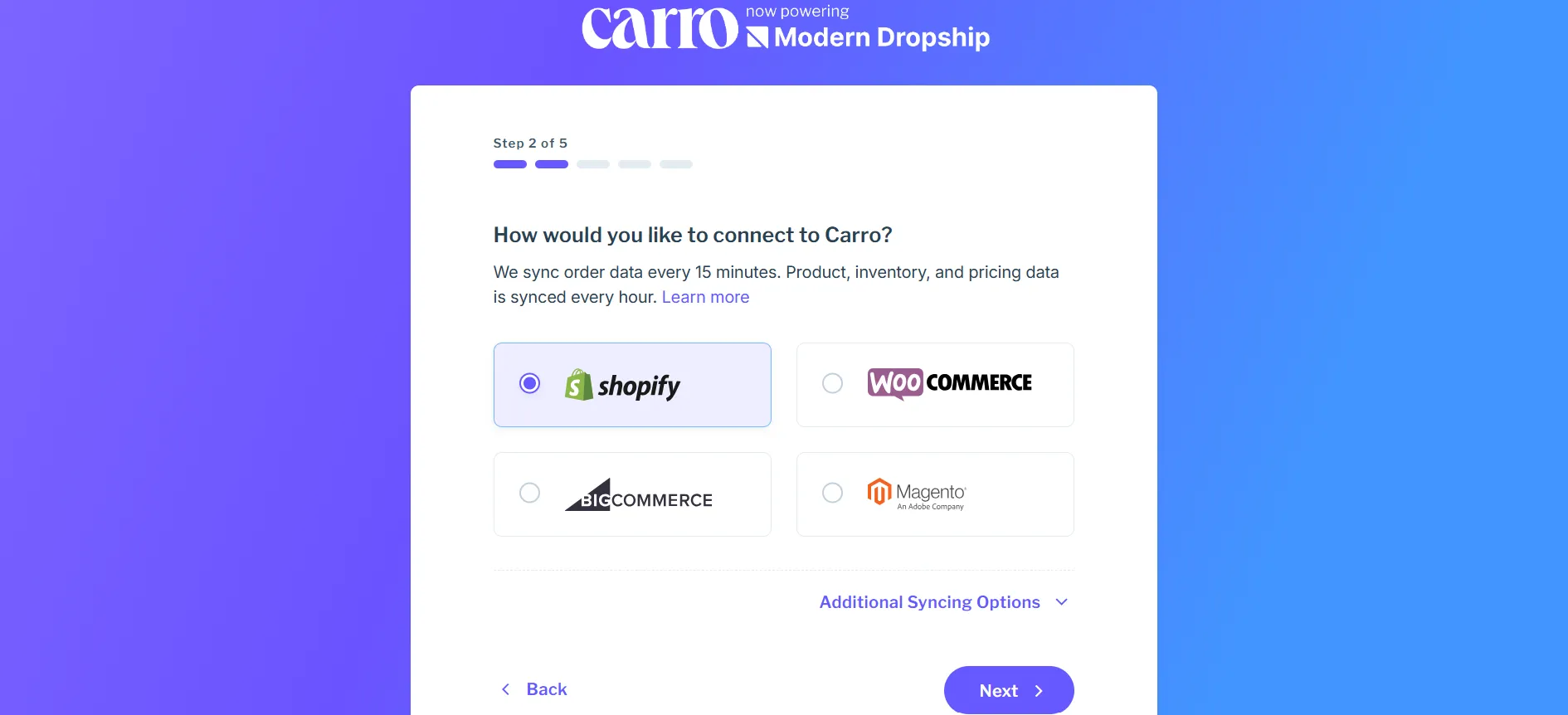
Retailers connect through native storefront integrations, an API, or webhooks. Shopify, WooCommerce, BigCommerce, and Magento connect directly. The API covers products, order creation, and order status, with webhooks pushing events as they happen.
Everything resolves into one internal model. A stock update becomes a variant record. A purchase order becomes an order. A ship notice becomes a fulfillment.
The mechanism that makes this work is a mapping layer with four field types. Core fields map to the internal model, attributes carry partner-visible data that falls outside it, private fields hold information used for troubleshooting, and constants pin values that never change. That is how one internal model survives contact with dozens of partner-specific dialects.
The latency difference, with a real number. On the supplier side, stock arrives as a file that Carro collects every 15 minutes. On the retailer side, an inventory change fires a webhook notification the moment it happens. Same system, same data, two paradigms, and a measurable gap between them. That is the EDI vs API trade-off made concrete rather than argued in the abstract.
Migrating Between Methods Without Breaking Anything
Partners move between methods as they grow. A brand that started on CSV builds an ERP integration. A distributor modernizes and offers an API. Planning for that movement is part of choosing an architecture.
Four things make a migration uneventful.
- Keep product identifiers stable. This is the one that causes real damage. If a variant is referenced by one code under CSV and a different code under EDI, every historical order breaks its link. Agree the identifier once and keep it through every method change.
- Run both in parallel briefly. Send the new method's data alongside the old and compare outputs before cutting over. Discrepancies surface in a comparison, not in production.
- Migrate one document at a time. Inventory first, since it is the highest frequency and the easiest to verify. Orders last, since they carry the most business risk.
- Test the rejection path on the new method. A migration that only tests successful orders has tested half the system.
Because Carro normalizes every method into the same internal model, a partner switching from CSV to EDI changes how data arrives rather than what it becomes. Orders, variants, and fulfillments keep the same shape, which is what keeps historical continuity intact.
A Decision Framework Instead of a Verdict
Rather than declaring a winner, work through these.
- Is a partner mandating one? Then the decision is made. Enterprise retail mandates are not negotiable.
- Are you connecting to companies you do not control? Favor EDI, because partner support is the binding constraint.
- Are you connecting systems you or your vendor own? Favor an API, because you control both ends.
- Is your partner network mixed? You need a layer that accepts several methods and normalizes them.
- Can your smallest partners produce a file at all? If not, CSV support is not a nice-to-have, it is the difference between having them and not.
- Do you have engineering capacity? APIs reward it. Without developers, a self-serve approach matters more than the protocol.
- How fresh does the data need to be? Live storefronts making sales decisions continuously need minutes, not overnight windows.
For the architectural side of this decision, our guide to EDI integration covers how connection topology changes what each method costs at scale.
Everything You Need to Know About EDI vs API
| Category | What You Need to Know |
|---|---|
| The category error | EDI is a document format and standard. An API is an interaction pattern. They sit at different layers. |
| What is actually compared | Batch document exchange over file transfer, against real-time request and response over the web. |
| The quick test | No technical control over the other party means EDI. A system you or your vendor operate means API. |
| EDI advantages | Near-universal partner support, standardized acknowledgements, stability, audit fit, and frequent mandates. |
| API advantages | Immediate latency, better developer experience, faster iteration, and event-driven notifications. |
| The third option | CSV, which many small brands can produce when they can manage neither of the other two. |
| The binding constraint | Partner readiness. You cannot API your way into a distributor running legacy software. |
| Migration | Keep product identifiers stable, run parallel briefly, migrate inventory first and orders last, test rejections. |
| Where Carro fits | EDI or CSV on the supplier side, native storefront integrations, API, or webhooks on the retailer side, all resolving into one internal model. |
Start Growing With Carro
Three things separate Carro from picking a side in this debate:
- Every method runs at once: Suppliers use EDI or CSV. Retailers use native integrations, the API, or webhooks. Neither side has to adopt the other's technology to trade.
- One internal model underneath: Whatever arrives resolves into the same shape, so your operations team sees one system rather than a collection of connection types, and a partner upgrading their method does not break historical continuity.
- Supply is included, not just plumbing: More than 1,500,000 products from vetted brands, hand-matched by account managers on category, audience, and price point. Retailers report up to 3.5 times revenue growth, up to 180% growth in average order value, and up to three times catalog size.
Carro is built for retailers and marketplaces running mixed supplier networks, and for brands wanting retail distribution without a wholesale negotiation.
Pricing starts at $149 per month with unlimited partnerships, onboarding is self-serve, and you can round-trip a complete test order in a sandbox before a single real partner is involved.
Frequently asked questions
What is the difference between EDI and API?
The difference between EDI and API is that EDI is a standardized document format while an API is a live connection between two systems. EDI specifies how a purchase order should be structured so any two companies read it identically, without saying how the file travels. An API defines how one system asks another a question and receives an immediate answer, without standardizing the content. They operate at different layers, which is why comparing them head to head produces confusing advice.
Is API better than EDI?
An API is not better than EDI in any general sense, because the two solve different problems. APIs are faster, easier for engineering teams to build against, and better suited to systems you control. EDI wins decisively on partner support, since enterprise retailers and distributors already speak it and many mandate it. A useful test is whether you have technical control over the other party: if not, EDI is usually the answer.
Can EDI and API work together?
EDI and API work together routinely, and most multi-supplier networks run both alongside CSV. A typical arrangement has enterprise partners exchanging EDI files while modern partners connect through an API, with a translation layer normalizing everything into one internal model. Carro works exactly this way, using EDI or CSV on the supplier side and native storefront integrations, an API, and webhooks on the retailer side. This is the practical answer for any network with partners at different levels of technical maturity.
Is EDI being replaced by APIs?
EDI is not being replaced by APIs, though the way EDI is delivered has changed considerably. The standard persists because thousands of companies already agree on it, and that shared agreement is precisely what makes automated trade possible between organizations with no common technology. What has been replaced are the older delivery models: per-kilo-character billing, months-long mapping projects, and overnight batch windows. The accurate framing is old standard, new delivery.
Which is faster, EDI or API?
An API is faster, since it returns an answer immediately while EDI files are typically collected on a cycle. The size of that gap depends entirely on the system's design rather than the standard. Carro collects supplier files every 15 minutes on the EDI side, while retailers receive a webhook notification the moment a supplier's inventory changes. For most retail workflows the difference between minutes and instant matters less than whether the partner can connect at all.
What if a supplier can use neither EDI nor an API?
Suppliers who can use neither should connect by CSV, which most can produce from whatever inventory tool they already run. Excluding them is a strategic mistake, since small and mid-size brands are frequently the differentiated assortment a retailer actually wants. Carro seeds product catalogs by CSV with template mapping, and a file matching the template submits automatically. Once loaded, those brands appear in the system identically to partners sending X12.
How do I migrate a partner from CSV to EDI?
Migrate by keeping product identifiers stable above everything else, since changing a variant reference breaks the link to every historical order. Run the new method in parallel with the old briefly and compare outputs before cutting over, then migrate one document at a time, starting with inventory and finishing with orders. Test the rejection path on the new method, not just successful orders. Because Carro normalizes every method into the same internal model, the migration changes how data arrives rather than what it becomes.