Best Rithum Alternatives in 2026 (Top-Rated Competitors Reviewed)
Compare the best Rithum alternatives for 2026. See features, pricing, and use cases for Carro, Mirakl, Logicbroker, Marketplacer, and more. Find your fit.

Key Takeaways
- What is Rithum: Rithum (formerly CommerceHub and ChannelAdvisor) is a comprehensive ecommerce platform designed for large enterprises to manage multichannel sales, order fulfillment, and digital marketing. It connects brands to over 420 marketplaces and retail channels, processing $50B+ in GMV annually.
- Rithum's Limitations: While powerful, Rithum's focus on enterprise-level clients means it can be complex, costly, and less agile for small to medium-sized businesses and DTC brands. Users report significant post-merger price increases (4–7x), rigid workflows, and support quality that has declined since the CommerceHub/ChannelAdvisor merger.
- Best Rithum Alternative: For retailers and marketplace operators prioritizing ease of use, rapid assortment expansion, and cost-efficiency, Carro stands out as the best overall alternative to Rithum. Carro is a dropship and marketplace infrastructure platform that manages the full supplier lifecycle, from onboarding and catalog ingestion to order routing, fulfillment tracking, and automated payouts, with usage-based pricing starting at 5% of sales.
- What Sets Carro Apart: Carro is the only platform on this list that combines a hand-matched supplier network of 1.5M+ products with automated order routing, real-time sync, and structured settlement, all from a single layer above your existing storefront.
- How to Choose: Focus on three factors: whether you need multi-channel listing management or supplier orchestration, how fast you need to go live, and whether your pricing tolerance is usage-based or enterprise-contract.
Rithum Alternatives at a Glance
| Platform | Pros | Cons | Key Features | Pricing Starts |
|---|---|---|---|---|
| Carro | Go-live in weeks, usage-based pricing tied to revenue, curated 1.5M+ product supplier network, unified dropship and marketplace infrastructure, white-glove onboarding support | Does not support the sale of digital goods, services, or subscription-based products. Strongest fit is US-based retailers. | Hand-matched supplier network, automated order routing, real-time inventory sync, multi-platform integrations (Shopify, Magento, BigCommerce, WooCommerce, EDI/SFTP) | 5% of sales (Standard); custom for Growth/Enterprise |
| Mirakl | Enterprise marketplace leader, highly scalable, trusted by Macy's, Kroger, and Airbus | Very high cost ($699–$2,299/month + GMV fees); requires separate ecommerce platform; lengthy implementation | Seller onboarding, AI-powered catalog management, order processing, 40+ integrations | $699/month (Growth) |
| Marketplacer | Seamless third-party seller integration, highly scalable for enterprise needs, high customer satisfaction | Can require technical expertise for implementation. Pricing not publicly available. | Seller onboarding, catalog management, pre-built connectors for Shopify Plus, BigCommerce, Salesforce Commerce Cloud | Custom (contact vendor) |
| Logicbroker | AI-powered product discovery, predictable annual subscription with no transaction fees, trusted by Samsung and Walgreens | Onboarding may be complex for smaller teams. Enterprise-oriented pricing. | AI-driven vendor onboarding, automated order routing, 200+ integrations, EDI/API/XML/CSV/JSON support | ~$3,000/year (custom quotes) |
| Sellbrite | User-friendly interface, affordable, good for small to medium-sized businesses | Can struggle with very high order volumes. Limited advanced features. | Multi-channel listing, centralized inventory sync, shipping label printing from multiple carriers | $29/month |
| Linnworks | Strong inventory and order management, wide range of integrations, automation capabilities | Steeper learning curve. Can become expensive as features are added. | Multi-warehouse inventory, workflow automation, extensive marketplace and shipping integrations | Custom (contact vendor) |
What is Rithum?
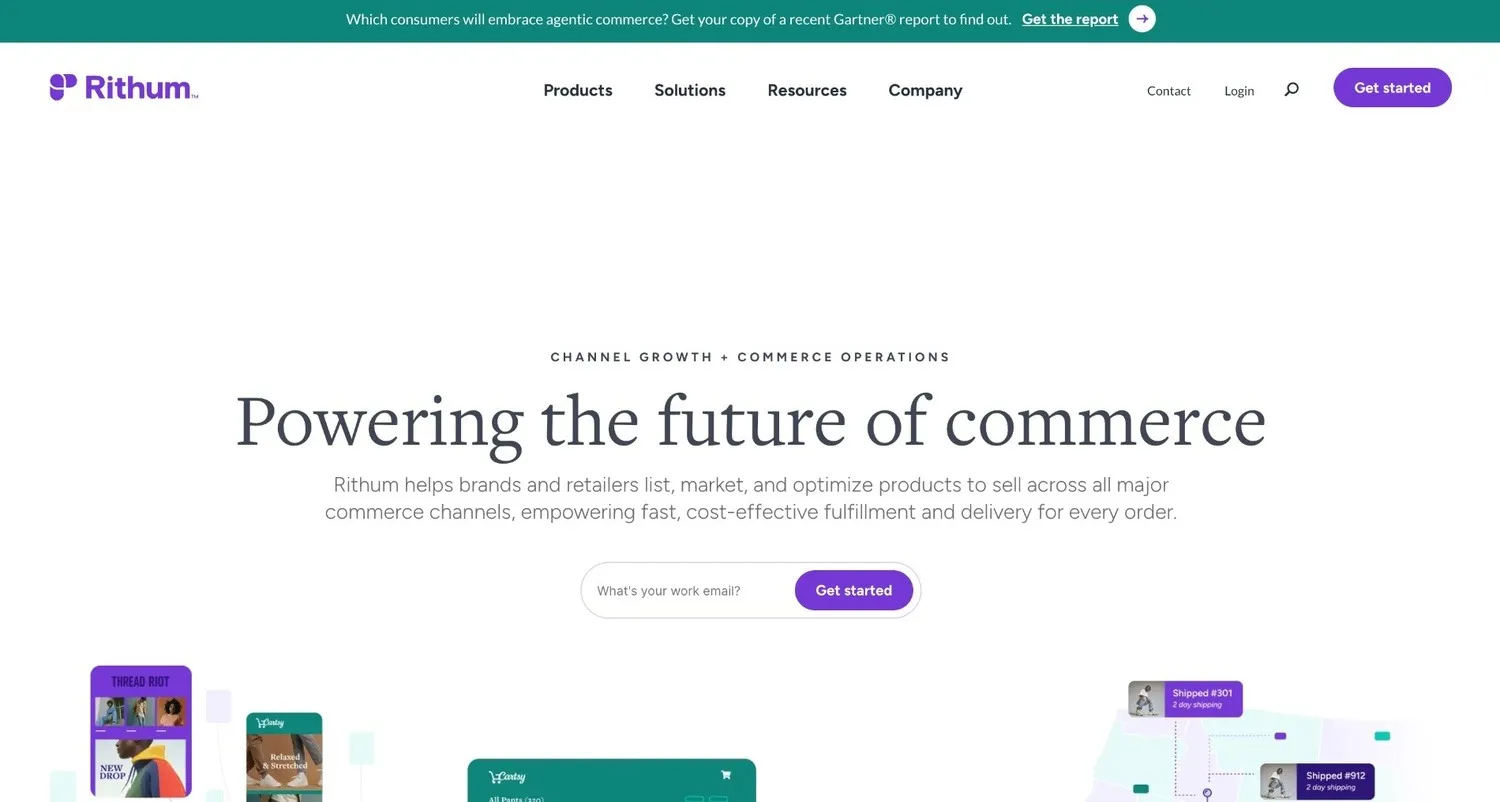
Before diving into alternatives, it's important to understand what Rithum is. Formed from the merger of CommerceHub and ChannelAdvisor, Rithum is an ecommerce platform built for the world's largest brands and retailers. Its platform provides a centralized system for managing sales across hundreds of channels, from marketplaces like Amazon to social commerce on TikTok.
Rithum's core strengths include broad channel reach (connecting to 420+ global marketplaces), enterprise-scale operations engineered for massive product catalogs and high order volumes, and end-to-end management covering everything from product listing and inventory to fulfillment and analytics. The company connects over 40,000 brands and retailers, processing $50 billion+ in GMV annually.
However, this enterprise focus is precisely why many brands are searching for best Rithum alternatives. The platform's complexity, pricing structure, and post-merger service changes are often misaligned with the needs of agile, growth-oriented businesses. Users report significant price increases following the CommerceHub/ChannelAdvisor merger, with some claiming costs rose 4–7x without corresponding feature improvements.
Why Look for Rithum Alternatives?
If you're managing a growing DTC brand or an SMB, Rithum's enterprise-first approach might not match the way you work.
Here are the common pain points that lead merchants to seek out alternatives to Rithum:
- High Cost of Ownership: Rithum's pricing is designed for enterprise budgets, often involving significant setup fees, monthly retainers, and revenue-sharing agreements that can be prohibitive for smaller companies. Multiple user reviews describe the platform as one of the most expensive options available, with fees increasing by approximately 4% annually.
- Complexity and Steep Learning Curve: The platform is feature-rich, but this also makes it complex to navigate. Teams often require specialized training and significant time to become proficient, slowing down operations.
- Rigid Workflows: Enterprise systems are built for stability, not speed. For DTC brands that need to pivot quickly, launch new partnerships, and test new products, Rithum can feel slow and inflexible. Users report needing to adapt their workflows to fit the platform rather than the reverse.
- Post-Merger Service Decline: Since the CommerceHub and ChannelAdvisor merger, user reviews across multiple platforms report a decline in support quality, account management consistency, and overall service responsiveness.
- Contract Lock-In: Rithum uses auto-renewing contracts with narrow cancellation windows. Multiple reviewers report difficulty cancelling, being sent to collections for unused service periods, and facing exit penalties.
For these reasons, exploring a rithum alternative is not just about finding a cheaper option – it's about finding a platform that aligns with a more modern, flexible, and efficient way of doing business.
What Happens After You Sign With Rithum
When looking at real user feedback across major review platforms like G2, Capterra, and Trustpilot, a pattern emerges. Three concerns come up repeatedly from teams that have implemented and operated Rithum:
Sales promises that don't match reality
This is the most consistent theme across all three platforms. One Capterra reviewer – a Director of Operations in retail – reported that after seven months with Channel Advisor, their ROI was negative 98%. They described a situation where the sales team promised managed marketplace services, but the actual execution fell short of what was agreed during the sales process.
On Trustpilot, another reviewer stated they contracted Rithum's Channel Advisor platform and described a company that promises integrations with marketplaces it has never actually built connections for, resulting in an entire lost month of operations.
Support that disappears after the sale
On G2, a reviewer titled their feedback "The lack of Support is really terrible" and described being unable to reach anyone by phone, with email responses taking over 8 hours and explanations that were "too technical for the average person.".
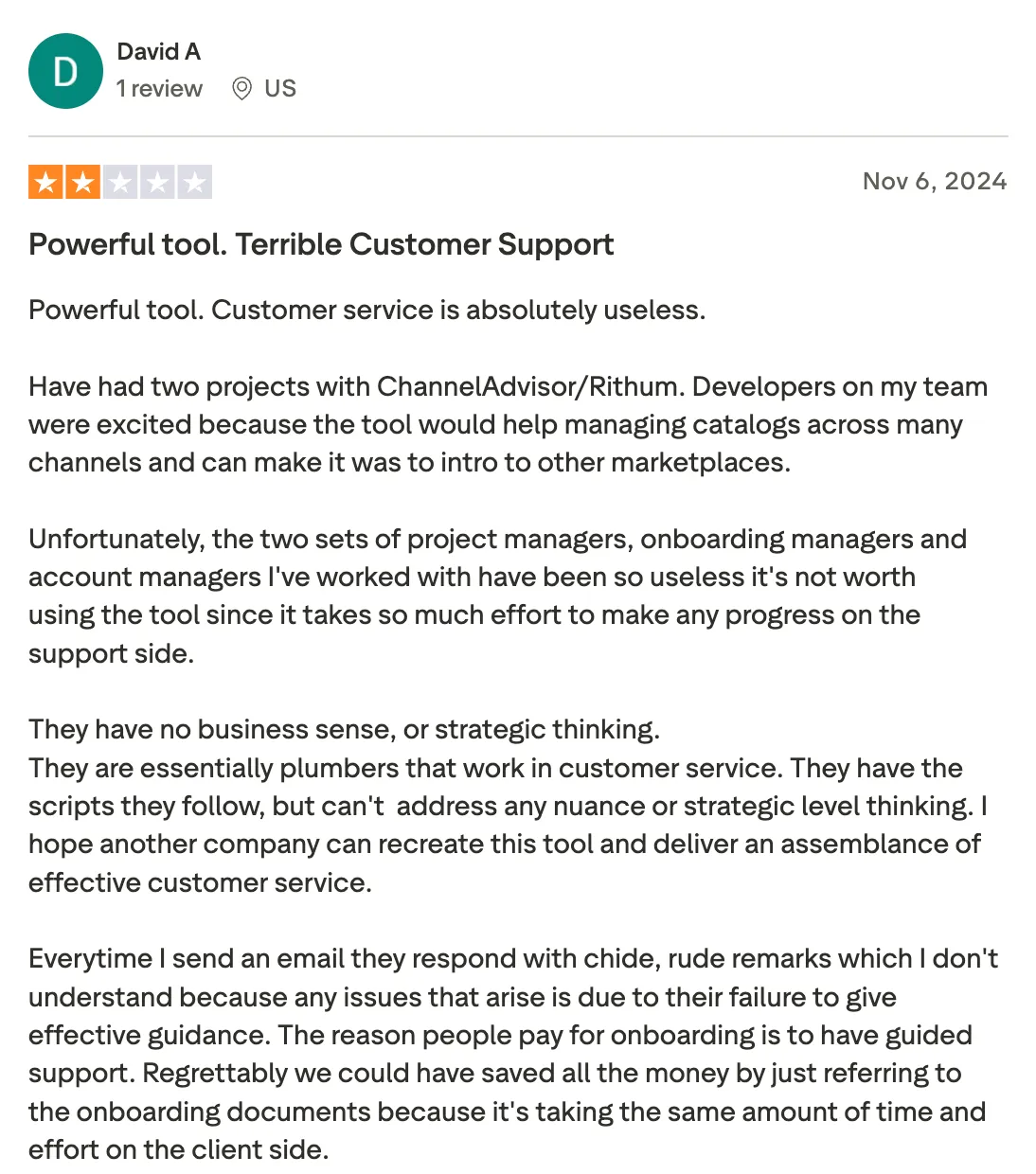
A Trustpilot reviewer called the platform a "powerful tool" but described customer service as "absolutely useless", noting that multiple project managers, onboarding managers, and account managers provided no meaningful help.
On Capterra, one reviewer described being yelled at by two different project managers during their onboarding.
Contracts you can't get out of
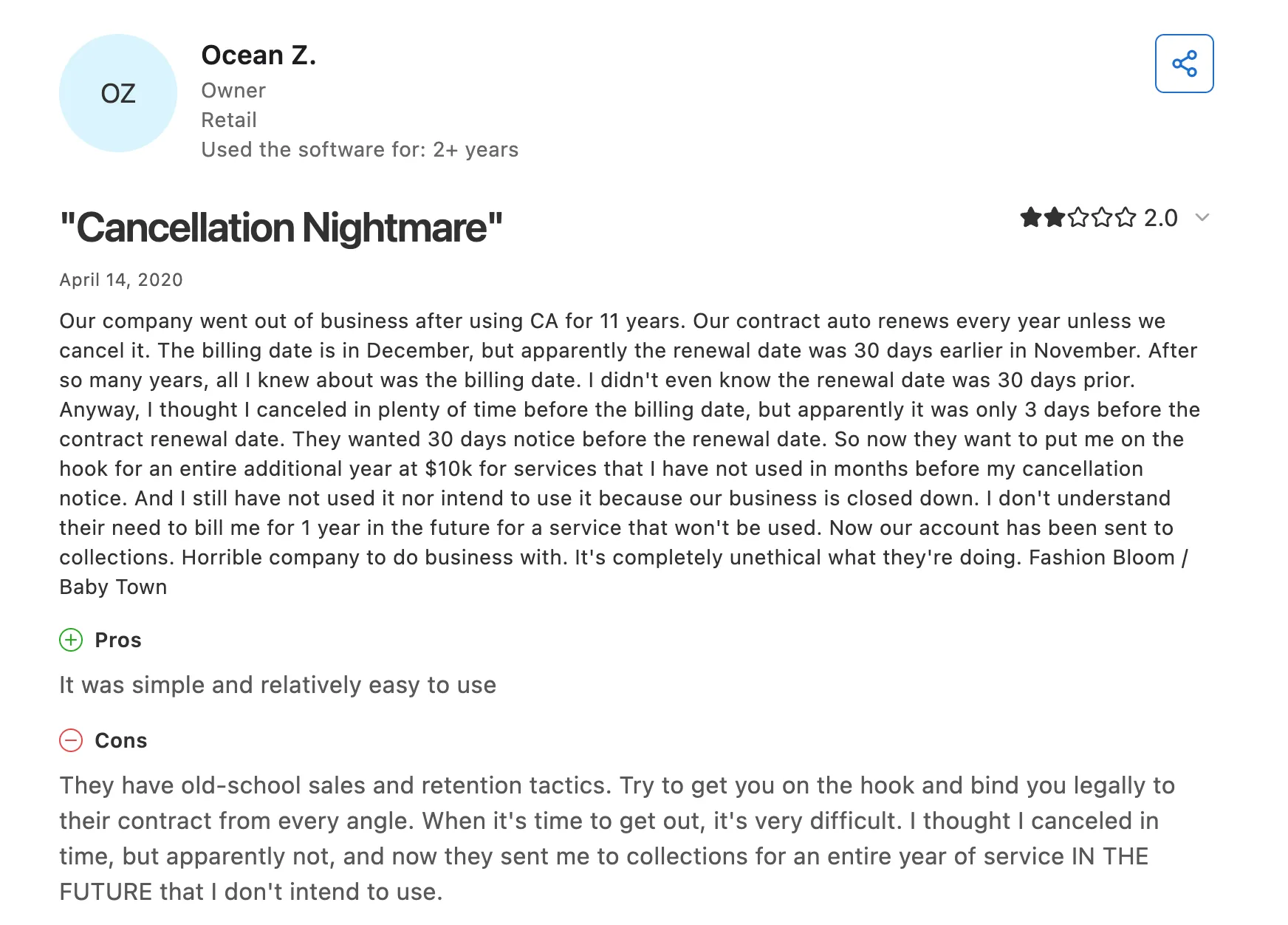
On Capterra, a business owner who used Channel Advisor for 11 years described an auto-renewing contract where the renewal date was 30 days before the billing date, a detail they were never told. After closing their business and attempting to cancel, they were billed $10,000 for a full additional year and sent to collections.
On Trustpilot, another reviewer reported signing up and receiving nothing for 9 months, only to have Rithum pursue them for $20,000. These are not isolated cases. Contract lock-in and cancellation difficulty appear in reviews across all three platforms.
Top Rithum Alternatives for 2026: In-Depth Review & Comparison
Choosing a platform is no longer just about adding more products to more channels. It's about curating high-quality assortments, automating operations, and protecting your margins. Here are the best alternatives to Rithum in 2026:
1. Carro
Overview
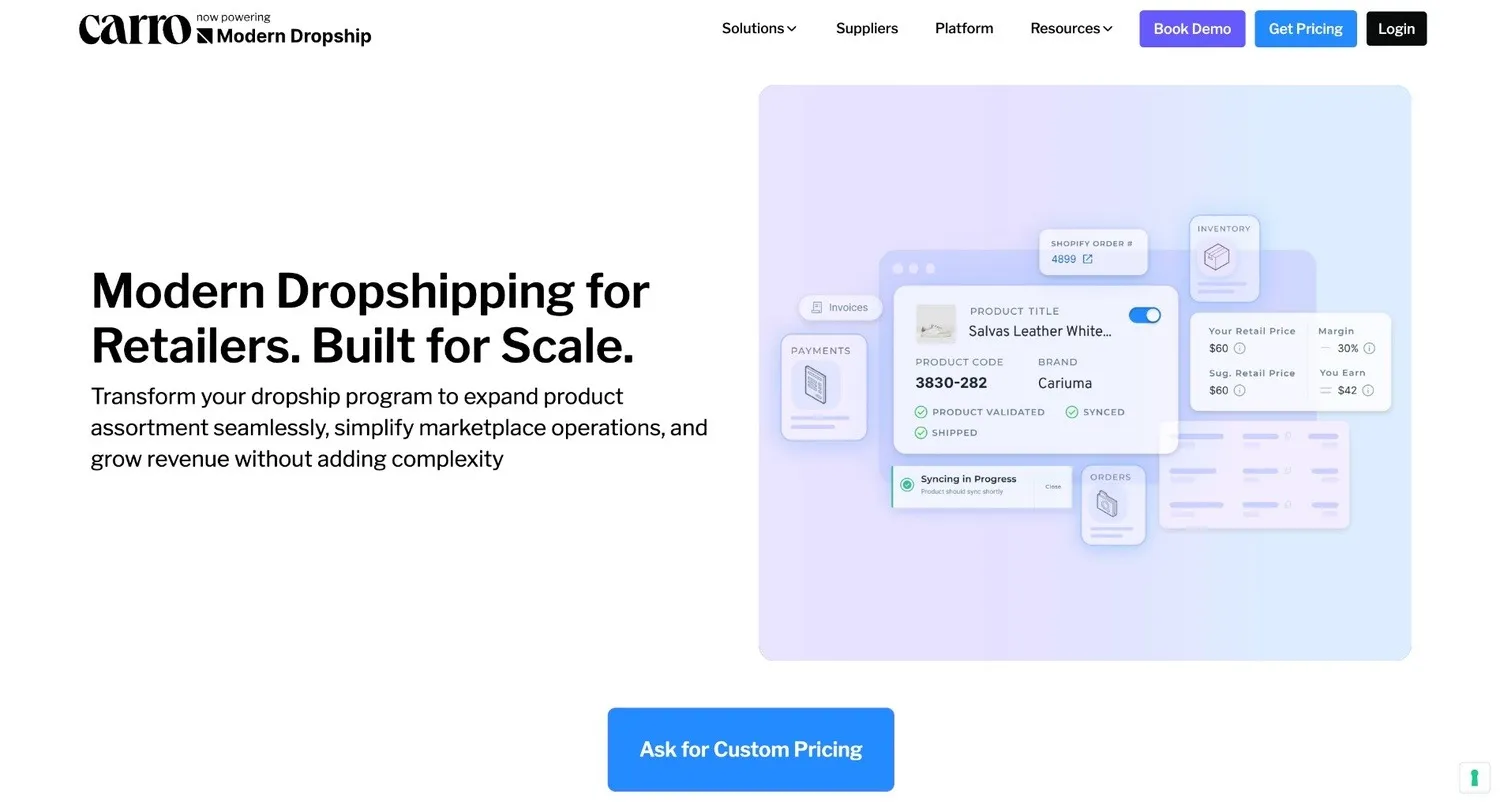
Carro is a dropship and marketplace infrastructure platform built for retailers looking to expand their product catalog without inventory risk or operational sprawl.
Unlike Rithum, which focuses on syndicating product data across hundreds of existing marketplaces, Carro manages the full supplier lifecycle within your own storefront – onboarding, catalog ingestion, pricing rules, inventory syncing, order routing, fulfillment tracking, and automated payouts.
Carro integrates directly into the storefronts retailers already run, including Shopify, Magento, BigCommerce, and WooCommerce, plus EDI, API, SFTP, and CSV connections for enterprise partners. Account managers hand-match retailers with complementary brands from a network of 1.5M+ products, so what goes online is selected for fit rather than dumped from a generic catalog.
Carro now powers Modern Dropship, serving as the infrastructure behind distributed retail operations where inventory lives with brands and distributors but the customer experience stays centralized. Retailers using Carro have reported up to 3.5x revenue growth, up to 180% AOV growth, and up to 3x increase in catalog size.
Ideal For
- Established retailers modernizing legacy dropship programs and replacing manual supplier workflows
- Online and pure-play marketplace operators scaling their supplier networks without adding headcount
- Mid-market DTC brands seeking curated retailer partnerships aligned with their positioning and audience
- Ecommerce directors and heads of merchandising testing new categories without inventory exposure
- Brand suppliers looking to expand distribution through trusted retail partners without wholesale friction
Top Features
- Hand-matched supplier network: Account managers connect retailers with complementary brands based on category fit, price point, and audience alignment – not algorithmic matching from an unfocused catalog.
- Automated order routing and settlement: Orders for partner products route to the correct supplier automatically. Payouts process immediately through Stripe, with full reconciliation and reporting.
- Real-time inventory and pricing sync: Product data, stock levels, and pricing update in real time across connected storefronts, reducing oversell risk and manual catalog maintenance.
- Multi-platform integrations: Native connectors for Shopify, Magento, BigCommerce, and WooCommerce, plus EDI, SFTP, API, and CSV for enterprise and distributor partners.
- White-glove onboarding support: Carro's team handles technical integration and partner enablement. Many clients launch without needing internal developer resources.
Why We're the Best Rithum Alternative
Rithum is built to syndicate your products across hundreds of external marketplaces. Carro is built to bring curated supplier products into your own storefront. Where Rithum gives you tools to manage listings across channels, Carro gives you both the tools and the suppliers - hand-matched by account managers from a curated network. You control the customer experience, the merchandising, and the brand presentation.
Pricing is usage-based (5% of sales on the Standard plan), so cost tracks the revenue the program creates. No auto-renewing enterprise contracts. No exit penalties. Most teams go live in weeks, not quarters.
Pros
- Usage-based pricing with no upfront infrastructure investment – cost rises only as revenue grows
- Go-live in weeks with pre-built integrations and structured onboarding workflows
- Curated supplier network of 1.5M+ products with human-led brand matching, not generic catalog dumps
- Full supplier lifecycle management from a single platform: onboarding, sync, routing, fulfillment, payouts
- Hands-on support team that handles technical integration so internal teams stay focused on growth
Cons
- Does not support digital goods, services, or subscription-based products
- Strongest fit is US-based retailers and brands – international coverage is growing but not as deep as Rithum's 420+ channel network
- Not designed for multi-channel listing syndication across dozens of external marketplaces – Carro focuses on your own storefront
Pricing
Carro's Standard Plan charges 5% of sales with unlimited transactions. It includes Shopify, Magento, BigCommerce, and WooCommerce integrations plus end-to-end dropship automation. The Growth Plan adds autonomous merchandising, a hand-matched supplier network, priority support, automated order routing, real-time sync, and expanded catalog capabilities. Enterprise pricing is custom.
Suppliers pay nothing to join. They set a revenue split with retailer partners and receive their full cut immediately via Stripe. All plans include full platform access, automated payments, basic performance insights, and access to the 1.5M+ product network.
Final Verdict
Carro is the best overall alternative to Rithum for retailers and marketplace operators that want to grow assortment and revenue within their own storefronts without inventory exposure or enterprise-contract overhead.
It combines supplier discovery, onboarding, operations, and settlement in one platform, something no other Rithum alternative on this list fully replicates. Teams that need multi-channel listing syndication across 420+ external marketplaces should stay on Rithum or evaluate Sellbrite/Linnworks instead.
2. Mirakl

Overview
Mirakl is a global leader in marketplace software, providing enterprise-level businesses with the technology to launch and scale a third-party seller model. Its platform manages everything from seller onboarding and catalog management to order processing and payments.
Companies like Macy's, Kroger, and Airbus use Mirakl to expand their product assortments without holding physical inventory. Where Rithum helps you sell on other people's marketplaces, Mirakl helps you become the marketplace. This is a fundamentally different strategy and the right choice for enterprises that want to own the platform rather than just list on it.
Ideal For
- Large enterprises planning to launch or scale their own third-party marketplace
- Retailers with the budget and technical resources for a 6–12 month implementation
- Organizations that want to own the marketplace model as a core business strategy
Top Features
- Marketplace platform: Provides the technology to onboard and manage third-party sellers, process orders, and control product catalogs at enterprise scale.
- AI-powered catalog management: Automates product data mapping and integration, reducing manual effort and time-to-market for new sellers.
- Seller management tools: Comprehensive suite for sellers to manage their presence, inventory, and orders on your marketplace.
Why It's a Strong Rithum Alternative
Mirakl is one of the strongest Rithum competitors for enterprises that want to shift from selling on other marketplaces to operating their own. Where Rithum connects you to 420+ external channels, Mirakl gives you the infrastructure to become the channel. For large retailers with the budget to support it, this is a strategic move from renting shelf space to owning the store.
Pros
- Industry-leading enterprise marketplace infrastructure trusted by major brands
- AI-powered catalog and seller management at scale
- Strong ecosystem of 40+ integrations with existing ecommerce platforms
- Designed for businesses processing significant GMV
Cons
- Very high cost: $699/month (Growth) to $2,299/month (Pro) plus GMV-based transaction fees
- Requires a separate ecommerce platform (Shopify, Adobe Commerce, Salesforce)
- Implementation takes months, not weeks – steep learning curve reported by users
- Overkill for most SMBs and DTC brands
Pricing
Mirakl's Growth plan starts at $699/month and the Pro plan at $2,299/month, both with additional GMV-based transaction fees. Enterprise contracts are negotiated individually. Independent analyses estimate total annual platform fees can reach ~$90,000/year before transaction costs.
Final Verdict
Mirakl is the right choice for well-funded enterprises looking to adopt the marketplace model as a core business strategy. It is an alternative to Rithum if your goal is to become the channel, not just sell on it. It is not practical for SMBs, DTC brands, or teams that need fast time-to-value. Those teams will find Carro a better match.
3. Marketplacer

Overview
Marketplacer is a marketplace SaaS platform designed to help businesses build, manage, and grow large-scale online marketplaces. With modular flexibility, Marketplacer serves both B2B and B2C companies looking to expand their product assortment by onboarding third-party sellers.
The platform integrates with Shopify Plus, Adobe Commerce, BigCommerce, Salesforce Commerce Cloud, and commercetools through pre-built connectors. Founded in Australia, it has built a reputation for deep ecommerce integrations and strong strategic guidance beyond software support.
Ideal For
- Mid-market and enterprise retailers adding a marketplace layer to an existing ecommerce storefront
- Companies running multi-category operations across retail, grocery, B2B, or loyalty verticals
- Organizations that already have their own supplier relationships and need infrastructure to manage them
Top Features
- Flexible marketplace architecture: Supports a wide range of marketplace models, including dropshipping, consignment, and traditional third-party selling.
- Pre-built ecommerce connectors: Integrates with Shopify Plus, Adobe Commerce, BigCommerce, Salesforce Commerce Cloud, and commercetools.
- Seller management and analytics: Robust onboarding, vendor analytics, and commission management tools for growing a seller network.
Why It's a Strong Rithum Alternative
Marketplacer is one of the strongest Rithum competitors for mid-market and enterprise organizations that want to transform their business into a marketplace operator. Where Rithum helps you sell on existing channels, Marketplacer gives you the infrastructure to add third-party sellers to your own platform. Reviewers consistently rate it highly (4.9/5 on Capterra), praising the team's marketplace expertise and willingness to provide strategic guidance.
Pros
- Deep integrations with major ecommerce platforms, reducing replatform risk
- Strong seller onboarding workflows and catalog management tools
- High customer satisfaction ratings and responsive support team
- Flexible architecture supporting multiple marketplace models
Cons
- Pricing is not public – every deal requires a custom sales process
- Can require technical expertise for implementation, especially for complex taxonomies
- Does not include a curated supplier network – you bring your own partners
Pricing
Marketplacer does not publish pricing. Contracts are custom and typically include a one-time implementation fee, an ongoing subscription, and transaction-based or GMV-based fees. Contact Marketplacer for a tailored quote.
Final Verdict
Marketplacer is a strong contender for established businesses that want to add a marketplace layer on top of their current ecommerce setup. It is not the right choice for retailers that need help finding suppliers – Marketplacer manages your partners, but it does not source them for you. Teams seeking a curated network and faster time-to-value will find Carro a better match.
4. Logicbroker

Overview
Logicbroker positions itself as an "Agentic Commerce Orchestration Engine," using AI to modernize multi-vendor commerce. The platform connects retailers, brands, and B2B organizations with a focus on frictionless connections and data-driven insights.
Trusted by enterprise names like Samsung, Walgreens, and Home Depot, Logicbroker powers over $10 billion in GMV annually. It supports EDI, API, XML, CSV, and JSON integrations through a single RESTful API endpoint. Logicbroker excels at automating the entire dropship and marketplace process, from onboarding new vendors in days to providing deep visibility into supply chain performance.
Ideal For
- Enterprise retailers managing large, distributed supplier networks across multiple fulfillment models
- Brands and distributors needing structured EDI connectivity with major retail partners
- B2B organizations with complex supply chain requirements and compliance needs
Top Features
- AI-powered product discovery and onboarding: On-demand supplier onboarding automates the majority of setup work, getting new vendors live in under an hour.
- Automated order routing and optimization: Evaluates each order against real inventory, SLAs, and cost to select the best fulfillment path, then monitors execution and adapts on exceptions.
- Multi-format integration support: Connects trading partners regardless of their technical setup – EDI, API, XML, CSV, JSON – through a single RESTful API endpoint.
Why It's a Strong Rithum Alternative
Logicbroker is one of the strongest Rithum competitors for enterprises that need deep supply chain visibility and predictable pricing. Unlike Rithum's post-merger pricing increases, Logicbroker charges a predictable annual subscription with no transaction fees – no per-order charges, no percentage of revenue.
For organizations managing hundreds of trading partners across complex fulfillment networks, Logicbroker's orchestration layer reduces manual effort and gives operations teams control without the contract lock-in issues reported by Rithum users.
Pros
- Predictable annual subscription pricing with zero transaction fees
- Enterprise-grade integrations: EDI, API, XML, CSV, JSON through one endpoint
- AI-driven onboarding that gets suppliers live in under an hour
- Trusted by major enterprises (Samsung, Walgreens, Home Depot) processing $10B+ GMV
Cons
- Enterprise-oriented pricing and sales process – not accessible for SMBs or early-stage retailers
- Vendor onboarding can be tedious for non-technical suppliers
- Some features lack thorough documentation, extending the learning curve
- Does not include a curated supplier network – you source your own partners
Pricing
Logicbroker charges a predictable annual subscription with no transaction fees. Third-party sources indicate pricing starts around $3,000/year, but most enterprise contracts are custom. Contact Logicbroker for a quote.
Final Verdict
Logicbroker is the right choice for enterprise retailers and brands managing complex, multi-vendor supply chains that need deep EDI connectivity, AI-driven orchestration, and predictable costs. It is not designed for mid-market retailers looking to quickly expand catalog with new supplier partnerships – those teams will find Carro's curated network and faster go-live a better fit.
5. Sellbrite

Overview
Sellbrite offers a straightforward and user-friendly platform for multichannel selling. It's designed for small-to-medium businesses that want to expand their reach to major marketplaces like Amazon, eBay, Walmart, and Etsy without the enterprise-level complexity of Rithum. Now owned by GoDaddy, Sellbrite focuses on doing a few things well: centralized product listing, inventory syncing, and shipping label printing. It is the most accessible rithum alternative on this list for teams with limited technical resources.
Ideal For
- Small to medium-sized businesses selling on 2–5 marketplaces
- Sellers who need affordable multi-channel listing management without enterprise overhead
- Teams with limited technical resources that need a plug-and-play solution
Top Features
- Centralized product management: Manage listings and variations across multiple channels from a single dashboard.
- Inventory syncing: Automatically sync inventory levels across all connected channels to prevent overselling.
- Shipping label printing: Print labels from multiple carriers (USPS, FedEx, UPS) directly within the platform.
Why It's a Strong Rithum Alternative
Sellbrite is one of the smartest Rithum alternatives for small businesses that need multi-channel listing management without enterprise complexity or pricing. Where Rithum connects to 420+ channels with enterprise-grade tooling, Sellbrite covers the 5–10 channels most SMBs actually sell on – at a fraction of the cost.
Pros
- Affordable entry point: plans start at $29/month
- User-friendly interface designed for non-technical teams
- Reliable inventory syncing across major marketplaces
- Now backed by GoDaddy, providing long-term platform stability
Cons
- Can struggle with very high order volumes – not designed for enterprise scale
- Limited advanced features compared to Rithum, Logicbroker, or Carro
- No supplier network or dropship infrastructure – focused purely on listing management
- Feature development has slowed since the GoDaddy acquisition
Pricing
Sellbrite plans start at $29/month for up to 100 orders. Plans scale to $179/month for higher order volumes. A free plan is available for stores with limited listings.
Final Verdict
Sellbrite is the right choice for small businesses that need affordable, simple multi-channel listing management across a handful of major marketplaces. It is not a fit for retailers that need supplier orchestration, dropship infrastructure, or inventory-free catalog expansion – those teams should evaluate Carro or Logicbroker instead.
6. Linnworks
Overview
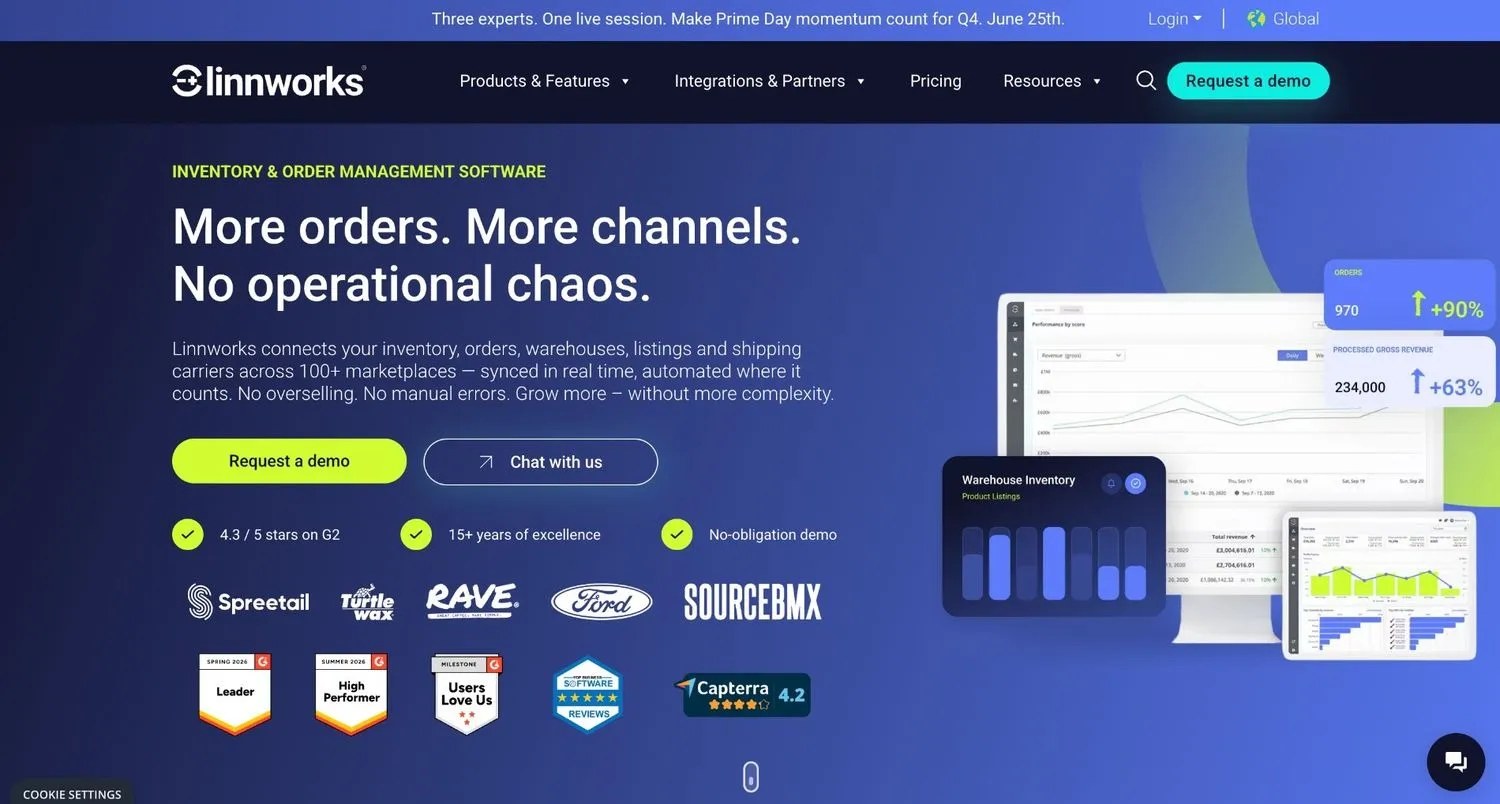
Linnworks is an inventory and order management platform that excels at automating ecommerce operations. It connects your entire sales process, from listing on channels to managing warehouse inventory and shipping. Linnworks is a step up from Sellbrite in terms of power and is aimed at businesses scaling their operations. It provides multi-warehouse inventory management, workflow automation, and an extensive library of integrations with marketplaces, shipping carriers, and ERP systems.
Ideal For
- Growing ecommerce businesses outgrowing simpler tools like Sellbrite
- Sellers managing inventory across multiple warehouses and locations
- Operations teams that need workflow automation for order routing, shipping, and repetitive tasks
Top Features
- Advanced inventory management: Manage stock across multiple warehouses and locations with real-time visibility and low-stock alerts.
- Workflow automation: Use rules to automate order routing, shipping selection, and other repetitive tasks based on order attributes.
- Extensive integration library: Connects with a wide array of marketplaces, shipping carriers, ERP systems, and accounting tools.
Why It's a Strong Rithum Alternative
Linnworks is one of the strongest Rithum alternatives for businesses that have outgrown simpler tools and need robust automation to handle increasing order volume. It provides much of the inventory and order management power of Rithum without the full enterprise cost or the rigid contract structures users report.
Pros
- Strong multi-warehouse inventory management with real-time visibility
- Powerful workflow automation that reduces manual operations
- Wide range of integrations covering marketplaces, shipping, and ERP
- More accessible pricing than Rithum for mid-market businesses
Cons
- Steeper learning curve than Sellbrite – requires time to configure automation rules
- Can become expensive as features and integrations are added
- Not designed for supplier orchestration or dropship infrastructure
- Interface can feel dated compared to newer platforms
Pricing
Linnworks does not publish pricing on its website. Plans are custom based on order volume, number of integrations, and feature requirements. Contact Linnworks for a tailored quote.
Final Verdict
Linnworks is the right choice for growing ecommerce businesses that need robust inventory and order management automation without the full enterprise cost of Rithum. It is not a fit for retailers that need supplier discovery, dropship infrastructure, or inventory-free catalog expansion. Teams focused on assortment growth should evaluate Carro instead
Why Carro Works Across Multiple Use Cases
Carro for Expanding Product Catalogs
Retailers that need broader product selection without inventory risk use Carro to add thousands of SKUs from trusted brands and distributors. Carro's account managers hand-match complementary products aligned to each retailer's audience, category, and price point. Products go live in days, not months – and every order routes to the supplier automatically while the retailer keeps full control of the customer experience.
Retailers using Carro have reported up to 3x increase in catalog size and up to 180% growth in average order value. This growth happens without purchasing inventory, adding warehouse capacity, or increasing internal operations headcount.
Carro for Scaling Marketplace Operations
Online marketplace operators managing multiple suppliers use Carro to consolidate onboarding, catalog ingestion, order routing, fulfillment tracking, and financial settlement into one platform. Instead of adding headcount as the supplier network grows, Carro's automation handles the operational load. Pre-built integrations for Shopify, Magento, BigCommerce, and WooCommerce – plus EDI, API, and SFTP for enterprise partners – mean new programs launch without custom development.
Marketplace operators working with Carro maintain full operational control: they choose which partners to work with, set fulfillment standards, control merchandising, and retain customer data. Customers experience a branded checkout with no indication of multi-party fulfillment.
Carro for Launching a New Marketplace
Pure-play marketplace operators launching from scratch use Carro to stand up infrastructure in weeks rather than months. The platform provides modular, plug-and-play architecture: payments, shipping, accounting, and partner management connect through pre-built integrations. Build only what you need today and expand capabilities as the marketplace grows.
Structured brand onboarding workflows get suppliers live through the integration methods that match their existing operations. No custom development required. Carro supports growth from early-stage launch through scale, helping expand assortment and increase transaction volume without introducing operational drag.
Carro for Brands Seeking New Sales Channels
Brands and suppliers use Carro to expand distribution through retailer partnerships without the friction of traditional wholesale.
Carro connects brands with retailers whose customers match their positioning, category, and price point. Supplier payouts are immediate when products sell, eliminating cash-flow delays and reducing operational overhead.
Brands approve each retail partner individually, set pricing and margin structures, and retain full visibility into sales performance and channel activity. This means growing revenue through established retailer audiences without investing in ads, promotions, or inventory commitments.
What Makes a Good Rithum Alternative?
1. Transparent Pricing Without Lock-In
A good Rithum alternative offers pricing that is transparent upfront, scales in proportion to the value it creates, and does not trap you in auto-renewing contracts with hidden renewal dates or exit penalties.
2. Support That Shows Up After the Sale
The most common complaint across Rithum reviews is support quality that declines after onboarding. A strong alternative provides consistent, responsive support throughout the relationship – not just during the sales process.
3. Fast Time to Market
Rithum implementations and onboarding can stretch for months. A genuine alternative should go live in weeks with pre-built integrations and structured onboarding workflows, so your team spends time selling, not configuring infrastructure.
4. Inventory-Free Assortment Expansion
If your goal is to grow your product catalog, a good Rithum alternative should let you expand selection without purchasing, warehousing, or owning inventory. The platform should connect you to suppliers and manage the data flow – product information, pricing, and stock levels – in real time.
5. Integration With Your Existing Stack
No retailer wants to replatform. A strong Rithum alternative integrates into the ecommerce systems you already run – Shopify, Magento, BigCommerce, WooCommerce – and supports enterprise connectivity through EDI, API, and SFTP without requiring custom development.
How to Choose the Right Rithum Alternative for Your Needs
1. Define Your Core Need: Listings, Marketplace, or Supplier Orchestration
Are you syndicating products across external marketplaces, building your own marketplace, or orchestrating suppliers within your existing storefront? Rithum and Sellbrite focus on multi-channel listing. Mirakl and Marketplacer focus on marketplace creation. Carro focuses on supplier orchestration within your own store. Match the tool to the job.
Getting this wrong means paying for capabilities you never use – or discovering gaps six months in. A retailer running a curated dropship program with 20 brand partners has different infrastructure needs than a brand listing on 50 external marketplaces.
2. Assess Your Supplier Situation
Do you already have supplier relationships, or do you need help finding them? Carro provides a curated supplier network with hand-matched introductions. Logicbroker, Marketplacer, and Rithum assume you bring your own partners. This distinction changes your time-to-value by weeks or months.
If you are starting from scratch without existing supplier contracts, a platform with a built-in network removes the longest bottleneck in any marketplace launch: finding, vetting, and activating partners. If you already have 50+ suppliers on EDI connections, your priority shifts to orchestration and automation instead.
3. Read the Contract Before You Sign
Rithum's contract practices are the single most-cited complaint across review platforms. Before committing to any alternative, confirm the contract term, auto-renewal policy, cancellation window, and exit penalties in writing. Prioritize platforms that offer month-to-month or usage-based pricing without long-term lock-in.
This is not standard due diligence – it is the most important factor separating a good experience from a costly one. Ask for the cancellation process in writing before you sign, not after.
4. Understand Total Cost of Ownership
Compare pricing models carefully. Multi-channel listing tools like Sellbrite start at $29/month. Usage-based pricing (Carro) ties cost to revenue generated. Predictable subscriptions (Logicbroker) offer budget certainty. Enterprise platforms (Mirakl, Rithum) can reach six figures annually.
Run a 12-month cost projection using your expected GMV and transaction volume. A platform that looks affordable at $10K/month in GMV can become your largest line item at $500K/month. Ask each vendor for a clear breakdown that includes platform fees, transaction fees, implementation costs, and any charges for additional integrations or support tiers.
5. Test Time to Value
Ask each vendor: how long until we go live with our first supplier or first listing? Answers range from "same day" (Sellbrite) to "three to six months" (Mirakl, Rithum). If speed matters – and it usually does – prioritize platforms with pre-built integrations and structured onboarding workflows.
Request a specific implementation timeline with milestones, not a vague "it depends." The best way to validate a vendor's go-live claim is to ask for references from customers with a similar tech stack and order volume. If they cannot provide one, the timeline they quoted is likely optimistic.
Everything You Need to Know About Rithum Alternatives
| Category | Key Considerations |
|---|---|
| Top 3 Alternatives | Carro (best overall — usage-based pricing, curated supplier network, go-live in weeks); Logicbroker (best for enterprise EDI orchestration); Sellbrite (best for SMB multi-channel listing) |
| Best Overall Option | Carro — combines supplier discovery, onboarding, operations, and settlement in one platform without enterprise-contract overhead |
| Why Look for Rithum Alternatives? | Post-merger price increases (4–7x reported), rigid contract lock-in with exit penalties, declining support quality, workflows that require adapting to the platform |
| How to Choose | Define your core need (multi-channel listing vs. marketplace creation vs. supplier orchestration), read the contract terms carefully, compare total cost of ownership |
| Price Range | From $29/month (Sellbrite) to $90,000+/year (Mirakl enterprise). Carro starts at 5% of sales. Most enterprise alternatives offer custom pricing. |
| Ease of Switching | Carro, Sellbrite, and Linnworks offer the fastest migration path (days to weeks). Mirakl and Marketplacer require longer implementation timelines (months). |
| Must-Have Features | Real-time inventory sync, automated order routing, transparent pricing, flexible contract terms, responsive post-sale support |
| Mistakes You Shouldn't Make | Signing a long-term contract without confirming cancellation terms, choosing based on channel count alone, underestimating implementation timeline, selecting a platform without verifying post-sale support quality |
Ready to Move On from Rithum? Try Carro
Carro is the only platform on this list that combines a hand-matched supplier network of 1.5M+ products, automated order routing, real-time inventory sync, and structured financial settlement – all from a single infrastructure layer above your existing storefront.
It is built for retailers modernizing dropship programs, marketplace operators scaling supplier networks, and DTC brands expanding distribution. Teams that need to grow catalog and revenue without adding inventory, headcount, or enterprise-contract overhead.
Usage-based pricing starts at 5% of sales. Most teams go live in weeks, not months. No auto-renewing contracts. No exit pena
Frequently asked questions
What is the best alternative to Rithum?
The best alternative depends on your business needs. For retailers focused on growth through curated supplier partnerships and inventory-free catalog expansion, Carro is the best Rithum alternative, as it offers usage-based pricing starting at 5% of sales, a hand-matched supplier network of 1.5M+ products, and go-live in weeks. For small businesses needing simple multichannel listing management, Sellbrite is a strong choice starting at $29/month.
How to migrate from Rithum to Carro?
Migrating from Rithum to Carro involves a shift from multi-channel listing syndication to supplier orchestration within your own storefront. Carro's team manages the technical integration and partner enablement, so most teams launch without needing internal developer resources. Pre-built connectors for Shopify, Magento, BigCommerce, and WooCommerce – plus EDI, API, and SFTP support – mean your existing commerce stack stays in place.
What's the difference between Rithum and Carro?
Rithum is an enterprise platform for listing products on hundreds of existing retail channels and marketplaces. It syndicates your catalog outward across a 420+ channel network. Carro is a dropship and marketplace infrastructure platform that brings curated supplier products into your own storefront, managing the full supplier lifecycle from onboarding to settlement. Rithum is about distribution volume across external channels. Carro is about assortment depth and supplier orchestration within your own store, with usage-based pricing and no contract lock-in.
What features should I look for in a Rithum alternative?
The features to look for in a Rithum alternative include real-time inventory and pricing sync, automated order routing, structured supplier onboarding workflows, integration support for your existing ecommerce platform, transparent pricing without hidden fee escalation, and flexible contract terms without auto-renewal traps or exit penalties. If you need help finding suppliers, look for a platform with a curated supplier network.
Can I use Rithum alternatives with Shopify?
Yes, several Rithum alternatives integrate directly with Shopify. Carro is built with native Shopify integration, turning any Shopify store into a marketplace or dropship hub with automated order routing and real-time inventory sync. Sellbrite and Linnworks also connect to Shopify for multi-channel listing management. Marketplacer integrates through Shopify Plus.
How long does it take to switch from Rithum to another platform?
Switching from Rithum to another platform takes anywhere from one day to six months depending on the alternative you choose. Sellbrite can be set up same-day for simple multi-channel listing. Carro's structured onboarding workflows get most teams live in weeks. Enterprise platforms like Mirakl and Marketplacer require longer implementation timelines due to custom integration work.