Best Automation Tools for Shopify Dropshipping in 2026 (Top Tools Reviewed)
Discover the best automation tools for Shopify dropshipping. Compare Carro, AutoDS and DSers to sync supplier stock and route every order. Discover more.
Carro is the best overall pick among the best automation tools for Shopify dropshipping in 2026 for Shopify retailers that want to add products from vetted brands without buying stock. It installs as a Shopify app, keeps partner stock and prices in sync, splits one order across several suppliers and settles each sale when it ships.
Most automation apps for Shopify were built for one job: importing products from a single overseas marketplace and forwarding orders back to it. That job gets harder once a cart holds products from several suppliers, each with its own stock file, price list and way of confirming a shipment.
This comparison is based on verified G2 and Capterra reviews and a detailed analysis of each tool, carried out in September 2026.
Key Takeaways (TL;DR)
- Why Do You Need It: Once a Shopify store sells products from more than one supplier, stock updates, price changes, order forwarding and supplier payments turn into daily manual work that grows with every new partner. Automation keeps that work moving without anyone copying orders between systems.
- Who It's For: Shopify stores that have outgrown one-supplier AliExpress automation, and established Shopify retailers adding brands without holding the stock. Consumer apps still suit new stores testing low-cost products from marketplaces.
- The Best Overall Automation Tool for Shopify Dropshipping: Carro. It connects your Shopify store to 1,500,000 products from established brands, then runs supplier onboarding, catalog sync, order routing and settlement in one workflow.
- What Sets Carro Apart: Carro pairs a vetted network of established brands with settlement that follows each shipment, so one Shopify order can split across several suppliers and each supplier is invoiced when its part ships.
- How to Choose the Right One: Check the quality of the suppliers behind the catalog, whether one order can split across several suppliers, and whether supplier payments follow the shipment. Then run a real test order before you commit.
Top Automation Tools for Shopify Dropshipping in 2026 at a Glance
| Company | Best For | Key Features | Pros | Cons |
|---|---|---|---|---|
| Carro | Shopify retailers adding vetted brands without buying stock | Shopify app, 1,500,000-product brand network, order splitting, settlement tied to shipment | Vetted, established brands; one order split across suppliers; suppliers can be paid when orders ship | USD settlement in Stripe-approved countries; hand-matched network on the Growth plan; few cheap generic products |
| AutoDS | Solo sellers running several stores off marketplace suppliers | One-click import from 25+ suppliers, stock and price monitoring, automated fulfillment, product research | Broad supplier list; multi-store dashboard; trend research | Billing complaints; bugs and slow fixes; uneven monitoring for some suppliers |
| DSers | New Shopify stores sourcing from AliExpress | AliExpress import, bulk ordering, supplier matching, order tracking | Fast bulk orders; easy for beginners; supplier swapping | Tied to AliExpress; advanced features on paid plans; slow support at times |
| Spocket | Stores that want US and EU suppliers | Supplier catalog, shipping times while browsing, Shopify import, samples | Faster-shipping regions; broad catalog; easy import | Trial billing complaints; slow support; best products gated |
| Syncee | Stores mixing dropship and wholesale suppliers | Supplier marketplace, auto upload, daily sync, CSV feed handling | Vetted supplier list; stock alerts; handles supplier feeds | Billing complaints; many items ship from China; support gaps |
| CJdropshipping | Sellers who want sourcing and fulfillment from one provider | Product sourcing, order fulfillment, global logistics, store connections | Quick sourcing; multi-store connections; beginner friendly | Slower shipping; slow listing to other stores; one supply source |
| Inventory Source | Resellers connecting to distributor dropship programs | Supplier directory, auto upload, inventory sync, order routing | Large supplier directory; low-upkeep sync; bulk pricing rules | Support complaints; pricing bugs; broken features reported |
| Flxpoint | Multi-vendor retailers that need rule-based routing | Routing rules, inventory sync across sources, catalog management, purchase orders | Detailed routing control; strong onboarding support; many integrations | Steep learning curve; long setup; thin documentation |
| Duoplane | Small retail teams managing vendor purchase orders | Vendor portal, order splitting, PO and invoice automation, ShipStation link | Vendor portal; accurate POs; hands-on support | Test-order cancels confusing; bundle edits limited; no supplier network |
| Spark Shipping | Sellers who source one product from several suppliers | Product data sync, rule-based routing, tracking push, multi-supplier mapping | Flexible routing; one product mapped to many sources; marketplace coverage | No supplier settlement; limited feature set; no supplier network |
What Are Automation Tools for Shopify Dropshipping?
Automation tools for Shopify dropshipping connect a Shopify store to the suppliers who hold the stock, then keep product data, stock levels, orders and payments moving between them without manual copying. The supplier ships each order from its own warehouse while the software carries the details between both sides.
The category spans a wide range. Consumer apps such as DSers and AutoDS import products from AliExpress and other marketplaces and place the order with the supplier once a customer checks out. Multi-supplier tools such as Flxpoint and Carro split each order across several suppliers, and Carro also settles what each one is owed.
Shopify dropshipping automation tools also split by where the suppliers come from: supplier networks that give you a catalog to list, and connectors that link your store to partners you already work with. A few, including Carro, cover both in one workflow.
On Shopify, the connection usually starts with an app. Suppliers that do not run Shopify stores of their own still need a way in, such as EDI, an API, SFTP or a CSV file on a schedule, and the tools built for multi-supplier programs accept all of them.
Our guide to the best dropshipping automation software compares the wider category beyond Shopify.
Why Do You Need Automation Tools for Shopify Dropshipping?
Manual dropshipping work grows with every supplier you add. Each new partner brings its own stock file and its own way of confirming shipments, and someone on your team ends up copying that information into Shopify by hand.
Orders are where the cost shows first. A mixed cart is one customer order that has to become two or three supplier orders, each sent in the format that supplier accepts. Tracking then has to come back from each supplier and land on the right Shopify order.
Stock and price errors hurt a Shopify store twice. A product that sells after the supplier runs out becomes a cancellation, and a supplier price increase that never reached your store can turn a profitable order into a loss.
Supplier payments are the last manual step. Without settlement tied to the order, someone rebuilds each supplier's invoice from statements at month end and credits returns by hand, and the retailer and the supplier end up arguing over whose spreadsheet is right.
The best automation tools for Shopify dropshipping change the daily routine. Stock and prices update from each supplier on a set cadence, and each paid order routes to the partner holding the stock, with tracking returned to Shopify when the parcel ships. For established retailers, adding a brand becomes a setup task with no purchase order attached.
If you are new to the model, our guide on how to sell on Shopify without inventory walks through the setup before any tool comes in.
Best Automation Tools for Shopify Dropshipping: In-Depth Review & Comparison
To rank the best automation tools for Shopify dropshipping, we judged each one on the work that follows a sale: how products and stock reach the store, how orders reach the supplier, how the supplier gets paid and how much manual checking is left over. We also weighed the quality of the suppliers each tool gives you access to, since fast automation on unreliable stock still produces cancellations.
Ratings and review themes reflect verified user reviews as of September 2026.
1. Carro
Overview
Carro connects Shopify retailers with vetted brands and distributors through one dropship platform. Shopify dropshipping automation tools such as DSers handle import and ordering, and Carro covers the full workflow from supplier setup to settlement. Retailers choose from 1,500,000 products from established brands without buying stock, and each supplier ships its orders from its own warehouse.
On Shopify, Carro installs as an app. It runs beside your existing payments, shipping, ERP and accounting systems, with no store rebuild and no custom build.
The workflow runs in eight steps: connect, prepare, sync, route, fulfill, track, invoice and reconcile. You can pick brands from the Carro network or connect suppliers you already work with, and both follow the same path.
Ideal For
- Shopify stores that have outgrown one-supplier AliExpress automation and want products from established brands
- Established Shopify retailers adding new brands or categories without a purchase order
- Dropship coordinators managing several suppliers who each ship part of the same customer order
- Brands and distributors that want their catalog in more Shopify stores, on terms they approve
- Finance teams that need supplier invoices and fees tied to each order
Top Features
- Shopify app with partner sync. Carro installs on your store, and its inventory management software keeps partner stock and prices current on the cadence each supplier connection supports, so nobody re-keys numbers when a supplier changes them.
- Split orders routed into each supplier's own system, with one customer order becoming separate supplier orders and nothing typed twice.
- Settlement that follows the shipment: the shipment triggers the supplier invoice and the charge to the retailer, and suppliers can be paid the day the order ships.
- Supplier onboarding in days. Every partner follows the same sequence, from account details and price list to a test order that checks the full path from fulfillment to invoicing before go-live.
- An exceptions view where stalled orders and SKU mapping errors appear with the detail needed to act, alongside failed charges that follow a configured process for a person to resolve.
Why We Stand Out
Carro pairs a curated supplier network with the operations that run after the sale. Most tools on this list do one of two jobs: supplying a catalog of generic products or automating suppliers you find yourself. Carro's dropship automation software covers both jobs for Shopify stores, and on the Growth plan, Account Managers hand-match brands to your audience.
Through Merchant Services, Carro holds the authorization to represent products from brands and distributors, so one commercial relationship with Carro replaces a separate agreement with every supplier. You can test a brand on real customer demand with no purchase order and drop it if it does not sell.
Most consumer dropship apps leave supplier payments to you and your card. In Carro, fees, commissions, shipping costs and return credits each land against the order they belong to, and you and the supplier read the same record.
Carro reports up to 3.5x revenue growth and up to 180% AOV growth for its retailers. The same catalog, kept current across every supplier, is what AI shopping agents need to place orders that can be filled.
Pros
- Adds products from vetted, established brands without a purchase order
- Splits one Shopify order into separate supplier orders, routed into each supplier's system
- Triggers supplier invoices from shipments, with fees and returns tied to the order
- Connects suppliers through EDI, API, SFTP, CSV or commerce apps without a custom build
- Runs beside existing payments, shipping, ERP and accounting systems
Cons
- The network centers on vetted, established brands, so sellers hunting the cheapest generic overseas products will find consumer dropship tools a closer fit
- Settlement runs in USD through a connected payment account in Stripe-approved countries
- The hand-matched supplier network and priority support sit on the Growth plan
Customer Reviews
Carro holds 4.4 out of 5 across 123 G2 reviews and 4.8 out of 5 across 16 Capterra reviews, with Capterra reviewers scoring it 4.8 for ease of use, 4.8 for value for money and 4.6 for customer service.
Reviewers praise the Shopify integration and quick setup, describing orders that land in their own store and get fulfilled like any other order. Several credit hands-on human support during onboarding, and brands mention retail channels they could not have opened alone.
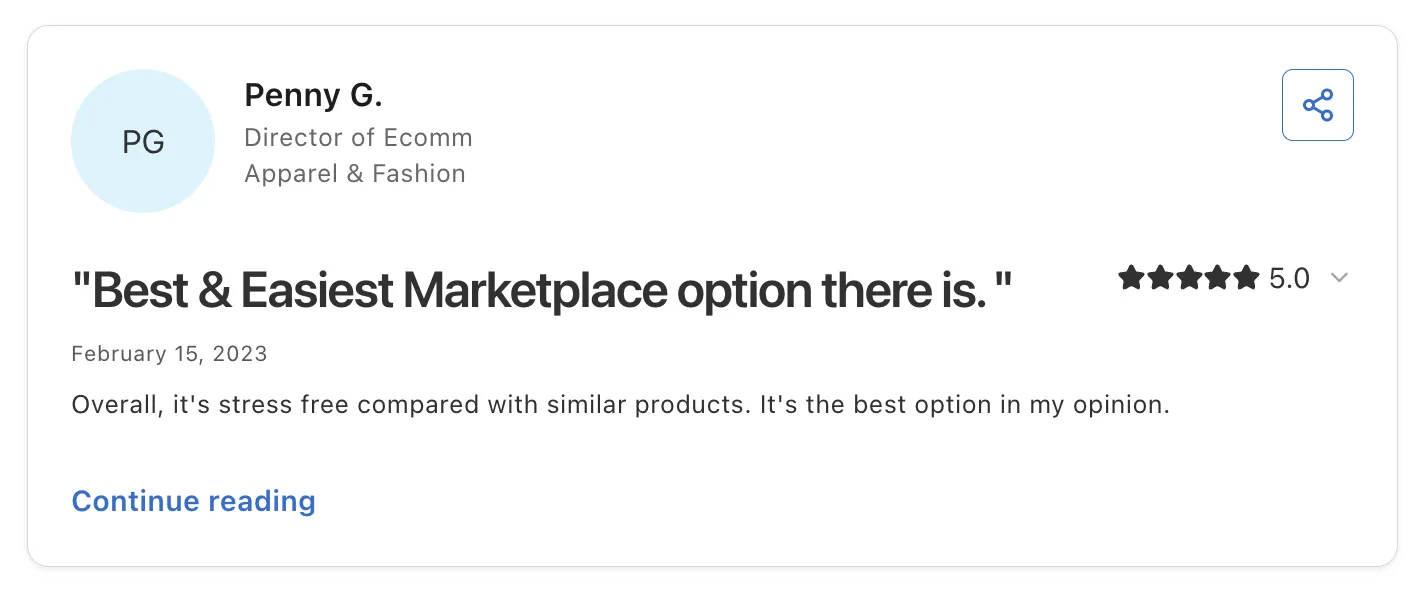
Reviewers also highlight the Shopify fit. Carro installs as an app, products and pricing import straight from the store, and a director of ecommerce describes it as stress free compared with similar products.
Final Verdict
Carro is the strongest option on this list for Shopify retailers adding established brands without buying the stock. It covers the full path from supplier setup to supplier payment, and the brands in its network are vetted before you list them.
PacSun uses it to test brands without owning inventory, and The Gents Store added 2,500+ unique products with no inventory requirement. Carro's customer success stories show how other retailers set up their programs.
2. AutoDS
Overview
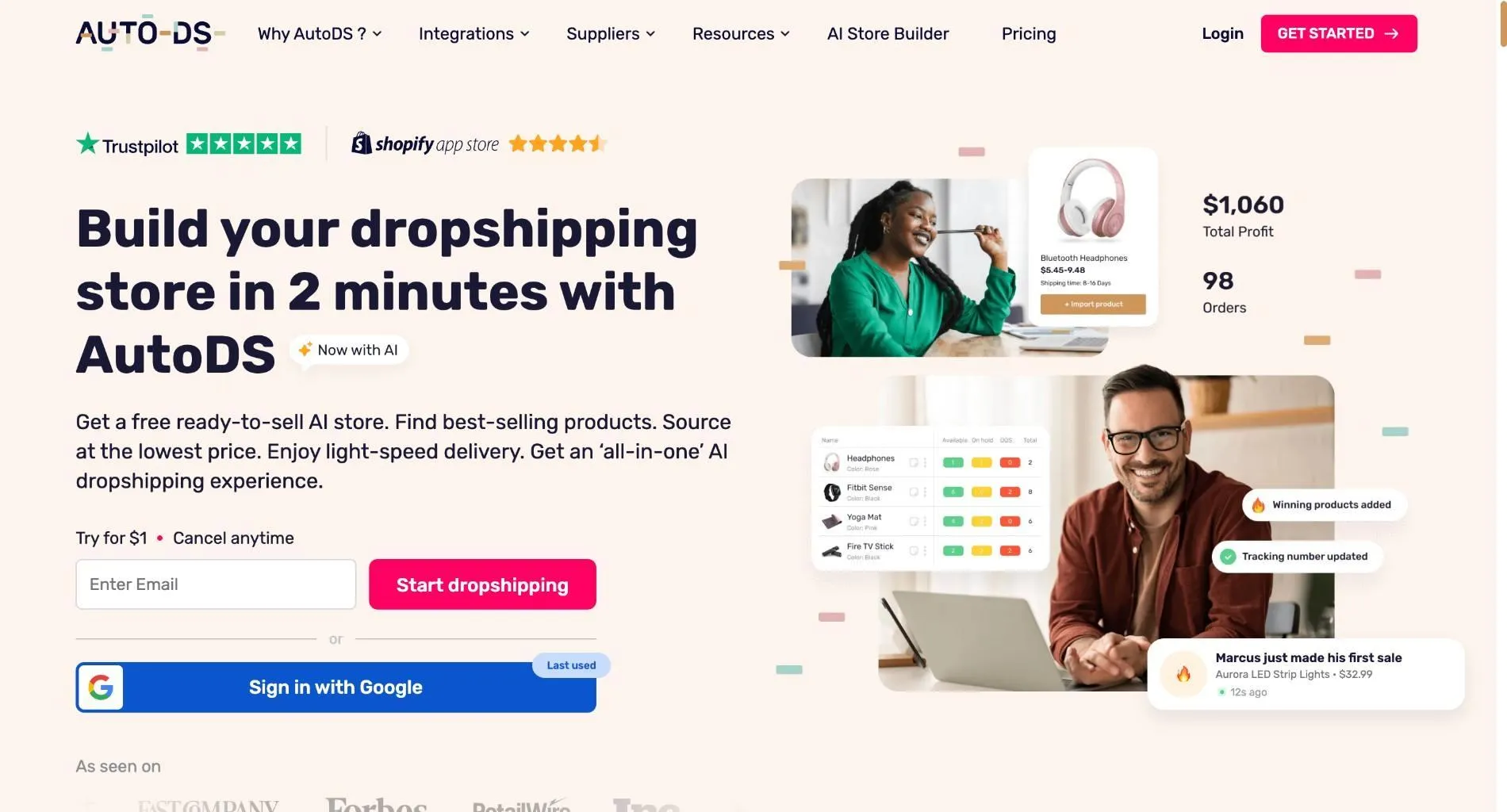
AutoDS is an all-in-one dropshipping tool for sellers who source from marketplaces and global suppliers. Founded in 2016, it imports products in one click from 25+ suppliers, including AliExpress and Walmart, then monitors their stock and prices.
It connects to Shopify, eBay, WooCommerce and Amazon, so one seller can manage several stores and suppliers from one dashboard. Trending-product lists and TikTok analytics help beginners decide what to test next.
Ideal For
- Solo sellers testing trending products on Shopify
- Sellers running Shopify and eBay stores side by side
- Stores that source from several marketplaces in one place
- Beginners who want import and ordering automated from the first day
Top Features
- One-click import from 25+ suppliers, with listings created in your store for editing.
- Stock and price monitoring: AutoDS watches supplier listings and updates your store when a price rises or an item sells out, which cuts cancellations.
- Automated fulfillment places the order with the supplier after the customer pays.
- Product research. Trending lists and TikTok analytics point new sellers toward items worth testing.
Why They Stand Out
AutoDS is one of the strongest choices for sellers who want product research and order automation in one tool. Its supplier list is wider than most consumer apps, and the multi-store dashboard suits sellers running Shopify alongside eBay.
Reviewers credit its monitoring for catching stock and price changes before they turn into losses, and several describe fast support.
Pros
- Imports from 25+ suppliers, including major marketplaces
- Monitors supplier stock and prices automatically
- Manages several stores and suppliers from one dashboard
- Includes product research and trend data
Cons
- Reviewers report confusing billing and unexpected charges
- Bugs and slow fixes appear in several reviews
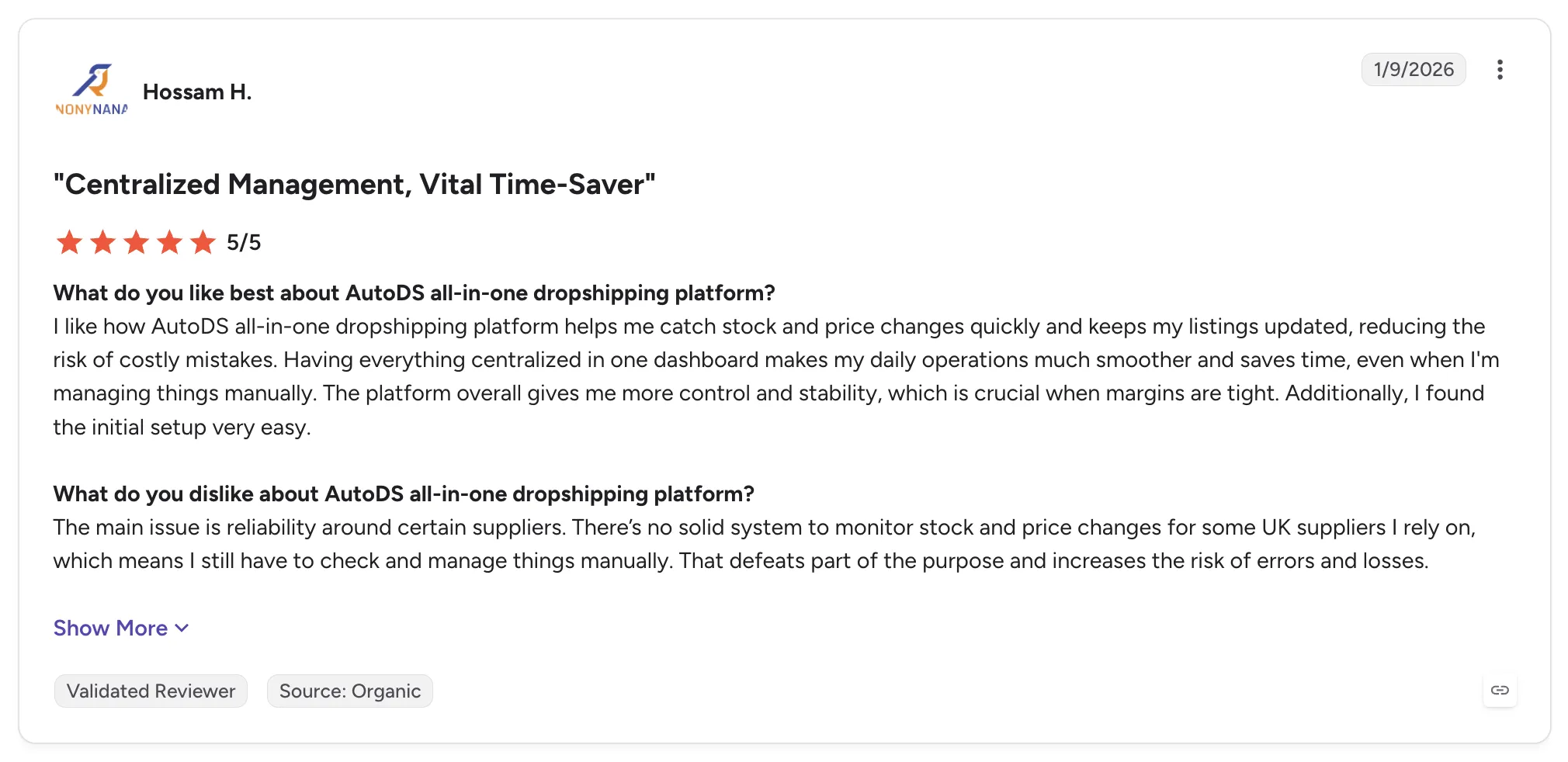
- Monitoring is less reliable for some suppliers, such as UK sources, which forces manual checks
- No vetted brand network or supplier settlement
Customer Reviews
AutoDS holds 3.9 out of 5 across 19 G2 reviews and 4.0 out of 5 across 174 Capterra reviews. The G2 sample is small, and billing complaints pull its score down.
Reviewers praise automated stock and price monitoring and a central dashboard that saves time. Beginners credit the product research, and several describe quick support.
Criticism focuses on billing, including annual charges after monthly billing and charges after cancellation. Others report frequent bugs with slow fixes and slow-shipping products.
Final Verdict
AutoDS suits solo sellers and new stores that want to test marketplace products quickly across Shopify and eBay. Its monitoring and one-click import remove most of the copying a beginner would otherwise do by hand.
Its limits show as a store grows into branded products. There is no vetted brand network, and you pay each supplier order by order, so retailers adding established brands will need a tool built for multi-supplier programs.
3. DSers
Overview
DSers is an AliExpress dropshipping tool built around fast ordering. Merchants import AliExpress products into their store and place orders in bulk with a few clicks, and the app tracks each order automatically.
It connects natively with Shopify and Wix, and one reviewer uses a direct eBay connection that skips Shopify. Its supplier-matching tools find better-rated or cheaper sellers for the same product, so you can swap suppliers when one falls behind.
Ideal For
- New Shopify stores sourcing mainly from AliExpress
- Sellers who place large numbers of AliExpress orders each day
- Beginners who want a low-effort start
- eBay sellers who want AliExpress ordering without a Shopify store in between
Top Features
- Bulk ordering. Place many AliExpress orders at once and avoid the errors of ordering one by one.
- Supplier matching finds better-rated or cheaper AliExpress sellers for a product you already list, then swaps them in quickly.
- Automatic order tracking that returns shipment status to the store.
- Order and shipping management from one central view, which reviewers credit with keeping orders organized.
Why They Stand Out
DSers is one of the smartest choices for stores that source almost entirely from AliExpress. Its bulk ordering handles volume that would be slow and error-prone by hand, and reviewers describe it as easy for beginners.
Supplier matching is its other strength: when a seller raises prices or slows down, you can swap in an alternative without rebuilding the listing.
Pros
- Places AliExpress orders in bulk
- Finds and swaps alternative suppliers for the same product
- Tracks orders automatically
- Connects with Shopify and Wix, plus a direct eBay link
- Easy to learn for first-time dropshippers
Cons
- Tied closely to AliExpress as a supply source
- Advanced features sit on paid plans
- Support can be slow, according to some reviewers
- No routing to branded suppliers and no supplier settlement
Customer Reviews
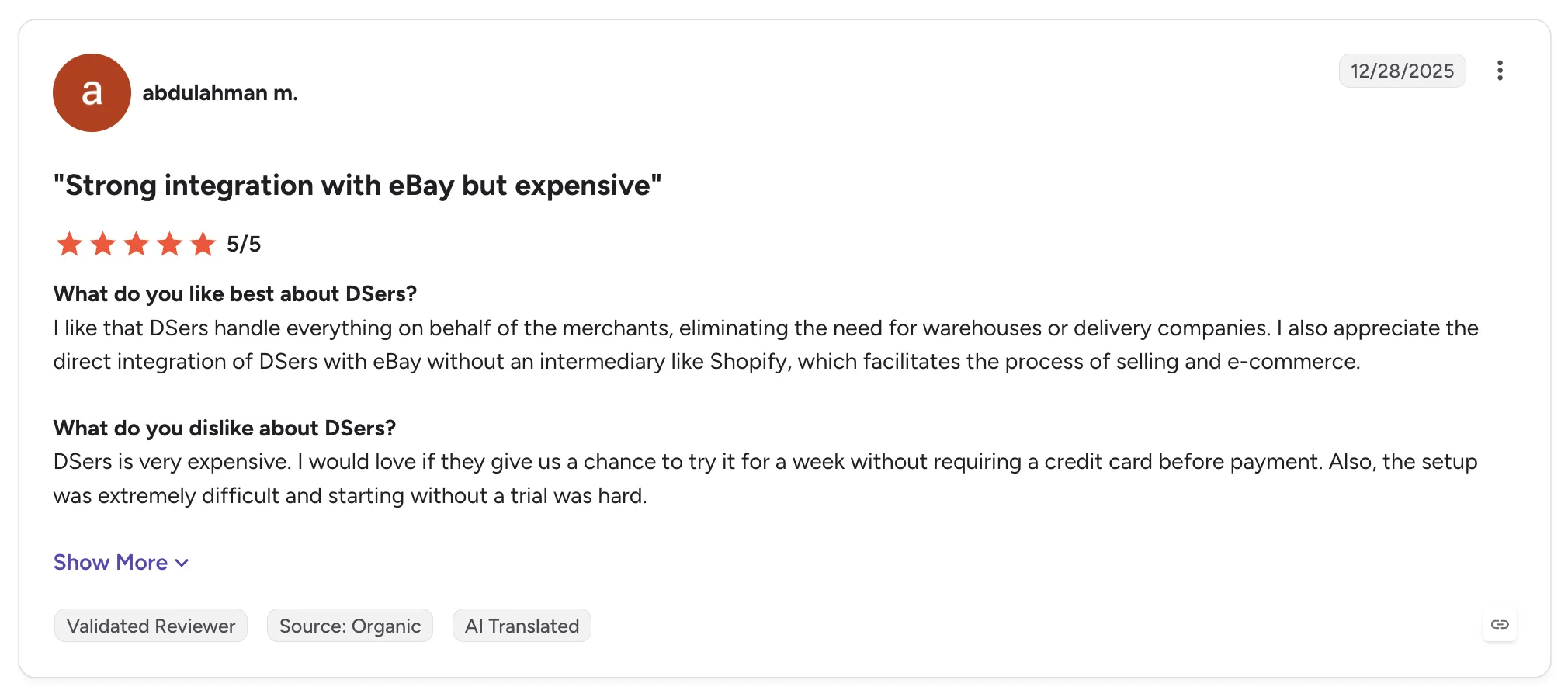
DSers holds 5.0 out of 5 across 2 G2 reviews and 4.7 out of 5 across 19 Capterra reviews. Both are small samples, and most reviews date from 2023.
Reviewers praise one-click bulk ordering to AliExpress, which saves time and avoids errors. The supplier-finding tools and a responsive support team also get credit.
On the downside, one reviewer calls it expensive and found setup hard, and another notes slow support and advanced features locked to paid plans.
Final Verdict
DSers suits new Shopify stores that source from AliExpress and need fast, accurate ordering at volume. For that job, reviewers describe it as easy to learn and fast at bulk ordering.
Its supplier reach ends at AliExpress, the main limit for growing stores. Stores moving toward established brands and multi-supplier orders will need a different supplier base with settlement built in.
4. Spocket
Overview
Spocket is a dropshipping supplier marketplace focused on US and EU suppliers. Stores import products from a catalog that shows shipping times as you browse, and orders go to the supplier after checkout.
It connects to Shopify, WooCommerce, BigCommerce, Wix and Squarespace, among others. The pitch is faster delivery than overseas marketplace sourcing, with samples available so you can check quality first.
Ideal For
- Shopify stores that want US and EU suppliers for faster delivery
- Sellers who want to order samples before listing products
- Stores on Wix or Squarespace as well as Shopify
- Beginners building a first catalog across many categories
Top Features
- Supplier catalog spanning almost every category, with the shipping origin shown.
- Shipping times while you browse, so you can skip slow items before they reach your store.
- Sample orders to check quality and delivery speed before you list a product.
- Shopify import: products and orders sync with your store.
Why They Stand Out
Spocket is one of the strongest options for stores that want suppliers closer to US and EU customers. Reviewers value seeing shipping time before importing, which helps set delivery expectations on the product page.
The catalog is broad, and older positive reviews describe an easy import and order flow for Shopify.
Pros
- Focuses on US and EU suppliers with shorter delivery times
- Shows shipping time during product browsing
- Offers samples before listing
- Connects with Shopify and several other storefronts
Cons
- Reviewers report billing at trial end and a strict no-refund policy
- Recent reviews describe support as slow or scripted
- Product costs can leave thin margins after shipping
- The best products sit behind premium plans
Customer Reviews
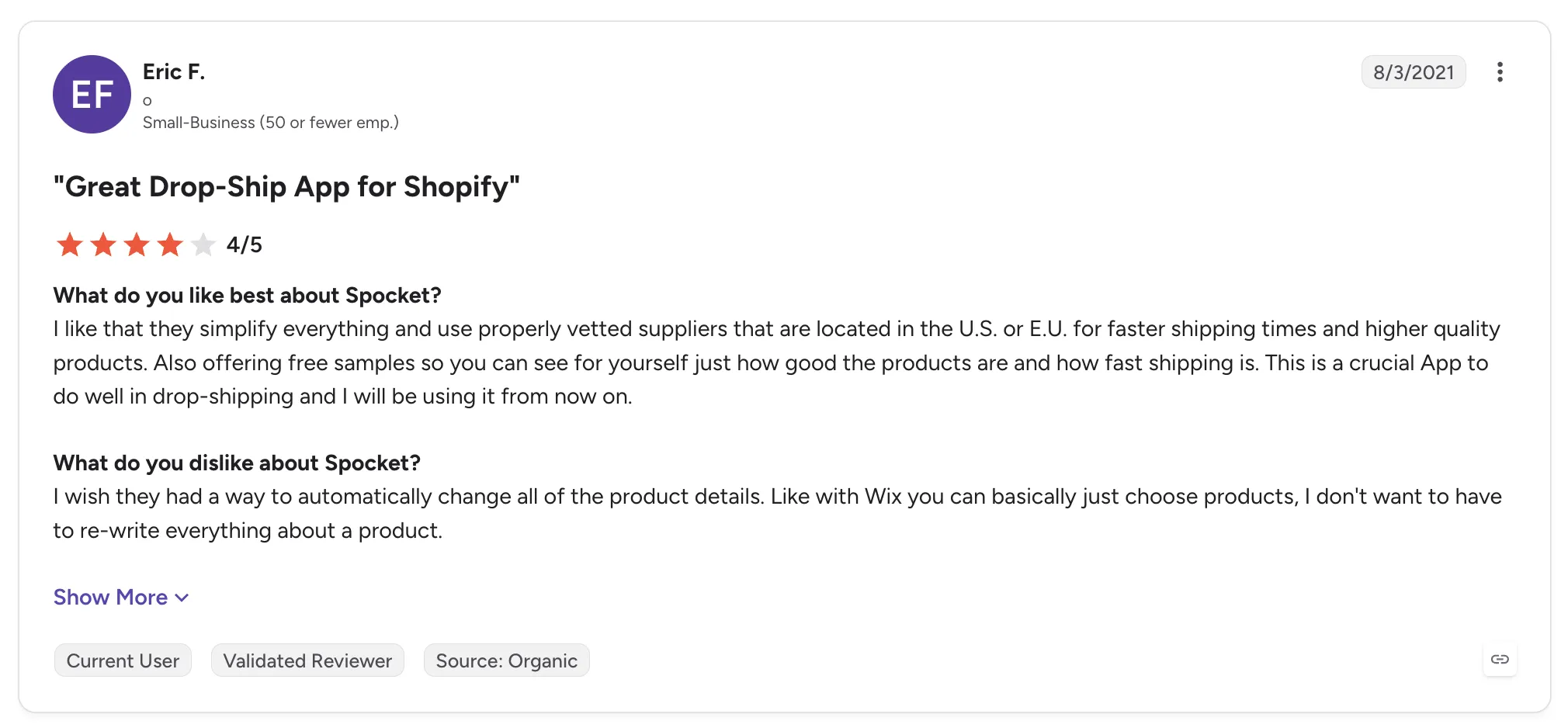
Spocket holds 4.2 out of 5 across 71 G2 reviews and 2.6 out of 5 across 41 Capterra reviews. Sentiment has turned negative: the positive G2 reviews date mostly from 2021, while recent reviews on both sites are low.
Reviewers praise vetted US and EU suppliers with faster shipping and a broad catalog. Others credit the easy product import for Shopify and the free samples.
Criticism concentrates on billing after trials without notice and refunds that were refused. Reviewers also describe slow or unresponsive support, and some find product costs high against Amazon and AliExpress.
Final Verdict
Spocket fits Shopify stores that want faster-shipping US and EU suppliers and are comfortable managing supplier choices themselves. Its shipping-time display is useful when delivery speed matters to your customers.
Recent reviews about billing and support are a real concern, and margins can be thin. Established retailers that want named brands with agreed terms per partner will find a closer fit in a curated brand network.
5. Syncee
Overview
Syncee is a dropshipping and wholesale marketplace where online stores connect to sell each other's products. Retailers list supplier products in their store, and each supplier handles fulfillment and shipping for the orders it receives.
It works across several ecommerce storefronts, including Shopify. Reviewers describe automatic product upload with daily sync and out-of-stock alerts. One credits it with handling complex supplier CSV feeds into Shopify.
Ideal For
- Shopify stores that want dropship and wholesale suppliers in one place
- Retailers working from supplier CSV feeds that need regular updates
- Suppliers that want to list products for retailers to pick up
Top Features
- Supplier marketplace with dropship and wholesale options from many regions.
- Automatic upload and daily sync, so stock changes reach your store without a manual import.
- Out-of-stock and quantity alerts that flag problems before a customer orders.
- CSV feed handling: reviewers use it to bring complex supplier files into Shopify.
Why They Stand Out
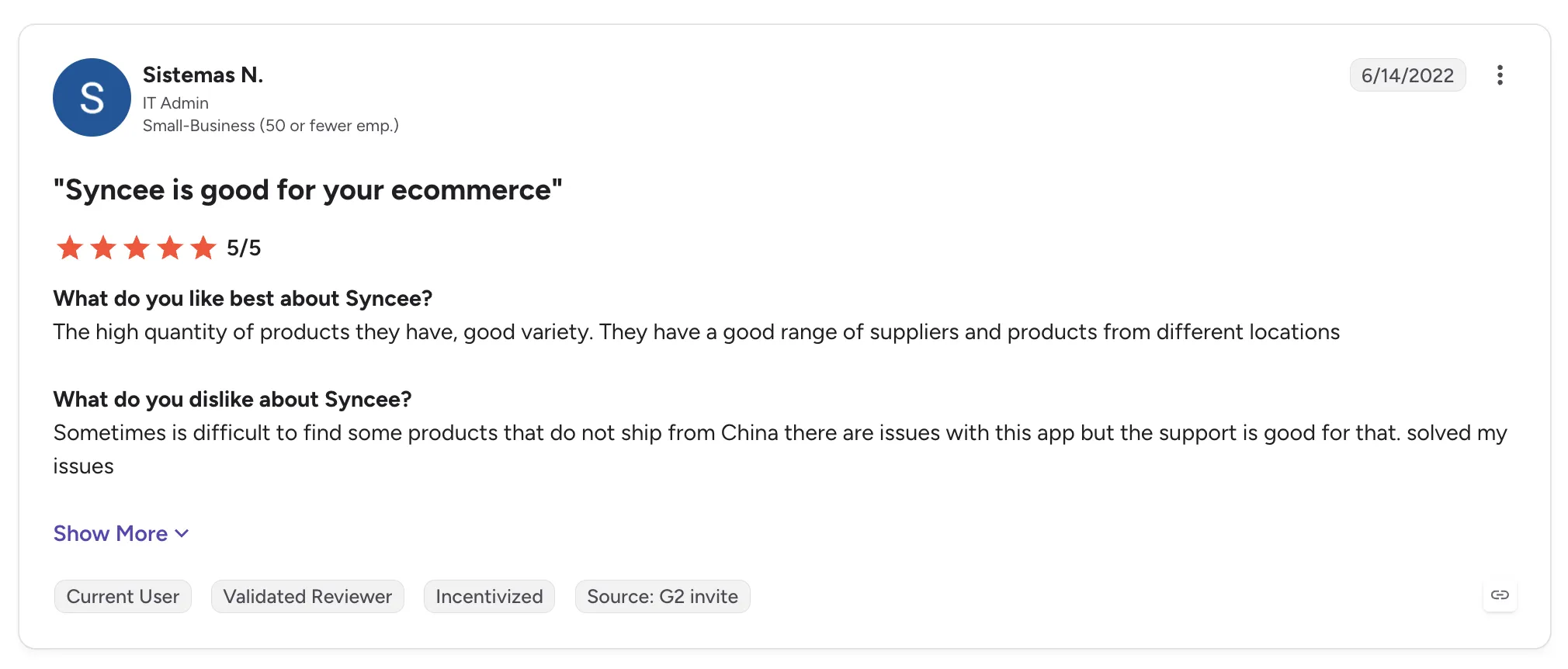
Syncee is one of the smarter choices for stores that want a supplier marketplace and feed handling in the same tool. Reviewers describe a wide range of vetted suppliers from different locations.
Its sync and stock alerts keep listings current once set up, which suits stores working from supplier files.
Pros
- Combines dropship and wholesale sourcing
- Uploads products automatically and syncs daily
- Sends out-of-stock and quantity alerts
- Handles complex supplier CSV feeds
Cons
- Reviewers find it hard to locate products that do not ship from China
- Product prices can run high
- No round-the-clock support, and one reviewer found the documentation thin
- Trial billing and cancellation complaints
Customer Reviews
Syncee holds 5.0 out of 5 across 4 G2 reviews and 2.0 out of 5 across 3 Capterra reviews. Both are small samples.
Reviewers praise a wide range of vetted suppliers and automatic product upload with daily sync. Support also gets positive mentions in the older reviews.
The criticism starts with sourcing: reviewers find it hard to avoid products shipped from China, and prices can run high. Capterra reviewers also report trial billing problems and one account deleted without warning.
Final Verdict
Syncee suits small Shopify stores that want a mix of dropship and wholesale suppliers and a tool to keep supplier feeds current. Its sync and alerts are practical for a catalog built from supplier files.
Reviewers struggle to find products that ship from outside China, and some report trial billing problems. Retailers adding established brands will want stronger supplier vetting and supplier payments inside the workflow.
6. CJdropshipping
Overview
CJdropshipping is a sourcing and fulfillment service for dropshippers. It offers product sourcing, product supply, order fulfillment and global logistics, so one provider handles an item from sourcing to delivery.
Sellers connect CJ products to their Shopify store or other storefronts, and CJ pulls and fulfills the orders. Because CJ is the supplier as well as the software, its ratings reflect service quality such as shipping speed as much as the app itself.
Ideal For
- Sellers who want sourcing and fulfillment from a single provider
- Shopify sellers running more than one store
- Beginners testing low-cost products
- Stores that need a specific product sourced on request
Top Features
- Product sourcing on request: ask CJ to find an item you want to sell, then list it from its catalog.
- Order pull and fulfillment. CJ takes orders from your connected store and ships them.
- Global logistics with shipping handled by the same provider that supplies the product.
- Multi-store connections for Shopify and other storefronts, including eBay.
Why They Stand Out
CJdropshipping is one of the smarter choices for sellers who want one provider to source and ship. Reviewers describe quick sourcing from a large catalog that is easy to reach.
Its store connections suit sellers running several shops, and some reviewers praise its customer service.
Pros
- Sources products quickly from a large catalog
- Handles fulfillment and logistics in-house
- Connects to several store types for multi-store sellers
- Accepts sourcing requests for new items
Cons
- Shipping can be slower than other providers
- Listing products to other stores is slow, with no built-in automation for it
- One reviewer reports order sync failures and cancelled orders
- Orders go to CJ as the supplier, so there is no routing to brands you choose
Customer Reviews
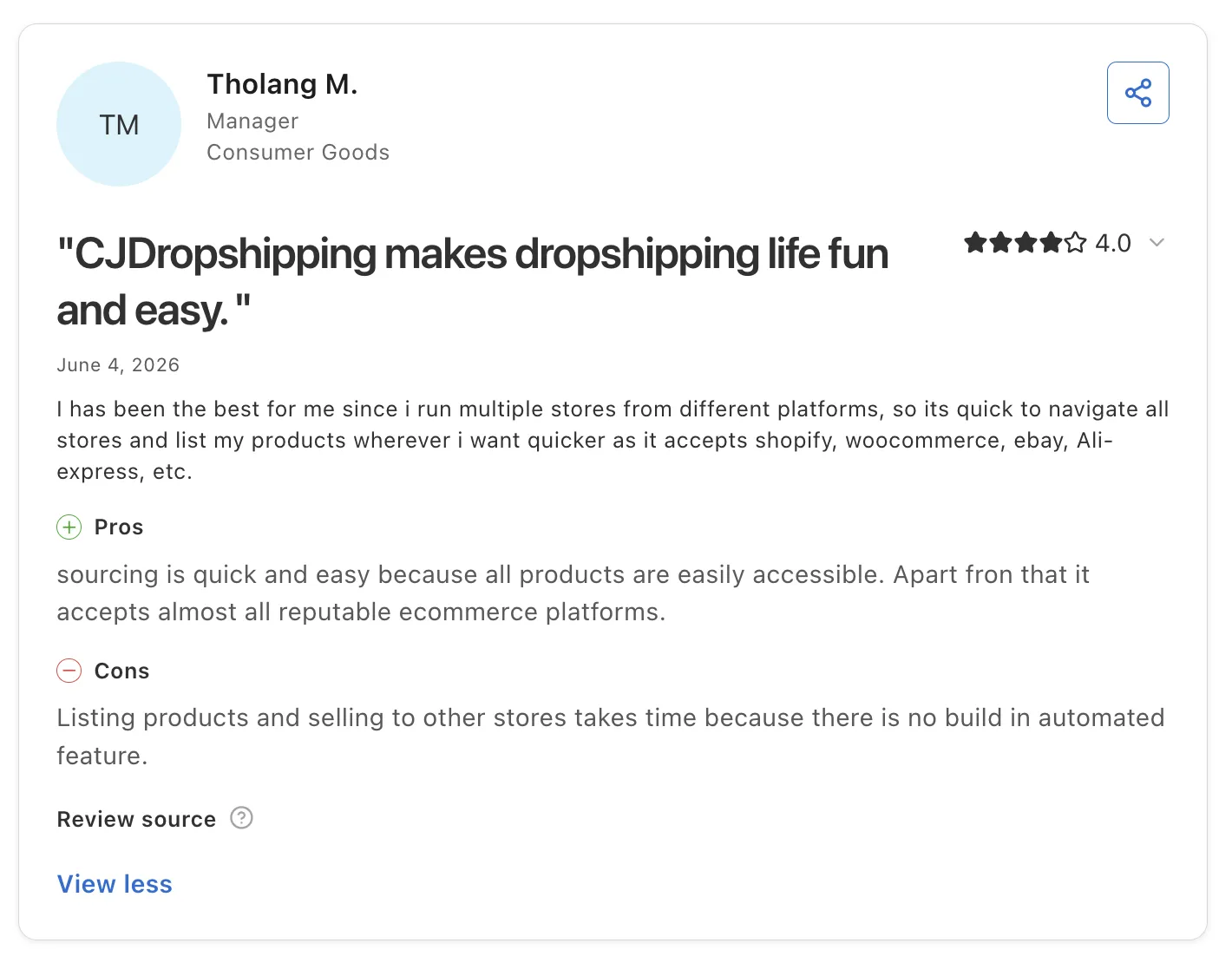
CJdropshipping holds 5.0 out of 5 across 2 G2 reviews, where it is listed as a service provider, and 4.0 out of 5 across 10 Capterra reviews. Both are small samples.
Reviewers praise quick, easy product sourcing and a large catalog. Multi-store sellers value the range of store connections, and beginners find it approachable.
The criticism focuses on shipping speed and slow listing to other stores. One Capterra reviewer warns newcomers off low-ticket dropshipping, and another alleges order sync failures between Shopify and CJ.
Final Verdict
CJdropshipping suits beginners and multi-store sellers who want one provider to source and ship low-cost products. It removes the need to find and manage separate suppliers at the start.
That same model limits growth into branded assortment, since every order goes through CJ. Retailers who want established brands shipping from their own warehouses will need a brand network with terms set per supplier.
7. Inventory Source
Overview
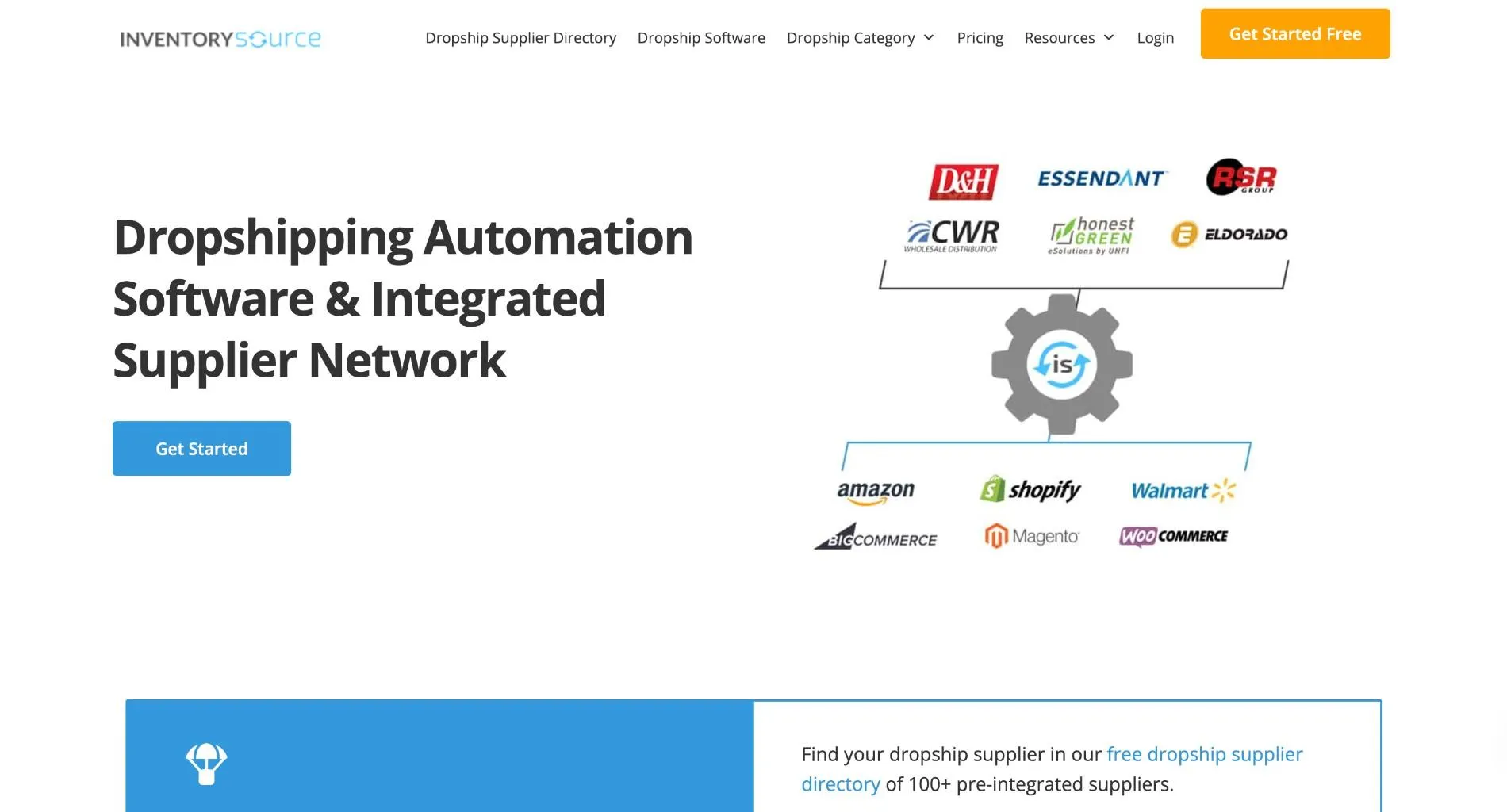
Inventory Source connects resellers directly to supplier and distributor dropship programs and keeps their catalogs updated. Based in Jacksonville, Florida, it describes itself as the largest and longest-running dropship data provider.
The software uploads supplier products to your store, syncs inventory, routes orders to each supplier and returns tracking. Integrations include Shopify, BigCommerce, Adobe Commerce, Ecwid and ShipStation.
Ideal For
- Resellers working with distributors that run dropship programs
- Shopify and BigCommerce stores with large supplier catalogs
- Owners who want pricing rules applied across thousands of products
- Retailers that already have supplier agreements and need the data connection
Top Features
- Supplier directory of dropship programs you can connect to.
- Automatic product upload and inventory sync, which one reviewer describes as low-maintenance once set up.
- Bulk pricing rules: one reviewer priced 13K products in seconds.
- Order routing to suppliers straight from your store.
Why They Stand Out
Inventory Source is one of the more established options for connecting a store to distributor dropship programs. Reviewers describe a large network of dropship suppliers and a sync that runs with little upkeep.
Its pricing rules help big catalogs keep margins consistent, and one reviewer says much of the business runs on autopilot once connected.
Pros
- Large directory of dropship suppliers and distributors
- Automatic product upload and inventory sync
- Bulk pricing rules across large catalogs
- Integrations with Shopify, BigCommerce, Adobe Commerce and ShipStation
Cons
- Reviewers rate customer service below standard, with no phone-first help
- Pricing bugs when listing products, plus site outages
- Costs climb when you run several businesses
- Broken core features and a poor onboarding reported
Customer Reviews
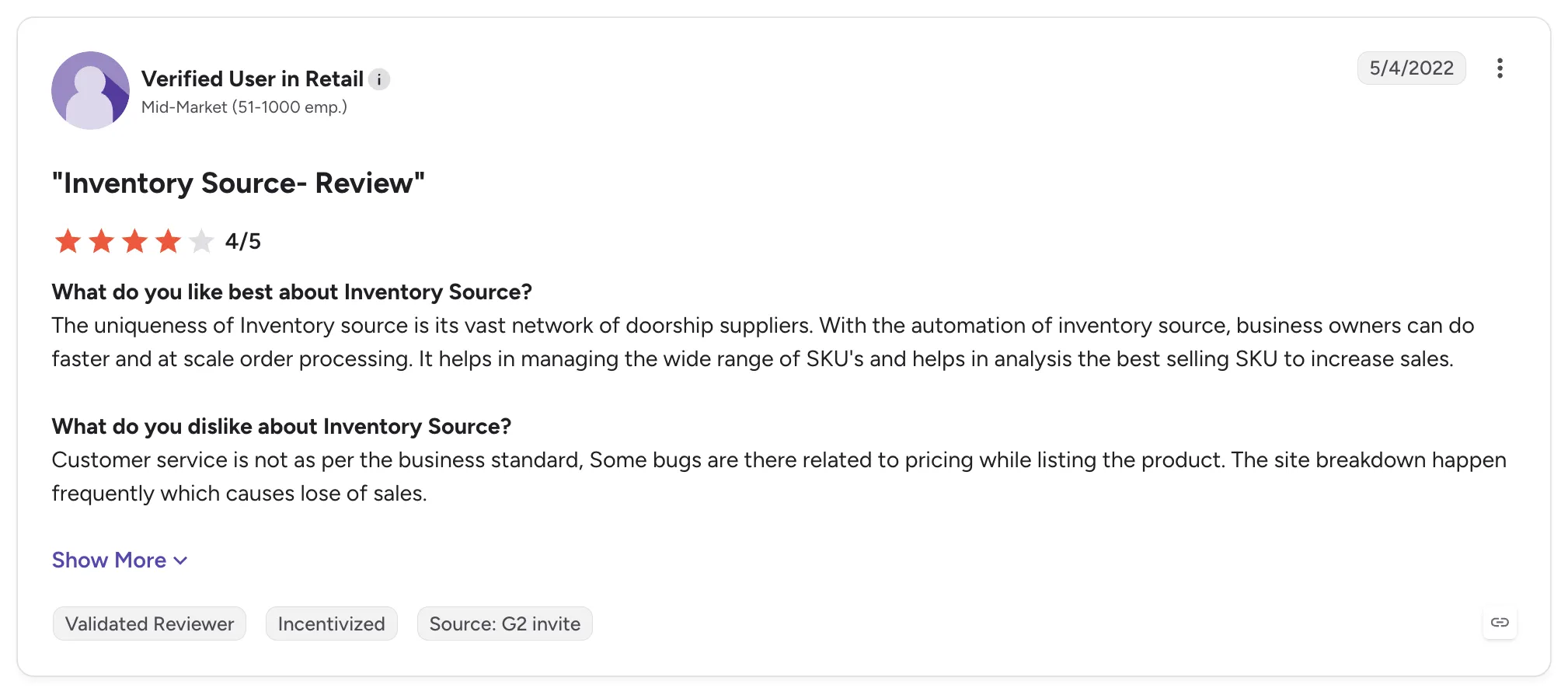
Inventory Source holds 4.6 out of 5 across 4 G2 reviews and 2.8 out of 5 across 6 Capterra reviews. Both are small samples from 2021 and 2022.
Reviewers praise dependable, low-maintenance sync of distributor data and a large network of dropship suppliers.
The criticism centers on support quality and on pricing bugs or outages that cost sales. Harsher Capterra reviews describe broken core features and a poor onboarding.
Final Verdict
Inventory Source suits resellers who already know which distributors they want and need a data connection to keep catalogs current. Its sync and pricing rules cover the core job for large catalogs.
Reviewers flag support problems and pricing bugs that cost sales. Retailers who want vetted brands introduced to them, with invoices tied to each shipment, will need a broader workflow.
8. Flxpoint
Overview
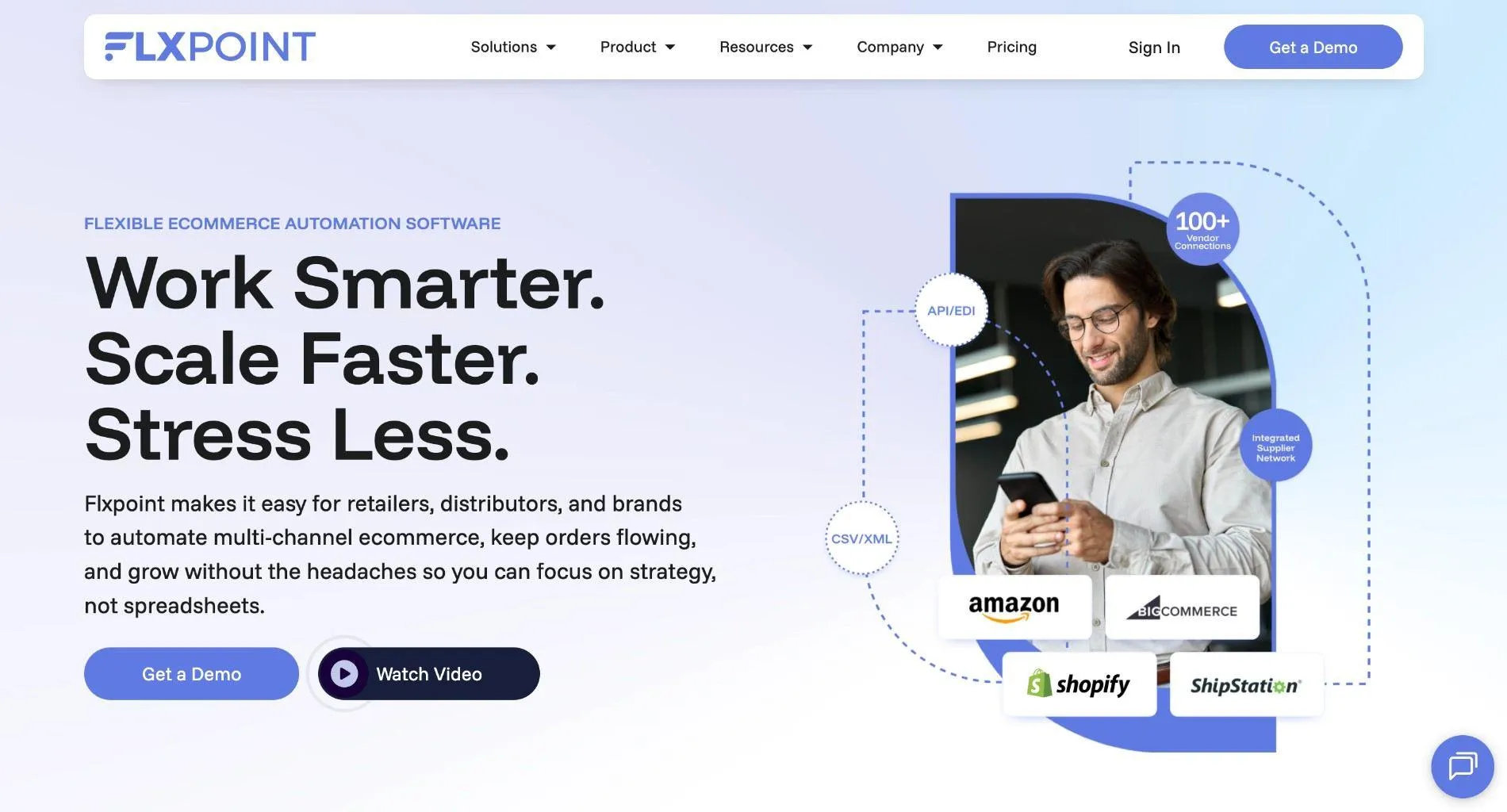
Flxpoint positions itself as retail operations software for connected commerce. It links a merchant's suppliers and warehouses to its sales channels and automates ecommerce operations without custom development.
Its modules cover order fulfillment, multichannel publishing, purchase order management, catalog management and data synchronization. Integrations include BigCommerce, eBay, NetSuite and Mirakl, and reviewers run multi-vendor dropship catalogs on Shopify with it.
Ideal For
- Multi-vendor dropship retailers with many supplier feeds
- Operations teams that want rule-based order routing
- Retailers selling across several channels from one catalog
- Businesses with time for a detailed onboarding
Top Features
- Rule-based order routing across many sources, with near real-time inventory visibility.
- Vendor feed handling: multi-vendor catalogs load from many feeds, including bundles and stacked data sources.
- Purchase order management that sends POs to each supplier from one screen.
- Multichannel publishing from one catalog to several sales channels.
Why They Stand Out
Flxpoint is one of the strongest options for retailers that want detailed control over multi-vendor routing. One reviewer describes routing rules and real-time inventory across more than ten sources.
Onboarding and support get consistent praise, with named reps helping over Zoom and email, and one reviewer notes it has never gone down.
Pros
- Rule-based routing across many suppliers and warehouses
- Near real-time inventory visibility
- Multi-vendor catalog handling, including bundles
- Hands-on onboarding and support
- Wide integration list
Cons
- Steep learning curve and complex setup
- Onboarding can take a long time
- Thin written documentation
- No supplier network, so you bring and manage your own vendors
Customer Reviews
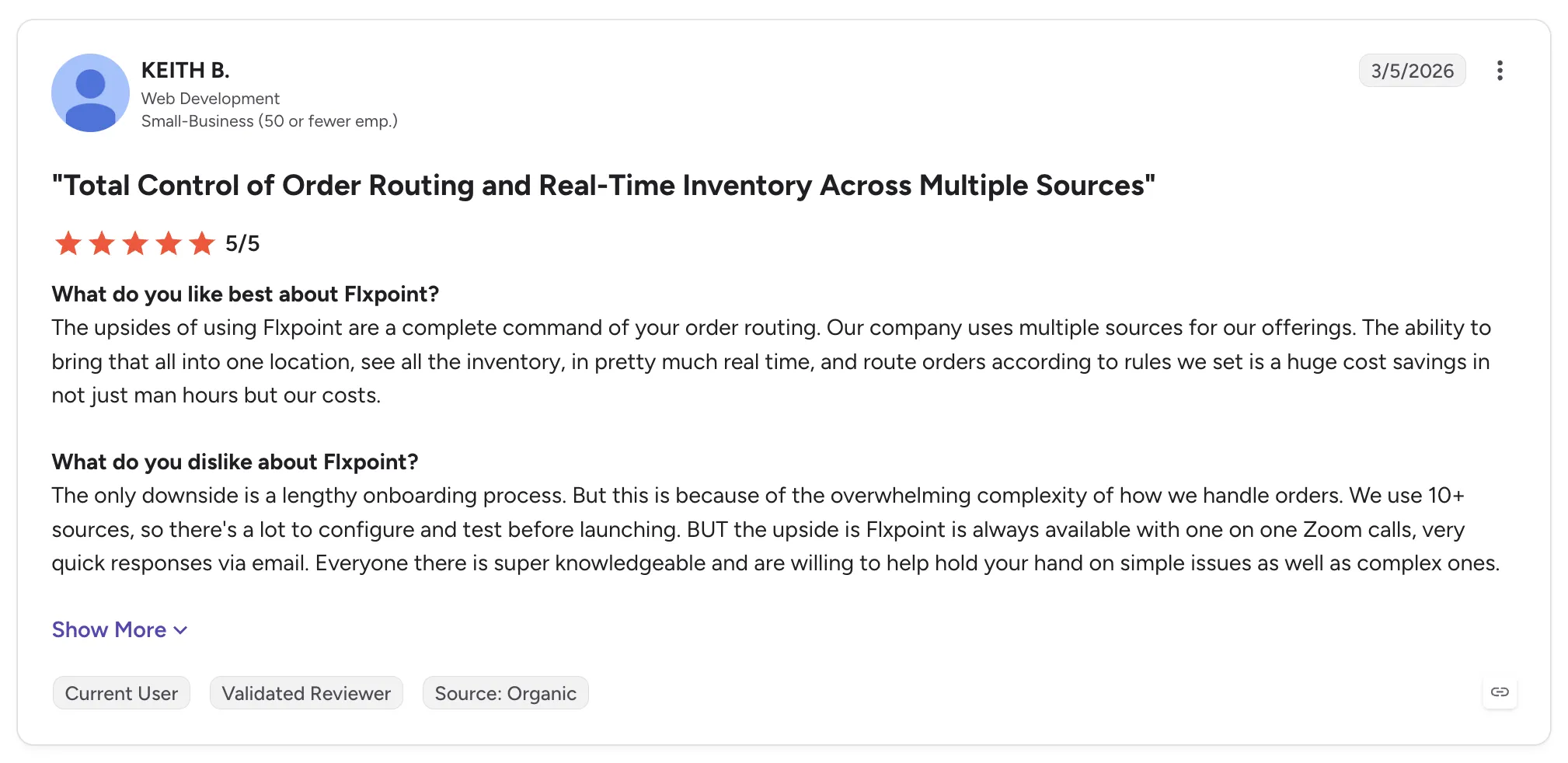
Flxpoint holds 4.7 out of 5 across 101 G2 reviews and 4.9 out of 5 across 7 Capterra reviews, a small sample on the second site.
Reviewers praise hands-on onboarding and support, along with rule-based routing across many sources. Stability and time saved through automation come up often.
The criticism focuses on complexity and a steep learning curve, which can make setup lengthy. Reviewers also want more written documentation, and one low review cites integration issues and slow email replies.
Final Verdict
Flxpoint suits multi-vendor retailers with complex routing needs and the time to configure them. Its routing rules and support make it a strong fit for large, multi-source catalogs.
You bring and manage the suppliers yourself, since Flxpoint has no brand network of its own. Shopify retailers that want vetted brands introduced to them may find it heavier than they need.
9. Duoplane
Overview
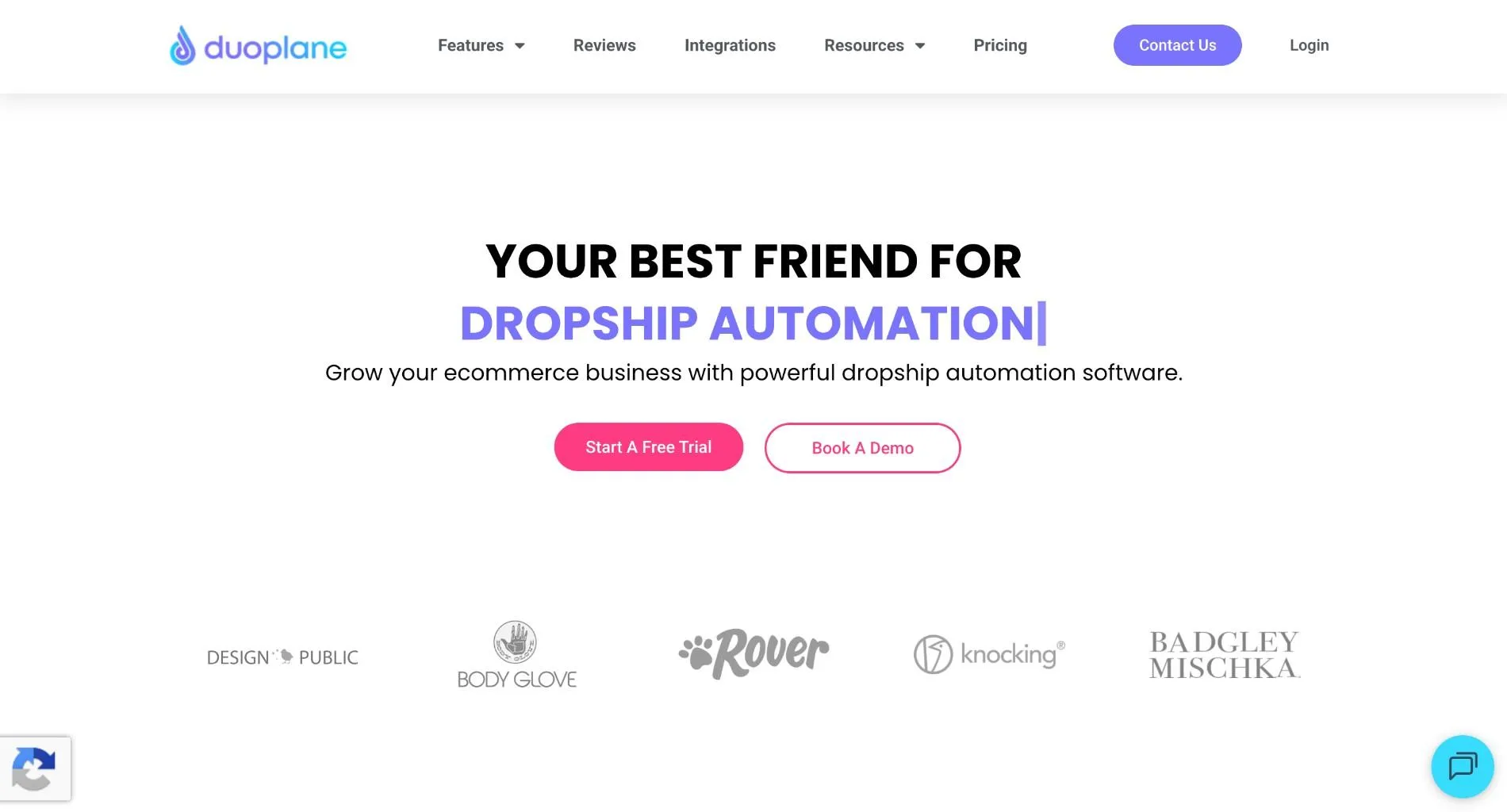
Duoplane is dropship automation software for retailers and their vendors. It automates back-end work such as order management, purchase orders, catalog updates and invoice payments, with dashboards and real-time alerts in one place.
When an order contains items from several vendors, Duoplane splits it and routes each purchase order to the right vendor, with tracking returned without manual entry. It integrates with Shopify, Shopify Plus, BigCommerce, ShipStation and Xero.
Ideal For
- Small retail teams running dropship with their own vendors
- Shopify Plus stores that route purchase orders to many vendors
- Retailers whose vendors lack their own systems and need a portal
- Teams using ShipStation for their own shipments
Top Features
- Vendor portal where suppliers log in and see every order assigned to them.
- Order splitting and PO routing across vendors, so each receives its part of the order.
- Invoice handling: reviewers credit it with removing PO and vendor-invoice errors across thousands of SKUs.
- ShipStation integration that reviewers describe as easy to set up.
Why They Stand Out
Duoplane is one of the smarter choices for small teams that manage vendor POs and invoices by hand today. Reviewers describe running thousands of SKUs without hiring for order operations.
The vendor portal helps suppliers that have no systems of their own, and support teaches customers to make changes themselves.
Pros
- Splits orders and routes POs to each vendor
- Vendor portal for suppliers without their own systems
- Cuts PO and vendor-invoice errors
- Integrations with Shopify, Shopify Plus, BigCommerce and ShipStation
Cons
- A shorter integration list than enterprise suites
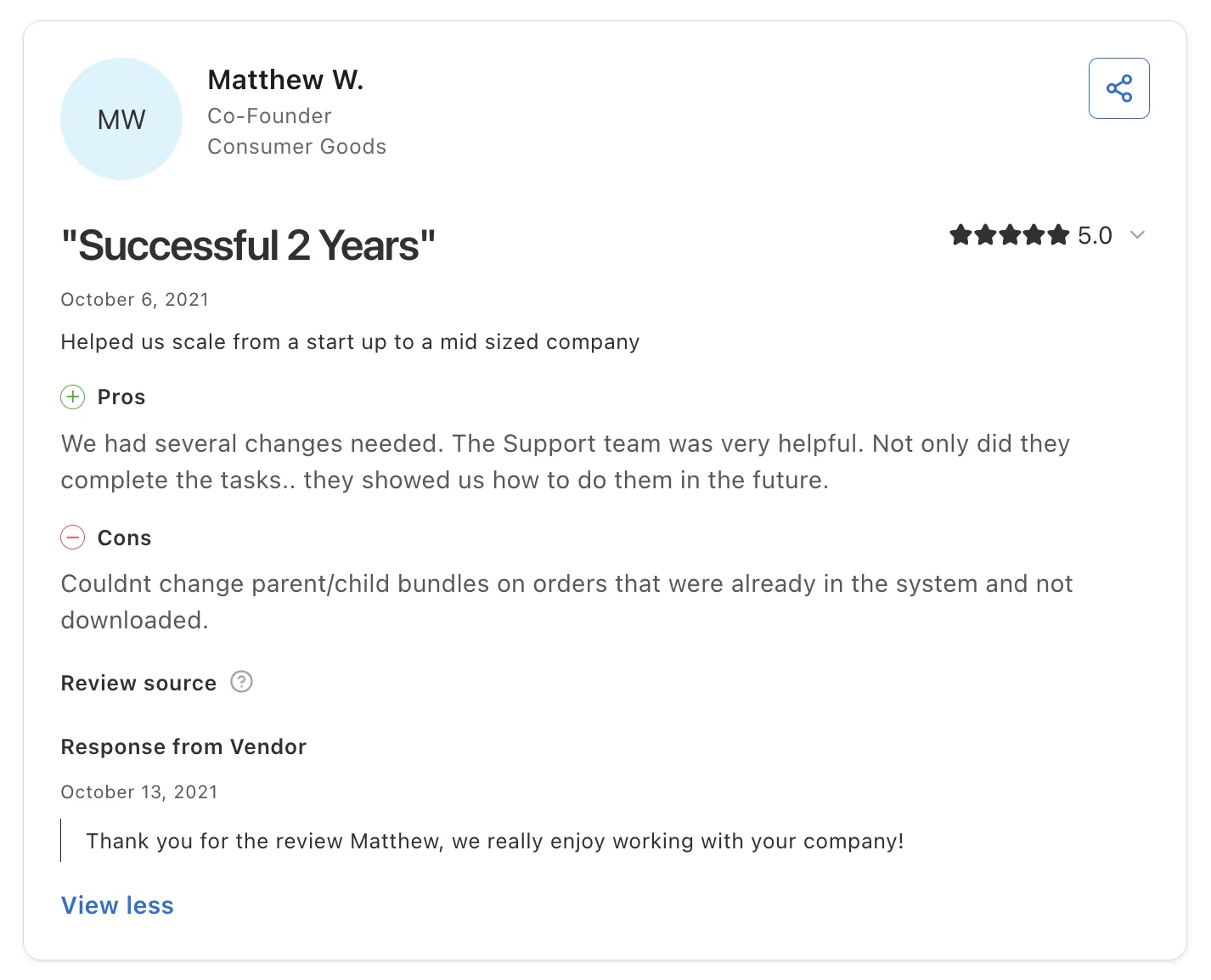
- Parent and child bundles cannot be changed on existing orders
- Cancelling test orders can be confusing alongside ShipStation
- No supplier network, so vendors come from your own relationships
Customer Reviews
Duoplane holds 5.0 out of 5 across 2 G2 reviews and 5.0 out of 5 across 5 Capterra reviews. Both are small samples, from 2019 and 2021.
Reviewers praise the vendor portal, where suppliers see all their orders in one place. A two-person company credits it with removing PO and invoice errors, and others describe helpful support and easy setup.
Reviewers flag two specific gaps: bundles cannot be changed on orders already in the system, and cancelling test orders caused confusion alongside ShipStation.
Final Verdict
Duoplane suits small retail teams that work with their own vendors and want POs and invoices handled without extra hires. The vendor portal is a practical answer for suppliers without systems of their own.
It has no supplier network, so retailers looking to add new brands will still need to find and sign each vendor themselves.
10. Spark Shipping
Overview
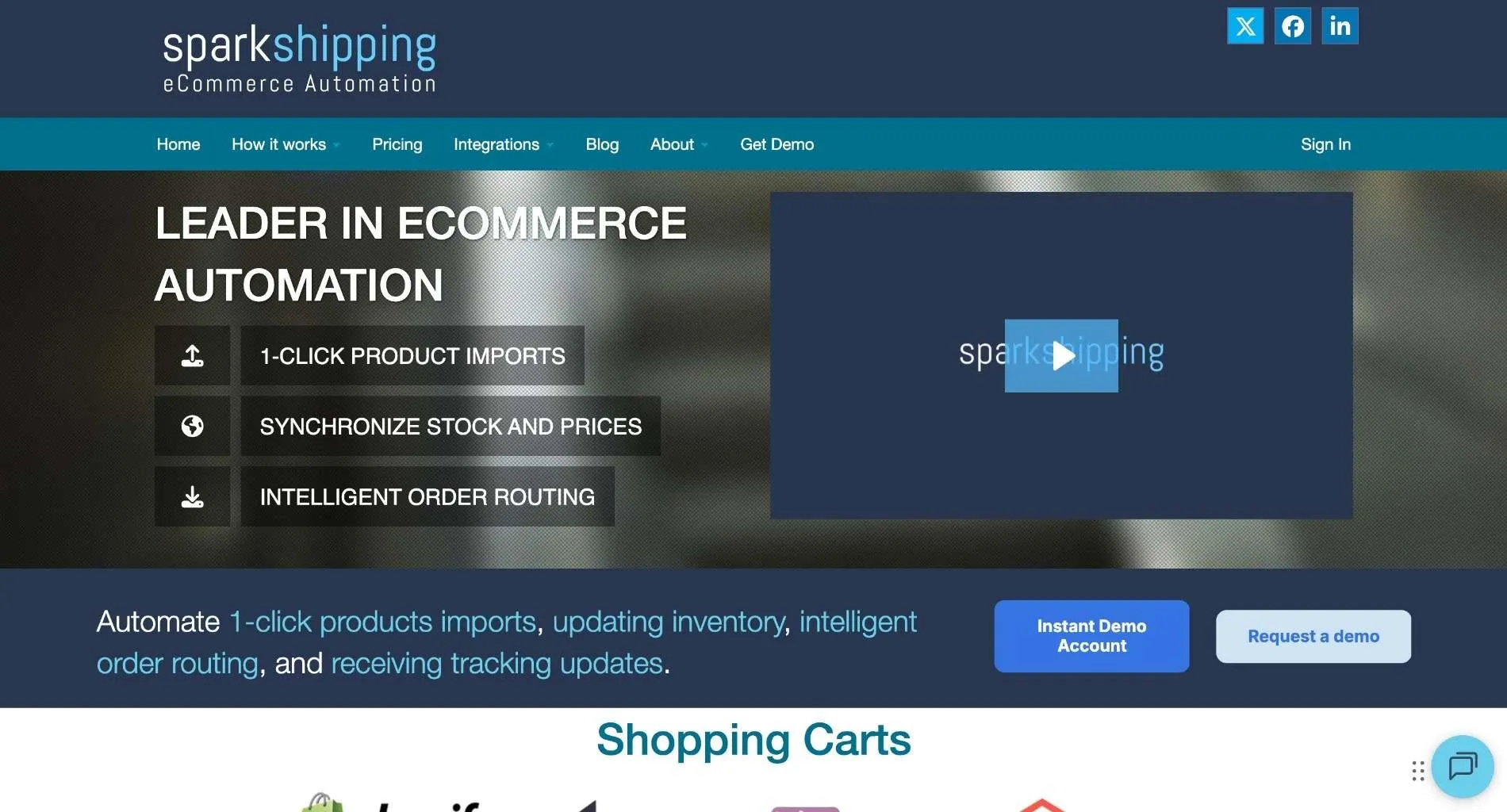
Spark Shipping is ecommerce automation software for online sellers who dropship or fulfill through multiple suppliers. It syncs product data and inventory from each supplier and pushes tracking back to the storefront.
Orders route to a supplier by rules you set, such as the source with stock or the lowest cost, which helps when the same product is available from more than one source. Reviewers mention support for many marketplaces alongside Shopify.
Ideal For
- Sellers stocking the same product from several suppliers
- Shopify stores that want orders routed by supplier stock or cost
- Merchants selling on marketplaces as well as Shopify
- Teams comfortable setting up routing rules
Top Features
- Product data sync from multiple suppliers, including one product connected to several sources.
- Rule-based order routing by stock or custom logic.
- Tracking push: shipment details return to the storefront once the supplier ships.
- Fast price updates that reach the store soon after a supplier changes them.
Why They Stand Out
Spark Shipping is one of the smarter choices for sellers who source the same products from several suppliers. Reviewers describe intelligent order routing and inventory sync with vendors.
Its multi-supplier mapping lets one listing draw on several sources, and one reviewer calls it good value.
Pros
- Routes orders by rules across several suppliers
- Maps one product to multiple suppliers
- Syncs product data and inventory with vendors
- Pushes tracking to the storefront
Cons
- No built-in supplier settlement or payouts
- One reviewer wants more features
- One reviewer worries that automation weakens direct supplier relationships
- No supplier network, so you source and sign vendors yourself
Customer Reviews
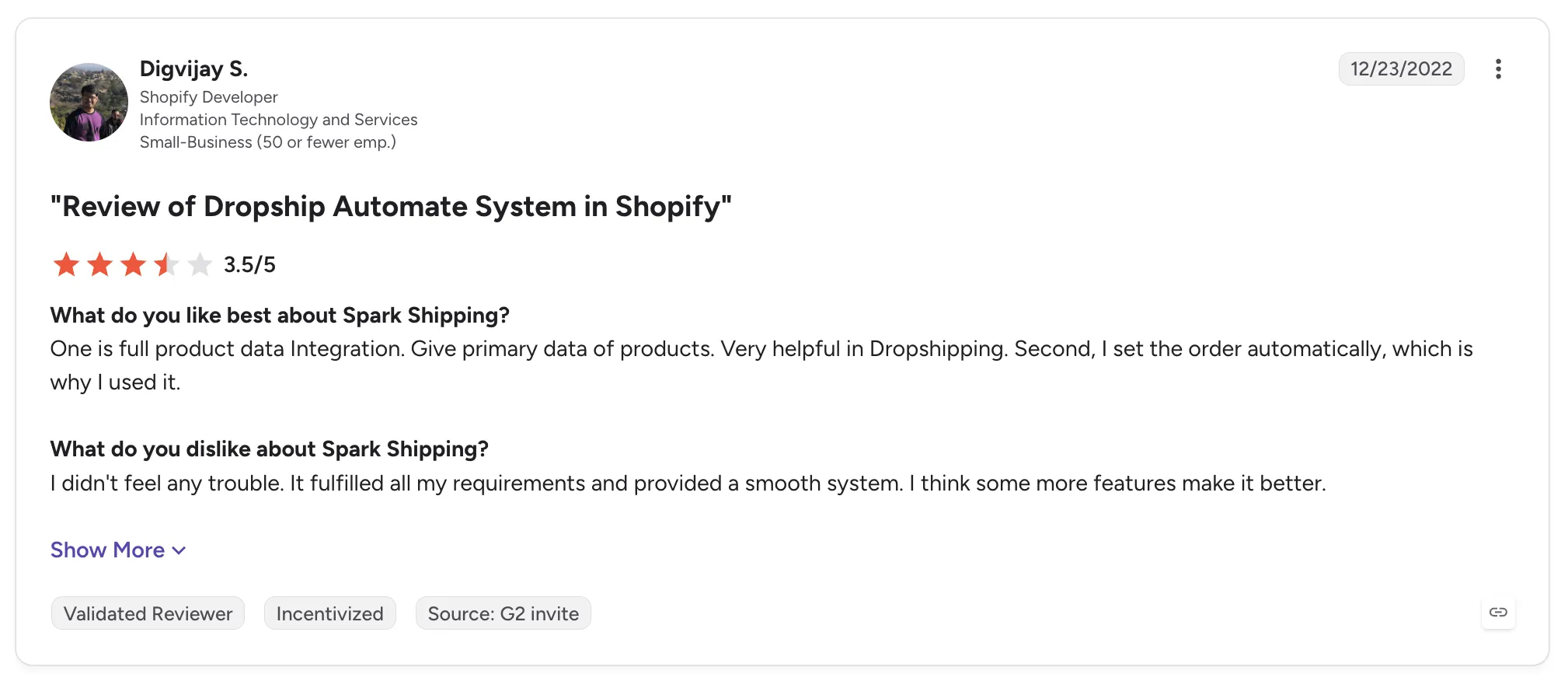
Spark Shipping holds 4.5 out of 5 across 4 G2 reviews, a small sample. All four came through G2 invitations between December 2022 and September 2023.
Reviewers praise product integration across multiple suppliers and automatic order routing, along with inventory sync with vendors.
Criticism is limited to two points: one reviewer wants more features, and another worries that automation weakens direct supplier relationships.
Final Verdict
Spark Shipping suits sellers who carry products from several suppliers and want orders routed by rules. Its multi-supplier mapping fits catalogs where one product has more than one source.
It has no supplier network and no supplier settlement. Retailers adding established brands will want sourcing and settlement covered in the same workflow.
How to Choose the Best Automation Tools for Shopify Dropshipping (What To Consider)?
The best automation tools for Shopify dropshipping differ most in what happens after checkout. Use these seven factors to test each option on your shortlist against your own suppliers and orders.
1. Start With the Suppliers Behind the Catalog
The supplier sets the shipping speed and product quality your customers see, whatever the software does. A tool that imports thousands of generic products quickly still leaves your store carrying the returns when those products disappoint.
Ask where the suppliers come from and who vets them. A network of established brands that ship from their own warehouses gives your Shopify store products customers already know. Check whether one commercial relationship covers that network, or whether every brand starts with its own supply agreement.
2. Test Brands on Real Demand Before You Buy
The point of dropship is learning what sells before any stock sits in your warehouse. Check that you can list a brand's products with no purchase order, keep the ones that sell and drop the rest.
You should stay in control of the listing while you test. You set the retail price and the merchandising. The sale stays under your store's name while the supplier packs and ships behind the scenes.
3. Check Whether One Order Can Split Across Suppliers
Once a store carries more than one supplier, customers will buy from several in the same cart. The tool should split that order into separate supplier orders and send each one into the system that supplier already uses.
Ask to see a mixed-cart order in a demo, from checkout to tracking. If the answer involves exporting a file or forwarding an email, the split is still manual. Also ask where a stalled order or a SKU mapping error shows up, and what detail comes with it.
4. Look at How Stock and Prices Stay Current
A price or stock change that reaches Shopify late becomes a cancellation or a loss. Check how each supplier's stock updates, and expect it to move on the cadence that supplier's connection supports. Partner price lists should set the cost for each relationship.
Also check what happens to your edits. Your changes to titles and images should apply to your copy of the product, while supplier updates to stock and cost keep flowing through, and validation should flag data problems before a product goes live.
5. Follow the Money From Shipment to Payout
Supplier payments are where many dropship programs fall back to spreadsheets. Look for a tool where the shipment triggers the supplier invoice, and where fees, commissions, shipping costs and return credits land against the order they belong to.
Both sides should read the same record. That ends the reconciliation calls over whose numbers are right, and suppliers can be paid the day an order ships. Failed charges should surface for a person to act on.
6. Confirm the Connection Works on Each Supplier's Terms
Suppliers run on different systems, and the tool needs to meet each one where it is. Some run Shopify stores of their own, while others trade through EDI, an API or a CSV file sent over SFTP on a schedule.
Ask what happens when a supplier has no technical team. The strongest answer is a vendor team that works on the setup with them, plus a test order that checks fulfillment, tracking and invoicing before go-live.
7. Plan for the Next Channel
AI shopping agents buy from catalogs with accurate stock and trustworthy product data. A stale catalog lets an agent place orders your suppliers cannot fill.
Pick a tool that keeps one catalog current across every supplier and routes each order to the supplier holding the stock. The same setup lets you open a marketplace on the Shopify store you already run, adding sellers without adding headcount.
Everything You Need to Know About Automation Tools for Shopify Dropshipping
| Company | Pros | Cons | Ease of Use | Integrations | Support | Supplier Quality | Multi-Supplier Orders |
|---|---|---|---|---|---|---|---|
| Carro | Vetted brand network; orders split across suppliers; suppliers can be paid when orders ship | USD settlement; hand-matched network on Growth plan; few cheap generic products | ⭐⭐⭐⭐ | ⭐⭐⭐⭐ | ⭐⭐⭐⭐⭐ | ⭐⭐⭐⭐⭐ | ⭐⭐⭐⭐⭐ |
| AutoDS | Broad supplier list; stock and price monitoring; multi-store dashboard | Billing complaints; bugs; uneven supplier monitoring | ⭐⭐⭐⭐ | ⭐⭐⭐⭐ | ⭐⭐⭐ | ⭐⭐⭐ | ⭐⭐⭐ |
| DSers | Bulk AliExpress orders; supplier swapping; beginner friendly | AliExpress focus; paid-plan features; slow support at times | ⭐⭐⭐⭐ | ⭐⭐⭐ | ⭐⭐⭐ | ⭐⭐ | ⭐⭐ |
| Spocket | US and EU suppliers; shipping times shown; samples | Billing complaints; slow support; thin margins | ⭐⭐⭐ | ⭐⭐⭐⭐ | ⭐⭐ | ⭐⭐⭐⭐ | ⭐⭐⭐ |
| Syncee | Dropship and wholesale; daily sync; CSV feeds | China-heavy sourcing; support gaps; billing complaints | ⭐⭐⭐ | ⭐⭐⭐⭐ | ⭐⭐ | ⭐⭐⭐ | ⭐⭐⭐ |
| CJdropshipping | Fast sourcing; fulfillment included; multi-store connections | Slower shipping; slow listing; one supply source | ⭐⭐⭐ | ⭐⭐⭐⭐ | ⭐⭐⭐ | ⭐⭐⭐ | ⭐⭐ |
| Inventory Source | Large supplier directory; low-upkeep sync; bulk pricing | Support complaints; pricing bugs; broken features | ⭐⭐⭐ | ⭐⭐⭐⭐ | ⭐⭐ | ⭐⭐⭐ | ⭐⭐⭐⭐ |
| Flxpoint | Rule-based routing; real-time inventory; strong support | Learning curve; long onboarding; thin docs | ⭐⭐⭐ | ⭐⭐⭐⭐⭐ | ⭐⭐⭐⭐⭐ | ⭐⭐⭐ | ⭐⭐⭐⭐⭐ |
| Duoplane | Vendor portal; accurate POs; helpful support | Test-order cancels; bundle edits; no supplier network | ⭐⭐⭐⭐ | ⭐⭐⭐ | ⭐⭐⭐⭐ | ⭐⭐⭐ | ⭐⭐⭐⭐ |
| Spark Shipping | Rule-based routing; multi-supplier mapping; marketplace support | No settlement; limited features; no supplier network | ⭐⭐⭐ | ⭐⭐⭐⭐ | ⭐⭐⭐ | ⭐⭐⭐ | ⭐⭐⭐⭐ |
Add the Next Brand to Your Shopify Store with Carro
Carro gives your Shopify store a vetted brand network and the operations to run it, from supplier setup to supplier payment. Partner stock and prices stay in sync, and each order splits across suppliers and settles when it ships.
You can test a brand on real customer demand with no purchase order, and suppliers come onto the network in days with a test order before go-live. If a category does not sell, nothing is left sitting in a warehouse.
Carro reports up to 3x catalog size growth for its retailers, and its customers include PacSun, eBay, Huckberry and Brookstone. Eric Flores, Drop Ship Coordinator, puts it plainly: "Carro has improved the way we manage suppliers, orders, and catalog operations, allowing us to set new products live much faster than before."
Among the best automation tools for Shopify dropshipping, Carro is the one built for retailers adding established brands. Pricing is scoped per program through a custom pricing request.
Book a demo with Carro and bring the brands you want on your Shopify store next.
Frequently asked questions
What are automation tools for Shopify dropshipping used for?
Automation tools for Shopify dropshipping are used for moving product data, stock, orders and payments between a Shopify store and the suppliers who ship the goods, without manual copying. They import supplier products, update stock and prices, send each paid order to the right supplier and return tracking. More advanced tools also split one order across several suppliers and invoice each supplier when its part ships. Carro, for example, connects Shopify stores to 1,500,000 products from established brands and runs that work in one workflow.
What are the best automation tools for Shopify dropshipping in 2026?
The best automation tools for Shopify dropshipping in 2026 are Carro, AutoDS, DSers, Spocket and Flxpoint, with Carro the best overall for Shopify retailers adding established brands without buying stock. Carro connects stores to 1,500,000 products from established brands and settles each sale with the supplier when it ships. AutoDS and DSers suit new stores automating marketplace and AliExpress sourcing. Flxpoint suits multi-vendor retailers who need detailed routing rules and have time for a longer setup.
What should I consider when choosing the right automation tools for Shopify dropshipping for me?
When choosing the right automation tools for Shopify dropshipping, consider supplier quality, whether one order can split across suppliers, how stock and prices stay current and whether supplier payments follow each shipment. Check that you can test brands on real demand with no purchase order, as Carro retailers can across 1,500,000 products from established brands. Confirm the tool connects to each supplier's system, including EDI, API, SFTP and CSV for partners without a Shopify store. Then run a test order that checks fulfillment, tracking and invoicing before you go live.
What features should I look for in automation tools for Shopify dropshipping?
The features to look for in automation tools for Shopify dropshipping are supplier stock and price sync, order splitting across suppliers, tracking returned to Shopify, an exceptions view for stalled orders and failed charges, and settlement tied to shipment. Partner price lists should set the cost for each supplier relationship, and your edits should change only your copy of a product. For growth, look for a vetted supplier network, such as Carro's 1,500,000 products from established brands, and connections through EDI, API, SFTP and CSV.
How does Carro differ from similar alternatives?
Carro differs from similar alternatives by combining a vetted network of 1,500,000 products from established brands with the operations that run after the sale, from supplier onboarding to settlement. Consumer tools such as AutoDS and DSers focus on marketplace sourcing for new stores, while connector tools such as Flxpoint and Duoplane automate suppliers you find yourself. Carro splits each Shopify order across suppliers and triggers the supplier invoice when the order ships. Through Merchant Services, one commercial relationship with Carro replaces a separate agreement with every supplier.
How do I get started with Carro?
You get started with Carro by booking a demo and bringing your Shopify store details and the suppliers you want to add. Carro installs as a Shopify app, and each supplier follows a defined onboarding sequence from account details, connection and product data to a price list and a test order that checks fulfillment, tracking and invoicing before go-live. Suppliers come onto the network in days, and you can pick brands from the network or connect partners you already work with. Pricing is scoped per program through a custom pricing request.
How easy is it to switch to Carro?
Switching to Carro is easy because the move changes the connection under your Shopify store while the storefront itself stays in place. Carro has moved the customer bases of Modern Dropship and Onport onto its software, and sellers can follow the retailer across. It runs beside your existing payments, shipping, ERP and accounting systems, so there is no store rebuild or custom build. The FairGround migrated from Onport, with the Carro team meeting brands directly to get them connected.
Will dropshipping hurt my Shopify store's reputation for quality?
Dropshipping will not hurt your Shopify store's reputation for quality when the products come from vetted, established brands that ship from their own warehouses. Carro's network of 1,500,000 products centers on established brands, and you choose which partners join and set the retail price yourself. Every order carries a documented state from confirmed through shipped with tracking, and stalled orders surface in an exceptions view for your team to act on. Returns run as requests the supplier accepts or rejects under the terms you agreed, and partners that underperform can be removed.