Best CJdropshipping Alternatives in 2026 (Top Competitors Reviewed)
Looking for the best CJdropshipping alternatives? Compare Carro, Spocket, Zendrop and 7 more on features, pricing and shipping speed. See the full breakdown.
Carro is the best overall alternative to CJdropshipping for retailers and marketplaces growing their catalog.
It swaps China-based sourcing for a network of vetted brands that hold their own stock and fulfill from their own warehouses in the markets they already sell into. That answers the two reasons sellers most often go looking for CJdropshipping alternatives: transit windows of two to four weeks, and the customs duties that now land on every cross-border parcel.
Pricing scales with your sales volume, and enterprise programs are custom quoted to match scope. There is no upfront inventory cost. You can test the model before moving any real volume onto it.
Key Takeaways (TL;DR)
- Who CJdropshipping Is For: Solo sellers and early-stage stores testing product ideas at close to zero upfront cost. CJ is free to join, its catalog runs into the millions of products, and its sourcing team will quote almost anything you send them a link to.
- Why Seek a CJdropshipping Alternative: Delivery speed and landed cost. Orders routed through Asian warehouses commonly reach US customers in 15 to 30 days once processing is counted, and every one of those parcels now needs a customs entry. Quality control and refund handling also appear repeatedly in negative reviews.
- Best Overall Alternative: Carro. It is the only option on this list where the products already sit in warehouses owned by the brands themselves, and where an account manager introduces you to those brands rather than pointing you at a search bar.
- What Sets Carro Apart: Hand-matched brand partnerships. Every other tool here gives you a catalog to browse; Carro gives you named brand relationships selected on category, audience and price point, with a large and growing catalog of products behind them.
- How to Choose: Decide three things first. Where your customers are, what margin your model needs after duties, and whether you want a catalog or a partner network.
Top CJdropshipping Alternatives in 2026 at a Glance
| Tool | Best For | Key Features | Pros | Cons | Pricing Starts |
|---|---|---|---|---|---|
| Carro | Retailers and marketplaces adding branded assortment | Hand-matched brand network, automated order routing, real-time sync, a large and growing catalog of products | Brand-fulfilled orders, no inventory risk | Built for retailers rather than solo testers; strongest on Shopify | Scales with sales volume; enterprise programs custom quoted |
| Spocket | Sellers who want vetted US and EU suppliers | Supplier vetting, branded invoicing, sample ordering, 0% commission | Fast domestic shipping options, clean Shopify app | Product caps on lower tiers; monthly cost before first sale | $39.99/mo |
| Zendrop | Beginners wanting US stock plus branding | US warehouse fulfillment, custom packaging, auto-fulfillment, Academy | Simple onboarding, branding at low volume | Free plan cannot import or fulfill; usage-based billing on Shopify | $49/mo (Pro) |
| AutoDS | Multi-marketplace sellers who want automation | Price and stock monitoring, auto-ordering, 40+ supplier imports, AI listings | Broad channel support, transparent tiers | Retail-sourced products squeeze margin; add-on credits | $26.90/mo (Shopify) |
| DSers | AliExpress sellers on a budget | Official AliExpress partner, bulk ordering, supplier optimizer, tracking sync | Genuinely usable free plan, low paid tiers | Same China transit times as CJ; locked to AliExpress | Free; $19.90/mo paid |
| Syncee | Retailers sourcing local suppliers globally | 8M+ product marketplace, DataFeed Manager, no transaction fees, in-app chat | Wide storefront support, supplier chat | Free plan is browse-only; supplier quality varies | Free; $39.99/mo Basic |
| Doba | Sellers wanting one integrated US supplier catalog | Vetted supplier network, AI Hub and Doba Pilot, data exports | Single point of contact, established since 2002 | Skews low-ticket general merchandise; no free plan | $28.67 USD/mo billed quarterly (Limited plan), as Doba labels it; monthly billing costs more |
| Modalyst | Boutique and Wix-based stores | Independent brand suppliers, virtual hangtags, automated margin rules | Free entry tier, strong fashion catalog | Product caps; commission on some brand sales | Free; $35/mo paid |
| Printful | Custom merchandise and apparel brands | In-house printing, 450+ blanks, 20+ integrations, branded packaging | No required subscription, consistent print quality | Print-on-demand only; highest per-unit cost in POD | Free; $24.99/mo Growth |
| Sellvia | Non-technical beginners wanting a turnkey store | Prebuilt store, curated catalog, personal manager, marketing academy | Fast path to a live store, guided onboarding | Curated catalog is narrow; add-ons stack on the base fee | $39/mo |
Why Consider CJdropshipping Alternatives?
What CJdropshipping Does Well
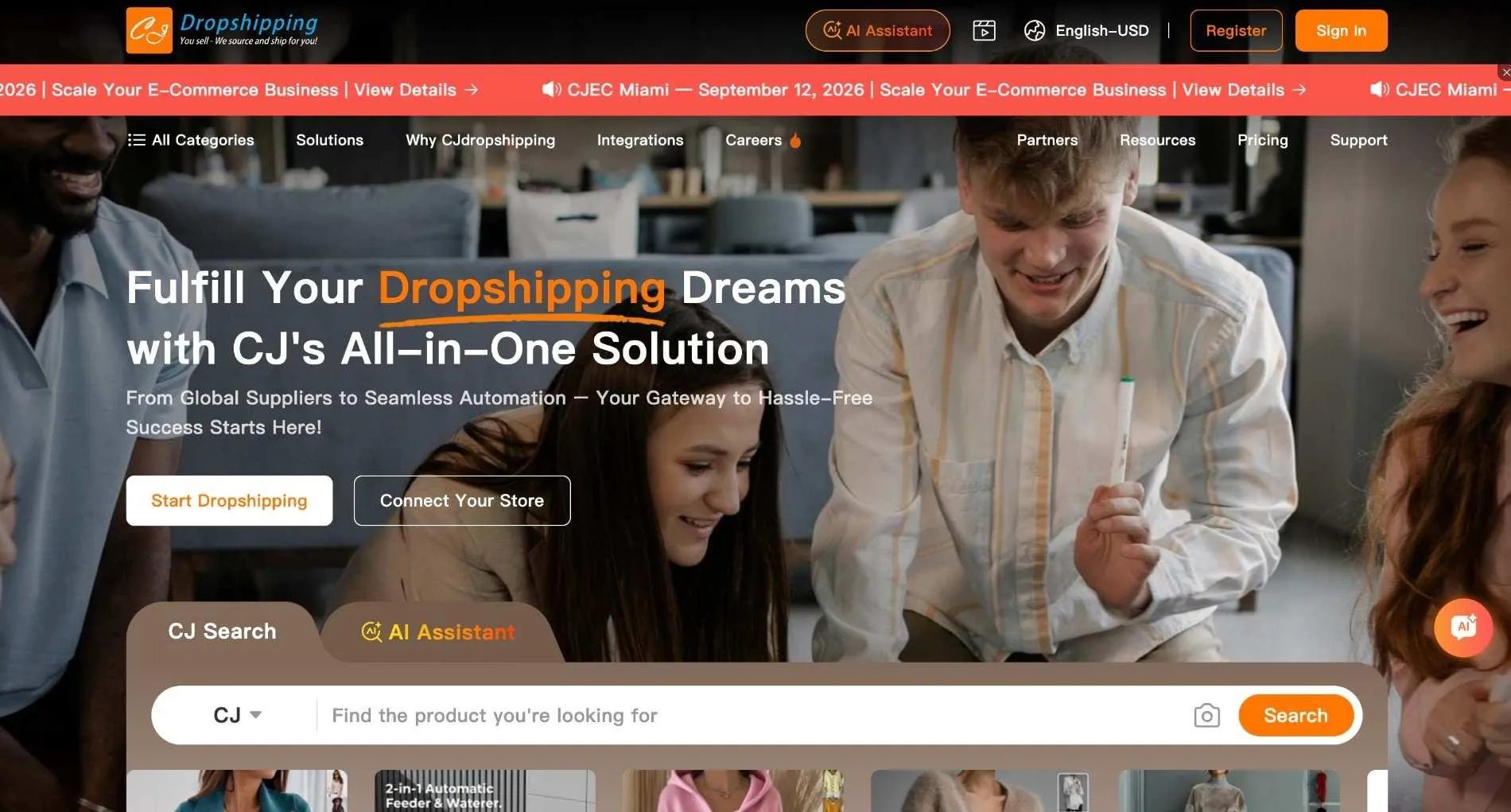
CJ has been running since 2015 and it earned its user base honestly. Joining costs nothing, listing products costs nothing, and there is no subscription gate between you and your first test order. For a seller with $200 and an idea, that matters more than any feature list.
The sourcing service is the part competitors struggle to copy. Send CJ a product link, an image or a description, and its team will search its supplier network and come back with a quotation.
CJ also owns fulfillment infrastructure rather than renting it. Warehouses across several countries, its own CJPacket shipping line, print-on-demand, photography and optional stocking all sit inside one account.
Sellers targeting US customers from CJ's US warehouse report delivery in roughly 5 to 10 business days, and European orders in 7 to 15. Its rating profile reflects a company that works well for some people and badly for others, with a strong Trustpilot score across more than 10,000 reviews while app stores run noticeably cooler.
Where CJdropshipping Falls Short
Five problems come up again and again, across reviews and across the pricing pages:
- Delivery runs 15 to 30 days in practice. Processing consumes days before a parcel moves at all, and transit adds another 7 to 15 on top.
- Joining is free, but everything after it is metered: shipping, inbound, outbound and stocking fees, all varying by warehouse region.
- Every cross-border parcel now needs a customs entry and a duty payment.
- Product quality and response times depend on which agent you are assigned.
- Images and descriptions usually arrive too rough to publish.
On any channel with shipping SLAs, TikTok Shop being the obvious one, that delivery arithmetic does not survive contact with the customer. The fee structure creates a second problem: products fulfilled from China to the US attract shipping and stocking fees, while the same product routed through a European warehouse can attract all four. Working out landed cost per SKU takes real effort before you publish anything.
Best CJdropshipping Alternative Overall
Carro is the best overall alternative to CJdropshipping. It covers the core job CJ does, filling a storefront with products you do not own or warehouse, and changes where those products come from.
Pricing scales with your sales volume, and enterprise programs are custom quoted to match scope. There is no upfront inventory cost. The products ship from brand partners' own facilities rather than crossing a border on their way to your customer.
Best CJdropshipping Alternatives: In-Depth Review & Comparison
1. Carro
Overview
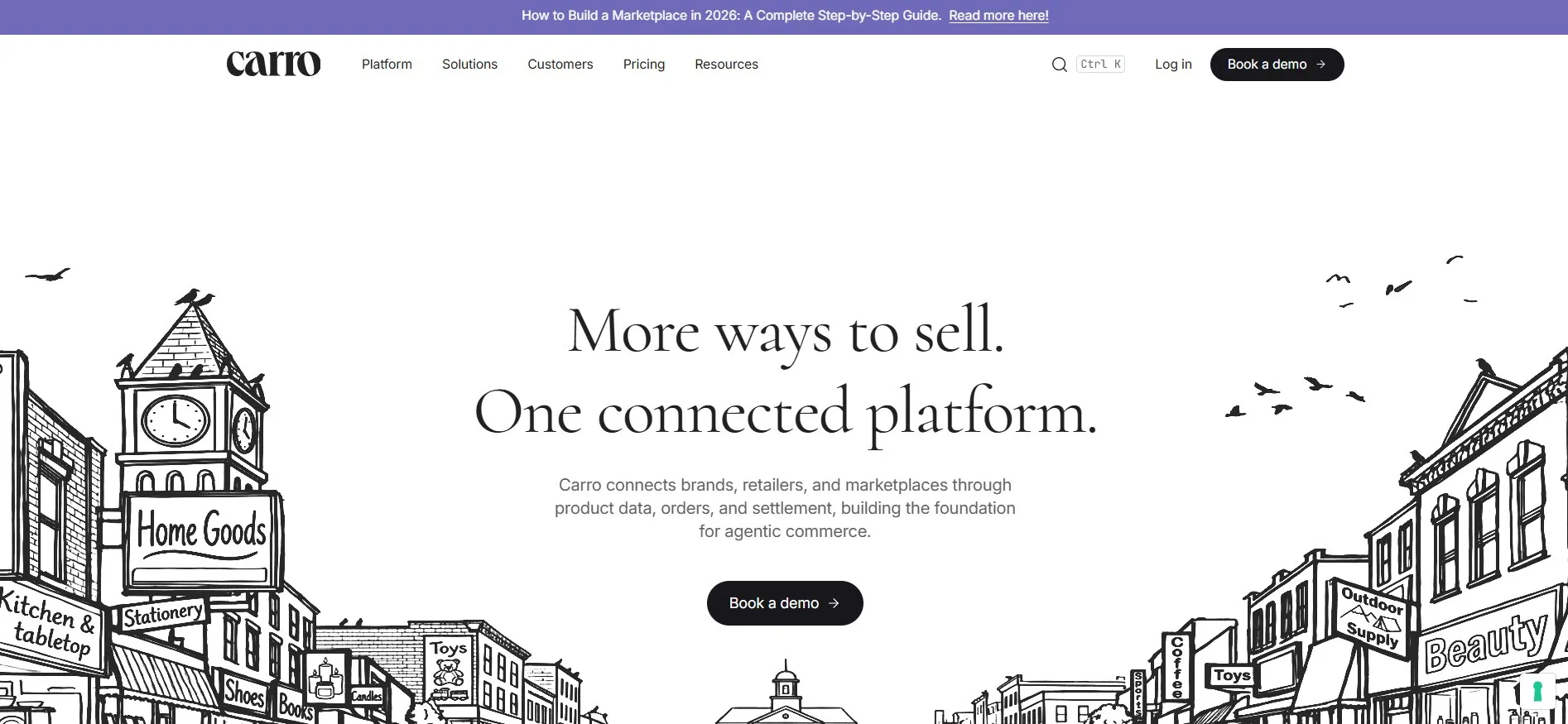
Carro is a dropship and marketplace platform for retailers who want to grow their catalog without buying stock. Where CJ sources anonymous factory goods and ships them from Asia, Carro connects you to established US and international brand partners that already hold inventory, already photograph their own products and fulfill from their own facilities.
Retailers connect through native Shopify, WooCommerce, BigCommerce and Magento integrations, or through the API, EDI, SFTP and CSV for partners with heavier systems. The catalog behind it is large and growing, with products from vetted brands.
Ideal For
- Established retailers in any market modernizing a dropship program without adding warehouse space
- Online marketplaces expanding assortment across many brand partners at once
- Shopify, WooCommerce, BigCommerce and Magento merchants who want native connection rather than middleware
- DTC brands looking for retail distribution without a wholesale negotiation
- Teams whose margin cannot absorb an import duty on every parcel they sell
Top Features
- Hand-matched supplier network, where account managers introduce you to complementary brands instead of pointing you at a directory
- Automated order routing that splits a cart spanning three brands into three supplier orders, with fulfillment status flowing back to the storefront
- Real-time sync across product, price and stock, so brand-side inventory changes reach your listings without anyone republishing anything
- Native apps for Shopify, WooCommerce, BigCommerce and Magento, plus EDI, API, SFTP and CSV for partners running legacy systems
- Automated payouts to brand partners as soon as their products sell, with reconciliation handled in-app rather than in a month-end spreadsheet
Why We're the Best CJdropshipping Alternative
The first difference is fulfillment origin. Products ship from brand partners' own facilities in the markets they already serve, so your customer waits days rather than weeks and the parcel is not clearing customs on its way to them.
The second is the quality of what you are selling. CJ's catalog is unbranded factory goods that any competitor can list at any price, while Carro's catalog is recognizable brands with their own equity, photography and product copy.
The third is that Carro supplies the relationships as well as the plumbing. Spocket, Syncee and Modalyst hand you a searchable directory; Carro hands you introductions, and retailers using it report up to 4.5x year-over-year sales growth and up to 350% higher AOV on carts with Carro products.
Pros
- Domestic fulfillment removes both the transit-time problem and the customs exposure
- Brand-supplied imagery and copy, which cuts the listing work CJ creates
- G2 reviewers report getting live in about one month
- Native integrations across Shopify, WooCommerce, BigCommerce and Magento, plus EDI and SFTP for enterprise partners
Cons
- Built for retailers and marketplaces expanding assortment, not for a solo seller testing a $9 gadget on a $0 budget
- Assortment depends on partner fit, so a very narrow niche may find fewer matched brands in the network than a broad catalog would
- Not a print-on-demand or custom-manufacturing route, so brands wanting their own logo on a product will still need Printful or a similar partner
Pricing
Pricing scales with your sales volume, and enterprise programs are custom quoted to match scope. There is no upfront inventory cost: brand partners hold the stock and ship each order.
Because cost tracks sales rather than parcels, partners or SKUs, the bill only grows when the assortment earns.
Final Verdict
Carro is the right move if your growth plan depends on adding assortment rather than adding warehouse space.
It answers the question retailers face at that point, which is how to add branded assortment that arrives in days and holds its margin after duty.
2. Spocket
Overview
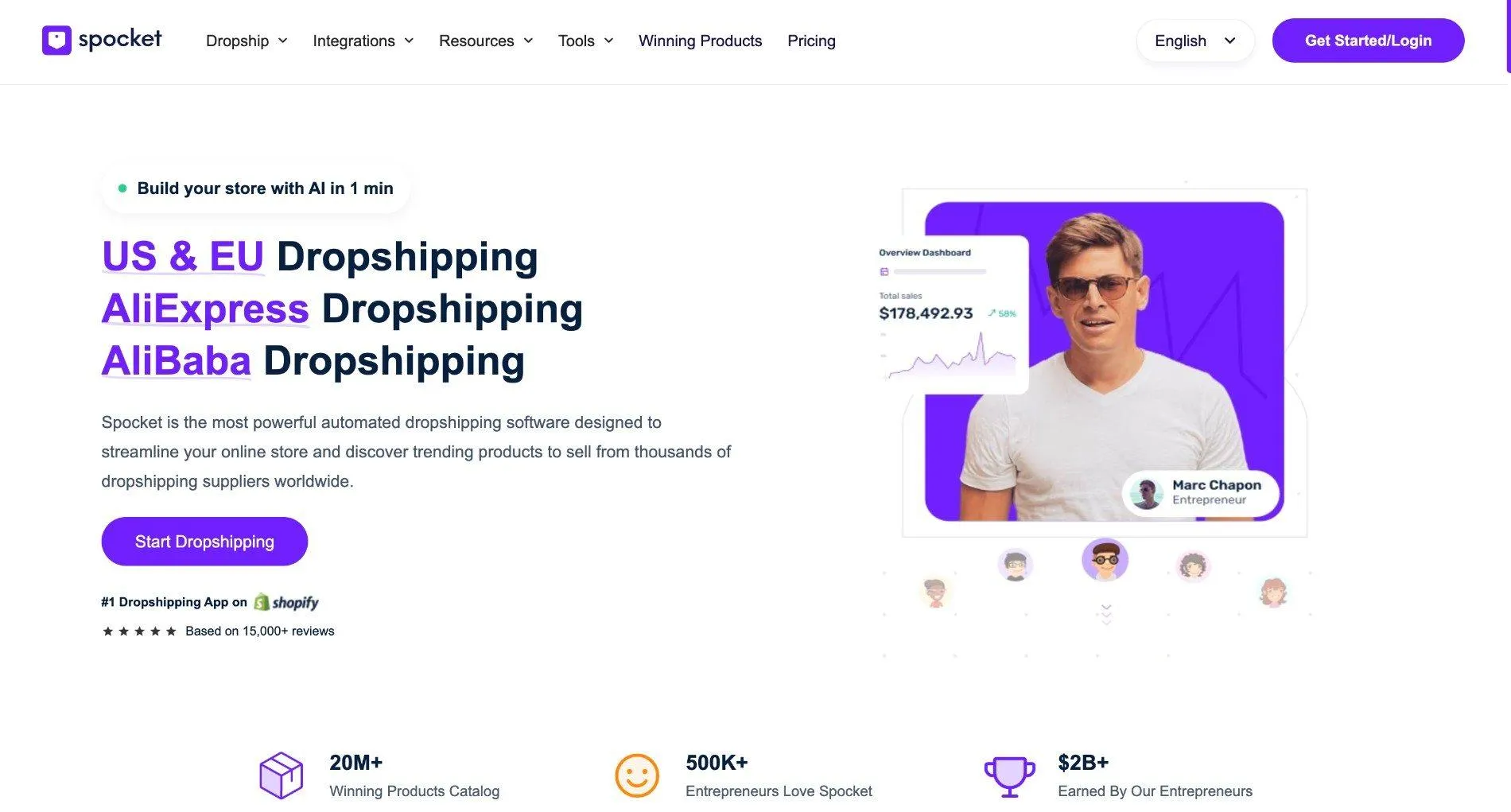
Spocket is a supplier marketplace built on a single premise: most dropshipping problems trace back to where the product ships from. It curates suppliers in the US and EU so orders reach customers in those regions quickly, and it vets who gets into the catalog rather than letting anyone list.
The company positions itself directly against China-first sourcing, and its own comparison content makes the case explicitly. Suppliers offer wholesale pricing at a discount off retail, and Spocket takes no commission on sales.
It integrates with Shopify, WooCommerce, Wix, BigCommerce and Squarespace, which is broader storefront coverage than most of this list.
Ideal For
- Shopify and WooCommerce sellers targeting US or EU customers
- Stores where delivery speed is part of the brand promise
- Sellers who want to order samples before listing
- Merchants in categories where product photography quality decides conversion
- Anyone burned by long transit windows on a previous supplier
Top Features
- Vetted supplier network concentrated in the US and EU, with domestic transit times as a result
- Branded invoicing on Professional and above, so your name appears on the packing slip rather than the supplier's
- Sample ordering at discounted rates, which lets you check quality before a customer does
- Real-time inventory sync and one-click imports into your storefront
- Zero transaction commission across all tiers
Why It's a Strong CJdropshipping Alternative
Spocket is one of the smartest choices when your priority is shortening delivery windows without rebuilding your storefront. The supplier base overlaps little with CJ's, and the vetting means fewer surprises on product quality.
Its main use cases sit in apparel, jewelry, home goods and beauty, where suppliers provide usable product imagery and descriptions. That removes a meaningful chunk of the listing work CJ generates.
Pros
- Genuine US and EU supplier concentration rather than a handful of local options in a mostly Asian catalog
- No commission on sales, so the subscription is your only software cost
- Sample ordering built into the workflow
- Five storefront integrations, including Wix and Squarespace
- Product data arrives clean enough to publish with light editing
- A catalog of 20M+ products, by Spocket's own count
Cons
- Product import caps bite early: 25 unique products on Starter, 250 on Professional
- The subscription is due before your first sale, unlike CJ's free entry
- Premium products and supplier sourcing requests sit behind the higher tiers
- Supplier prices are higher than Chinese factory rates, so per-unit margin is thinner
Pricing
Four tiers: Starter at $39.99 per month, Professional at $59.99, Empire at $99.99 and Unicorn at $299.99. Every plan carries a 7-day trial and charges no transaction fee.
Unique product limits are what separate them: 25 on Starter, 250 on Professional, 10,000 on Empire and 25,000 on Unicorn. Annual billing is advertised at up to 8 months free.
Final Verdict
Spocket suits stores selling to US and EU customers where fast delivery and clean product data justify a subscription.
It is a poor fit for sellers running wide catalogs, since even the Professional tier caps you at 250 unique products, and for anyone whose model depends on the lowest possible unit cost. If you want vetted suppliers but also want brand names attached to the products, Carro's network is the closer comparison.
3. Zendrop
Overview
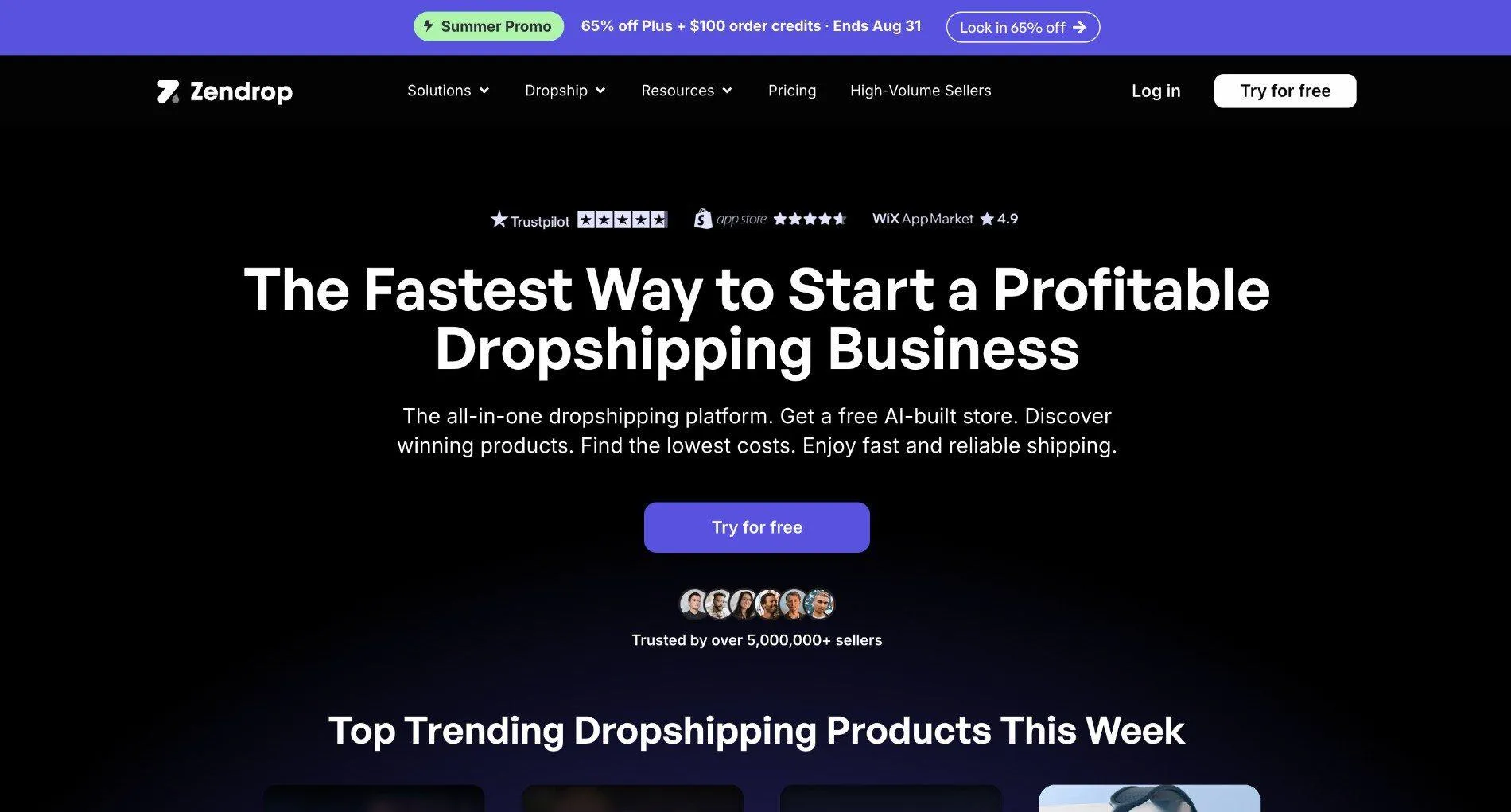
Zendrop built its reputation on being the friendliest way out of AliExpress-style sourcing. It combines a product catalog with US warehouse stock, automated fulfillment, custom packaging and a substantial education layer aimed at first-time sellers.
The branding service is what distinguishes it in practice. Custom packaging, inserts and logo printing are available at low volume, which lets a solo operator run a store that does not look like a solo operator's store.
Zendrop has moved most new signups onto usage-based billing through Shopify and Wix. Charges are based on the peak number of linked products during a billing cycle rather than a flat tier.
Ideal For
- First-time dropshippers who want structure and coaching alongside a supplier
- Sellers who want branded packaging without minimum order quantities
- Stores selling into North America where 5 to 8 day delivery is the target
- Merchants who value a guided setup over configuration depth
Top Features
- US warehouse fulfillment for selected products, with delivery in roughly 5 to 8 days
- Custom branding covering packaging, inserts and logo print at accessible volumes
- Automated fulfillment that removes per-order manual approval
- Zendrop Academy, weekly coaching calls and chargeback management on the Plus tier
- Private product listings and a trending product finder
Why It's a Strong CJdropshipping Alternative
Zendrop is one of the strongest picks for a seller whose main frustration with CJ is the unbranded, generic feel of what arrives at the customer's door. Its branding tooling addresses that at a price point solo operators can reach.
The US warehouse stock is the second draw. It does not cover the whole catalog, but for products stocked domestically the delivery gap against CJ is substantial.
Pros
- Branding and custom packaging available without MOQ commitments
- Genuine US fulfillment on part of the catalog
- Onboarding designed for people who have never run a store
- Education and coaching included in the higher tier
- Chargeback management, which is unusual at this price
Cons
- The free plan cannot import products or process orders, so it functions as a browsing tool only
- Usage-based billing charges on peak linked products in a cycle, so removing products later does not reduce that month's bill
- Not all catalog items ship from the US, and it is not always obvious which
- More expensive than CJ's entry point by a wide margin
- Reviewers note that the education content is aimed squarely at beginners
Pricing
Standard plans run Free, Pro at $49 per month or $399 per year, and Plus at $79 per month or $549 per year.
Usage-based tiers for Shopify and Wix signups work differently: $29 per month for 1 to 20 linked products, $49 for 21 to 100 and $79 for 101 or more.
Final Verdict
Zendrop makes sense for beginners who want branded packaging and a guided path to their first sale, and for stores small enough that the product caps do not pinch.
It is a weaker choice for established retailers, since the catalog is generic merchandise rather than recognized brands, and the free tier gives you nothing operational. Sellers past the learning stage usually find the coaching layer irrelevant to what they are paying for.
4. AutoDS
Overview
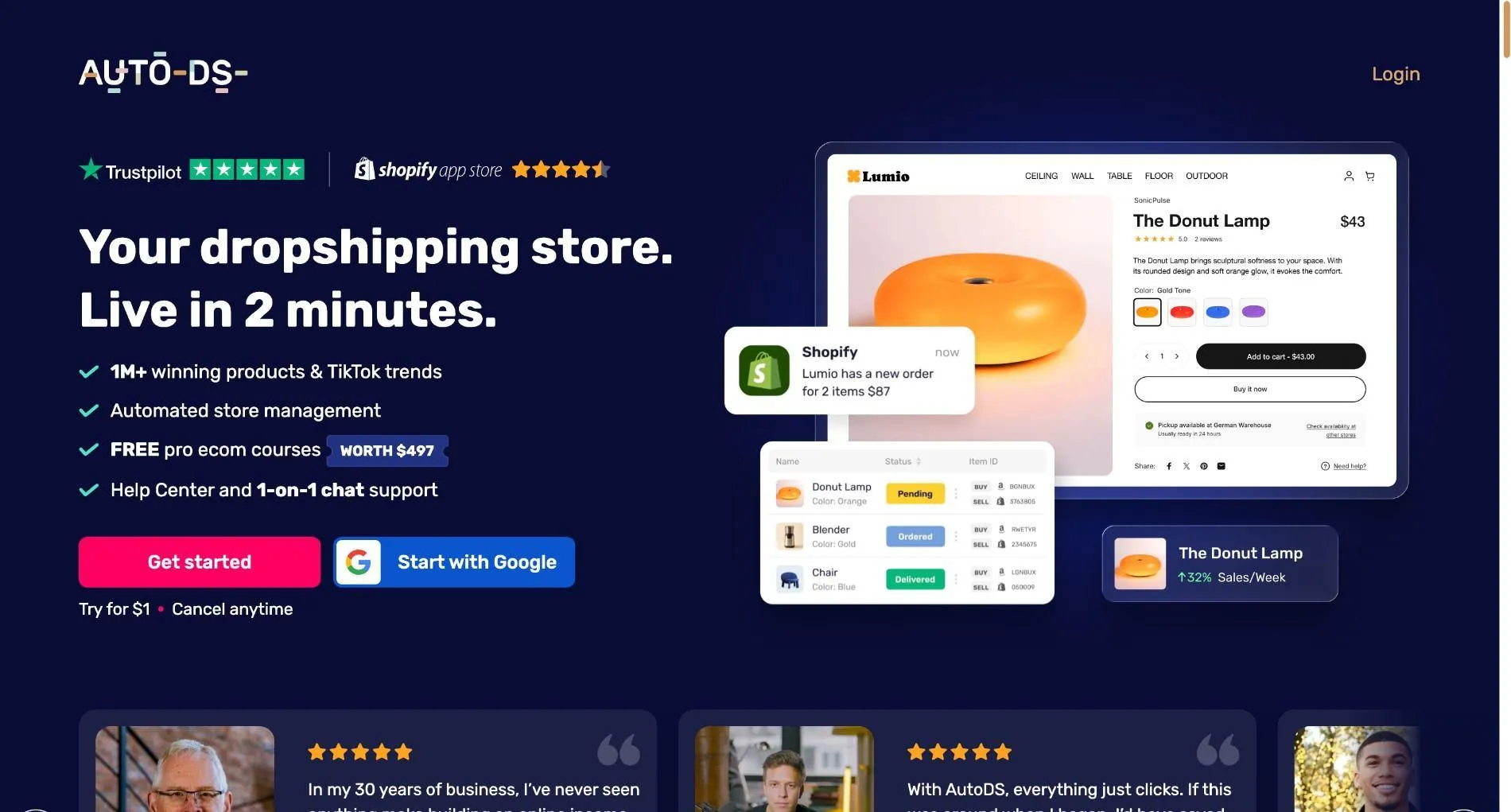
AutoDS is an automation suite rather than a supplier. It imports products from more than 40 supported sources, monitors their price and stock continuously, fulfills orders automatically and pushes tracking back to the customer.
Its distinguishing feature is channel breadth. Where most of this list is Shopify-centric, AutoDS supports eBay, Amazon, Facebook Marketplace, TikTok Shop, Etsy, Wix and others, with pricing that varies per channel.
The company publishes its tiers openly and is unusually direct about where costs sit, which reviewers consistently credit. It also runs its own warehouse and marketplace alongside the third-party imports.
Ideal For
- Sellers running the same catalog across several marketplaces at once
- eBay and Amazon dropshippers who need continuous price and stock monitoring
- Operators managing hundreds or thousands of SKUs
- Anyone whose main risk is overselling out-of-stock products
Top Features
- Automatic price and stock monitoring across all imported suppliers, which prevents the two most common dropshipping failures
- Auto-ordering that places supplier orders without manual intervention
- Imports from 40+ suppliers, so you are not locked to one source
- AI-generated titles and descriptions for bulk listing work
- Product research tools with sales data attached
Why It's a Strong CJdropshipping Alternative
AutoDS is one of the smartest choices if your problem with CJ is operational rather than logistical. It sits above whatever supplier you use, so you can keep sourcing from CJ while automating the parts CJ does not handle.
For multi-channel sellers it has no close equivalent here. Managing eBay, Amazon and a Shopify store from one dashboard is a genuine capability gap in the rest of the field.
Pros
- Widest marketplace coverage on this list
- Public, itemized pricing with no sales call required
- Stock and price monitoring that runs continuously rather than on a schedule
- A 3-day trial with full access to the chosen tier
- Annual billing cuts the rate by roughly 25%
Cons
- Many supported suppliers are retail sources, so you buy at retail and resell, which compresses margin against wholesale sourcing
- Pricing differs by marketplace, making comparison awkward
- Add-on credits for fulfillment and mentorship stack on top of the base tier
- It supplies automation, not products, so sourcing quality remains your problem
- The interface carries a learning curve at the higher tiers
Pricing
Tiers vary by selling channel. On the Shopify plan, Import is $26.90 per month for up to 200 products, Starter is $39.90 for 201 to 500, and Advanced is $66.90 for 501 to 1,000, with a custom Enterprise tier above that.
Annual billing takes 25% off. A 3-day trial is available, and add-ons price separately: auto ordering at $9.90 per month, VA access and the product finding hub at $14.97 each, and mentorship at $39.97.
Final Verdict
AutoDS is recommended for multi-marketplace operators and high-SKU sellers who need automation more than they need a new supplier.
Its limitation is that it does not change what you are selling or where it ships from, so a seller leaving CJ over delivery times will still be waiting three weeks unless they also change source. For most retailers the question is sourcing rather than tooling, which puts AutoDS in front of a narrower group than its feature list suggests.
5. DSers
Overview
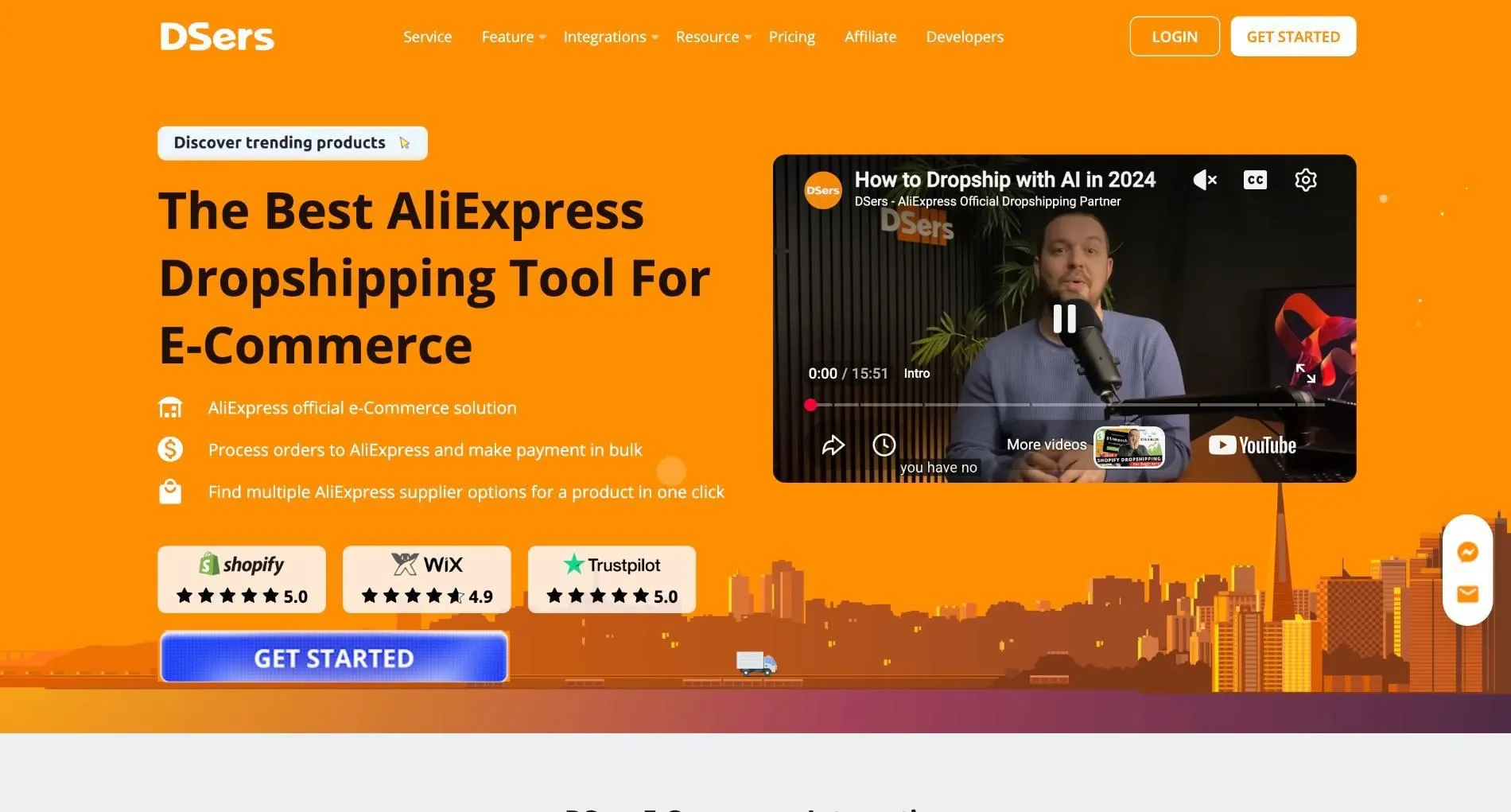
DSers is the official AliExpress dropshipping partner and the successor to Oberlo for most Shopify sellers. It handles bulk order placement, supplier optimizing, inventory sync and tracking updates across AliExpress.
Its supplier optimizer is the standout function. It surfaces alternative AliExpress suppliers for the same product, sorted by price and rating, which frequently finds a cheaper source for something you already sell.
The free tier covers up to 3 stores and 3,000 products with no time limit, which is enough to run a real business rather than a demo.
Ideal For
- Sellers committed to sourcing from AliExpress
- Beginners with no software budget who still need order automation
- Stores processing high order volume from a small number of suppliers
- Merchants running several Shopify or WooCommerce stores from one dashboard
Top Features
- Bulk order placement, which turns hundreds of manual checkouts into one action
- Supplier optimizer that compares alternative AliExpress sources for the same SKU
- Automated tracking sync back to the storefront and the customer
- Multi-store management from a single account
- Price and stock automation rules on paid tiers
Why It's a Strong CJdropshipping Alternative
DSers is one of the strongest options for sellers whose objection to CJ is cost rather than speed. The free plan genuinely works, and AliExpress pricing is frequently below CJ's quoted rates for the same item.
Its main use case is order volume. Sellers processing hundreds of AliExpress orders a day rely on bulk ordering to keep the operation viable at all.
Pros
- Free plan with no expiry covering 3 stores and 3,000 products
- Official AliExpress partnership, so the integration is maintained rather than reverse-engineered
- Supplier optimizer regularly finds cheaper sources for existing products
- Paid tiers are cheap relative to the category
- 14-day free trial on Advanced and Pro
Cons
- Ties you to AliExpress, which means the same China transit times and customs exposure as CJ
- No fulfillment infrastructure, warehousing or quality inspection of its own
- Multi-marketplace support is weak compared with AutoDS
- Reviewers report billing issues including charges after cancellation
- Product data quality is inherited from AliExpress listings, which is to say variable
Pricing
Four tiers. Basic is free and covers 3 stores and 3,000 products, while Advanced is $19.90 per month with 10 stores and 20,000 products.
Pro is $49.90 per month with 25 stores and 75,000 products, and Enterprise is $499 per month. Annual billing saves roughly 20%.
Final Verdict
DSers is recommended for AliExpress sellers who want automation without a subscription, and it is the most rational free starting point in this category.
Its limitation is structural. It changes how you order, not where the product comes from or how long it takes to arrive, so any seller leaving CJdropshipping over delivery speed, customs cost or quality control will find those problems intact on the other side.
6. Syncee
Overview
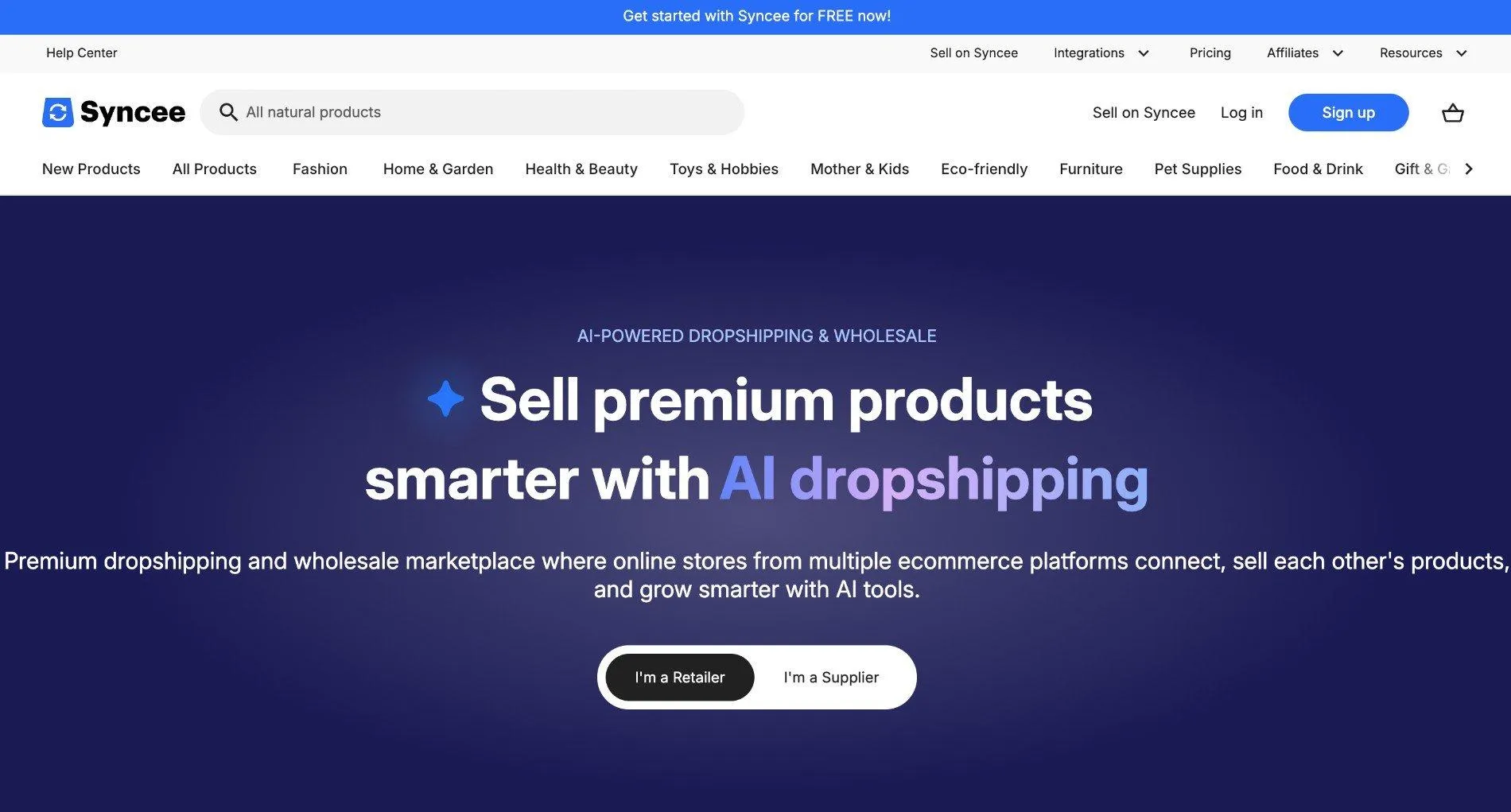
Syncee runs a global B2B marketplace connecting retailers with suppliers in the US, Canada, EU, UK and Australia. Alongside it sits a DataFeed Manager for retailers who already have their own supplier list and only need the file handling automated.
The company calls its model collective dropshipping, where stores across multiple ecommerce storefronts connect and sell each other's products. In practice it functions as a large searchable supplier directory with strong local coverage and automated catalog updates.
Its catalog runs past 8 million products, and it charges no transaction fees on retail plans.
Ideal For
- Retailers wanting local suppliers in a specific region rather than a global average
- Stores on Wix, Squarespace or BigCommerce, where supplier app choice is thinner
- Merchants who already have supplier relationships and need feed automation
- Sellers who want direct chat with suppliers before committing
Top Features
- Marketplace of 8 million-plus products with filtering by supplier country
- DataFeed Manager for importing and scheduling updates from your own suppliers
- In-app chat between retailers and suppliers
- Pricing rules and multi-level catalog settings
- Integrations spanning Shopify, Wix, WooCommerce, BigCommerce, Squarespace and more
Why It's a Strong CJdropshipping Alternative
Syncee is one of the smartest choices when your sourcing requirement is geographic. Filtering for suppliers in a single country is a first-class function rather than an afterthought, which matters if you are selling into Australia or the UK and cannot use a US-centric network.
The DataFeed Manager is the second draw and serves a different buyer entirely. If you have already negotiated with suppliers directly, it automates the file work without you paying for a marketplace you will not browse.
Pros
- Genuine multi-region supplier coverage rather than US-only
- No transaction fees on retail plans
- Broadest storefront integration list on this comparison
- Supplier chat before you commit to listing anything
- Free plan lets you assess the catalog before paying
Cons
- The free plan is browse-only; publishing products requires a paid subscription
- Supplier quality varies, and reviewers report fulfillment disputes where Syncee's role is limited to introduction
- The free trial runs only 3 days, which is tight for judging supplier response times
- No fulfillment infrastructure of its own
- The interface carries more configuration than beginner tools
Pricing
A free plan covers browsing, wholesale prices and favorites. Paid retailer tiers run Basic at $39.99 per month, Pro at $59.99 and Business at $99.99, all with a 0% transaction fee.
Import limits separate them: 100 products and one supplier on Basic, 250 products and unlimited suppliers on Pro, and 10,000 products on Business. A 3-day free trial applies across the paid tiers.
Final Verdict
Syncee is recommended for retailers with a specific geographic sourcing requirement, and for teams that already have suppliers and want the feed work automated.
Its limitation is that it introduces and then steps back, so when a supplier underperforms you are largely on your own. Retailers who want a vendor that stands behind the partnership will find Carro's account-managed model closer to what they expect.
7. Doba
Overview
Doba has been running since 2002, which makes it the oldest name on this list. It aggregates vetted suppliers into a single catalog with one integration point, so retailers deal with Doba rather than with each supplier individually.
Its 2026 development has been the AI Hub, including Doba Pilot, which handles product research, listing generation and seller operations support. That is a meaningful addition for a service historically centered on catalog access and order routing.
Categories skew toward general merchandise: beauty and health, electronics, home and garden, outdoor, baby, toys, sports and clothing.
Ideal For
- Retailers who want one supplier relationship instead of twenty
- Sellers in general merchandise categories
- Stores wanting US-based supplier coverage without vetting each one
- Merchants who value a long operating history over novelty
Top Features
- Aggregated supplier catalog behind a single integration
- Doba Pilot AI tooling for research, listing and operations
- Automated inventory and order sync
- Data export tools for bulk listing across channels
- Supplier vetting handled before products reach the catalog
Why It's a Strong CJdropshipping Alternative
Doba is one of the strongest picks when consolidation is the goal. Managing one account instead of a spread of individual supplier relationships removes real administrative weight, particularly for retailers running wide general-merchandise catalogs.
Its US supplier concentration also addresses the delivery-time gap against CJ, at least for products sourced domestically.
Pros
- Single integration covering many suppliers
- Long operating history and established supplier vetting
- AI tooling added in 2026 for listing and research work
- Multiple billing frequencies including monthly, quarterly and annual
- Low-cost paid trial rather than a hard paywall
Cons
- No free plan, so evaluation costs money from day one
- Catalog skews to lower-ticket general merchandise and is a poor fit for high-ticket models
- Product margins are frequently thin because the same catalog is available to every subscriber
- Little brand differentiation, since competitors can list identical products
- Higher tiers climb quickly for what remains a catalog subscription
Pricing
Four tiers, billed monthly, quarterly at 5% off or annually at 15% off. Doba's pricing page labels each displayed price "USD/mo billed quarterly", so the rates below are monthly amounts charged three months at a time: Limited at $28.67, Basic at $56.99 and Standard at $142.66. Enterprise is available on monthly or annual terms only. Monthly billing costs more.
There is no free plan. Basic offers a 7-day trial for $0.99 and Standard a 5-day trial at the same price, while Limited has no trial at all.
Final Verdict
Doba is recommended for general-merchandise retailers who want supplier consolidation and are comfortable competing on execution rather than exclusivity.
Its limitation is that the catalog is shared with every other subscriber, so pricing pressure is built in and brand differentiation is not available. Retailers whose growth depends on selling products competitors cannot list will need brand partnerships rather than an aggregated catalog.
8. Modalyst
Overview
Modalyst connects retailers with independent brands and suppliers across the US, UK, Europe, Canada and Australia, with a catalog weighted toward apparel, accessories and boutique goods. It is the default dropshipping app inside Wix, which gives it a distinct user base.
Its curation angle is boutique rather than mass market. Suppliers include independent labels alongside broader sources, and Modalyst supports custom branding and virtual hangtags on product listings.
Automated margin rules let retailers set pricing logic once and apply it across the catalog.
Ideal For
- Wix store owners, where Modalyst is the native option
- Boutique fashion and accessories retailers
- Stores wanting independent brand names rather than unbranded goods
- Sellers testing a niche catalog on a free tier before committing
Top Features
- Independent brand supplier network across five regions
- Virtual hangtags and custom branding on listings
- Automated pricing and margin rules applied across the catalog
- Native integration with Wix, Shopify and BigCommerce
- Real-time inventory sync with supplier stock
Why It's a Strong CJdropshipping Alternative
Modalyst is one of the smartest choices for boutique retailers, particularly in fashion, where the difference between a named independent label and an unbranded factory item shows up directly in conversion rate.
For Wix merchants it is close to the only well-integrated option, which makes the comparison straightforward for that group.
Pros
- Free entry tier that allows real selling rather than browsing only
- Independent brand names attached to products
- Strong position in apparel and accessories
- Native Wix integration
- Branding and hangtag features on listings
Cons
- Product limits on lower tiers are restrictive
- Commission fees apply on some premium brand sales, cutting into margin
- Supplier network is smaller than Syncee's or Spocket's
- Reviewers cite inconsistent customer service
- Category coverage outside fashion and accessories is thin
Pricing
Three tiers: Hobby at $0 per month with a 25-product limit, Start Up at $35 per month with 250 products, and Pro at $90 per month with no product limit.
Annual billing saves up to 25% on the two paid plans. Modalyst also runs pre-negotiated supplier contracts carrying a standardized commission split and a 14-day return policy.
Final Verdict
Modalyst is recommended for boutique fashion retailers and Wix store owners who want independent brand names on a modest budget.
Its limitations are catalog breadth and the commission structure on premium brands, which erodes margin exactly where the products are most attractive. Retailers outside apparel, or those needing thousands of SKUs, will run into the ceiling quickly.
9. Printful
Overview
Printful is print-on-demand rather than product sourcing. You upload designs, Printful prints them on blanks from a catalog of more than 450 products across 7 in-house fulfillment centers plus partner facilities in Brazil, Japan, and Australia, and ships directly to your customer under your branding.
That makes it an alternative to one specific part of CJdropshipping rather than all of it. CJ offers print-on-demand as a service line, but Printful is the specialist and the difference in output quality is visible.
There is no required subscription. You pay per-product cost plus shipping when an order comes in.
Ideal For
- Apparel and merchandise brands selling their own designs
- Creators monetizing an audience without inventory
- Stores wanting genuine branded packaging and inserts
- Sellers who need US and EU production facilities for local delivery
Top Features
- 7 in-house fulfillment centers plus partner facilities in Brazil, Japan and Australia, rather than a broker network
- 450+ blank products covering apparel, accessories and home goods
- 20+ integrations including Shopify, Etsy, WooCommerce, Amazon and TikTok Shop
- Branded packaging, custom labels and personalized packing slips
- Design tools included at every tier, including the free one
Why It's a Strong CJdropshipping Alternative
Printful is one of the strongest options for anyone whose product is a design rather than a sourced item. Owning the artwork removes the price competition that defines generic dropshipping, since nobody else can list your product.
Production location is the second advantage. US and EU facilities mean domestic delivery windows and no customs entry on the way to the customer.
Pros
- No required subscription, so software cost is zero until you choose otherwise
- Consistent print quality from its own fulfillment centers, with partner facilities only in Brazil, Japan and Australia
- The Growth plan fee is waived once you reach $12,000 in annual sales
- Broadest integration list among print-on-demand options
- Full catalog and design tool access on the free plan
Cons
- Print-on-demand only, so it cannot replace CJ for sourced physical goods
- Highest per-unit cost among major print-on-demand services
- Margin depends entirely on your retail pricing, since base costs are fixed
- Add-ons including premium images, custom labels and embroidery digitization are charged separately
- Branded packaging carries a storage minimum plus a per-item picking fee
Pricing
Free to use with no monthly fee. You pay product cost plus shipping per order, and that is the whole bill for most sellers.
The Growth plan is $24.99 per month and gives up to 33% off product pricing, 9% off branding, 20% off sample orders and free embroidery digitization on selected products. Printful states the fee is waived once your store reaches $12,000 in annual sales, and Enterprise pricing is custom.
Final Verdict
Printful is recommended for design-led brands and creators, where owning the artwork is the entire competitive position.
Its limitation is scope. It is not a route to a broad catalog, and a retailer trying to fill a storefront with varied products will need a sourcing partner alongside it, since most sellers leaving CJdropshipping want products to sell rather than products to design.
10. Sellvia
Overview
Sellvia sells a packaged route into ecommerce: a prebuilt store, a curated product catalog, a personal manager and a marketing academy. It is aimed squarely at people who have never run an online business, and it works with WordPress, WooCommerce and Shopify alongside its own hosted store.
The catalog is curated rather than exhaustive, with product pages, descriptions and imagery prepared in advance. That removes the listing work but narrows what you can sell.
Buyers should read the terms carefully. Sellvia's April 2026 terms describe physical products as sourced by AliExpress suppliers, with Sellvia not storing or shipping them, which sits awkwardly against marketing that references fast US shipping.
Ideal For
- Complete beginners who want a working store without technical setup
- Sellers who value a guided launch over configuration control
- Merchants wanting prepared product pages rather than raw supplier data
- Anyone who wants a named manager during their first months
Top Features
- Prebuilt turnkey store with products preloaded
- Curated catalog with prepared descriptions and imagery
- Personal manager assigned to the account
- Marketing academy and promotional materials
- Sellvia Payments and integrated order handling
Why It's a Strong CJdropshipping Alternative
Sellvia is one of the smartest choices for a specific buyer: someone who wants to be selling this week and does not want to make a hundred setup decisions first. The prepared listings remove the single biggest time cost of a CJ-based store.
The guided model also addresses a real failure point. Most first-time sellers quit before their first sale rather than after it.
Pros
- Fastest route from signup to a live, populated store
- Product pages arrive ready to publish
- Assigned manager and support during onboarding
- Free trial available on the base plans
- Education content included rather than sold separately
Cons
- The curated catalog is narrow compared with any marketplace on this list
- Add-on service packages stack quickly on top of the base subscription
- Auto-renewal after the trial requires card details up front, and each turnkey store can bill separately
- Fulfillment claims in marketing and in the terms do not read consistently
- Trustpilot flagged fake review activity on the profile, so treat the historic score with caution
Pricing
Sellvia lists three plans. The base subscription and Sellvia PRO both sit at $39 per month flat rate, and a High-Ticket Dropshipping Store package is $490 as a one-time fee.
Optional service packages carry separate charges on top of that. A free trial is available but requires card details up front, and the subscription auto-renews when the trial ends.
Final Verdict
Sellvia is recommended for non-technical beginners who want a functioning store and a person to talk to, and it delivers that faster than anything else here.
Its limitations are catalog breadth, add-on cost stacking and a fulfillment model that is harder to pin down than it should be. Established retailers and anyone wanting control over their own stack will find it restrictive rather than helpful.
Why Carro Works Across Multiple Use Cases
Carro for Established Retailers Modernizing Dropship
Retailers with a legacy dropship program usually carry the same three problems. A handful of supplier relationships held together by email, catalog data that goes stale between updates, and a settlement process that consumes a person at month end.
Carro replaces that with automated onboarding, real-time catalog and stock sync, and payouts triggered on fulfillment. Adding partner number fifteen then costs roughly what partner number two cost, and headcount stops being the ceiling on assortment.
Carro for Online Marketplaces Scaling Assortment
Marketplaces cannot dictate a protocol to their suppliers. A marketplace courting 100 DTC brands has no leverage to demand X12 fluency from a five-person company, so it needs several ways in resolving to one internal model.
Carro accepts native storefront connections, API, EDI, SFTP and CSV. An enterprise distributor and a small brand onboard through the same process at different technical levels, and order routing then treats them identically.
Carro for New Marketplace Launches
Standing up a marketplace usually means a build. Carro removes most of it: connect the storefront, onboard brand partners through defined workflows, and let order routing, tracking and settlement run from day one.
Launches measured in weeks rather than months change what you can test. Validating a category becomes an experiment rather than a commitment.
Carro for Brands Seeking Distribution
Brands on the supply side get the inverse benefit. One connection reaches every retailer on the network, including partners not yet met, and payouts arrive as soon as products sell rather than on 60-day wholesale terms.
Control stays with the brand throughout. You approve each retail partner, set pricing and margin structures per partner, and can end a relationship that stops fitting.
Carro for Retailers Cutting Customs Exposure
This is the use case that did not exist three years ago. With de minimis suspended indefinitely, every cross-border parcel carries duty and a customs entry, and models built on sub-$20 items shipped individually from Asia absorb that badly.
Sourcing from brand partners that already hold stock in-market removes the exposure entirely. The product is already in the country when the order arrives.
What Makes a Good CJdropshipping Alternative?
1. Fulfillment Origin That Matches Your Customers
Wherever most of your revenue comes from, your stock should already be there. In-market fulfillment cuts delivery from weeks to days and removes customs entries from the per-order cost.
Ask any prospective supplier where stock physically sits before you look at anything else. It is the one answer that reshapes every other number in the comparison.
2. Cost You Can Model Before You Commit
CJ's fee structure varies by warehouse region and service combination, which makes per-SKU margin hard to work out in advance. Sellers routinely discover their real cost after the third order rather than before the first.
The same test applies to the subscription. Model your bill at three times your current partner count and catalog size, because per-product caps and per-partner fees charge you more for succeeding. Carro's share-of-sales pricing sits at the other end of that spectrum from a cap like Spocket's 250-product Professional tier.
3. Product Data You Can Publish
Supplier images and descriptions either save you work or create it. Brand-supplied photography and copy remove a hidden cost that scales linearly with catalog size.
It is also the difference between listing 50 products and listing 5,000. Rewriting every listing is survivable at small scale and impossible at large scale.
4. Automation Across Routing, Tracking and Settlement
Sourcing is only the first half of the job. Once orders arrive, somebody has to route each one to the right supplier, chase tracking, handle returns and reconcile payouts, and that work grows with every partner you add.
A genuine replacement automates the whole cycle rather than the import step alone. The test is whether your assortment can triple without your operations headcount moving.
5. Products Your Competitors Cannot Copy
Generic factory goods put you in a price race with everyone else listing the same SKU. Whoever accepts the thinnest margin wins, and that is rarely a business worth winning.
Branded assortment, curated partnerships or your own designs give you something to compete on besides being cheapest. It also lifts average order value, because a recognized brand supports a price that an unbranded equivalent does not.
How to Choose the Right CJdropshipping Alternative for Your Needs
1. Map Your Order Volume by Destination Country
Pull last quarter's orders and sort by ship-to country. If more than half go to one region, source from that region.
This single check eliminates most of the list before you compare a single feature. It takes about ten minutes.
2. Calculate Your Post-Duty Margin on Your Top 10 SKUs
Take your best sellers, add the applicable duty and customs handling to the landed cost, and recalculate margin.
Any SKU that goes negative needs a different source, not a different tool. No amount of automation fixes a product that loses money on arrival.
3. Decide Whether You Need a Catalog or Partnerships
A catalog is products anyone can list. Partnerships are relationships with terms attached.
Retailers building differentiated assortment need the second, and most of this list only supplies the first. Getting this wrong is the most expensive mistake in the category.
4. Count the Products You Actually Publish
Spocket caps Starter at 25 unique products and Professional at 250. Zendrop's usage billing charges on peak linked products in a cycle, so a temporary catalog expansion sets the price for the whole month.
If your catalog runs to thousands of SKUs, price the tier you will be on in twelve months rather than the one you start on.
5. Test the Integration Before You Test the Products
Connect the tool to a staging store and push a test order end to end, including a cancellation and a return.
Onboarding friction that shows up at partner three is much cheaper to discover now. Most vendors will let you do this during a trial.
6. Check What Happens When a Supplier Fails
Ask directly: who handles it when a partner ships late or ships wrong? Marketplace models frequently answer "you do."
Account-managed models answer differently. The gap matters most on the day it comes up, which is why it belongs in the evaluation rather than in the post-mortem.
7. Time the Path from Signing to First Order
Ask how long onboarding takes and who does the work. Programs that take months to stand up cost you a selling season, while the ones measured in weeks let you treat a new category as an experiment rather than a commitment.
Then ask what happens per order once you are live. If routing, tracking and payouts still need a person, your partner count is capped by headcount rather than by demand.
Everything You Need to Know About CJdropshipping Alternatives
| Category | Key Considerations |
|---|---|
| Top 3 Alternatives | Carro for branded assortment at any scale, Spocket for vetted US and EU suppliers, AutoDS for multi-marketplace automation |
| Best Overall Option | Carro. Brand-fulfilled orders, hand-matched partnerships, a large and growing catalog of products |
| Why Look for CJdropshipping Alternatives | Delivery windows of 15 to 30 days, customs duty on every parcel since de minimis ended, variable quality control, product data that needs rewriting |
| How to Choose | Sort orders by destination country, recalculate post-duty margin, decide between a catalog and partnerships, price the tier you will need in twelve months |
| Price Range | Free (DSers, Printful, Modalyst entry) up to $499 per month at the top end. Most functional tiers sit between $40 and $150 |
| Ease of Switching | Native Shopify, WooCommerce, BigCommerce and Magento apps mean the storefront does not change. Carro reviewers report about one month to implement |
| Must-Have Features | Real-time stock sync, automated order routing, publishable product data, automated settlement, unlimited or high partner limits |
| Mistakes You Shouldn't Make | Comparing subscription fees while ignoring landed cost, buying automation when the real problem is sourcing, picking a tier on today's catalog size, skipping a test order through the full cycle |
Ready to Move On from CJdropshipping? Try Carro
Carro does three things nothing else on this list does together. Products ship from brand partners' own facilities, so your customer waits days rather than weeks.
Account managers introduce you to brands by category, audience and price point, so assortment growth becomes a conversation rather than a search.
That combination is built for a specific kind of team. Retailers and marketplaces whose growth depends on selling more products rather than storing more products, and DTC brands who want retail distribution in any market without a wholesale negotiation.
Retailers running the model report up to 4.5x year-over-year sales growth, up to 350% higher AOV on carts with Carro products and up to 3x catalog growth in under a year. Pricing scales with your sales volume, and enterprise programs are custom quoted to match scope.
FAQs About CJdropshipping Alternatives
What is CJdropshipping used for?
CJdropshipping is used for sourcing products from mostly Chinese suppliers and shipping them directly to customers without holding inventory. It combines a catalog of millions of products with warehousing, its own CJPacket shipping line, print-on-demand and product photography in one account. Sellers also use its sourcing service to get quotations on products found elsewhere. It has run since 2015 and is free to join, with paid tiers from around $16 per month.
What are the best CJdropshipping alternatives in 2026?
The best CJdropshipping alternatives in 2026 are Carro for retailers building branded assortment, Spocket for vetted US and EU suppliers, Zendrop for beginners wanting US stock plus branding, AutoDS for multi-marketplace automation, and DSers for AliExpress sellers on a free plan. Syncee, Doba, Modalyst, Printful and Sellvia cover narrower cases. Carro leads for retailers because it supplies brand partnerships alongside the software, with a large and growing catalog of products. Its pricing scales with your sales volume, and enterprise programs are custom quoted to match scope. Pricing across the field runs from free to $299 per month.
What features should I look for in a CJdropshipping alternative?
The features to look for in a CJdropshipping alternative are domestic fulfillment matching your customer base, calculable landed cost per SKU, publishable product images and copy, automated order routing with real-time stock sync, and pricing that does not cap partner growth. Domestic fulfillment matters most since the $800 de minimis exemption was suspended, because every cross-border parcel now carries duty. Product caps are the second thing buyers miss: Spocket's Professional tier stops at 250 unique products, while Carro places no limit on partnerships.
How to choose the best CJdropshipping alternative for your needs?
To choose the best CJdropshipping alternative for your needs, sort last quarter's orders by destination country and source from wherever most of your customers are. Then recalculate margin on your top 10 SKUs with duty and customs handling added, since any product that goes negative needs a different supplier rather than better software. Decide whether you need a browsable catalog or named brand partnerships, because most tools supply only the first. Finally, push a test order through the full cycle before migrating anything.
Is it easy to switch from CJdropshipping to an alternative?
Switching from CJdropshipping to an alternative is straightforward for the storefront and slower for the catalog. Carro, Spocket, Zendrop, Syncee and Modalyst all offer native Shopify apps, so the store itself does not change and connection takes minutes. The work sits in re-sourcing products and rebuilding listings, which is why product data quality on the receiving end matters. Carro reviewers on G2 report an average implementation of about one month.
Isn't CJdropshipping cheaper than any paid alternative?
CJdropshipping is cheaper on subscription and frequently more expensive per order once the full cost is counted. There is no monthly fee, but sellers pay shipping, inbound, outbound and stocking fees that change by warehouse region, plus customs duty on every cross-border parcel since the de minimis suspension. A $15 product entering the US now needs a customs entry that did not exist in 2024. Against that, Carro's pricing scales with your sales volume, and enterprise programs are custom quoted to match scope. There is no upfront inventory cost and no duty on the parcel, so the bill tracks what you actually sell.