Best Ecommerce EDI Solutions in 2026: Reviewed & Compared for Multi-Supplier Retailers
Compare the best ecommerce EDI solutions in 2026. Carro, SPS Commerce, TrueCommerce, Orderful, Cleo and more, with features and pricing.

Key Takeaways (TL;DR)
- The best overall ecommerce EDI solution: Carro. It is the only option here that is simultaneously an EDI-capable connection layer and a curated supply network, so the output is not just connectivity but assortment you can actually sell.
- Carro is also the fastest to value in this comparison: G2 reviewer data puts Carro at one month to implement and ten months to return on investment, ahead of every other provider here with published figures.
- Why you need it: Manual supplier coordination collapses somewhere around the fifth partner, while stale stock data quietly costs you oversells, refunds, and reviews.
- Who it is for: Retailers and marketplaces running multi-supplier catalogs, dropship programs, or extended assortment, plus brands trying to reach retail partners without a wholesale negotiation.
- How to choose: Judge on five things: multi-supplier orchestration rather than document translation alone, connection flexibility across EDI and CSV and API, native storefront integration, automated settlement, and pricing that does not punish growth.
- Expected price: Carro uses usage-based pricing that starts at $149 per month with unlimited partnerships, so adding trading partners does not add a connection fee. Higher tiers and a custom enterprise option are available as volume grows, and a free trial is offered.
Top Ecommerce EDI Solutions in 2026 at a Glance
| Company | Best For | Key Features | Pricing | Rating |
|---|---|---|---|---|
| Carro | Retailers and marketplaces wanting connectivity plus a supply network | EDI and CSV supplier onboarding, native storefront integrations, automated order routing, curated partner network | From $149/mo, unlimited partnerships | 4.4 G2 / 4.8 Capterra ★★★★☆ |
| SPS Commerce | Suppliers selling into big-box retail | Full-service managed EDI, extensive retail connectivity, vendor compliance tooling | Custom quote | 4.3 G2 / 4.2 Capterra ★★★★☆ |
| TrueCommerce | Teams with no in-house EDI capability | Fully managed service, large trading partner network, deep ERP integration | Custom quote | 4.4 G2 / 4.3 Capterra ★★★★☆ |
| Orderful | Engineering-led teams that want API-style control | API-first EDI, real-time validation, full visibility of raw transactions | From $99/mo; Web EDI $189/mo per trading partner | 4.7 G2 / 4.7 Capterra ★★★★★ |
| Cleo | Complex enterprise integration patterns | Any-to-any integration, EDI plus API plus flat file, deep observability | Custom quote | 4.4 G2 / 4.6 Capterra ★★★★☆ |
| Logicbroker | Enterprise retailers running dropship programs | Dropship and marketplace orchestration, partner onboarding, ERP connectors | Custom quote | 4.0 G2 ★★★★☆ |
| Rithum | Large multi-channel commerce operations | Dropship, marketplace and retail media in one suite, wide channel coverage | Custom quote | 4.0 G2 / 3.8 Capterra ★★★★☆ |
One number in that table deserves separate attention. G2 collects self-reported implementation and payback data from reviewers, and across the providers publishing it, the spread is wide: Carro at one month to implement and ten months to ROI, SPS Commerce at three and fourteen, TrueCommerce at four and fifteen, Cleo at four and seventeen, and Rithum at three and nineteen.
Those figures matter more than a feature checklist, because every month of implementation is a month where the commercial opportunity sits idle and nobody earns anything from the partnership.
What Is an Ecommerce EDI Solution?
An ecommerce EDI solution is software that handles standardized document exchange between an online retailer and its suppliers, so stock counts, orders, confirmations, and shipping updates move between systems without manual work.
Five documents carry almost the whole job. The stock update (846) says what is available. The purchase order (850) says ship this. The acknowledgement (855) confirms what the supplier can fill. The ship notice (856) returns the courier and tracking. The invoice (810) asks for payment, and is increasingly replaced by automatic payouts.
The category splits into three shapes worth distinguishing before you shortlist anything.
- Managed EDI services do the work for you. You outsource mapping, testing, and maintenance to a vendor with an implementation team.
- EDI platforms and translators give you the tooling and expect your team to run it.
- Commerce networks bundle document exchange into a system that also handles supplier relationships, pricing, order routing, and settlement.
Those three answer genuinely different questions. Picking the wrong shape is a more expensive mistake than picking the wrong vendor within a shape, because it determines how much work stays on your side permanently rather than just during setup.
Why Do You Need an Ecommerce EDI Solution?
Because manual coordination has a ceiling, and it is lower than most teams expect.Up to about four supplier relationships, a person can hold it together with email and spreadsheets. Someone downloads the order, emails the supplier, waits, chases the tracking number, updates the customer. It is inefficient but survivable.
At supplier ten, that person has become a full-time router between systems and is the reason orders ship late. At supplier thirty, you have hired three of them and the error rate went up anyway.
The cost side is measurable. <cite index="24-1">Manual order handling runs somewhere between $50 and $150 per order, falling to roughly $25 once digital processing replaces it.</cite> At a thousand orders a month, the gap between those two figures is a salary.
The revenue side matters more. Reliable supplier stock data is the thing that makes it safe to list products you do not own. Without it, extended assortment is a bet on someone else's spreadsheet. With it, your catalog can grow far past anything your warehouse could hold, which is a different business model rather than an efficiency gain.
Who Needs an Ecommerce EDI Solution?
Multi-Supplier Retailers
Retailers running catalogs sourced from dozens of brands need accurate stock and automated routing across every one of them. The difficulty is not any single connection, it is that partner count multiplies both the work and the failure surface.
What makes this group distinctive is that their suppliers were never selected for technical capability. They were selected for assortment fit, which means the network contains an enterprise distributor and a five-person brand side by side. A solution that only serves one end of that range quietly narrows the catalog to whoever happened to have the right systems.
Online Marketplaces
Marketplaces face the same problem with an added constraint: they cannot mandate a protocol. A marketplace courting a hundred DTC brands has no leverage to demand X12 fluency from a five-person company, so it needs multiple on-ramps resolving into one internal model.
Onboarding speed is the binding constraint here rather than document handling. If activating a supplier consumes six weeks of your team's attention, your partner count is capped by headcount rather than demand, and every improvement in onboarding time translates directly into assortment growth.
Dropship Programs
Dropship inverts what EDI was designed for. Instead of a few bulk orders to a distribution center, you get thousands of single-unit orders going to consumer addresses, each needing tracking returned within hours.
That changes what the documents have to carry and how fast they have to move. Purchase orders carry a consumer's home address, ship notices become customer-facing because the tracking number reaches a shopper directly, and stock accuracy stops being a planning question and becomes a refund-and-review question.
Brands and Distributors Selling Into Retail
Suppliers need to satisfy whatever their retail partners require. Every partner publishes a different implementation guide, so the effort compounds unless the connections are consolidated somewhere.
The commercial framing matters as much as the technical one for this group. When each new retail relationship carries an integration cost, brands become selective for reasons that have nothing to do with commercial fit, declining well-matched smaller retailers because the build is not worth it.
3PLs and Fulfillment Providers
Third-party logistics providers manage inventory for multiple clients, each with their own trading partners, and need inbound notices and outbound confirmations flowing across a complicated web of relationships.
Their requirement differs from a retailer's in one important way: they are rarely the commercial party in the relationship. They need to support whatever their clients' partners demand, which makes connection flexibility more valuable to them than any individual feature.
Best Ecommerce EDI Solutions: In-Depth Review & Comparison
1. Carro
Overview
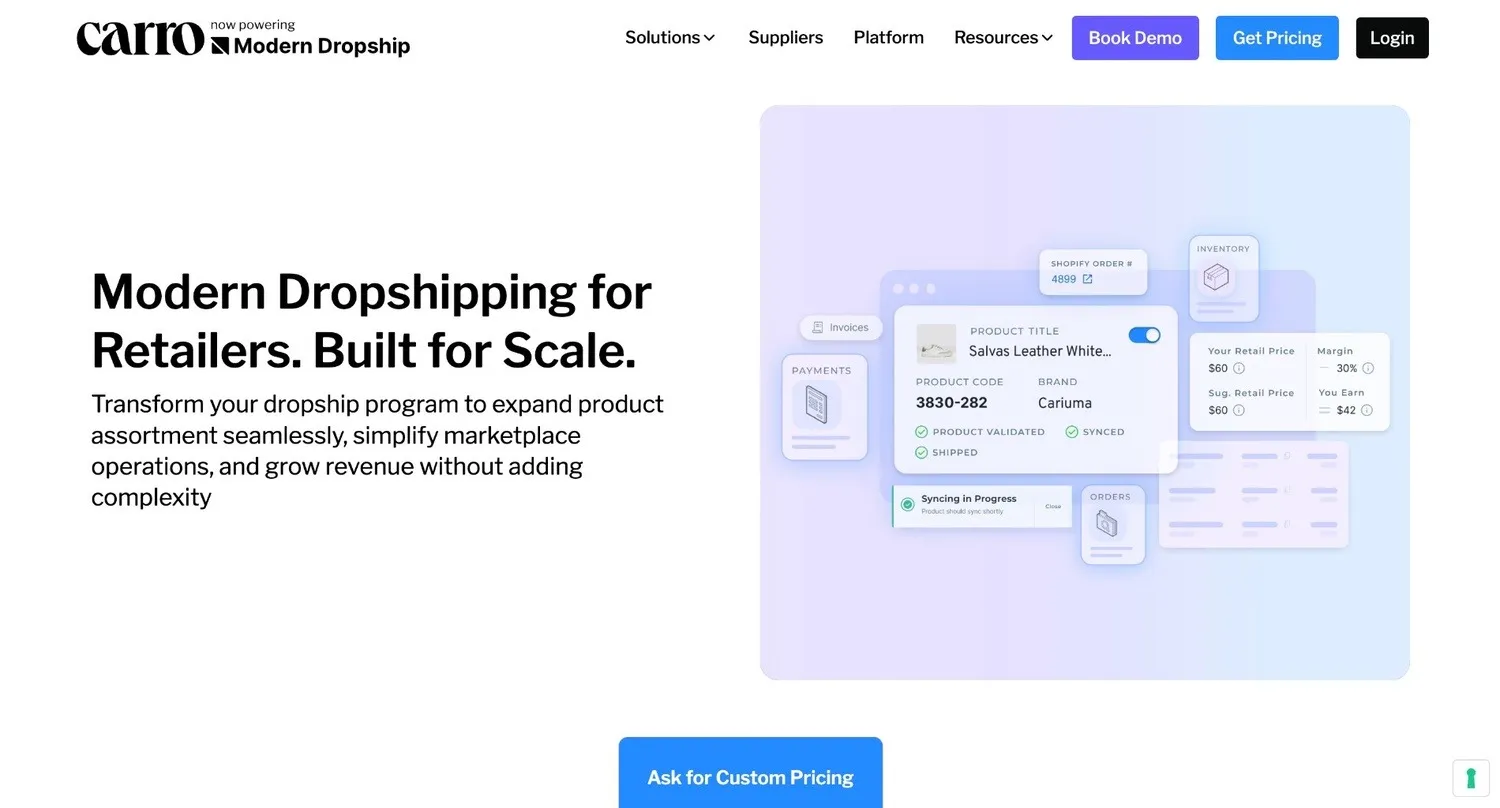
Carro is a dropship platform built for retailers and marketplaces looking to expand their product catalog without the burden of inventory. It differs from everything else on this list in scope: the others move documents, while Carro moves documents and supplies the partners on the other end of them, with access to more than 1,500,000 products from vetted brands.
The architecture splits the two sides of the trade rather than treating them identically. Suppliers connect by EDI over SFTP, or by CSV upload with template mapping if they cannot produce X12 files. Retailers connect through native integrations for Shopify, WooCommerce, BigCommerce, and Magento, or through the API, and never open an X12 file. Carro translates between them.
Reviewer data reflects that design. Carro holds 4.4 out of 5 on G2 across 123 reviews and 4.8 out of 5 on Capterra, where it scores 4.8 on value for money, 4.6 on ease of use, and 4.6 on customer service. The features reviewers rate highest are catalog management, ecommerce management, and multi-vendor support, all at 5.0, with third-party integrations at 4.8.
The number that stands out most is speed to value. G2 reviewers report an average implementation time of one month and a return on investment inside ten months, which is the fastest on both measures among the providers in this comparison that publish the data.
Ideal For
- Retailers and marketplaces growing assortment across many suppliers
- Dropship programs that need order routing, tracking, and payouts automated
- Brands wanting retail distribution without months of wholesale negotiation
- Teams with no in-house EDI expertise who still need to trade with partners who have it
- Merchants already running Shopify, WooCommerce, BigCommerce, or Magento
Top Features
- Supplier EDI over SFTP. Four documents make a supplier transactional: 846, 850, 855, and 856. Invoicing is optional because invoices generate on shipment confirmation. Functional acknowledgements (997) confirm receipt of every file.
- CSV onboarding for smaller brands. Catalogs seed by CSV with template mapping, so partners who cannot produce X12 still join the network.
- Native storefront integrations. Shopify, Shopify Plus, WooCommerce, BigCommerce, and Adobe Commerce connect directly, across sixteen integrations in total.
- Automated order routing with split orders. A basket spanning three brands becomes three supplier orders, routed without anyone deciding anything.
- Hand-matched supplier network. Account managers pair retailers with brands on category, audience, and price point rather than pointing them at a directory.
- Visible exception handling. Failures queue in TradeOps Issues, and every order page keeps a per-document record with status, download, and a retry that does not require re-transmission.
Why We Stand Out
Every other option on this list improves how you exchange documents. Carro changes what the connection gets you. A supplier satisfying one published specification becomes transactional with every retailer on the network, including partners they have not met yet, which turns distribution from an engineering project into a commercial conversation. For retailers, the same connection delivers assortment rather than just plumbing.
The second differentiator is that Carro was purpose-built for multi-supplier marketplaces rather than adapted from a generic dropship tool or a wholesale EDI product. That shows up in decisions competitors did not have to make: no file batching in either direction, supplier folders collected every fifteen minutes, and stock updates recommended every five to fifteen minutes. Those are choices made by a system that assumes a live storefront is making selling decisions continuously.
The third is that the commercial layer sits alongside the technical one. Price lists are margin-based and assigned per partner, so terms change without touching the integration. Only active, priced products become visible to partners, which makes merchandising control structural rather than a matter of policy. And returns are handled in-platform with dedicated events rather than being left as a manual exception.
Pros
- Connectivity and supply in one place, which no managed EDI service on this list offers
- Fastest implementation and ROI in this comparison per G2 reviewer data
- Suppliers connect once and reach the entire retailer network
- Retailers never handle EDI at all
- Highest value-for-money score in the set at 4.8 on Capterra
- Self-serve onboarding with a sandbox for full order round trips before go-live
Cons
- Purpose-built for inventory-free assortment growth, so teams whose primary need is tracking stock in their own warehouse will run a dedicated inventory system alongside it
- Strongest fit for retailers on Shopify, WooCommerce, BigCommerce, or Magento, where native integration does the heavy lifting
- Usage-based pricing is designed for businesses growing through partnerships rather than very high volume, very low margin commodity trading
Reviews
Average rating: 4.4 out of 5 on G2 (123 reviews), 4.8 out of 5 on Capterra (16 reviews). Reviewers score value for money at 4.8, customer service at 4.6, and ease of use at 4.6.
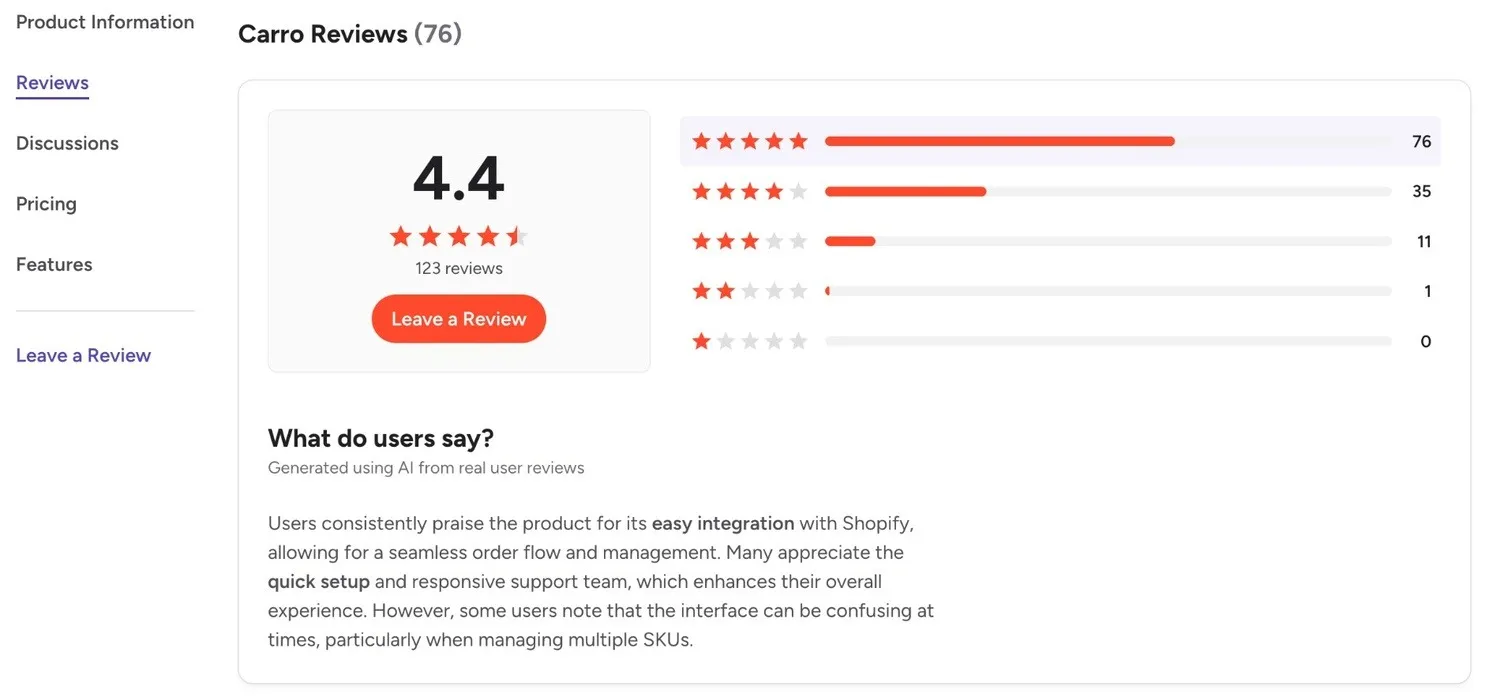
Sentiment centres on two themes. The first is integration simplicity, with G2 reviewers consistently highlighting easy Shopify integration and the seamless order flow that follows, alongside quick setup and a responsive support team. Review titles across both platforms repeat the pattern: "Seamless Integration," "Best & Easiest Marketplace option there is," and "The friendly integrator."
The second is commercial outcome rather than technical function, which is unusual in this category. Reviewers describe unlocking new revenue streams and call it a game changer for B2B businesses, and several note that the support team is proactive rather than reactive.
Pricing
Usage-based, starting at $149 per month with unlimited partnerships. Higher tiers and a custom enterprise option are available for larger volumes, and a free trial is offered.Because pricing scales with usage rather than per trading partner or per document, the cost curve differs structurally from the managed services in this comparison. Adding partner twenty does not add a connection fee, which matters if network growth is your strategy rather than a side effect.
Final Verdict
Carro is the strongest choice on this list when your growth strategy depends on adding partners rather than adding warehouse space. Every other option here improves how you exchange documents with relationships you already have. Carro does that and supplies the relationships, which is why it sits first: the output is assortment you can sell, not just connectivity you can operate.
Fastest implementation, fastest payback, and best value for money are the three measures a buyer should weigh most heavily, because they reflect what happens after the contract is signed.
2. SPS Commerce
Overview
SPS Commerce is one of the largest full-service EDI providers, focused heavily on retail supply chains. Its Fulfillment product manages the complete EDI lifecycle for suppliers selling into major retailers, and its analytics tooling reports on sales and fulfillment performance by partner.The company's scale is its defining characteristic. It maintains an extensive pre-built retailer network accumulated over decades, along with deep institutional knowledge of specific retailers' compliance quirks, certification processes, and chargeback rules. For a supplier whose primary channel is big-box retail, that accumulated knowledge is difficult to replicate elsewhere.
Reviewer sentiment is solid on capability and noticeably weaker on commercial experience. SPS holds 4.3 out of 5 on G2 across 689 reviews and 4.2 out of 5 on Capterra across 523, but value for money sits at 3.8, the lowest of the established providers here. Feature scores are modest too, with EDI at 3.8, data transformation at 3.8, third-party integrations at 3.6, and exceptions management at 3.3.
Ideal For
- Suppliers whose primary channel is big-box retail
- Businesses needing broad pre-built retailer connectivity
- Teams that want vendor compliance handled externally
- Organizations with no intention of building internal EDI capability
Top Features
- Full-service managed EDI covering testing through production support
- Extensive network of pre-built retailer connections
- Vendor compliance tooling aimed at reducing chargebacks
- Item data management for keeping product information consistent across retailers
- Analytics dashboards tracking sales and fulfillment by retail partner
Why They Stand Out
Retail depth is the differentiator. SPS has spent decades accumulating knowledge of how specific retailers behave, which matters enormously if a particular partner mandates them or if big-box compliance is the whole job. Capterra reviewers reflect this in their pros, describing a highly accessible user experience with intuitive interfaces, simple onboarding, and adaptable customization.
The managed model is the second strength. G2 reviewers consistently credit the platform with simplifying EDI compliance and reducing manual work, which allows small teams to trade with large retailers without hiring EDI specialists. For organizations where the alternative is building capability internally, that trade is frequently worth making.
Pros
- Very broad retailer connectivity built over decades
- Deep compliance expertise for major retail mandates
- Removes the need for in-house EDI staff
- Useful analytics on fulfillment performance by partner
- Large review base of 689 on G2, giving a reliable picture
Cons
- Value for money scores 3.8 on Capterra, the lowest among established providers here
- Capterra reviewers report frequent errors, unclear notifications, and difficulty troubleshooting document issues
- Pricing structure described by reviewers as high and confusing
- Three months to implement and fourteen months to ROI per G2 reviewer data
- Exceptions management scores 3.3, the weakest feature rating in this comparison
Reviews
Average rating: 4.3 out of 5 on G2 (689 reviews), 4.2 out of 5 on Capterra (523 reviews). Ease of use scores 4.4, customer service 4.1, and value for money 3.8.
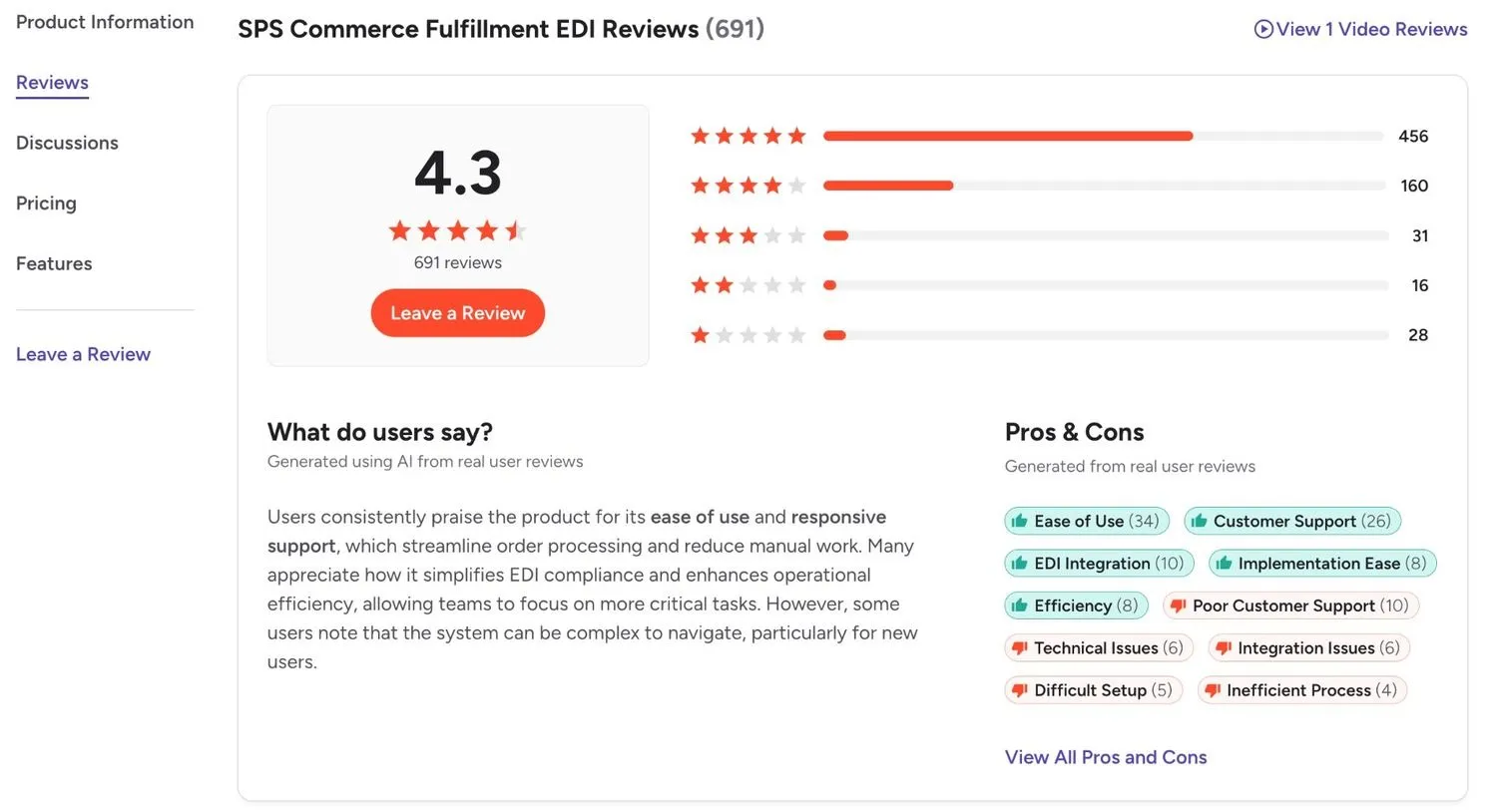
G2 sentiment is broadly positive on ease of use and support responsiveness, with reviewers describing streamlined order processing and reduced manual work. Titles like "Streamlined Order Processing That Reduces Manual Work" and "Scaled Quickly with SPS and Eliminated Manual Workflows" capture the upside. Several reviewers note the system can be complex to navigate for newcomers.
Capterra tells a more mixed story, and the negative reviews are notably blunt. Recurring themes include unclear error notifications, difficulty correcting document issues, and pricing complaints, with review titles including "force customer to pay for services that has not launched" and "Please consider other options." One reviewer summarized the split neatly by praising the automation while calling the documents "a little pricey for me."
Pricing
Custom, quote-based, driven by services, partner count, and volume. Capterra lists a starting price of $20 per month, though reviewers consistently report that the effective cost lands far higher once partners and transaction volume are counted. The pricing complaints in reviews are structural rather than about the headline number. Reviewers describe unexpected charges and difficulty predicting cost as usage varies, which is characteristic of per-document and per-partner billing models.
Final Verdict
SPS is a reasonable choice when a specific retail partner requires it or when big-box compliance is the whole job, and the breadth of its retailer network is genuinely hard to match. The managed model suits organizations that will never build internal EDI capability.
The caution is commercial rather than technical. With value for money at 3.8, an exceptions management score of 3.3, and a substantial volume of reviews citing unclear billing and troubleshooting difficulty, buyers with a genuine choice of provider should model total cost carefully and test the exception workflow before committing.
Where SPS is not the right fit is a retailer building a multi-supplier catalog rather than servicing one. It connects relationships you already have and supplies none of its own, its pricing structure works against networks that grow by adding partners, and at three months to implement and fourteen to payback it is a slow answer for a team whose constraint is assortment rather than compliance.
3. TrueCommerce
Overview
TrueCommerce sells EDI as a managed service rather than software. Its team handles mapping, testing, maintenance, and support, and it integrates with a wide range of ERPs and commerce systems including QuickBooks, SAP, Microsoft Dynamics, NetSuite, and Acumatica. It also runs supplier enablement programs that bring your own vendors up to compliance.
Positioning is squarely around outsourcing complexity. Where other providers give you tools, TrueCommerce gives you a team, which is the correct answer for organizations that have decided EDI is a utility rather than a capability worth owning. Its trading partner network is reported at over 92,000 connections.
Reviewer data is strong on service and weak on cost predictability. TrueCommerce holds 4.4 out of 5 on G2 across 446 reviews and 4.3 out of 5 on Capterra across 537, with customer service at 4.2 and value for money at 4.0. Feature scores are among the better ones here, with data import/export at 4.7 and real-time data at 4.6.
Ideal For
- Businesses that want a done-for-you EDI service
- Companies connecting to a large, diverse network of trading partners
- Enterprises running complex ERP environments
- Teams with no internal EDI expertise and no plans to build any
Top Features
- Fully managed mapping, testing, and ongoing support
- Trading partner network reported at over 92,000 connections
- Supplier enablement programs to onboard your own vendors
- Deep integration with major ERP systems
- Real-time data and strong import/export capability, rated 4.7 and 4.6 by reviewers
Why They Stand Out
The managed model is the differentiator, and reviewers back it up more consistently than for any other provider in this comparison. G2 sentiment repeatedly praises responsive support and quick issue resolution, with titles including "Effortless EDI Management with Stellar Support," "Fast, Responsive TC Team Makes EDI Setup and Troubleshooting Easy," and "Always-Available Support That Delivers."
The second strength is stability once live. Capterra reviewers describe streamlined and intuitive navigation that enables quick task completion with minimal training, and the platform's ERP integration depth means data flows into financial records without a second project. Where TrueCommerce is working well, reviewers describe it as reliable infrastructure they stop thinking about.
Pros
- Removes technical complexity entirely through a managed team
- Very large trading partner network at over 92,000 connections
- Strongest support sentiment among the managed services here
- Data import/export rated 4.7 and real-time data 4.6 by reviewers
- Deep ERP integration across QuickBooks, SAP, Dynamics, and NetSuite
Cons
- Capterra reviewers describe costs as high and unpredictable, with unexpected fees and difficulty managing charges as usage varies
- Four months to implement and fifteen months to ROI per G2 reviewer data
- Alerts and notifications score 3.6, the weakest of its feature ratings
- Less control and flexibility than API-driven or self-serve alternatives
- G2 reviewers note trading partner integration can be challenging
Reviews
Average rating: 4.4 out of 5 on G2 (446 reviews), 4.3 out of 5 on Capterra (537 reviews). Customer service scores 4.2, value for money 4.0, and ease of use 4.1.
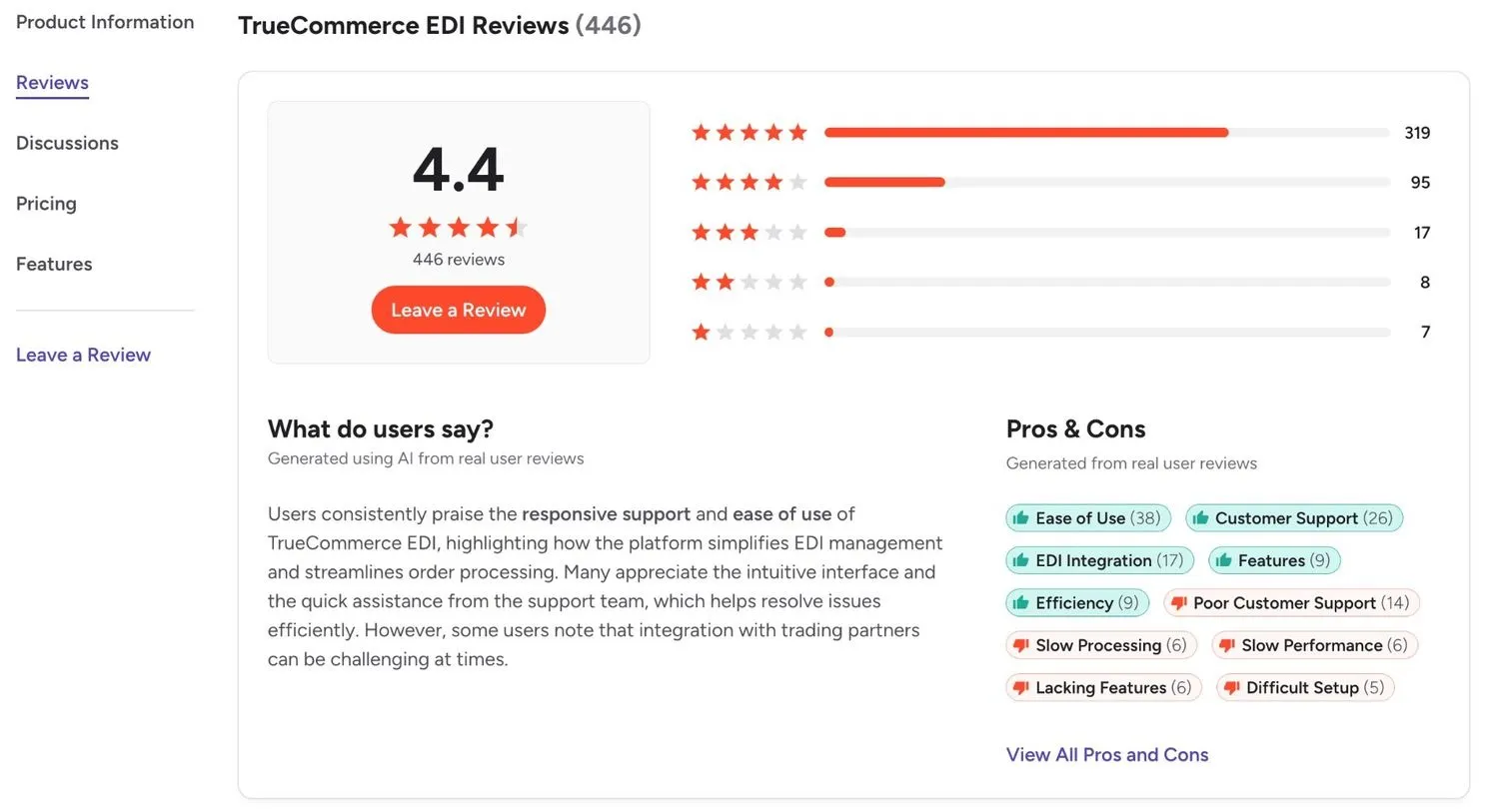
Support is the dominant positive theme across both platforms. G2 reviewers describe fast, knowledgeable assistance and an intuitive interface that simplifies EDI management, and the strongest reviews specifically credit named support staff. Where integrations are properly established, reviewers report long-term stability.
The criticism concentrates on cost and onboarding rather than capability. Capterra's own summary flags high and unpredictable costs with unexpected fees, and the harshest reviews focus on implementation delays, with titles including "No implementation, but charging months together" and "Very disorganized company." Several reviewers describe support ticketing as making help harder to get than direct contact.
Pricing
Custom, quote-based, depending on partner count, volume, and integration complexity. Capterra lists a starting price of $19.95 per month with custom pricing available above that.The consistent reviewer complaint is unpredictability rather than the headline rate. Charges varying with usage in ways customers found difficult to forecast is the specific issue named, which is worth probing directly during a sales conversation.
Final Verdict
TrueCommerce is a strong option if you view EDI as a utility to outsource and value support quality above cost predictability. The support sentiment in its reviews is the best of any managed service here, and once integrations are live, reviewers describe genuine reliability.
The trade is time and cost visibility. Four months to implement and fifteen months to payback are meaningful commitments, and the volume of reviews citing unexpected charges suggests contract terms deserve close reading before signing.
Where TrueCommerce is not the right fit is any team that needs to move quickly or wants cost certainty. Four months to go live rules it out when a partner is already waiting, the unpredictable-billing complaints are frequent enough to be a pattern rather than a few unhappy customers, and like every managed service here it services the trading partners you bring rather than helping you find new ones.
4. Orderful
Overview
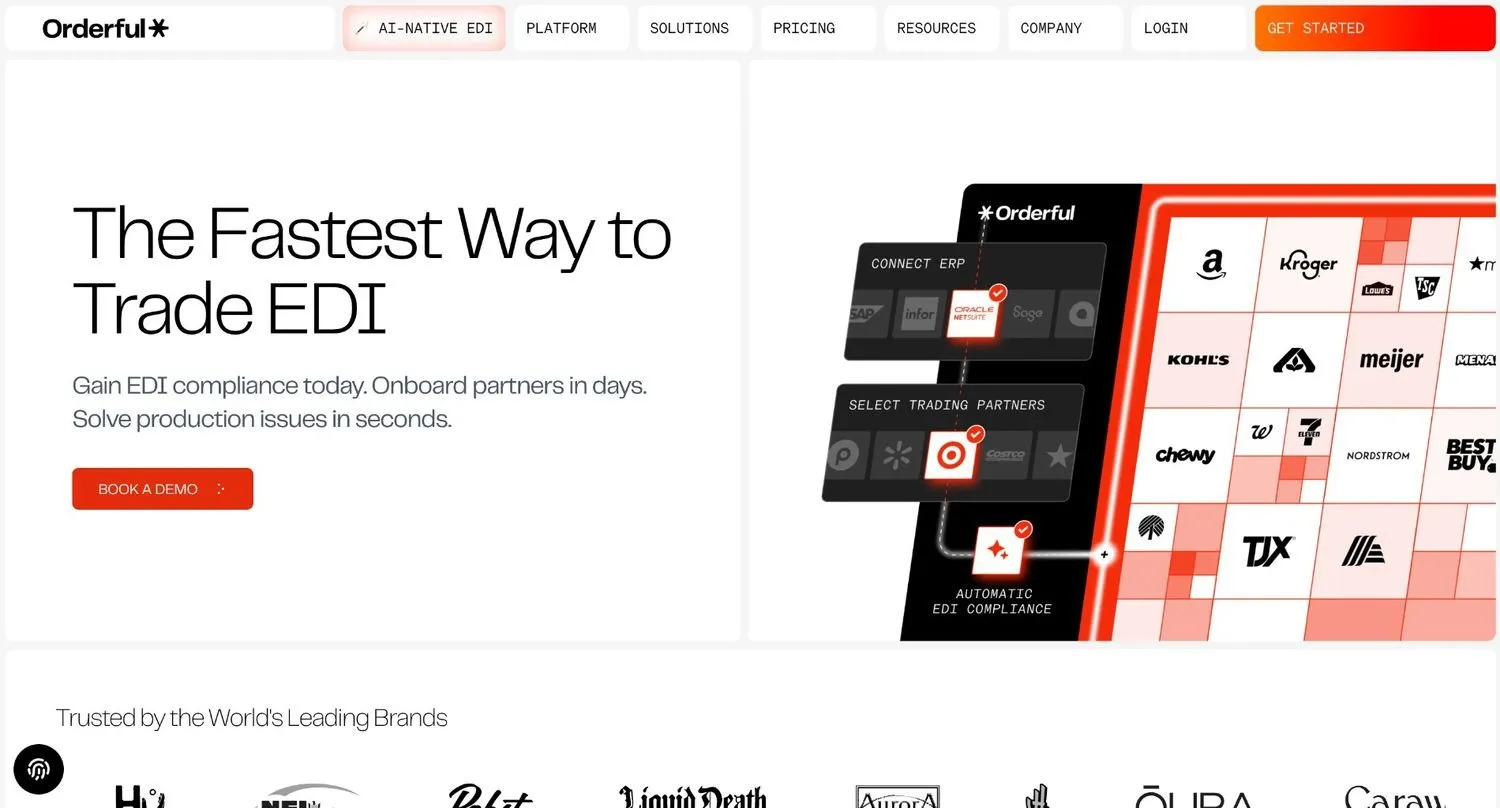
Orderful takes an API-first approach to EDI, aimed at engineering teams who would rather work with modern tooling than legacy translators. It validates transactions in real time against trading partner requirements and gives customers full visibility of raw transaction data, which is unusual in a category where most providers abstract that away.
The product philosophy is control rather than convenience. Where managed services position themselves as handling everything so you do not have to, Orderful positions itself as doing the heavy lifting on communications while letting your team work directly with the data through an API. That appeals strongly to teams with developers and rather less to teams without.
It is the highest-rated provider in this comparison on both platforms, holding 4.7 out of 5 on G2 across 115 reviews and 4.7 out of 5 on Capterra. Ease of use and value for money both score 4.8, and customer service 4.7, which are the strongest figures in the set.
Ideal For
- Engineering-led teams building EDI into their own systems
- Companies that want visibility of raw transaction data
- Businesses replacing a legacy provider that hid the underlying documents
- Teams comfortable writing their own API integrations
Top Features
- API-first architecture with a REST API for EDI on the Integrated tier and above
- Real-time validation against partner requirements before transmission
- Full visibility of raw transactions rather than abstracted summaries
- Broad connectivity across X12, EDIFACT, AS2, SFTP/FTP, and VAN, with 997, 999, and TA1 acknowledgements
- Data transformation rated 4.6 and alerts and notifications 4.5 by reviewers
- SOC 2 compliance, SAML single sign-on, and role-based access control on higher tiers
Why They Stand Out
Transparency is the genuine differentiator, and reviewers describe it in exactly those terms. One detailed Capterra review explains that Orderful was the first system they found that let them see everything, contrasting it with previous EDI providers that would not expose raw transactions, and notes that the provider handles the communications layer while the customer works through an API directly from their ERP.
The second strength is what that visibility enables operationally. Because customers can access raw transaction data, they can write their own reporting and notifications rather than depending on whatever the vendor built. Reviewers describe significantly shortened customer EDI implementation cycles as a direct result, with one calling it "the Swiss Army Knife of EDI platforms." Orderful's own published case study with logistics provider NFI reports new trading
partners onboarded in under five days and a 90% reduction in onboarding time, figures worth treating as vendor-reported rather than independently verified.
Pros
- Highest rated in this comparison at 4.7 on both G2 and Capterra
- Ease of use and value for money both rated 4.8
- Full visibility of raw transaction data, which reviewers repeatedly single out
- Publishes pricing openly rather than requiring a sales call
- Broad protocol support including AS2, VAN, and SFTP alongside X12 and EDIFACT
Cons
- The Web EDI tier prices per trading partner, so cost scales directly with network size
- Requires engineering resource to get full value from the API-first model
- Not a supply network, so you bring your own trading partners
- Reporting and analytics scores 3.6, the weakest of its feature ratings
- G2 reviewers note a moderate understanding of EDI is still necessary
Reviews
Average rating: 4.7 out of 5 on G2 (115 reviews), 4.7 out of 5 on Capterra (16 reviews). Ease of use scores 4.8, value for money 4.8, and customer service 4.7.
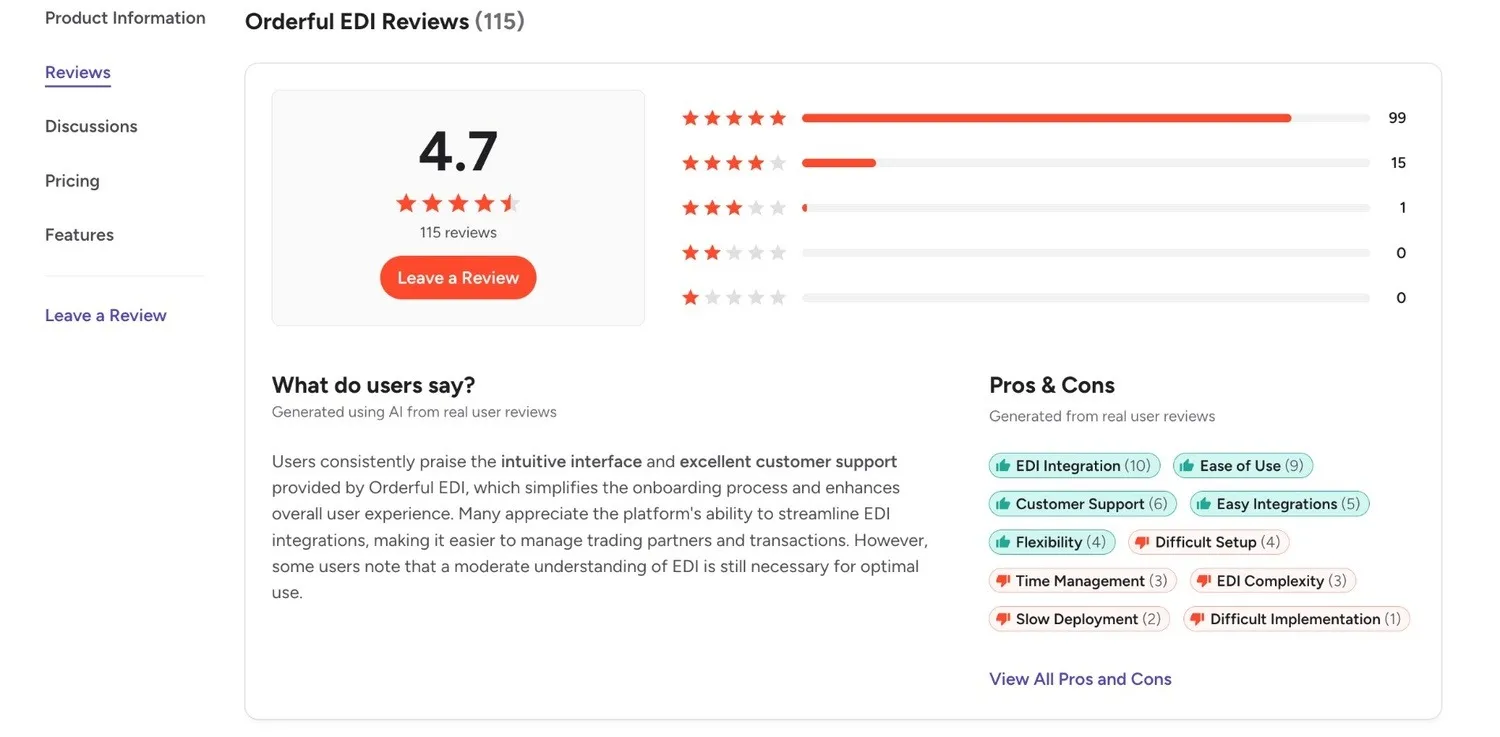
Sentiment is the most consistently positive in this comparison. G2 reviewers highlight the intuitive interface and excellent support, describing a platform that simplifies onboarding and makes trading partner management considerably easier. Titles include "Orderful: An EDI Game Changer," "Orderful has made our EDI much more manageable," and "Great tool for those starting with EDI."
The qualifications are narrow but worth noting. Reviewers observe that a moderate working knowledge of EDI is still required, so it is not a route around the subject entirely. One G2 reviewer rated the sales-to-delivery experience poorly, describing a gap between the pitch and the go-live experience, though this sits against a large majority of positive accounts.
Pricing
Orderful publishes its tiers openly, which is unusual in this category and something reviewers credit directly. Labels starts at $99 per month for retail-compliant UCC-128 labels. Web EDI Fulfillment is $189 per month per trading partner. Integrated, which adds the REST API for EDI, starts at $399 per month. Enterprise is custom and aimed at organizations with more than 20 trading partners.
The per-trading-partner structure on the Web EDI tier is the detail worth modeling carefully. At three partners the entry cost is modest; at twenty it is a materially different number, which is presumably why Orderful directs larger networks toward Enterprise. Buyers whose strategy involves steadily adding partners should price the tier they will be on in eighteen months rather than the one they start on.
Final Verdict
Orderful is the best fit for teams with engineering capacity who want control and transparency, and its reviewer scores are the strongest in this comparison across every dimension measured. Publishing pricing at all, in a category where most competitors require a sales call, is a genuine mark of confidence. Two things shape the fit. Orderful connects the trading partners you already have, so it suits a supplier satisfying existing retail relationships better than a retailer whose actual problem is finding brands to sell. And because the Web EDI tier prices per trading partner, the economics favor networks that are deep rather than broad.
Where Orderful is not the right fit is a team without developers, or a retailer whose goal is assortment rather than connectivity. The API-first model that makes it excellent for engineering-led teams becomes a barrier without them, reviewers confirm a working knowledge of EDI is still required, and there is no supply network or storefront layer, so a merchant looking to grow their catalog would still need to source every brand relationship themselves.
5. Cleo

Overview
Cleo Integration Cloud handles EDI alongside APIs and flat files, positioning itself as an any-to-any integration layer for complex enterprise environments. It emphasizes visibility into transaction flows and supports both self-service and managed models, with AS2 capability rated 4.3 by reviewers. The product sits deliberately broader than retail EDI. Cleo serves organizations whose integration requirements span multiple system types and protocols, which makes it capable in situations where a retail-shaped tool would not fit, and correspondingly heavier for a straightforward supplier document exchange.
Reviewer data is strong on support and mixed on learning curve. Cleo holds 4.4 out of 5 on G2 across 398 reviews and 4.6 out of 5 on Capterra across 85, with customer service at 4.6, value for money at 4.4, and ease of use at 4.3.
Ideal For
- Enterprises with complicated, mixed integration requirements
- Teams needing EDI, API, and file-based flows in one place
- Organizations that want detailed operational visibility
- Businesses where AS2 is a partner requirement
Top Features
- Any-to-any integration across EDI, API, and flat file
- AS2 capability rated 4.3 by reviewers
- Detailed transaction observability and real-time monitoring
- Hybrid self-service and managed delivery options
- Strong ERP and supply chain system connectivity
Why They Stand Out
Breadth is the differentiator. Cleo handles integration patterns well beyond retail EDI, which suits organizations whose requirements do not fit a retail-shaped box, and the features reviewers rate as most critical reflect this: data storage management, alerts and notifications, and real-time monitoring rather than pure document exchange.
Support is the second consistent strength, and it comes through unusually strongly in the reviews. G2 sentiment credits stellar support and quick resolution of issues, with reviewers repeatedly naming individual support staff in their write-ups. Titles including "Outstanding Customer Service and Easy-to-Use Cleo" and "Personable Support and Effortless Trading Partner Setup" are typical.
Pros
- Handles complex, non-standard integration requirements across protocols
- Customer service rated 4.6, among the highest here
- Strong observability into what is happening operationally
- Flexible delivery model spanning self-service and managed
- Large review base of 398 on G2
Cons
- G2 reviewers cite a difficult learning curve and note the platform can feel complex
- Four months to implement and seventeen months to ROI per G2 reviewer data
- Document management scores 3.7, the weakest of its feature ratings
- Reviewers report search functionality often requires exact matches
- Implementation typically involves professional services
Reviews
Average rating: 4.4 out of 5 on G2 (398 reviews), 4.6 out of 5 on Capterra (85 reviews). Customer service scores 4.6, value for money 4.4, and ease of use 4.3.
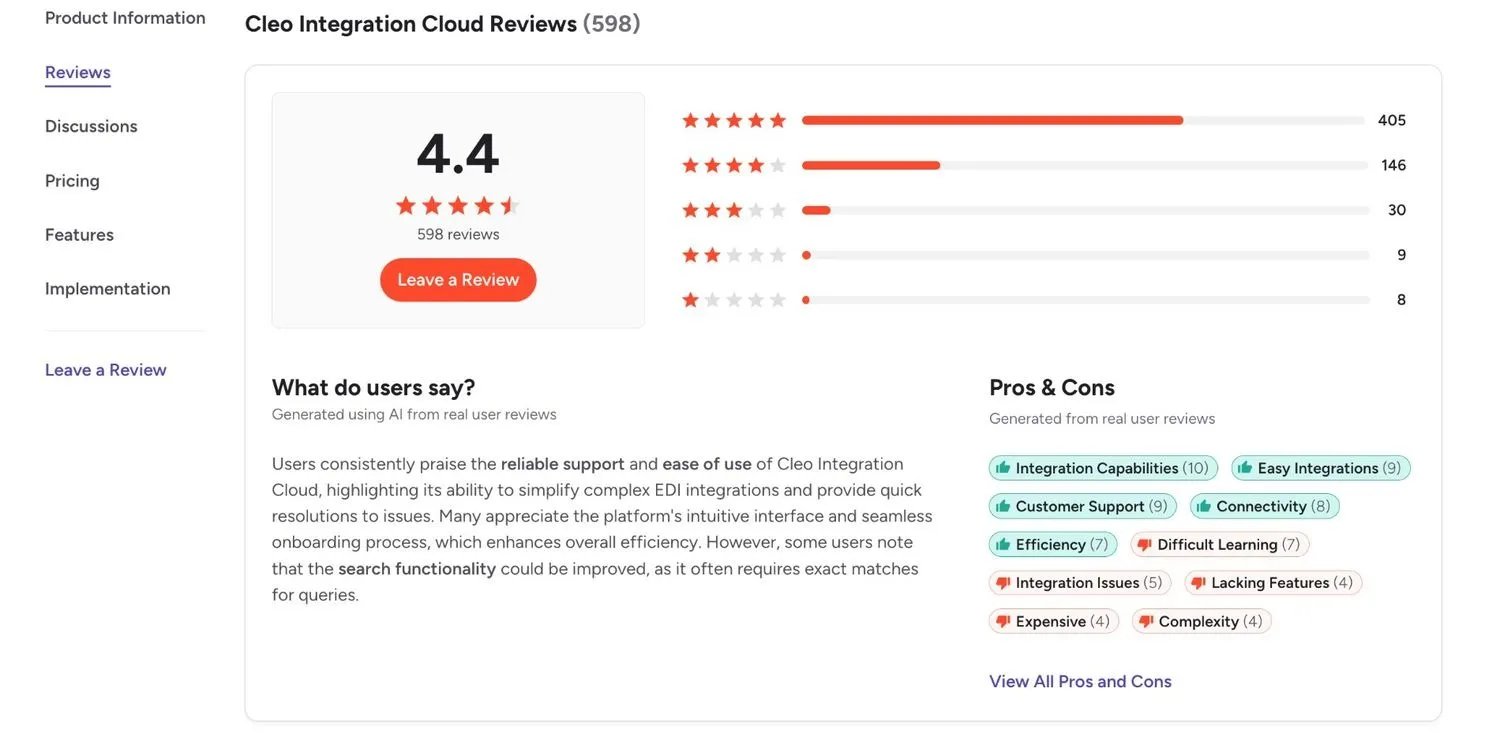
The positive sentiment concentrates on support and capability. Reviewers describe a platform that simplifies genuinely complex EDI integrations and provides quick resolutions when problems arise, with several noting that data transformation is among the most capable they have used. One Capterra reviewer called it the most complete and powerful data transformation system available.
Criticism centres on usability rather than function. G2 reviewers flag a difficult learning curve, integration issues, and complexity, and specifically note that search functionality tends to require exact matches rather than returning approximate results. Cost also appears in the negative tags, consistent with an enterprise product.
Pricing
Custom, quote-based. Capterra lists a Web EDI portal tier from $99 per month, with enterprise configurations quoted individually.Pricing appears in reviewer criticism often enough to be worth noting, though less prominently than for SPS Commerce. As with other quote-based providers, total cost depends heavily on partner count and transaction volume rather than the entry tier.
Final Verdict
Cleo is right for enterprises with genuinely complex integration needs across multiple system types, and the support quality reflected in its reviews is a real asset when those integrations get complicated. The consideration is proportionality. Four months to implement and seventeen months to payback are substantial for a retailer whose requirement is supplier documents flowing reliably, and the learning curve reviewers describe is a real cost for teams without dedicated integration staff.
Where Cleo is not the right fit is a mid-market retailer or marketplace whose actual need is assortment growth. Most of what makes Cleo powerful is enterprise integration breadth that a supplier-document workflow never touches, the difficult learning curve and complexity flagged by G2 reviewers land hardest on teams without integration specialists, and seventeen months to payback is difficult to justify when a narrower tool would solve the problem in a fraction of the time.
6. Logicbroker
Overview
Logicbroker focuses specifically on dropship and marketplace orchestration for enterprise retailers, which makes it the closest direct comparison to Carro on this list. It handles partner onboarding, order routing, and connectivity across EDI, API, and file-based methods, with connectors for major commerce and ERP systems.
The positioning is enterprise-first. Logicbroker targets large retailers running established dropship programs, and its capabilities are built for that scale, which shows in both its strengths and in how heavy it can feel for a mid-market team. Its review base is the smallest here at 30 on G2, with an average of 4.0 out of 5. That limited sample makes the sentiment harder to read confidently than for providers with hundreds of reviews.
Ideal For
- Enterprise retailers running established dropship programs
- Organizations launching a marketplace with existing supplier relationships
- Teams needing ERP connectivity alongside partner orchestration
- Businesses trading B2B drop ship at significant volume
Top Features
- Dropship and marketplace orchestration built for the model
- Multi-method partner connectivity across EDI, API, and files
- Partner onboarding workflows
- Connectors for major commerce and ERP systems
- Support for ASN, invoice, and inventory transaction flows
Why They Stand Out
Purpose-built dropship capability is the differentiator, and it is genuine. Reviewers running B2B drop ship programs describe full drop ship lifecycle support covering ordering, inventory, transmission via cknowledgement, ASN, and invoice, across multiple connection methods including cXML, EDI, JSON, CSV, and API.
Ease of use is the second consistent theme. G2 sentiment credits the platform with simplifying complex processes, allowing quick onboarding and efficient order management, with review titles including "Makes EDI Integrations Easy" and "Simple and effective!" Reviewers who fit the enterprise dropship profile tend to rate it well.
Pros
- Genuinely designed for dropship rather than adapted to it
- Handles partner variety well across multiple connection methods
- Reviewers describe responsive support and effective account management
- Strong ERP connectivity
- Full drop ship lifecycle coverage including ASN and invoice flows
Cons
- Smallest review base in this comparison at 30 on G2, making sentiment harder to read
- G2 reviewers report vendor onboarding can be tedious, slowing initial setup
- Reviewers describe mapping capabilities as limited, with one noting only one mapping table for all clients
- Enterprise focus makes it heavy for mid-market teams
- You supply your own partner relationships
Reviews
Average rating: 4.0 out of 5 on G2 (30 reviews).
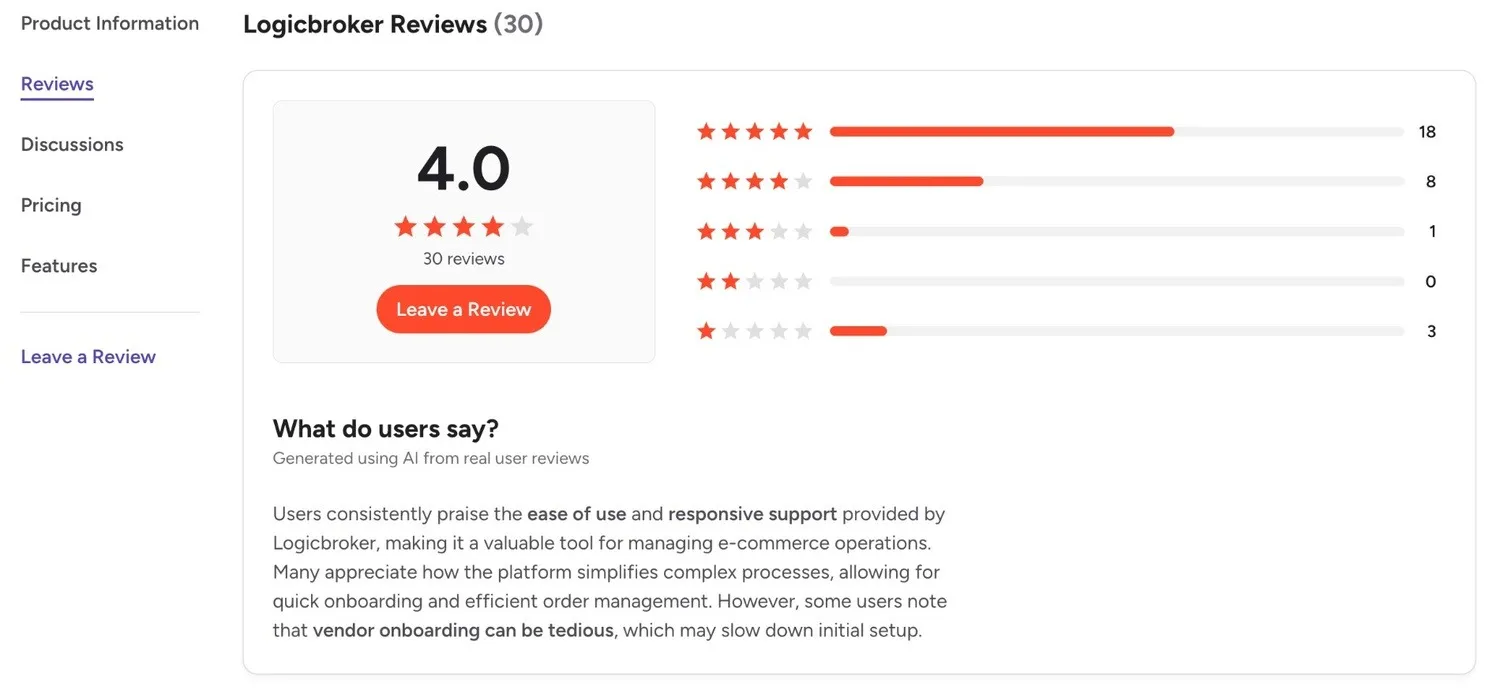
Positive sentiment focuses on ease of use and support responsiveness. Reviewers describe a platform that simplifies complex ecommerce operations and enables quick onboarding, with several highlighting the vendor management portal as a strength and noting that the support team responds effectively to issues raised.
The criticism is more specific than for most providers here, largely because the review base is small enough that individual accounts carry weight. Recurring points include tedious vendor onboarding, limited mapping flexibility, and one detailed review describing slow support and contract terms that proved inflexible. Several reviewers note the learning curve is steep for beginners.
Pricing
Custom, quote-based, positioned at enterprise level. No public pricing is available and G2 lists it as contact vendor for pricing. The absence of published pricing is consistent with an enterprise sales model, and reviewers do not report the cost surprises that appear in SPS Commerce and TrueCommerce feedback, though the smaller sample makes this harder to judge.
Final Verdict
Logicbroker is a serious option for large retailers with existing supplier relationships and budget for an enterprise implementation, and its dropship-specific capability is real rather than repositioned.
The gap versus Carro is supply and scale fit. Logicbroker connects the partners you already have, and its enterprise orientation means mid-market teams frequently find it heavier than their requirement warrants.
Where Logicbroker is not the right fit is a mid-market retailer, or anyone who needs the supplier relationships as well as the orchestration. It assumes you arrive with brands already signed, reviewers report vendor onboarding is tedious enough to slow initial setup and that mapping flexibility is limited, and with only thirty reviews there is considerably less evidence to evaluate than for the alternatives here.
7. Rithum
Overview
Rithum, formed from the combination of CommerceHub and ChannelAdvisor, offers dropship, marketplace, and retail media capability in one suite. It targets large multi-channel operations that want channel management and supplier orchestration together, with very broad marketplace coverage.
The breadth is the product. Few competitors connect to as many marketplaces and channels, and for a brand or retailer selling across dozens of destinations, consolidating that into one suite has obvious appeal. The post-merger product surface is correspondingly large.
Reviewer data is the weakest in this comparison. Rithum holds 4.0 out of 5 on G2 across 124 reviews and 3.8 out of 5 on Capterra across 91, with value for money at 3.2, customer service at 3.3, and ease of use at 3.6. G2 reviewers report nineteen months to return on investment, the longest here.
Ideal For
- Large retailers and brands selling across many channels
- Operations wanting marketplace and dropship in a single suite
- Teams that also need retail media and channel management
- Businesses with dedicated staff to manage a complex suite
Top Features
- Combined dropship and marketplace orchestration
- Very broad marketplace and channel coverage
- Inventory management rated 4.1 by reviewers, its strongest feature score
- Multi-channel marketing and catalog management
- Supplier network access alongside channel tooling
Why They Stand Out
Channel breadth is the clear differentiator. Reviewers describe centralizing listings, inventory, and orders across hundreds of channels, and for operations at that scale the consolidation genuinely reduces the number of systems a team has to run. One G2 review titled "Rithum Centralizes Listings, Inventory, and Orders Across Hundreds of Channels" captures the core value directly.
The second strength is inventory and order synchronization at volume. Reviewers highlight the platform's ability to sync inventory across multiple marketplaces reliably and to reduce the manual work of managing listings separately per channel, with one describing it as streamlining multi-channel operations efficiently.
Pros
- Widest channel and marketplace reach in this comparison
- Combines capabilities usually bought separately
- Inventory management rated 4.1, its strongest feature area
- Established at enterprise scale with a substantial review base
- Reviewers credit reliable multi-channel inventory synchronization
Cons
- Lowest ratings in this comparison at 4.0 on G2 and 3.8 on Capterra
- Value for money scores 3.2 and customer service 3.3 on Capterra
- Nineteen months to ROI per G2 reviewer data, the longest here
- G2 reviewers report limited customization, editing difficulties, and data management issues
- Capterra reviews raise repeated concerns about contract terms and cancellation
Reviews
Average rating: 4.0 out of 5 on G2 (124 reviews), 3.8 out of 5 on Capterra (91 reviews). Ease of use scores 3.6, customer service 3.3, and value for money 3.2.
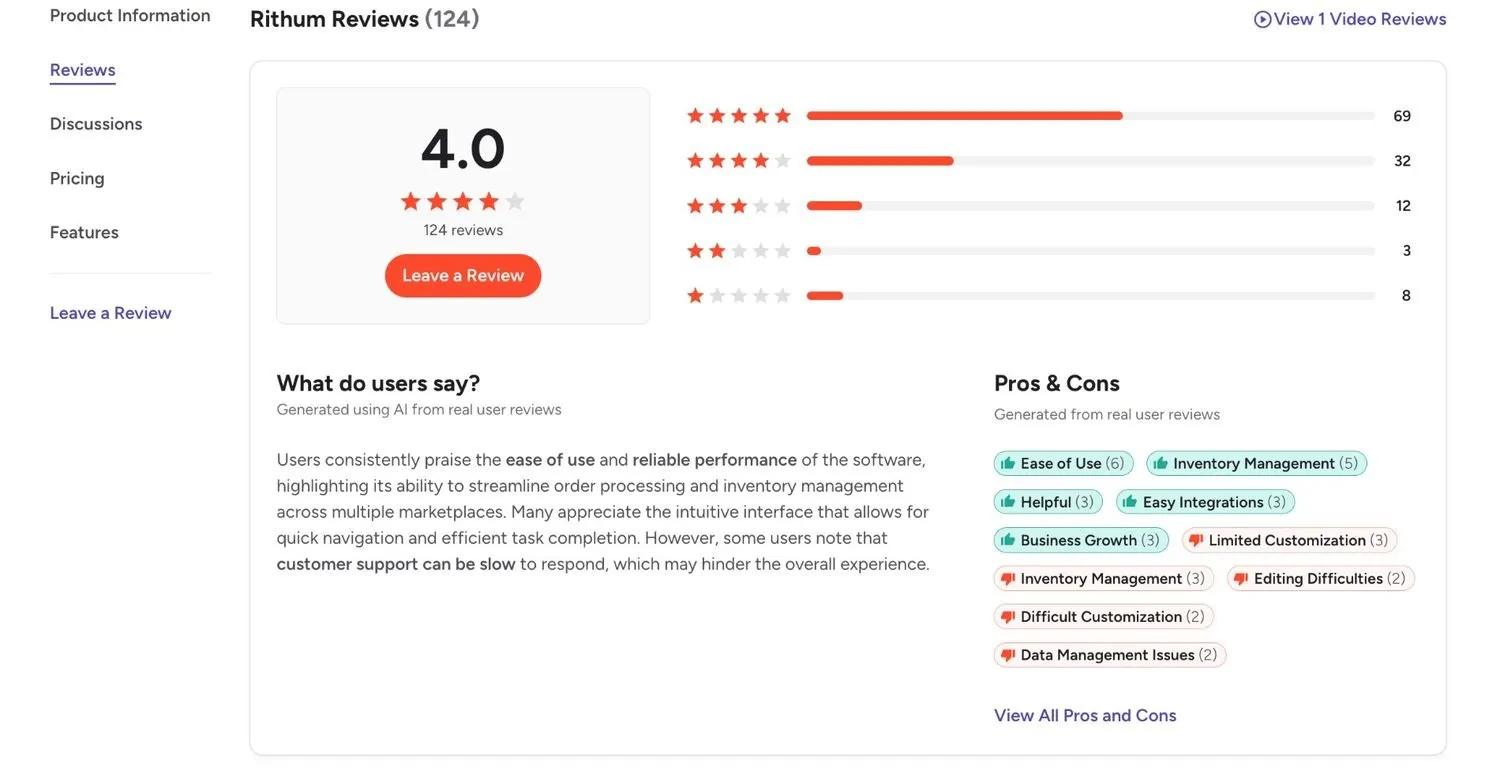
G2 sentiment is moderately positive on function. Reviewers praise ease of use and reliable performance, particularly the ability to streamline order processing and inventory management across many marketplaces, and several describe the interface as intuitive for day-to-day navigation. Support speed is the most commonly cited weakness.
Capterra sentiment is considerably harsher, and the pattern is commercial rather than technical. Review titles include "Cancellation Nightmare," "They just want to get your sale and lock you into a contract," and one detailed account reporting negative ROI over seven months. Contract terms, billing, and support responsiveness dominate the negative feedback rather than product capability.
Pricing
Custom, quote-based, enterprise-level. No public pricing is available. Reviewer commentary about cost is unusually pointed, with value for money at 3.2 being the lowest score in this comparison. Contract structure specifically, rather than the headline price, is what reviewers most frequently object to.
Final Verdict
Rithum is worth evaluating if you need channel management and dropship together at enterprise scale, and its marketplace breadth is difficult to match elsewhere.
Reviews
Average rating: 4.0 out of 5 on G2 (124 reviews), 3.8 out of 5 on Capterra (91 reviews). Ease of use scores 3.6, customer service 3.3, and value for money 3.2.
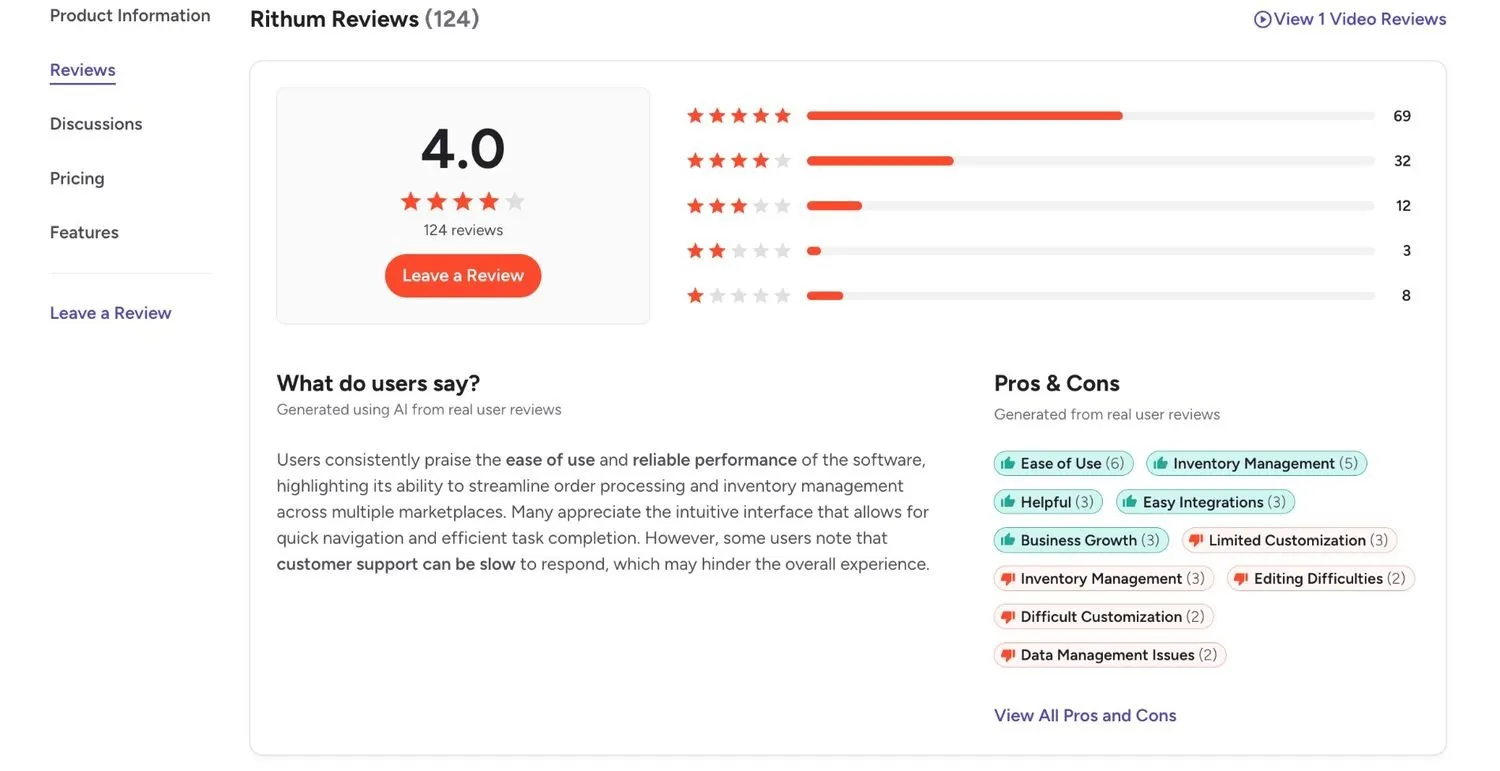
G2 sentiment is moderately positive on function. Reviewers praise ease of use and reliable performance, particularly the ability to streamline order processing and inventory management across many marketplaces, and several describe the interface as intuitive for day-to-day navigation. Support speed is the most commonly cited weakness.
Capterra sentiment is considerably harsher, and the pattern is commercial rather than technical. Review titles include "Cancellation Nightmare," "They just want to get your sale and lock you into a contract," and one detailed account reporting negative ROI over seven months. Contract terms, billing, and support responsiveness dominate the negative feedback rather than product capability.
Pricing
Custom, quote-based, enterprise-level. No public pricing is available. Reviewer commentary about cost is unusually pointed, with value for money at 3.2 being the lowest score in this comparison. Contract structure specifically, rather than the headline price, is what reviewers most frequently object to.
Final Verdict
Rithum is worth evaluating if you need channel management and dropship together at enterprise scale, and its marketplace breadth is difficult to match elsewhere.
5. Pricing That Does Not Punish Growth
Model your bill at three times current volume and three times current partner count. Per-document and per-kilo-character models charge you more for succeeding. Per-partner models penalize network growth, which is a problem if adding partners is the strategy. Orderful's Web EDI tier at $189 per month per trading partner is a clear worked example: reasonable at three partners, a very different figure at twenty.
Reviewer feedback in this comparison makes the point sharply. Cost predictability, rather than headline price, is the single most common complaint across SPS Commerce, TrueCommerce, and Rithum reviews, and it is the thing buyers most consistently underestimate during evaluation. Carro's unlimited partnerships at a flat monthly entry point sits at the other end of that spectrum, which matters most for networks that grow wide rather than deep.
Everything You Need to Know About Ecommerce EDI Solutions
| Company | G2 / Capterra Rating | Pros | Cons | Ease of Use | Support | Value for Money | Supply Network |
|---|---|---|---|---|---|---|---|
| Carro | 4.4 / 4.8 | Connectivity plus curated supply, fastest implementation and ROI here, self-serve | Built for partner-fulfilled rather than owned inventory | ★★★★☆ | ★★★★☆ | ★★★★☆ | ★★★★☆ |
| SPS Commerce | 4.3 / 4.2 | Broad retail connectivity, compliance depth, managed onboarding | Value for money 3.8, unclear notifications, pricing complaints | ★★★☆☆ | ★★★★★ | ★★★★☆ | ★☆☆☆☆ |
| TrueCommerce | 4.4 / 4.3 | Best support sentiment here, 92,000+ partners, strong ERP depth | Unpredictable costs, four months to implement | ★★★☆☆ | ★★★★★ | ★★★★☆ | ★☆☆☆☆ |
| Orderful | 4.7 / 4.7 | Highest rated here, full transaction visibility, publishes pricing openly | Needs developers, Web EDI priced per trading partner, no supply network | ★★★☆☆ | ★★★★☆ | ★★★★☆ | ★☆☆☆☆ |
| Cleo | 4.4 / 4.6 | Any-to-any integration, strong support | Difficult learning curve, seventeen months to ROI | ★★★☆☆ | ★★★★☆ | ★★★★☆ | ★☆☆☆☆ |
| Logicbroker | 4.0 / — | Purpose-built dropship, multi-method connectivity, deep observability | Small review base, tedious vendor onboarding, limited mapping | ★★★☆☆ | ★★★☆☆ | ★★★★☆ | ★★☆☆☆ |
| Rithum | 4.0 / 3.8 | Widest channel coverage, strong inventory sync | Lowest scores here, value 3.2, nineteen months to ROI | ★★★☆☆ | ★★★☆☆ | ★★★★☆ | ★★★★☆ |
Start Growing With Carro
Every other option on this list makes document exchange work better. Carro is the only one that also solves what the documents are for.
- One supplier connection reaches the entire network: Satisfy four document requirements and you are transactional with every retailer on Carro, including partners you have not met yet. For retailers, the same connection delivers assortment rather than plumbing.
- Neither side adopts the other's technology: Suppliers send X12 files to an SFTP folder, or upload a CSV if they cannot produce X12. Retailers work inside Shopify, WooCommerce, BigCommerce, or Magento and never see a document.
- The supply is already there: More than 1,500,000 products from vetted brand partners, hand-matched by account managers on category, audience, and price point rather than dumped into a directory.
The reviewer data supports all three. Carro records the fastest implementation and the fastest return on investment of any provider in this comparison publishing that data, alongside the highest value-for-money score at 4.8 on Capterra. Retailers running the model report up to 3.5 times revenue growth, up to 180% growth in average order value, and up to three times catalog size.
Carro is built for retailers and marketplaces growing assortment across many suppliers, and for brands chasing retail distribution without a wholesale negotiation. Pricing starts at $149 per month with unlimited partnerships, onboarding is self-serve, and you can round-trip a complete test order in a sandbox before a single real partner is involved.
Frequently asked questions
What is the best ecommerce EDI solution in 2026?
The best ecommerce EDI solution in 2026 is Carro for retailers and marketplaces whose growth depends on expanding assortment through supplier partnerships. It combines EDI-based supplier connectivity with native storefront integrations and a curated network of more than 1,500,000 products, which no pure EDI service offers, and G2 reviewers report the fastest implementation and payback in this comparison at one month and ten months respectively.
What should I consider when choosing the right ecommerce EDI solution for me?
Consider five factors: whether the system orchestrates the full supplier lifecycle or only translates documents, whether it accepts EDI, CSV, and API connections from partners of varying maturity, whether it integrates natively with your storefront, whether it automates settlement as well as data, and how pricing behaves as you grow. Model your bill at three times current volume and partner count before signing, since cost predictability is the most common complaint across reviews of the managed services in this category. The most common expensive mistake is buying a translator when you needed orchestration.
How does Carro differ from similar alternatives?
Carro differs by supplying both the connection and the partners on the other end of it. Managed EDI services like SPS Commerce and TrueCommerce move documents between relationships you already have, while Carro provides access to more than 1,500,000 products from vetted brands, hand-matched by account managers on category and audience. It also splits the two sides of the trade: suppliers connect by EDI over SFTP or by CSV, while retailers work natively in Shopify, WooCommerce, BigCommerce, or Magento. G2 reviewer data also puts Carro fastest to implement at one month against three to four for the managed alternatives.
How do I get started with Carro?
Getting started with Carro is self-serve. Create an account, connect your storefront or set up your SFTP connection depending on whether you are a retailer or a supplier, load and price your catalog, then run a test order through the sandbox before going live. Suppliers need four documents to become transactional: the 846, 850, 855, and 856, or they can seed a catalog by CSV if they cannot produce X12. The sandbox lets you round-trip a complete order, including rejection scenarios, before a real partner is involved.
How easy is it to switch to Carro?
Switching to Carro is designed around your existing setup rather than replacing it. Retailers connect through native integrations for Shopify, WooCommerce, BigCommerce, and Magento, so the storefront does not change. Suppliers keep sending the X12 files their ERP already produces, over SFTP hosted by Carro or on their own server. G2 reviewers report an average implementation time of one month, the shortest among providers in this comparison publishing that figure.
Is EDI still necessary if my suppliers all use Shopify?
EDI becomes necessary the moment your network includes a distributor or enterprise brand whose ERP only speaks X12, which happens quickly as catalogs grow. The practical requirement is a system that accepts both, so a Shopify brand and a legacy distributor look identical to your operations team. Demanding one method across a mixed network costs you partners, and those partners are frequently the differentiated assortment you want most.