What Is EDI? A 2026 Plain-English Guide to Electronic Data Interchange
What is EDI? A plain-English guide to Electronic Data Interchange, the five core documents, and EDI compliance. See how Carro handles it for you.

You are probably here because someone put three letters in an email and expected you to know what they meant. A retail partner says you need to be "EDI compliant" before they can list you. A supplier says their system "only does EDI." Your ops lead mentions an 850 like it is a word.
So, what is EDI? It is not software you buy. It is a language your computers and your partners' computers agree to speak, so that orders, stock counts, and shipping updates move between two companies without a single person retyping anything.
That is the whole idea. Everything else is detail, and this guide covers the detail that actually affects decisions.
Key Takeaways (TL;DR)
- EDI stands for Electronic Data Interchange. It is a standardized way of formatting business documents so different companies' software reads them identically.
- It is a language, not a product. You do not buy "an EDI." You buy software or a service that speaks it on your behalf.
- Five documents cover most of retail. Stock updates, purchase orders, acknowledgements, ship notices, and invoices carry the full order lifecycle.
- "EDI capable" and "EDI compliant" are not the same thing. Capable means your system can send and receive the format at all. Compliant always means compliant with one specific partner's rules.
- Ecommerce flipped who needs it. EDI began as a mandate that big-box chains imposed on suppliers. Now any retailer running a multi-supplier catalog needs it themselves.
- Carro handles the format so you do not have to. Suppliers connect once over SFTP with four required documents. Retailers work inside Shopify, WooCommerce, BigCommerce, or Magento and never open an EDI file.
EDI at a Glance
| Without EDI | With EDI | |
|---|---|---|
| Sending an order to a supplier | Email, spreadsheet, or a portal login | Delivered automatically to their system |
| Knowing what is in stock | A file someone sends when they remember | An update that arrives on a schedule |
| Confirming a supplier can fill it | A reply email, eventually | A structured confirmation, line by line |
| Getting tracking to the customer | Chased by hand | Returned with the shipment notice |
| Cost as volume grows | Rises with headcount | Broadly flat |
| Where errors come from | Typing | Mismatched setup between partners |
| Time to add a partner | Immediate but unscalable | Days through a network, weeks direct |
What Is EDI?
EDI stands for Electronic Data Interchange. It is the computer-to-computer exchange of business documents in a standardized format. The word doing the heavy lifting is standardized.
Two companies running completely different software still need to agree on what an order looks like. Which box holds the quantity. Which box holds the delivery address. How a date is written. EDI is that agreement, written down and adopted across entire industries.
Think of it as a form that everybody fills in the same way. Your system prints the form, the partner's system reads it, and because both sides already agreed on the layout, nothing gets lost in translation.
The standard used across most of North America is called ANSI X12. In Europe and much of the rest of the world, the equivalent is EDIFACT. They do the same job with different vocabulary.
Each document type gets a number. A purchase order is an 850. A stock update is an 846. Those numbers look intimidating from the outside and turn out to be the easiest part once you know what each one means.
A Short History of Why EDI Exists
The history explains the design, which is worth two minutes. Before EDI, trading between two companies meant paper. A buyer typed a purchase order, posted or faxed it, and someone at the supplier retyped it into their own system. Every retype was an opportunity for a wrong quantity, a wrong address, or a lost order.
Industries that moved a lot of freight solved this first. Transport and grocery led, and by the late 1970s a US standards committee had begun formalizing what became ANSI X12. The point was never elegance. The point was that a purchase order from any company should be readable by any other company without a phone call.
Retail adopted it aggressively because retail had the leverage. If you wanted shelf space in a national chain, you met their document requirements. That is why, for decades, EDI was experienced by most businesses as a mandate handed down rather than a tool chosen.
Two design consequences survive from that era and still shape how EDI behaves:
- It is document-oriented, not conversational. EDI sends a complete statement rather than asking a question and waiting for a reply. That fits business paperwork well and explains why acknowledgements are separate documents rather than instant responses.
- It is deliberately conservative. The format barely changes, because changing it would break the agreement that makes it valuable. Stability is the feature, not the bug.
What has changed dramatically is everything around the format: how connections are established, how quickly documents move, and how much it costs. That distinction matters when someone tells you EDI is outdated.
The Five EDI Documents You Actually Need to Know
Retail and ecommerce run on five documents. Learn these and you can follow almost any conversation about EDI.
- 846, the stock update: The supplier tells you what is available right now. This is what keeps a storefront from selling something that ran out yesterday.
- 850, the purchase order: Ship this. It carries the items, quantities, prices, and the address the goods are going to.
- 855, the acknowledgement: Got it, and here is what we can actually fill. Good acknowledgements answer line by line, so a partial rejection does not sink the whole order.
- 856, the ship notice: It has left the building. This carries the courier, the tracking number, and what is inside the box.
- 810, the invoice: Please pay. Increasingly optional, because modern systems generate invoices automatically the moment a shipment is confirmed.
There is a sixth worth knowing about, though you rarely think about it. The 997 is a functional acknowledgement, a receipt that says "your file arrived and it was readable." It carries no business meaning. It exists so nobody has to wonder whether a document vanished.
Dozens of other document types exist for warehousing, routing, and financial reporting. Almost no ecommerce business needs them on day one. If you want to see the full order lifecycle in motion, our walkthrough of how EDI works follows a single order from stock update through to payout with a real annotated file.
What Is EDI Software?
EDI software is any system that produces, reads, transports, and monitors these standardized documents on your behalf. It does four jobs:
1. Translation - converts data from your system's format into the standard, and back again on the way in.
2. Validation - checks a document against the rules before it goes out, so errors surface on your side rather than your partner's.
3. Transport - moves the file between companies, usually over a secure file transfer connection, a direct link, or a shared network.
4. Exception handling - catches what fails and puts it somewhere a human will actually see it.
That fourth job is the one buyers underrate and operators care about most. Documents fail. Files arrive malformed, a product reference does not match, a partner changes a requirement without telling anyone. What separates workable EDI software from painful EDI software is whether failures queue up visibly with a retry button, or disappear until a customer complains.
You can buy these four jobs in several shapes:
- A translator you run yourself: Maximum control, and you own the mapping, the monitoring, and the maintenance.
- A managed service: A vendor's team handles mapping and support. Suits organizations with no intention of building internal capability.
- A commerce network: Document exchange is bundled into a system that also handles supplier relationships, pricing, order routing, and settlement.
The right shape depends on how many partners you have and how much of this you want to own. The third option has become the default in ecommerce because it answers the commercial question as well as the technical one.
EDI Capable vs EDI Compliant: The Difference That Costs Money
These two phrases get used interchangeably. They mean different things, and confusing them is how projects blow their timelines.
EDI capable means your system can send and receive documents in the standard format at all. It is a yes or no question about your technical setup.
EDI compliant means you meet the specific requirements of one specific trading partner. It is never a general state. You are compliant with someone.
Here is why that distinction bites.
Every partner publishes their own implementation guide, and those guides disagree. Industry guidance on wholesale EDI notes that a large retailer may dictate which transaction sets, communication methods, data fields, timing rules, packaging details, and testing procedures its suppliers have to support. The next retailer will dictate a different set.
So two suppliers can both be "EDI capable" and only one of them can trade with a given partner.
A concrete example helps. To become transactional on Carro, a supplier supports four documents: the stock update (846), purchase order (850), acknowledgement (855), and ship notice (856). Invoicing is optional, because invoices generate automatically once a ship notice is accepted. That published, finite list is what compliance looks like when someone writes it down.
Most partners publish something comparable. The difference between approaches is how many separate lists you have to satisfy, which is the whole argument covered in our guide to EDI integration architectures.
How EDI Moves Between Two Companies
Three things have to happen for any of this to work. The data has to be formatted into the agreed structure, delivered from one company to the other, and translated into whatever each side's own system uses internally.
Delivery is where the vocabulary gets thick, so here it is in plain terms:
- SFTP - a secure folder. You drop a file in, your partner picks it up. Widely used and easy to reason about.
- AS2 - a direct encrypted connection between two companies, common where an enterprise partner mandates it.
- A VAN - a Value-Added Network, which works like a shared post office that everyone connects to once. It solves connectivity and traditionally charges per document.
Carro uses SFTP, hosted either by Carro or on the supplier's own server with a single static IP whitelisted. Suppliers place outgoing files in one folder and collect incoming files from another.
Two design choices determine how fresh your data is. Carro collects supplier files every 15 minutes, and it accepts one document per file rather than allowing many to be batched together. Batching made sense when networks delivered on overnight timetables. On a live storefront, it is delay you chose.
Who Actually Needs EDI in 2026?
For thirty years the answer was simple: suppliers to big-box retail. Walmart, Target, and Home Depot mandated it, so anyone wanting shelf space complied. Ecommerce inverted that.
As online retailers grew into marketplaces and built dropship programs, they landed on the buying side of the same problem. They now needed standardized communication with dozens of suppliers whose technical maturity ranged from an enterprise ERP to a shared inbox.
EDI stopped being a compliance cost imposed from above. It became infrastructure that retailers need for their own operations.
You have hit the point where it matters when any of these are true.
- A partner mandates it. The most common trigger, and non-negotiable.
- You are adding your fifth or sixth supplier. Manual processes hold up to about four relationships and then stop.
- Your ops team has become human middleware. If people spend their day copying data between two systems, that is the signal.
- You oversold something. Stale stock data has a customer-facing cost, and it repeats.
- You want to sell products you do not own. Dropship and marketplace models depend on trusting a stock number from someone else's warehouse.
That last trigger is the one that changes strategy rather than operations. Reliable supplier stock data is what makes extended assortment viable, which is covered in depth in our guide to EDI for ecommerce.
What EDI Costs and What It Saves
Two numbers frame the decision.
On the cost side, per-partner mapping and testing is commonly estimated at $200 to $2,000, with subscriptions ranging from a few hundred dollars to several thousand a month depending on volume and partner count. Networks that spread one integration across many partners sit at the lower end, because the per-partner work happens once. Carro starts at $149 per month with unlimited partnerships.
On the savings side, industry analysis of B2B order processing puts manual handling at roughly $50 to $150 per order, falling to about $25 once digital processing replaces it. Run those against your own volume and the arithmetic usually answers itself. At a thousand orders a month, the gap between manual and automated handling is the salary of someone you did not need to hire.
The larger effect is structural rather than arithmetic. Manual processing costs rise in step with order volume. Automated processing does not. That is the actual reason businesses adopt EDI, and everything else is a supporting argument.
How Carro Handles EDI
Carro takes an approach worth understanding because it splits the two sides of the relationship rather than treating them the same:
- Suppliers connect by EDI. A brand sets up one connection over SFTP and supports the four required documents. Everything runs on ANSI X12 version 004010, one transaction set per file, with the outbound folder checked every 15 minutes.
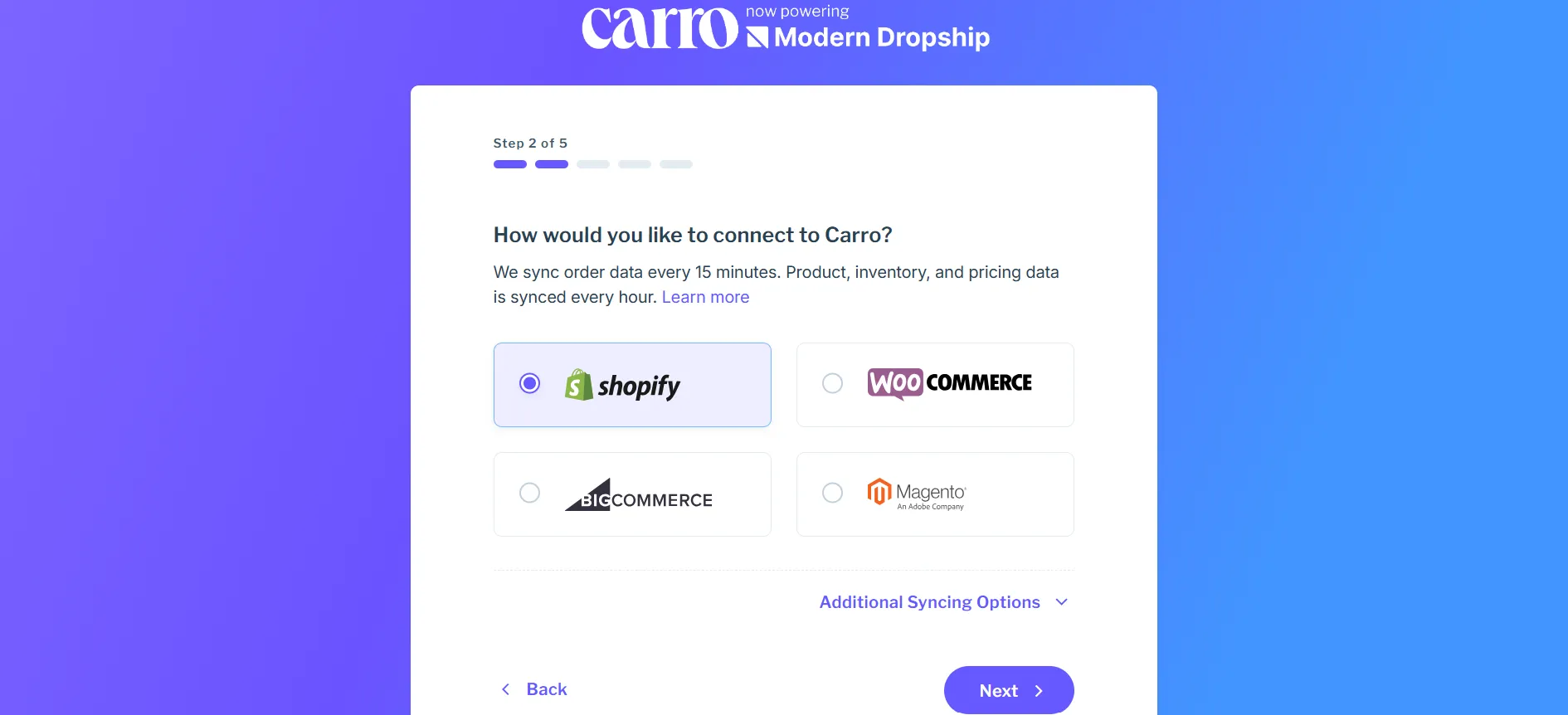
- Retailers connect natively. Shopify, WooCommerce, BigCommerce, and Magento integrate directly, with an API and webhooks available for teams that want them. A retailer works inside the storefront they already run.
Carro sits between the two and translates. The supplier writes a file in the format their ERP already produces. The retailer sees an order appear in their storefront. Neither side has to adopt the other's technology to trade.
For a supplier, one specification unlocks the whole network rather than one partner. Adding retail partner number eleven becomes a commercial conversation instead of an engineering project.
Two operational details matter more than they sound. Failures land in a queue called TradeOps Issues rather than disappearing quietly. And every order page keeps a record of each document sent and received, with its status, a download, and a retry that does not need re-transmission.
What separates Carro from a pure document-exchange service is that the commercial layer sits alongside the technical one. Carro is purpose-built for multi-supplier dropship rather than adapted from a generic tool, so price lists are margin-based and assigned per partner, only active and priced products become visible, and the network itself supplies the partners: more than 1,500,000 products from vetted brands, hand-matched by account managers on category, audience, and price point.
Merchants describe the effect in commercial rather than technical terms. As VYSN put it: "We can now grow our product assortment across multiple platforms from one centralized place, which improves the customer experience and allows us to offer a much broader, more compelling selection without adding operational friction."
Everything You Need to Know About EDI
| Category | What You Need to Know |
|---|---|
| What EDI stands for | Electronic Data Interchange. The computer-to-computer exchange of business documents in a standardized format. |
| What it actually is | A language, not a product. Two companies agree on how a document is structured so their software reads it identically. |
| Why it exists | It replaced paper and retyping between trading partners, formalized from the late 1970s onward, and stability is what keeps it valuable. |
| The standards | ANSI X12 across North America, EDIFACT internationally. Same job, different vocabulary. |
| The five documents | 846 stock update, 850 purchase order, 855 acknowledgement, 856 ship notice, 810 invoice. A 997 confirms a file arrived. |
| What EDI software does | Translation, validation, transport, and exception handling. The last one separates good from painful. |
| Capable vs compliant | Capable means your system speaks the format. Compliant means you meet one specific partner's published rules. |
| Who needs it | Anyone with more than about five suppliers, anyone mandated by a partner, and any retailer selling stock they do not own. |
| What it costs | $200 to $2,000 per partner for mapping, with subscriptions from a few hundred dollars monthly. Carro starts at $149 with unlimited partnerships. |
| Where Carro fits | Suppliers connect once over SFTP with four documents. Retailers use native storefront integrations or the API. |
Start Growing With Carro
Three things separate Carro from a conventional EDI setup:
- You never have to learn the format. Carro handles translation on both sides. Suppliers send files their ERP already produces. Retailers work in the storefront they already use.
- One connection reaches every partner. A supplier who satisfies four document requirements becomes transactional with every retailer on the network, including ones they have not met yet.
- There is a network on top of the pipes. More than 1,500,000 products from vetted brand partners, hand-matched by account managers on category, audience, and price point. Retailers running this model report up to 3.5 times revenue growth, up to 180% growth in average order value, and up to three times catalog size.
Carro is built for retailers and marketplaces expanding assortment across many suppliers, and for brands chasing retail distribution without months of wholesale negotiation. Pricing starts at $149 per month with unlimited partnerships, onboarding is self-serve, and you can round-trip a complete test order in a sandbox before a single real partner is involved.
Frequently asked questions
What does EDI stand for?
EDI stands for Electronic Data Interchange, the computer-to-computer exchange of business documents in a standardized format. It replaces emails, faxes, spreadsheets, and manual data entry between trading partners. The dominant standard in North America is ANSI X12, while EDIFACT is used across most international trade. Both do the same job of making sure two companies' systems read the same document identically.
What is EDI software?
EDI software is any system that creates, reads, transmits, and monitors standardized business documents on your behalf. It handles four jobs: translating between your internal data and the standard format, validating documents against the rules before sending, transporting files between companies, and surfacing failures for someone to fix. It comes as a self-managed translator, a fully managed service, or as a capability built into a commerce network. Which shape fits depends mostly on how many trading partners you have.
What is EDI compliant?
EDI compliant means you meet the specific document, formatting, and testing requirements of one particular trading partner. Compliance is never general, because every partner publishes its own implementation guide specifying which documents, fields, timing rules, and certification steps apply. Two suppliers can use identical software and only one of them qualifies with a given retailer. On Carro, compliance means supporting four documents: the 846, 850, 855, and 856.
What is EDI capable?
EDI capable means your system can send and receive documents in a standard EDI format at all, independent of any particular partner's rules. It is a technical yes or no about your own setup, whereas compliance is measured against someone else's requirements. Being capable is a prerequisite for becoming compliant but does not guarantee it. Most businesses become capable once and then work through compliance partner by partner.
Is EDI still used in 2026?
EDI is still used in 2026 and remains the standard for automated document exchange across retail, wholesale, distribution, and logistics. Major retailers continue to mandate it, so suppliers without it are locked out of those channels entirely. What has changed is the delivery model, with cloud connections and self-serve onboarding replacing the slow, expensive implementations of the past. The format itself has proven remarkably durable.
What is the difference between EDI and API?
The difference is that EDI is a standardized document format usually exchanged as files, while an API is a live connection that returns answers immediately. EDI has decades of industry-wide agreement behind it, which is why enterprise retailers require it. APIs are faster and easier for software teams to build against, but far fewer trading partners offer one. Most multi-supplier networks end up running both, which is why Carro uses EDI on the supplier side and native storefront integrations plus an API on the retailer side.
Do I need EDI to sell on Shopify?
You do not need EDI to sell on Shopify directly, since Shopify handles consumer orders on its own. You need it once you start working with suppliers or retail partners whose systems exchange documents that way, which is common in dropship and marketplace models. Shopify does not speak EDI natively, so this is handled through an app or a connected service. Carro connects to Shopify natively and manages the EDI side with suppliers so the merchant never touches it.
Isn't EDI outdated technology?
EDI is old, but the standard itself is not the problem. It has survived because thousands of companies already agree on it, and that agreement is precisely what makes automated trade possible at scale. What genuinely dated badly were the older delivery models: per-kilo-character billing, mapping projects measured in months, and overnight batch windows. Modern systems keep the format and replace those, which is why the honest framing is old standard, new delivery.