How Inventory Management Helps in Reducing Costs? The Strategies Most Retailers Miss in 2026
Cost reduction strategies in inventory management reach past the warehouse. Cut supplier admin and oversell refunds with seven moves most teams miss. See how.
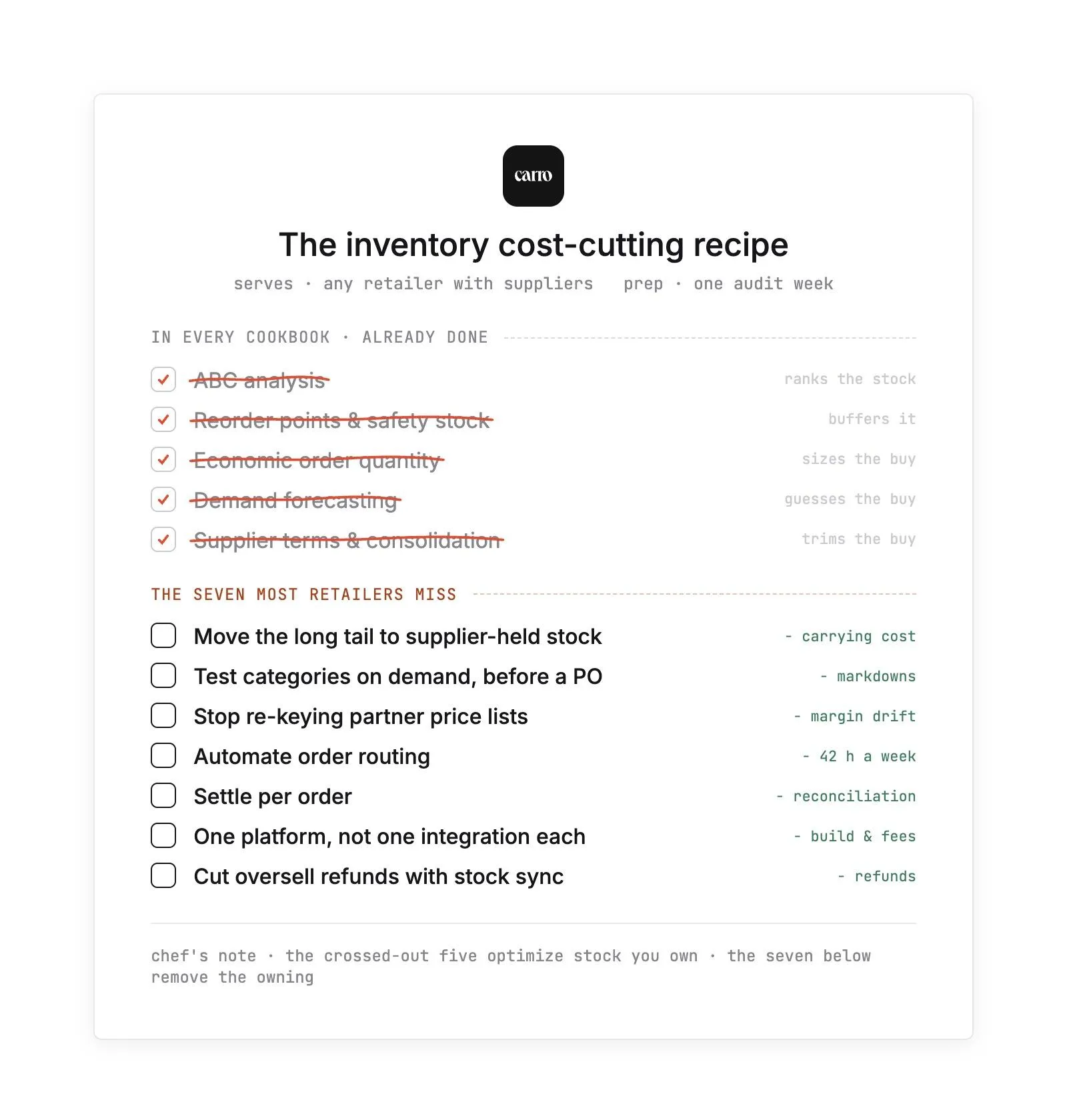
Most lists of cost reduction strategies in inventory management open with the same five tools: ABC analysis, reorder points and safety stock, economic order quantity, demand forecasting and better supplier terms.
All five work, and all five cut the cost of stock you already bought and stored. If you sell products from partner brands, a second set of savings sits outside the warehouse, in costs most reviews never tag as inventory.
Look at the purchase order written to test a category with no sales history, or the afternoon someone spends re-keying a supplier's new price list into the store and the margin sheet.
Refunds for items a partner sold out of two days earlier belong on that list too, usually coded to customer service. None of these costs shows up on a carrying-cost line, so most cost reviews walk right past them.
This guide covers the standard toolkit fast, then spends most of its length on seven strategies retailers tend to miss. All seven sit between your store and your suppliers.
That's where admin grows with every partner you add and finance rebuilds invoices by hand at month-end. You'll finish with a before-and-after view of how inventory management helps in reducing costs.
It's written for retailers, marketplaces and shopping platforms that sell products other companies hold, or plan to. If you run one warehouse of your own SKUs, the first half pays off right away and the second shows what changes once partner brands arrive.
Key Takeaways (TL;DR)
- The standard toolkit: ABC analysis, reorder points, EOQ, forecasting and supplier terms cut the cost of units already sitting on your balance sheet.
- Four parts of carrying cost: capital tied up in stock, storage, service costs such as insurance and taxes, and risk from shrinkage and obsolescence.
- The largest missed saving: moving the long tail of your range to supplier-held stock, so a slow seller carries zero stock cost while it waits for a buyer.
- Test on demand before you buy: a category proven on real orders from a partner's stock hands your next purchase order the sales history a forecast needs.
- Per-supplier admin: price list re-entry, order re-keying, one-off integrations and month-end reconciliation compound with every supplier until a single connected workflow stops the growth.
- Oversell refunds: put them in the inventory cost review, since they trace back to supplier stock data that reached the storefront late or landed on the wrong SKU.
- Where Carro fits: vetted brands from a network of 1,500,000 products connect to Shopify, Magento 2, WooCommerce and BigCommerce stores, and each order is routed and settled when the supplier ships.
Cost Reduction Strategies in Inventory Management: at a Glance
Twelve strategies, with the cost each one cuts and the situation where it pays off.
| # | Strategy | Cost it cuts | Works best when |
|---|---|---|---|
| 1 | ABC analysis | Counting effort and capital spread evenly across uneven SKUs | You hold a wide owned catalog with a few high-value lines |
| 2 | Reorder points and safety stock | Stockouts and oversized buffers | Supplier lead times are known and demand is steady |
| 3 | Economic order quantity (EOQ) | Combined ordering and holding cost | Demand is stable and each order carries a fixed cost |
| 4 | Demand forecasting | Overbuying and the markdowns that follow | The SKU or category has sales history |
| 5 | Supplier terms and consolidation | Unit cost, freight and ordering admin | You buy enough volume to negotiate |
| 6 | Move the long tail to supplier-held stock | Carrying cost on slow sellers | A SKU completes the range but sells occasionally |
| 7 | Test categories on demand before a purchase order | Dead stock from unproven categories | You are entering a category with no sales history |
| 8 | Stop re-keying partner price lists | Admin hours and margin leakage | Several suppliers update their costs during the year |
| 9 | Automate order routing | Order handling labor and misroutes | Carts regularly mix products from different brands |
| 10 | Settle per order | Reconciliation labor and invoice disputes | Finance assembles supplier invoices from statements |
| 11 | Stop paying for one integration per supplier | Build and maintenance cost | Each supplier runs a different system |
| 12 | Cut oversell refunds with stock sync | Refunds, cancellations and support time | Partner stock also sells on other channels |
The first five rows are the standard toolkit for stock you own.
For a retailer with a growing partner assortment, rows six to twelve are usually where the unexamined money sits, in supplier-held stock and the admin around it.
Where Inventory Costs Come From
Before you cut anything, name the lines. Inventory cost spreads across budgets owned by different teams, so no single report shows all of it.
Get the scale in view first. IHL Group's 2026 Inventory Distortion Study puts the yearly global cost of out-of-stocks and overstocks at $1.7 trillion, about 6.2% of retail sales.
| Cost type | What it includes | Where it tends to hide |
|---|---|---|
| Carrying (holding) cost | Capital tied up in stock, storage space, insurance, taxes, handling | Split across rent, finance and warehouse budgets |
| Ordering cost | Writing purchase orders, receiving, inspection, freight per shipment | Buyer and receiving team time |
| Stockout cost | Lost sales, expedited freight, backorder handling, customers who buy elsewhere | Never booked, since a lost sale leaves no invoice |
| Shrinkage and obsolescence | Theft, damage, counting errors, out-of-season stock written down | Year-end write-offs and markdowns |
| Admin and labor | Price list updates, product data entry, order re-keying, tracking chases, invoice assembly | Salaries in operations, merchandising and finance |
| Returns | Reverse freight, inspection, restocking, refunds, write-downs | Customer service and finance budgets |
Carrying cost is the line most guides put a number on, and you can break it into four parts. First comes the capital tied up in stock, including interest if you borrowed to buy it.
Add storage, service costs such as insurance, taxes and software, and inventory risk from shrinkage, damage and obsolescence.
Build the rate from twelve months of your own numbers: add up those four parts and divide by average inventory value.
The result reflects your rent and your financing, and it becomes the number every strategy below gets measured against.
In a program with many partner suppliers, the admin and returns rows deserve more attention than they usually get. The admin row climbs with every supplier you add, whether or not you ever hold their stock, and it rarely has a single owner.
The NRF and Happy Returns 2025 returns report (October 2025) estimated that shoppers would send back 19.3% of online sales in 2025, part of $849.9 billion in total retail returns.
Every one of those returns carries reverse freight and a refund, so the returns row earns its place in your inventory cost review.
For the wider operating picture, including shipping, packaging and customer service, our guide on how to reduce ecommerce operational costs covers the full set. This article stays with the costs attached to products and the suppliers behind them.
The Standard Cost Reduction Strategies in Inventory Management
These five are the backbone of cost reduction in inventory management for any retailer that buys and stores its own stock. Put them to work on your owned catalog first.
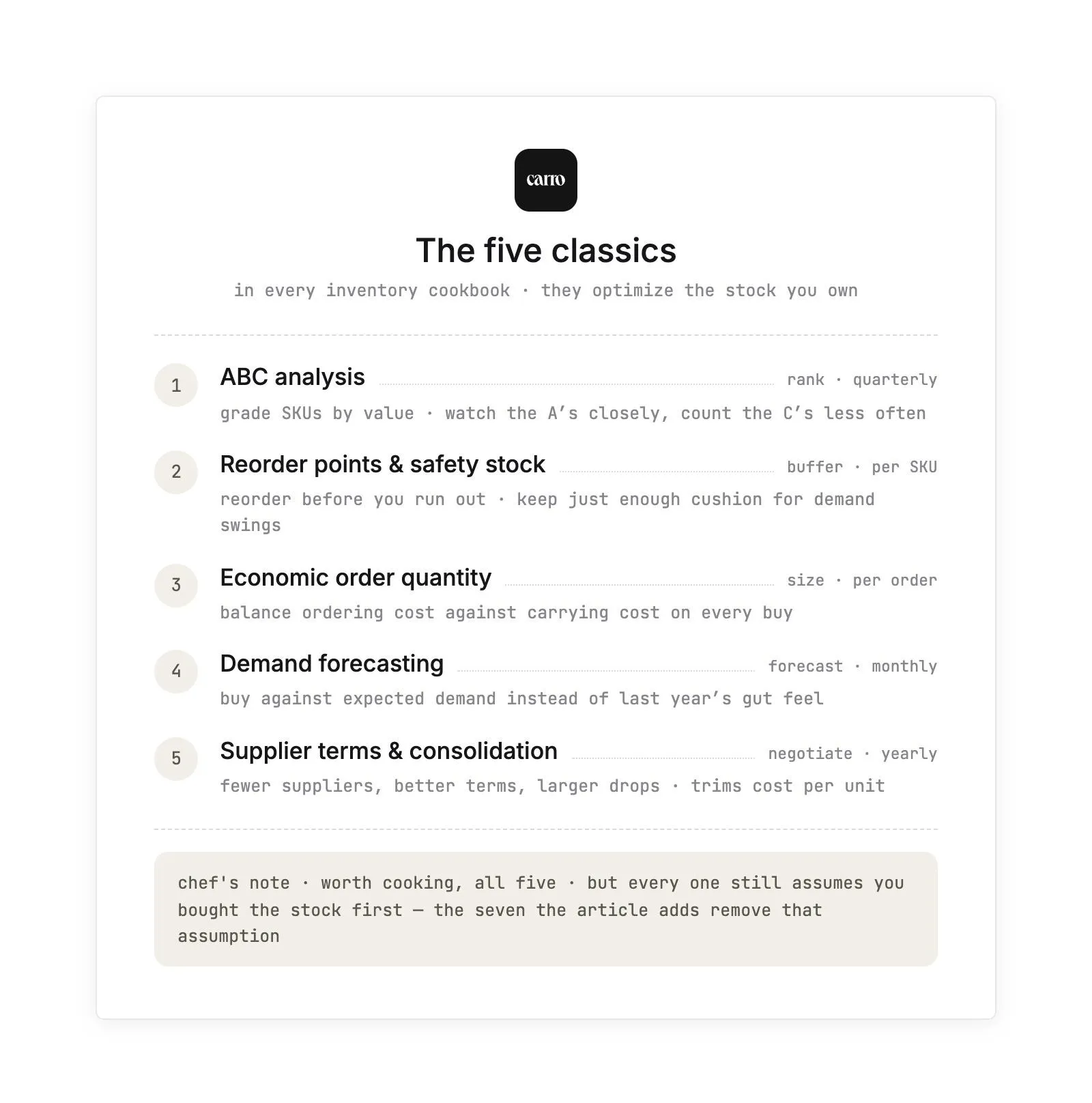
Start with ABC analysis if you only have time for one, because it tells you where the other four deserve the most effort. Supplier terms sits last, since it leads into the strategies most retailers miss.
1. ABC Analysis
ABC analysis ranks SKUs by annual consumption value, meaning units sold multiplied by unit cost, then sorts them into three classes.
A small share of SKUs in the A class carries most of the value. The long C class holds many SKUs and little of it.
ABC tells you where to spend control effort. Give A items frequent cycle counts and a weekly look at reorder settings. For C items, use the simplest controls you can defend and place larger, less frequent orders.
The C class is where ABC hits its limit. Those SKUs still tie up capital and shelf space, and the analysis ranks them lower without telling you how to stop paying to hold them. The first missed strategy below picks up right there.
2. Reorder Points and Safety Stock
A reorder point tells you exactly when to buy. The standard version is expected demand during the supplier's lead time plus safety stock.
For example, a SKU selling 10 units a day on a 14-day lead time, with 40 units of safety stock, reorders at 180 units.
Safety stock is your buffer against demand spikes and late deliveries. Size it with care: an oversized buffer sits on the shelf for months, and an undersized one costs a sale plus, often, expedited freight to recover.
Recalculate both numbers at least once a season, and any time a supplier's lead time moves. A reorder point set during a slow quarter will run dry in a busy one.
3. Economic Order Quantity
EOQ finds the order size that minimizes the combined cost of placing orders and holding stock.
The formula is EOQ = √(2DS / H). D is annual demand in units, S is the fixed cost of placing one order and H is the annual cost of holding one unit.
Try it with illustrative numbers: 2,400 units of annual demand, $50 per order and $6 per unit per year to hold. That gives √(2 × 2,400 × 50 / 6) = √40,000 = 200 units per order.
The model assumes steady demand and a fixed cost per order. It fits repeat, stable SKUs well and misleads on seasonal or fashion lines, where demand swings from month to month.
4. Demand Forecasting
Good forecasting cuts overbuying and the markdowns that follow it. Start with sales history by SKU and by week, adjust for seasonality, promotions and known events, and track forecast error so you know which lines to trust.
Measure error per category. A category your forecast misses by a wide margin every season needs a larger buffer or a different buying approach, and averaging it with accurate categories hides the problem.
Forecasting's hard limit is history. A category you have never sold has none, which is why new-category bets are where retailers most often end up holding dead stock.
5. Supplier Terms and Consolidation
Unit cost is the obvious lever in a supplier negotiation, and only one of several. Payment terms, minimum order quantities, freight terms and return allowances all change what a unit costs by the time it sells or gets written off.
Consolidating purchases with fewer suppliers can lower ordering cost and win better terms through volume. It also concentrates risk, so keep a second source for A-class lines where one supplier's delay would empty the shelf.
For more on running the owned side well, see our guide on how to improve inventory management.
All five strategies share one assumption: the units sit on your balance sheet. For the slice of your range that doesn't need to be there, the next section starts with not buying it at all.
Seven Cost Reduction Strategies Most Retailers Miss
These inventory management cost reduction strategies work on the space between your store and your suppliers. They pay off most for retailers adding partner brands, and for marketplaces and shopping platforms that onboard sellers in volume.
Each one opens with the cost and closes with how Carro cuts it on the store you already run.
Carro is a dropship platform that connects retailers with vetted brands and distributors. It runs the supplier operations in between, from onboarding and catalog sync to order routing and payouts.
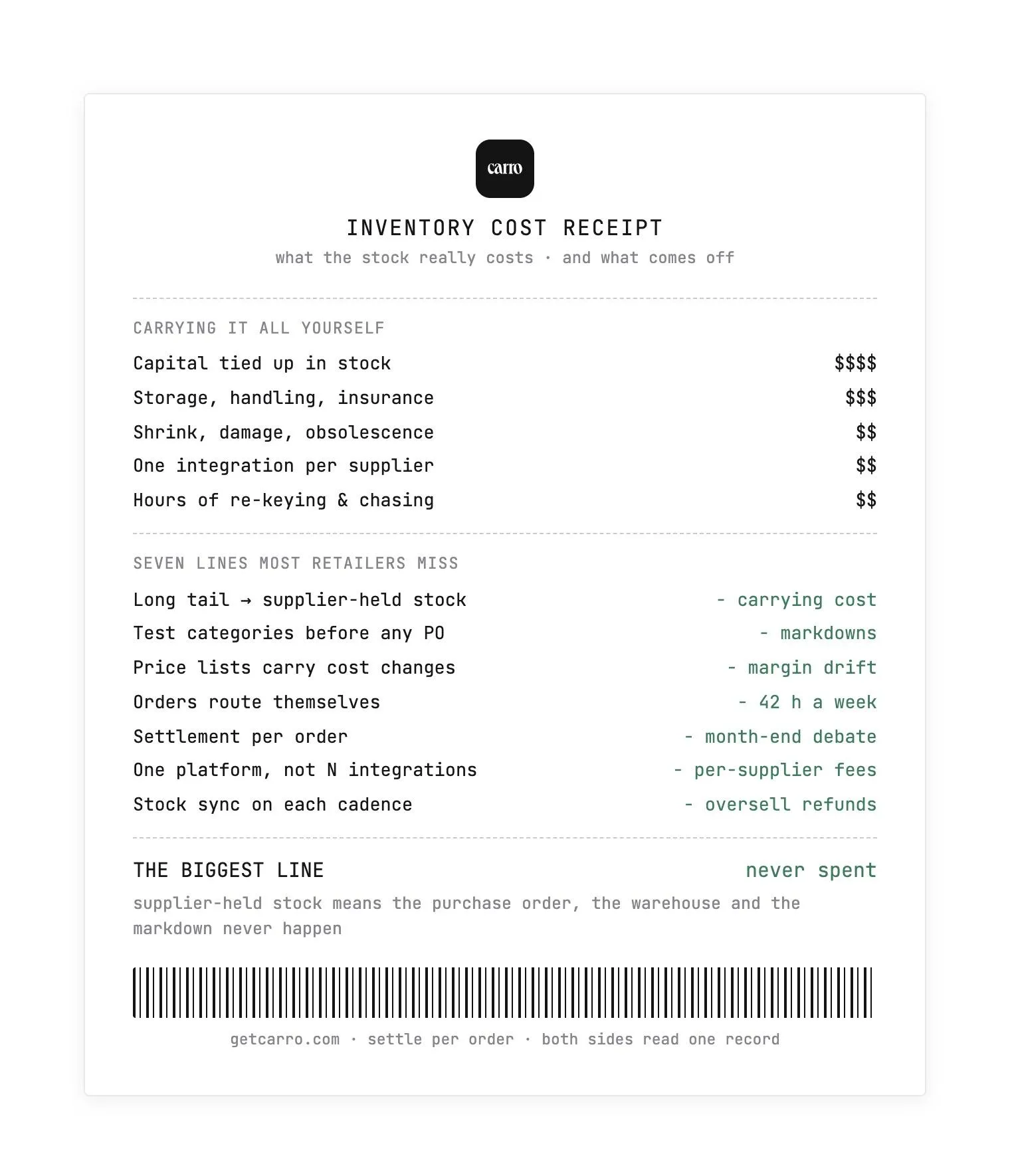
1. Move the Long Tail to Supplier-Held Stock
Every slow SKU you own soaks up capital, space and count effort, with markdown risk on top. The long tail often exists for good reasons, such as completing a size run or offering the accessory that goes with a best seller.
Let the brand hold the unit in its own warehouse and ship it when your customer orders. You set the retail price, and the sale stays under your brand. Until someone buys it, that slow seller costs you nothing to store or mark down.
This is the model behind Carro's dropshipping expansion use case. You add products from vetted brands and distributors in a network of 1,500,000 products, and you choose which partners join.
Account Managers hand-match brands to your categories and audience, so the range you add fits the customers you already have.
Super73, the electric bike maker, used it to add helmets, lights and other rider accessories it didn't stock, and became a one-stop shop for its riders. The Gents Store added more than 2,500 unique products through a curated marketplace with no inventory requirement!
Keep the A class owned. Fast, predictable sellers usually justify the margin and control of holding stock, and the standard toolkit keeps their cost in check.
2. Test Categories on Demand Before a Purchase Order
A new category bought on forecast is a bet with no history behind it. When it misses, the bill arrives months later as markdowns, storage and write-downs, long after anyone remembers the buying meeting.
Flip the sequence and you cut that risk. List partner products in the category first, watch real orders come in, and write a purchase order only for lines that have proven themselves. Your next forecast then has actual sales data to work from.
In Carro, your team starts from audience and category criteria. For example, filter by audience (outdoor, ages 25 to 44) and category (trail footwear), see which brands fit, and mark two to test with no purchase order.
Whatever doesn't sell, you drop, with nothing left to clear from a warehouse.
PacSun runs a dropship program without inventory risk on the same principle. Its Dropship Coordinator describes faster product launches and brands tested without owning inventory.
3. Stop Re-Keying Partner Price Lists
Supplier cost changes arrive as emailed files or portal notices. Someone re-enters each one into the store and the margin sheet, and every re-entry is a chance to leave an old cost in place.
The labor is the smaller cost. When a supplier raises its price and your records keep the old figure, every sale at the old margin leaks money until finance reconciles the month and catches it.
Teams that track supplier costs in an inventory management system in Excel feel this first, since the file has no live link to the supplier's actual price list.
In Carro, a partner price list sets the cost for each relationship, so your team stops re-entering numbers when a supplier changes them.
You still set the retail price and the merchandising. Your edits change your copy of a product, and the supplier's original stays untouched.
4. Automate Order Routing
A cart holding products from three brands means three supplier orders. Done by hand, someone splits the order and sends each part to its supplier by portal or email.
Every handoff is a chance for a wrong item or a missed order, and tracking still has to be chased afterward. A misrouted order costs you a second shipment plus the support time spent explaining the delay.
With Carro's order execution, a single customer order splits into separate supplier orders. Each one routes into the system that partner already works in, with nothing re-keyed.
Each order carries a documented state, from confirmed at the supplier through shipped with tracking. Your team sees where every parcel stands without chasing each partner for updates.
Some decisions stay with your team, on purpose. Failed charges, SKU mapping errors and stalled orders land in an exceptions view with the detail a person needs to act, so your team works from a list of named problems.
For the step-by-step version, see our guide on how to automate inventory management.
5. Settle Per Order to Cut Reconciliation
Month-end in a multi-supplier program often means assembling supplier invoices from statements after the fact. Then fees and return credits get rebuilt in a spreadsheet until both sides agree.
Every hour spent there is an inventory cost, even when the budget line says finance.
Carro's payment settlement ties each supplier invoice to the order it came from.
A shipment triggers the supplier invoice under the agreed settings, with configured delays where a program needs them. Billing then charges the retailer and credits the supplier through the connected payment account.
Product cost, partner fees, processing charges, commissions, shipping costs and return credits each land against the order they belong to. They stay separate within each partner relationship, and retailer and supplier read the same order and the same figures.
A failed charge follows the configured process and surfaces for a person to act on, and return acceptance and refunds stay separate steps.
Suppliers can also be paid the day an order ships, which cuts the payment chasing that slow cycles create on their side.
6. Stop Paying for One Integration Per Supplier
Suppliers on different systems tend to arrive with their own connections: a hand-built EDI mapping for one, a spreadsheet emailed every Monday for the next.
You pay to build each one. Then you pay again every time a supplier changes a file format or an endpoint, usually through a script nobody on the team wants to own.
Carro connects on each supplier's terms, through EDI, API, SFTP, CSV or a platform app. Every new supplier follows the same onboarding path as the last: account details, connection, product data, partner price list, test order and go live.
Progress is visible per supplier. Your team can see, for example, that one supplier has its Shopify app installed and 128 of 212 products mapped, with the price list and test order still to come.
Suppliers without technical teams get hands-on help from the Carro team. Carro runs beside your existing payments, shipping, ERP and accounting systems, so there's no replatform and no custom build.
For network inventory, Merchant Services adds one more saving. One commercial relationship with Carro covers the brands it represents, so you skip negotiating a separate supply agreement with each supplier.
7. Cut Oversell Refunds With Stock Sync
Partner stock also sells on the partner's own site and in other retailers' stores. When your storefront reads a stale count, you sell a unit that's already gone.
Then you absorb the refund and the support time, and sometimes you lose the customer as well.
Most oversells trace back to one of two causes. Either stock arrives on a slow schedule, such as a nightly file for a fast-moving category, or a SKU maps to the wrong variant, so a correct count lands on the wrong product.
Carro moves stock from the supplier's system on the cadence each connection supports. When a supplier offers more than one connection, pick the faster one for fast-moving categories and keep scheduled files for slow sellers.
Validation flags data problems before products go live, and SKU mapping errors appear in the exceptions view with the detail needed to fix them. Sync lag between supplier and storefront is one of the inventory management challenges nobody talks about.
How Inventory Management Helps in Reducing Costs: Before and After
The table below shows how inventory management helps in reducing costs once your inventory management software covers supplier-held stock as well as the units in your warehouse.
Illustrative example: a hypothetical retailer that keeps its best sellers in its own warehouse and adds partner brands for the rest of the range. The rows describe workflow changes and carry no measured figures.
| Workflow | Before: manual, per supplier | After: one connected workflow | Cost line it moves |
|---|---|---|---|
| Adding a new category | First purchase order bought on forecast, stored, marked down if it misses | Partner products listed and tested on real orders, stock bought only for proven lines | Carrying, obsolescence |
| Long-tail SKUs | Held in the warehouse, counted, written off when they age | Held by the brand and shipped when a customer orders | Carrying, shrinkage |
| Supplier price change | Emailed file re-keyed into the store and the margin sheet | Partner price list sets the cost for that relationship | Admin, margin leakage |
| Mixed-brand order | Split by hand and sent to each supplier by email or portal | Split into supplier orders and routed into each partner's system | Order handling labor |
| Tracking | Chased by email when a customer asks | Documented order state from confirmed to shipped with tracking | Support time |
| Supplier invoice | Assembled from statements at month-end | Triggered by the shipment under agreed settings | Finance labor |
| Fees and return credits | Rebuilt by hand in a spreadsheet | Each lands against the order it belongs to | Reconciliation, disputes |
| Return request | Forwarded between inboxes until someone decides | Runs as a request the supplier accepts or rejects under agreed terms | Returns handling |
| New supplier connection | Another mapping, script or file format to maintain | Same onboarding path as the previous supplier | Integration build and upkeep |
| Oversold item | Found after checkout, cancelled and refunded | Stock updated on the connection's cadence, mapping errors raised as exceptions | Refunds, support |
Two steps keep a person in the loop on purpose. The supplier still decides whether to accept each return under the agreed terms and refund settings.
A failed charge still lands with someone on your team, who now sees it with the detail needed to act.
The stock you own stays on the standard toolkit from the first half of this guide.
The revenue side moves as well: Carro retailers report up to 3.5x revenue growth, up to 180% growth in average order value and up to 3x catalog size!
Those are revenue results. They belong in a cost review because the assortment behind them arrived without a purchase order.
Which Strategy to Start With, by Retailer Type
Start where your largest unexamined cost sits. The table maps four common situations to a first move.
| Retailer type | Where cost piles up first | Start with | Add next | Carro module |
|---|---|---|---|---|
| Legacy retailer with a dropship program | Per-vendor spreadsheets, hand-built EDI mappings, month-end reconciliation | Settle per order | One onboarding path for every supplier | Payment Settlement, Supplier Onboarding |
| Online marketplace | Seller onboarding and payouts that grow with every seller | Stop building one integration per seller | Automated routing with an exceptions view | Supplier Onboarding, Order Execution |
| DTC brand adding partner products | Accessories and adjacent products it would otherwise buy | Move the long tail to supplier-held stock | Test new categories on demand | Merchant Services, Catalog & Inventory |
| Shopping platform | Merchants who need products without buying stock, suppliers on many systems | A supplier connects once and reaches every store | Fees, payouts and returns worked out per order | Catalog & Inventory, Payment Settlement |
Legacy retailers usually know exactly where reconciliation hurts, because finance has been rebuilding supplier invoices for years. They can add suppliers while their agreed EDI connections keep running, so each new supplier can start on per-order settlement while those connections run.
Marketplaces carry cost per seller. The Carro approach is to source and assess partners in bulk, onboard them through one workflow and let orders route themselves. That's how a marketplace can add sellers and products without adding headcount.
DTC brands adding partner products are in Super73's position. Riders want the helmet and the light alongside the bike, and supplier-held stock covers those lines while the brand's inventory budget stays on its own products.
Shopping platforms face the problem across every store they host. A supplier connects once and reaches every store on the platform, with the Carro team handling setups for suppliers on different systems.
Orders split across as many suppliers as a cart needs, and fees, payouts and returns are worked out per order.
Everything You Need to Know About Cost Reduction Strategies in Inventory Management
The whole guide in one table, ready for your next cost review or conversation with finance.
| Topic | What you need to know |
|---|---|
| The standard toolkit | ABC analysis, reorder points and safety stock, EOQ, demand forecasting and supplier terms cut the cost of stock you own. |
| Carrying cost | Capital, storage, service costs such as insurance and taxes, and risk from shrinkage and obsolescence. Calculate your own rate from a year of figures. |
| The scale | IHL Group's 2026 Inventory Distortion Study puts the global cost of out-of-stocks and overstocks at $1.7 trillion a year, about 6.2% of retail sales. |
| Costs that hide | Stockouts, per-supplier admin and returns rarely appear on an inventory report, though each has a real cost. |
| EOQ | √(2DS / H), which fits stable, repeat SKUs and misleads on seasonal ones. |
| The long tail | Move slow sellers to supplier-held stock, where the brand stores the unit until a customer orders it. |
| New categories | List partner products, test them on real orders, and buy stock only for proven lines. |
| Partner price lists | Each relationship's cost comes from its price list, so supplier changes need no re-keying. |
| Order routing | One customer order splits into supplier orders routed into each partner's system, with exceptions sent to a person. |
| Settlement | The shipment triggers the supplier invoice, and fees, shipping and return credits land against the order. |
| Integrations | Suppliers connect through EDI, API, SFTP, CSV or a platform app and follow the same onboarding path. |
| Oversells | Use the fastest connection each supplier can offer for fast sellers, and fix SKU mapping errors as they surface. |
| Where Carro fits | A dropship platform for Shopify, Magento 2, WooCommerce and BigCommerce stores, with a curated network of vetted brands and distributors. |
Take the carrying cost, costs that hide and settlement rows to finance first, since those lines sit split across several budgets. The long tail and new categories rows belong in your next buying meeting, where they decide which SKUs you stop purchasing.
Why Carro Is the Right Move
Three things set Carro apart for a retailer cutting inventory cost.
1. Inventory-free growth through one relationship: add products from vetted brands and distributors without buying stock, and test brands and categories on real demand before you commit. One commercial relationship with Carro covers the inventory it represents.
2. One path for every supplier: onboarding, catalog and inventory sync, order routing, fulfillment tracking, invoicing and payouts run in a single workflow. Each new supplier follows the same path as the last, so the work per supplier stops growing as you add more.
3. Settlement that follows the shipment: the shipment triggers the supplier invoice, then the retailer is charged and the supplier credited through the connected payment account. Product cost, fees, processing and returns stay tied to the order, and both sides read the same record.
Carro is built for retailers, marketplaces and shopping platforms on Shopify, Magento 2, WooCommerce or BigCommerce, transacting in USD in Stripe-approved countries. It fits best when your partner assortment is growing faster than the team that runs it.
A single-warehouse retailer whose only cost problem is owned stock will get more from the standard toolkit and a warehouse inventory tool.
Bring your supplier list and the exception that costs you most each month. The Carro team will walk through how both would run on your store.
Frequently asked questions
What are cost reduction strategies in inventory management?
Cost reduction strategies in inventory management are methods for lowering the total cost of buying, holding, moving and selling stock. The standard five, from ABC analysis to economic order quantity, cut the cost of stock you own. A second group of seven works on supplier-held stock and the admin around it, where retailers with partner brands usually find more unexamined cost.
How does inventory management help in reducing costs?
Inventory management helps in reducing costs by matching how much stock you hold to real demand. For owned stock, reorder points and order sizes set from sales history cut both overbuying and stockouts. For partner stock, syncing supplier-held inventory to your storefront removes the upfront purchase order. Carro retailers report up to 3x catalog size with the added products held by their suppliers.
What are the most overlooked inventory management cost reduction strategies?
The most overlooked inventory management cost reduction strategies sit between the retailer and its suppliers, where standard cost reviews rarely look. They include moving long-tail SKUs to supplier-held stock, testing new categories before writing a purchase order and settling each order at shipment. Each one targets admin, reconciliation or refund cost that a carrying-cost report never shows.
How do you calculate inventory carrying cost?
You calculate inventory carrying cost by adding up a year of capital, storage, service and inventory risk cost, then dividing the total by your average inventory value. Capital cost covers the money tied up in stock, and risk covers shrinkage, damage and obsolescence. Use your own figures over a borrowed industry average, because rent and financing change the result.
What does cost reduction inventory management look like for a marketplace?
Cost reduction inventory management for a marketplace focuses on the work each seller adds, since the marketplace rarely holds the stock itself. The largest costs are seller onboarding, stock updates, multi-seller order routing and per-order payouts. With Carro, every seller follows one onboarding path over EDI, API, SFTP or CSV, and a marketplace can open on an existing store in weeks.
What is the best inventory management software for reducing costs in 2026?
The best inventory management software for reducing costs in 2026 is Carro for retailers and marketplaces that sell products their suppliers hold. Carro connects your store to a network of 1,500,000 products from vetted brands, so you add assortment without a purchase order. It also triggers the supplier invoice when each order ships, which cuts month-end reconciliation.
How do I get started with Carro?
To get started with Carro, book a demo, bring your supplier mix and connect your Shopify, Magento 2, WooCommerce or BigCommerce store. From there you choose brands from the Carro network or connect the partners you already work with. A test order checks fulfillment, tracking and invoicing before products go live, and suppliers come onto the network in days.
Do dropship margins cancel out the savings from holding less inventory?
Dropship margins do not cancel out the savings from holding less inventory once you compare an owned unit's full cost with a partner unit you pay for only after a customer buys it. The owned unit carries capital, storage and markdown cost before it sells. You set the retail price on every partner product, and Carro retailers report up to 180% AOV growth.