What Are the Biggest Challenges With Inventory Management? The Ones Nobody Talks About
What are the biggest challenges with inventory management once suppliers hold the stock? Meet the eight most guides skip, with a fix for each. Read the guide.
Most answers to what are the biggest challenges with inventory management describe one company counting its own stock in its own warehouse. Those problems are real, and their fixes are well documented.
The more interesting problems start when the stock belongs to someone else. At 9:40 a.m., a brand partner sells its last size-10 Trail Runner 2 on its own site.
Your storefront keeps showing three units until the supplier's next file lands at noon. In that window, one of your customers buys a pair that no longer exists.
Retailers running dropship programs, and marketplaces with dozens of suppliers, hit this window on their fastest sellers. The stock sits in another company's system, and the price moves on that company's schedule.
Each of these problems traces back to a specific cause, from a slow stock file to an unmapped SKU, and each one has a fix you can roll out supplier by supplier.
This guide gives the usual inventory management challenges a short, fair hearing, then digs into the eight that sit between companies.
Carro is a dropship platform that connects retailers and marketplaces with vetted brands and distributors. It runs the supplier operations in between, from onboarding and catalog sync to order routing and payouts.
Wherever Carro handles one of these challenges, the fix names the exact part of Carro that does the work.
Key Takeaways (TL;DR)
- The standard list: inaccurate counts, stockouts and overstock, forecasting, and multi-channel visibility all live inside one company and its own warehouse.
- Eight challenges between companies: supplier-held stock, sync lag, supplier product data, moving partner prices, SKU mapping errors, multi-supplier returns, fee reconciliation, and suppliers with no technical team.
- Sync lag: a stock file that arrives every few hours leaves a window in which your storefront sells units a supplier no longer has.
- Every supplier multiplies the work: a connection, a SKU map, a price list, a return policy and an invoice cycle arrive with each one, so manual processes stall long before the supplier count looks large.
- The fix that compounds: one shared path, where every supplier connects and settles the same way and the work per supplier stays flat as you add brands.
- People still decide: partner approval, return decisions and failed charges stay with people on your team or the supplier's, and good tooling puts the detail in front of them.
- Where Carro fits: the supplier side of inventory on the store you already run, across a vetted network of 1,500,000 products from established brands.
What Are the Biggest Challenges With Inventory Management: at a Glance
The table groups twelve challenges by where they come from: your own operation or the space between companies.
| # | Challenge | Where it comes from | What it looks like | What fixes it |
|---|---|---|---|---|
| 1 | Inaccurate counts | Your own operation | The system says four, the shelf holds one | Cycle counts and a scan at every stock movement |
| 2 | Stockouts and overstock | Your own operation | Bestsellers gone, slow sellers taking space | Reorder points from real sell-through |
| 3 | Forecasting | Your own operation | Buying a category before demand is known | Demand tests on supplier-held stock |
| 4 | Multi-channel visibility | Your own operation | The same unit sold on two channels | One available-to-sell figure for every channel |
| 5 | Stock in someone else's system | Between companies | Selling units you cannot count | A known connection per supplier |
| 6 | Sync lag | Between companies | Oversells between stock updates | Faster cadence, buffers on slow feeds |
| 7 | Supplier product data | Between companies | Broken filters, wrong images | Field mapping and validation before launch |
| 8 | Moving partner prices | Between companies | Margin shrinks and nobody notices | A partner price list per relationship |
| 9 | SKU mapping errors | Between companies | Failed orders or the wrong variant shipped | Variant-level mapping and a test order |
| 10 | Returns across suppliers | Between companies | One refund, three sets of return terms | Returns as requests under agreed terms |
| 11 | Fees and payouts | Between companies | Finance rebuilds invoices at month end | Settlement tied to each order |
| 12 | Suppliers with no technical team | Between companies | Signed partners that never go live | App or file connections plus hands-on setup |
Rows one to four have well-known fixes, so they get a quick pass. Rows five to twelve are where multi-supplier retailers and marketplaces lose most of their hours, and that's where the rest of this guide goes.
What Are the Biggest Challenges With Inventory Management? The Short Answer
The biggest challenges with inventory management depend on who holds the stock. If you buy and warehouse everything you sell, the hard problems are accuracy and timing.
You need to know what's on the shelf, and you need to buy the right amount before customers ask for it.
Sell products that other companies ship, and the list changes. The stock and the product data live in systems you don't run, so the hard problems move to sync, mapping and settlement across every supplier.
Many programs run both models at once: owned stock for core lines, supplier-held stock for the extended assortment. That mix explains how a team can keep a clean warehouse count and still cancel partner orders for stock that ran out upstream.
The Challenges Everyone Lists
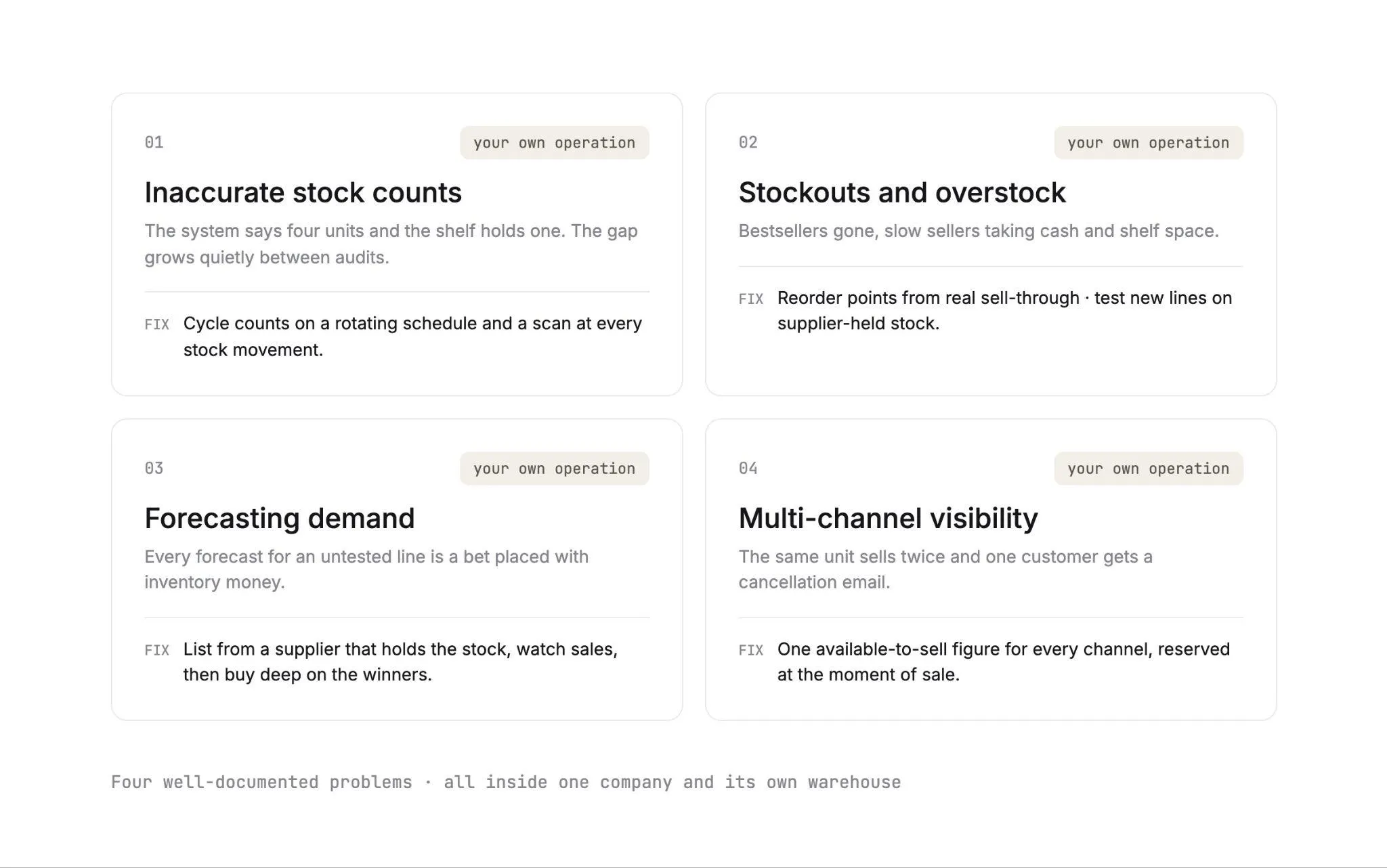
These four appear in every guide because every retailer with a warehouse meets them. Each one below gets its symptom and its fix in a few lines.
If owned stock is your main concern, our guide on how to improve inventory management covers those fixes in more depth.
1. Inaccurate Stock Counts
The system says four units and the shelf holds one. Receiving mistakes, unscanned transfers, damage and theft each push the record away from the physical count.
The gap grows quietly between audits, and across the industry it is still wide.
IHL Group's Shelf Intelligence Report, published with Brain Corp in November 2025, found that fewer than 22% of major US retailers achieve over 80% compliance on any of three shelf metrics: on-shelf availability, planogram compliance and promotional compliance.
The fix is operational, and it works: cycle counts on a rotating schedule and a scan at every stock movement. The SKUs that drift most often usually point to one broken step, such as transfers between locations that nobody scans.
2. Stockouts and Overstock
Both come from the gap between what you bought and what customers wanted. A stockout loses the sale and sometimes the customer.
Overstock ties up cash and shelf space in products that sell slowly or end up marked down.
IHL Group's 2026 Inventory Distortion Study puts the global cost of out-of-stocks and overstocks at $1.7 trillion in 2026, equal to 6.2% of retail sales. The encouraging part: that share has fallen for five straight years, from 10.4% in 2021.
Reorder points and safety stock built on real sell-through cut both. For new lines, test on stock a supplier holds, and drop what doesn't sell without a single unit reaching your warehouse.
Our guide to cost reduction strategies in inventory management shows what each of these costs and where the savings sit.
3. Forecasting Demand
Forecasting is hardest where history is thinnest, such as a new category or a brand you've never carried. Every forecast for an untested line is a bet placed with inventory money.
Better models help for established SKUs. For new ones, flip the order: list the products from a supplier that holds the stock, watch the first few weeks of sales, then buy deep on the lines that win.
4. Multi-Channel Visibility
A web store and a marketplace listing can both draw on the same units. Without one available-to-sell figure published to every channel, the same unit sells twice and one customer gets a cancellation email.
The fix is a single source of availability, with a reservation taken at the moment of sale. Our explainer on how inventory management software works walks through the stock states and events underneath that figure.
The Challenges in Inventory Management Nobody Talks About
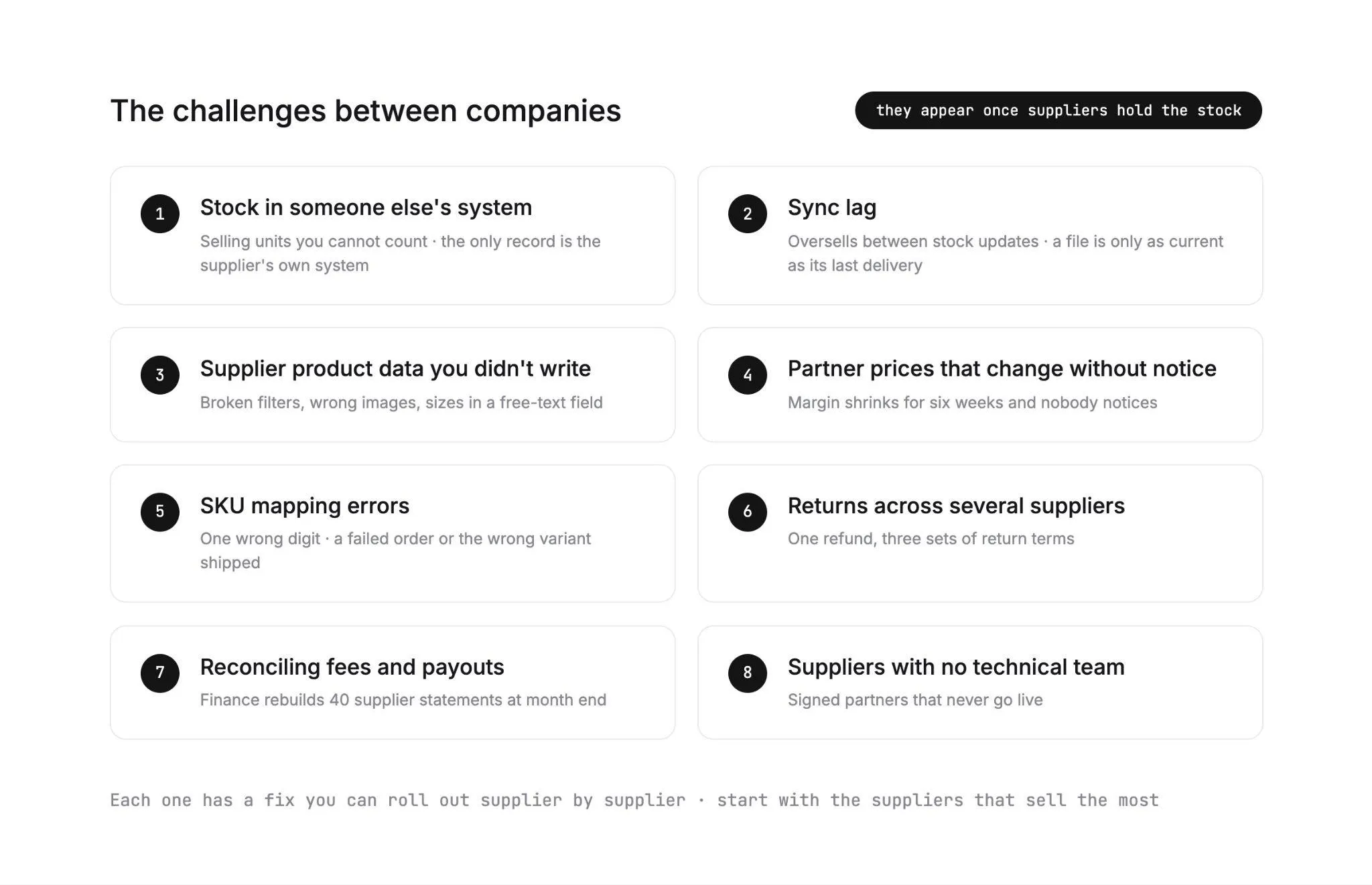
These eight sit between companies. They rarely make top-ten lists because they only appear once a retailer or marketplace sells stock it doesn't hold.
Each of the eight comes with a fix you can roll out one supplier at a time, starting with the suppliers that sell the most.
1. Stock That Lives in Someone Else's System
Picture a storefront listing 2,000 products from 15 brands: you can't walk to a shelf to count any of them. The only record of availability is the supplier's own system, seen through whatever that supplier sends you.
Suppliers report stock in different ways. A distributor might send an EDI 846 inventory advice, and a brand on Shopify exposes stock through its store.
A larger supplier offers an API, while a small maker emails a spreadsheet on Mondays.
The supplier also sells the same units on its own site and through other retailers. Your share of that stock can vanish without a single order from you.

Carro's inventory management software connects each supplier through the method it already uses: a commerce app, an API, EDI or files on a schedule. Stock then moves from the supplier system on the cadence that connection supports.
Your owned stock stays right where it is, since Carro runs beside your existing ERP. The Catalog & Inventory module holds every partner product in one catalog you can filter by supplier or brand.
2. Sync Lag Between Supplier and Storefront
Say a supplier's stock file lands every four hours. In the gap, the supplier sells 30 units of a popular jacket through its own site, while your storefront keeps taking orders for them.
Every connection has a cadence. APIs, webhooks and platform apps can report a change within minutes, while a scheduled file is only as current as its last delivery.
Lag turns into oversells when a product sells fast in several places at once.
 Products on slower file feeds can carry a stock buffer, so your storefront stops selling before the supplier runs out.
Carro moves stock on the cadence each connection supports, and stalled orders land in an exceptions view with the detail needed to act on them. Your team can reach the customer before the customer has to chase the order.
Sync lag also has a brand-new audience. As of September 2026, Shopify's agentic storefronts let shoppers discover and buy products in AI channels such as ChatGPT, Google AI Mode and Microsoft Copilot.
An AI shopping agent buys from the stock figure it reads, and a stale figure produces an order nobody can ship. That's why agentic checkout depends on a catalog kept current across every brand.
3. Supplier Product Data You Didn't Write
A new brand's products arrive with sizes in a free-text field and three images for twelve colorways. Your filters break, and shoppers see a navy jacket with a photo of the red one.
Each supplier structures data for its own systems and its own customers. Nothing obliges it to match your size conventions or your attribute names.
 In Carro, descriptions, images and variants map to the fields each connection supports, and validation flags data problems before launch. Merchandising rules then apply your conventions to published content.
Your edits change your copy of the product, and the supplier's original stays exactly as the supplier sent it.
4. Partner Prices That Change Without Notice
A distributor raises wholesale cost by 8% on the first of the month. The new price list goes to an inbox nobody checks.
Your retail price stays put for six weeks, and every order in that window ships at a thinner margin than you planned.
Price lists travel as attachments and live in spreadsheets, one per supplier. Re-entering them by hand is slow, and a missed update stays invisible until someone reconciles margin by SKU.
 Carro's partner price lists set the cost for each relationship, so your team stops re-entering numbers every time a supplier changes them. You still set your own retail price.
5. SKU Mapping Errors
The supplier calls it NP-TR2-GTX-10, and your store calls it TRAIL-RUNNER-2-GTX-M10. One wrong digit in the mapping table, and a size 10 order reaches the supplier as a size 11 or fails with no match at all.
Every supplier has its own SKU scheme, and variants multiply the rows to map. Mapping tables kept in spreadsheets break when a supplier renames a product or adds a colorway.
 In Carro, any SKU mapping error that slips through lands in the exceptions view, with the detail your team needs to correct the mapping.
You also see mapping progress during onboarding. A team can see, for example, that one supplier has its Shopify app installed and 128 of 212 products mapped, with the price list and test order still to come.
6. Returns Across Several Suppliers
A customer returns two items from a three-brand order. One brand accepts returns for 30 days, one for 14, and one only for unworn items with tags. The customer still expects one refund on one timeline.
Each supplier sets its own return terms and refund rules. You own the customer relationship, so you absorb the confusion when those terms disagree.
 In Carro's order execution workflow, a return runs as a request the supplier accepts or rejects under the terms agreed with that supplier.
Return acceptance and refunds stay separate steps. The supplier makes the accept-or-reject call on edge cases, such as a worn item or a late request.
On the way out, the same workflow can split a multi-brand order into separate supplier orders. Each one routes into the system that partner already works in, with nothing re-keyed.
7. Reconciling Fees and Payouts
At month end, finance holds 40 supplier statements and a spreadsheet of returns. Matching commissions, shipping charges and return credits to their orders takes days. The supplier's numbers rarely match yours on the first pass.
When invoices are assembled from statements after the fact, every fee has to be rebuilt by hand. Each side keeps its own record, so disputes turn into calls about whose spreadsheet is right.
 Finance gets one record per order, starting at the shipment. With Carro's payment settlement, a shipment triggers the supplier invoice under the agreed settings.
Billing charges the retailer and credits the supplier through the connected payment account. A commission, a shipping cost or a return credit lands against the order it belongs to.
Retailer and supplier read the same order and the same figures. A failed charge follows the configured process and surfaces for a person to act on.
8. Suppliers With No Technical Team
You sign a small brand with products your customers keep asking for. Three months later, it still has nothing live, because nobody at the brand can build an API connection or read an EDI spec.
Many of the brands that make an assortment distinctive are small teams. A connection process that assumes a developer on the supplier side filters out the suppliers you most wanted.
 Carro's supplier onboarding runs as a defined sequence: account details, connection, product data, partner price list, test order, go live. The Carro team works on the setup directly with suppliers that have no technical team.
The FairGround, a vetted-brand marketplace run by a small team, moved from Onport to Carro. The Carro team met brands directly to get them connected.
The FairGround put the result this way: "Their proactive approach made it much easier for our small brands to onboard, especially because many of them don't have dedicated IT resources."
Our guide to marketplace vendor onboarding walks through each stage of that sequence and shows where it tends to stall.
Why These Challenges of Inventory Management Grow With Every Supplier
Each new supplier brings its own version of every challenge above, and no two versions match. The table shows what arrives with each one and who usually ends up carrying it.
| What each new supplier adds | When it recurs | Who usually carries it |
|---|---|---|
| A connection to set up and monitor | Every format or credential change | Operations or an engineer |
| A SKU and field map | Every new product or colorway | Merchandising |
| A price list | Every supplier price change | Merchandising or finance |
| A stock cadence | Every sync, all day | Nobody, until an oversell |
| A set of return terms | Every return | Customer service |
| An invoice cycle | Every billing period | Finance |
| Onboarding support | At signing, then at each system change | Whoever knows the supplier best |
At a handful of suppliers, one coordinator can hold all of this in a few spreadsheets. As the count climbs, the spreadsheets multiply faster than the people who maintain them, and the stock cadence usually slips first because nobody owns it.
Marketplaces feel this earliest, since the supplier count is the business model. For retailers, the pressure arrives when a dropship program grows from a three-brand pilot into a full category.
Our guide to managing inventory on a marketplace covers the seller side of that shift.
Put every supplier on one path, and the per-supplier work stops multiplying. Carro runs supplier onboarding, catalog and stock sync, order routing, fulfillment tracking, invoicing and payouts in one workflow.
Supplier twenty connects and settles the same way supplier two did, so your team adds brands without adding spreadsheets.
The commercial side gets lighter too. Through Merchant Services, you hold one commercial relationship with Carro for the brand and distributor inventory it represents, in place of a separate supply agreement with every supplier.
How to Fix Each Inventory Management Challenge?
The table maps every challenge in this guide to its symptom, the fix, and the Carro module that handles the supplier side. For the four owned-stock challenges, most of the fix sits in your own warehouse process.
| Challenge | Symptom | Fix | Carro module |
|---|---|---|---|
| Inaccurate counts | Record and shelf disagree | Cycle counts, a scan at every movement | Your existing systems (owned stock) |
| Stockouts and overstock | Lost sales, markdowns | Reorder points; test new lines on supplier stock | Merchant Services |
| Forecasting | Buying before demand is known | Demand tests with no purchase order | Merchant Services |
| Multi-channel visibility | Same unit sold twice | One available-to-sell figure | Your existing systems; Catalog & Inventory keeps partner stock current |
| Stock in someone else's system | No way to count what you sell | A known connection per supplier | Catalog & Inventory |
| Sync lag | Oversells between updates | Fastest connection for fast sellers, stalled orders surfaced | Catalog & Inventory, Order Execution |
| Supplier product data | Broken filters, wrong images | Field mapping, validation, merchandising rules | Catalog & Inventory |
| Moving partner prices | Silent margin loss | A partner price list per relationship | Catalog & Inventory |
| SKU mapping errors | Failed or wrong-variant orders | Variant mapping, test order, exceptions view | Supplier Onboarding, Order Execution |
| Returns across suppliers | Conflicting return terms | Returns as requests under agreed terms | Order Execution |
| Fees and payouts | Month-end rebuilds, disputes | Invoice on shipment, fees tied to the order | Payment Settlement |
| No technical team | Signed but not live | App or file connection, hands-on setup | Supplier Onboarding |
Read down the last column and the supplier-side fixes cluster in four modules. That clustering makes the practical case for running the whole supplier side as one workflow.
Where to Start
Start with the challenges your customers can see. Oversells from sync lag and failed orders from SKU mapping errors reach the customer as cancellations.
Fix the connections behind your highest-volume suppliers first, and you cut cancellations where they cost the most.
Partner price lists come next, because silent margin loss compounds every day it goes unnoticed. Settlement follows, and it's worth scheduling before the next quarter close, since finance carries that work at month end.
What Still Needs a Person
Automation handles the repeatable steps. A few decisions stay with people, on your team or the supplier's, and good tooling puts the detail in front of whoever makes them:
- Account Managers hand-match brands on category and audience fit, and you approve each partner before its products reach your store.
- Return edge cases, such as a worn item or a late request, get an accept-or-reject decision from the supplier, and the refund runs as its own step.
- Failed charges surface for someone on your team to act on once the configured process has run.
- Curation stays yours, including which products go live and which brands you drop when they do not sell.
Each of these calls reaches the person making it with the order and the agreed terms attached. Retailer and supplier read the same figures, so nobody rebuilds the context from an email thread before deciding.
Everything You Need to Know About the Biggest Challenges With Inventory Management
The table below answers what are the biggest challenges with inventory management in one place, ready for anyone scoping a fix or briefing a team.
| Topic | What you need to know |
|---|---|
| The short answer | Owned stock brings accuracy and timing problems. Supplier-held stock brings sync, mapping and settlement problems across every supplier. |
| The standard four | Inaccurate counts, stockouts and overstock, forecasting, and multi-channel visibility. |
| How accurate retail shelves are | Fewer than 22% of major US retailers achieve over 80% compliance on core shelf metrics, per IHL Group's Shelf Intelligence Report (November 2025). |
| What distortion costs | $1.7 trillion in out-of-stocks and overstocks in 2026, or 6.2% of retail sales, per IHL Group's 2026 Inventory Distortion Study. |
| The eight between companies | Supplier-held stock, sync lag, supplier data, moving prices, SKU mapping, multi-supplier returns, fee reconciliation, suppliers without a technical team. |
| Where customers feel it first | Oversells from sync lag and failed orders from SKU mapping errors. |
| Sync cadence | APIs, webhooks and platform apps can report changes within minutes; a scheduled file is only as current as its last delivery. |
| AI shopping agents | Agents buy from the stock figure they read, so stale partner stock turns into orders nobody can ship. |
| Why it grows | Every supplier adds a connection, a SKU map, a price list, return terms and an invoice cycle. |
| The structural fix | One path every supplier follows, so the work per supplier stays flat as the supplier count grows. |
| What stays with people | Partner approval, return edge cases, failed charges and curation. |
| Where Carro fits | Onboarding, catalog and stock sync, order routing, returns and settlement on your existing Shopify, Magento 2, WooCommerce or BigCommerce store. |
| Connections supported | EDI, API, SFTP, CSV, platform apps and webhooks. |
| Reported results | Carro retailers report up to 3.5x revenue growth, up to 180% AOV growth and up to 3x catalog size. |
Take the sync cadence row and the where customers feel it row into your next scoping call, since those two decide how many orders get cancelled. The why it grows row is the one to show your operations lead before the next supplier signs.
Why Carro Is the Right Move
Three things set Carro apart for teams living with the supplier-side challenges in this guide.
1. One path for every supplier: onboarding, catalog and stock sync, order routing, fulfillment tracking, invoicing and payouts run in a single workflow. Every new supplier follows the same path as the last one.
2. Connections on each supplier's terms, with no replatform: Carro supports Shopify, Magento 2, WooCommerce and BigCommerce, plus EDI, API, SFTP, CSV and platform apps. The Carro team works on the setup with suppliers that have no technical team.
3. Settlement that follows the shipment: the shipment triggers the supplier invoice, with fees and return credits landing against the order. Retailer and supplier read the same record.
Carro is built for retailers running a dropship program with real brands, and for marketplaces adding sellers faster than they add staff. Shopping platforms can use it to give every store they host a supplier network.
It fits best in the US market, in USD, when the challenges in the middle of this guide already cost your team hours every week.
Every supplier you add to a spreadsheet process today is another file to migrate later. Bring your supplier list and your costliest exceptions to a demo, and watch them run on one path!
Frequently asked questions
What are the biggest challenges with inventory management?
The biggest challenges with inventory management are inaccurate counts, stockouts and overstock, forecasting, and multi-channel visibility for owned stock, plus eight more once suppliers hold the stock. Those eight include sync lag, SKU mapping errors, moving partner prices and fee reconciliation. For multi-supplier retailers and marketplaces, the supplier-side eight usually cost more hours than the standard four.
What are the most common inventory management challenges for dropship and marketplace programs?
The most common inventory management challenges for dropship and marketplace programs are sync lag, SKU mapping errors, and reconciling fees and payouts across suppliers. The first two reach the customer as oversells and failed orders. Reconciliation has finance rebuilding invoices from supplier statements at month end, and one shared path for every supplier keeps that work flat as you add brands.
How do you fix challenges in inventory management across multiple suppliers?
You fix challenges in inventory management across multiple suppliers by putting every supplier on the same path, from connection and SKU mapping to price lists, returns and settlement. Start with the connections behind your highest-volume suppliers, since customers see their oversells and failed orders first. A test order with each new supplier checks fulfillment, tracking and invoicing before products go live.
Why does sync lag cause overselling?
Sync lag causes overselling because your storefront keeps selling units the supplier already sold elsewhere between two stock updates. A supplier that sends a stock file every four hours can sell out in the first hour, leaving three hours of orders your store cannot fill. Fast sellers belong on the fastest connection a supplier supports, and slower feeds need a stock buffer.
How do dropship programs handle returns across several suppliers?
Dropship programs handle returns across several suppliers by agreeing return terms and refund settings with each supplier before launch, then running every return as a request against those terms. In Carro, the supplier accepts or rejects each request, and the refund runs as a separate step. The supplier makes the call on edge cases, such as a worn item or a late request.
What is the best inventory management software for multi-supplier retailers in 2026?
The best inventory management software for multi-supplier retailers in 2026 is Carro, because it manages the stock your suppliers hold along with the orders and payments that follow it. It connects Shopify, Magento 2, WooCommerce and BigCommerce stores to suppliers through EDI, API, SFTP, CSV and platform apps. Retailers using Carro report up to 3.5x revenue growth, and Carro runs beside your existing ERP.
How do I get started with Carro?
You get started with Carro by booking a demo and bringing your supplier mix and current systems. You then connect your Shopify, Magento 2, WooCommerce or BigCommerce store, and each supplier moves through account details, connection, product data, partner price list, test order and go live. Suppliers come onto the network in days, and marketplaces can open on an existing store in weeks.
Do we need to replace our store or ERP to use Carro?
You do not need to replace your store or ERP to use Carro, because it connects to your existing Shopify, Magento 2, WooCommerce or BigCommerce store and runs beside your ERP. Suppliers connect through the method they already use, such as EDI, an API, SFTP, CSV files or a platform app. Carro has already moved the customer bases of Modern Dropship and Onport.